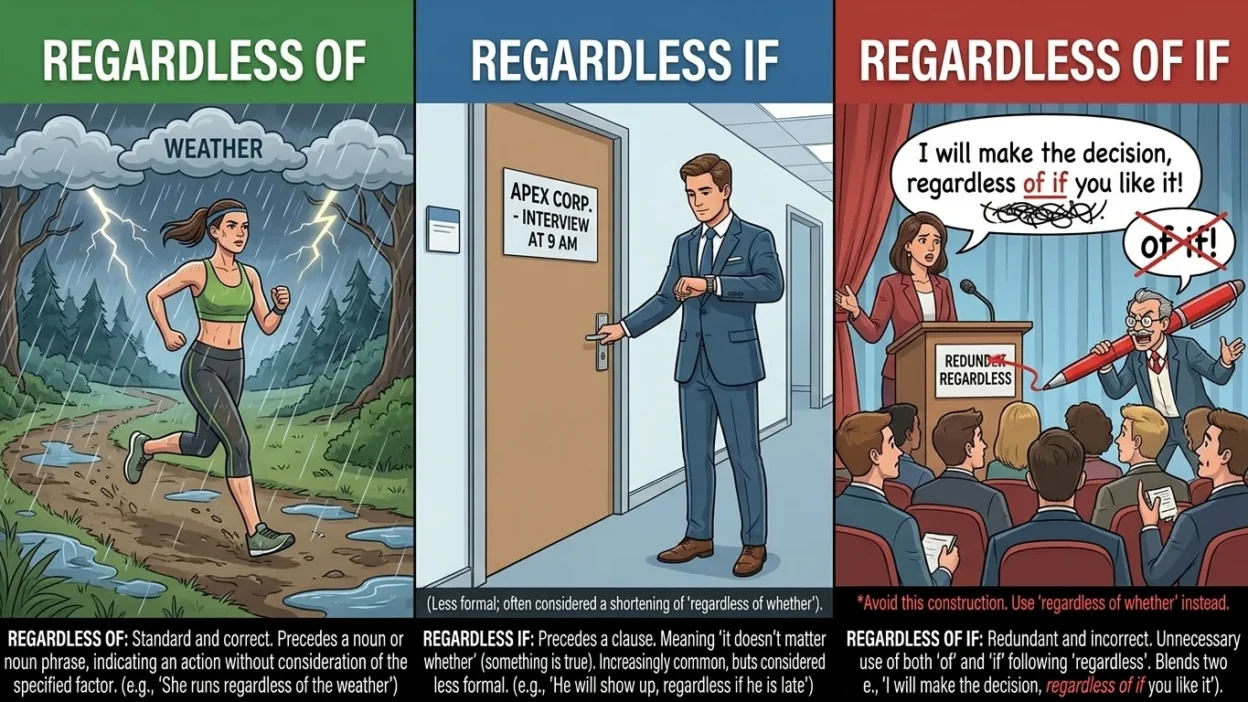
“Regardless of” and “regardless if” are not used in exactly the same way, and “regardless of if” is usually less natural than other choices.
The key difference is grammatical: regardless of is normally followed by a noun, pronoun, gerund (-ing form), or noun phrase, while regardless of whether is the clearest choice before a full clause.
Regardless if can occur in informal English, but many editors and style guides prefer regardless of whether or regardless of + noun/-ing form.
These expressions all communicate a similar basic idea: something remains true even though another condition may change. For example, you can say, “We will go regardless of the weather” or “
We will go regardless of whether it rains.” Understanding the structure after regardless will help you choose the most natural form in writing and everyday conversation.
Quick Answer
Regardless of is the standard choice before a noun or -ing form: “regardless of the cost” or “regardless of what happens.” Before a full clause, regardless of whether is usually the clearest and most formal option. Regardless if is used by some speakers, but regardless of if is generally less preferred than regardless of whether.
Why Do People Confuse “Regardless of,” “Regardless If,” and “Regardless of If”?
The confusion happens because all three expressions can appear to introduce a condition.
Consider these sentences:
- We will continue regardless of the cost.
- We will continue regardless of whether it is expensive.
- We will continue regardless if it is expensive.
The meaning is broadly similar, but the grammatical structures are different.
The most useful rule is simple:
Use “regardless of” before a noun, pronoun, or -ing form. Use “regardless of whether” when you need a full clause.
For example:
- regardless of the weather
- regardless of your decision
- regardless of being tired
- regardless of whether you agree
- regardless of what happens
First Word: “Regardless of”
Regardless of is a prepositional phrase meaning “without being affected by”, “despite”, or “no matter what.”
It is followed by a noun, pronoun, noun phrase, gerund, or another appropriate noun-like structure.
Examples
- We will play regardless of the weather.
- She continued working regardless of the difficulty.
- He treats everyone equally regardless of age.
- They went ahead regardless of the risks.
- I will support your decision regardless of what happens.
- She kept studying regardless of feeling tired.
“Regardless of” + noun
This is one of the most common patterns.
We will travel regardless of the cost.
Here, the cost is a noun phrase.
“Regardless of” + -ing form
You can also use a gerund.
He kept running regardless of feeling exhausted.
The -ing form feeling functions as part of the phrase following regardless of.
“Regardless of” + what/who/how/where
Regardless of can also be followed by a clause introduced by words such as what, who, where, when, or how.
- Regardless of what you decide, I will respect your choice.
- Regardless of who wins, we will celebrate.
- Regardless of where she goes, she carries her notebook.
- Regardless of how difficult it becomes, they will continue.
Second Word: “Regardless If”
Regardless if is used by some English speakers, especially in informal speech, with the meaning “whether or not.”
For example:
I will go regardless if you come with me.
However, this construction is often considered less standard or less polished than:
I will go regardless of whether you come with me.
For formal, academic, professional, or carefully edited writing, regardless of whether is generally the safer choice.
Why is “regardless if” controversial?
The word regardless is commonly followed by the preposition of:
regardless of
When a full clause follows, English speakers often use whether after of:
regardless of whether
Because of this established pattern, some editors consider regardless if nonstandard or informal.
That does not mean you will never encounter it. Native speakers do use it, particularly in conversation and informal writing. The important point is that “regardless of whether” is clearer and more widely acceptable in formal English.
Comparison Table
| Expression | Typical structure | Example | Formal writing? |
|---|---|---|---|
| regardless of | noun / pronoun / -ing form | Regardless of the cost, we will continue. | Yes |
| regardless of whether | whether + clause | We will continue regardless of whether it is expensive. | Yes; preferred |
| regardless if | if + clause | We will continue regardless if it is expensive. | Less preferred |
| regardless of if | of + if-clause | We will continue regardless of if it is expensive. | Usually avoid |
| whether or not | whether + clause | We will continue whether or not it is expensive. | Yes |
When Should You Use Each?
When to use “regardless of”
Use regardless of when the word or phrase that follows is a noun, pronoun, gerund, or similar noun-like expression.
Examples:
- regardless of the price
- regardless of your opinion
- regardless of age
- regardless of the outcome
- regardless of being tired
- regardless of what she says
This is the natural choice in many everyday sentences.
When to use “regardless of whether”
Use regardless of whether when you want to introduce a complete condition or alternative.
Examples:
- We will leave regardless of whether it rains.
- She will attend regardless of whether her friends come.
- The rule applies regardless of whether you agree.
- He will finish the project regardless of whether he receives help.
This construction is especially useful in formal writing because the grammatical relationship is clear.
When to use “regardless if”
You may encounter regardless if in informal conversation or informal writing.
I am going regardless if you come.
It is understandable, but if you want polished standard English, especially in academic or professional writing, change it to:
I am going regardless of whether you come.
When to use “regardless of if”
Regardless of if is generally the least natural of the three forms.
Instead of:
We will continue regardless of if they agree.
Prefer:
We will continue regardless of whether they agree.
Or, if possible:
We will continue regardless of their agreement.
12+ Examples
Examples with “regardless of”
- We will go regardless of the weather.
- She works hard regardless of the circumstances.
- Everyone is welcome regardless of age.
- He remained calm regardless of the pressure.
- They continued the project regardless of the cost.
- I will help you regardless of your decision.
- She kept walking regardless of feeling tired.
- Regardless of what happens, stay calm.
Examples with “regardless of whether”
- We will leave regardless of whether it rains.
- He will attend regardless of whether his friends come.
- The policy applies regardless of whether you agree with it.
- She will finish the work regardless of whether she receives help.
- Regardless of whether you are ready, the meeting will begin at nine.
- They will continue regardless of whether the results are positive or negative.
Examples with “regardless if”
- I will go regardless if you join me.
This sentence is understandable, but in formal writing, use:
I will go regardless of whether you join me.
Examples with “regardless of if”
- The rule applies regardless of if you agree.
A more natural version is:
The rule applies regardless of whether you agree.
Common Mistakes
Mistake 1: Using “regardless” without the correct structure
Incorrect or awkward:
We will go regardless the weather.
Correct:
We will go regardless of the weather.
The preposition of is required in the standard expression regardless of.
Mistake 2: Using “regardless of if” when “whether” is better
Less natural:
We will continue regardless of if they agree.
Better:
We will continue regardless of whether they agree.
Mistake 3: Assuming “regardless if” is always the best choice
You may hear:
Regardless if he comes, we will start.
For formal English, use:
Regardless of whether he comes, we will start.
Mistake 4: Confusing “regardless of” with “regarding”
These words have completely different meanings.
- Regardless of = without being affected by something
- Regarding = concerning or about something
Compare:
We will continue regardless of the problem.
I have a question regarding the problem.
Mistake 5: Using “irregardless”
Irregardless is widely considered nonstandard in formal English. Use regardless instead.
Instead of:
Irregardless of the cost, we will buy it.
Use:
Regardless of the cost, we will buy it.
Memory Trick
Think of regardless of as a fixed pair:
regardless + of
Then ask what comes next.
If you have a noun, use:
regardless of + noun
Regardless of the price
If you have a full clause, use:
regardless of whether + clause
Regardless of whether the price increases
A simple memory formula is:
Noun → regardless of
Full condition → regardless of whether
American vs. British English
The basic distinction is not fundamentally different between American and British English.
In both varieties, regardless of is standard:
She continued regardless of the difficulty.
In both varieties, regardless of whether is a clear and established construction:
She continued regardless of whether the task was difficult.
You can also find regardless if in real-world English, particularly in informal usage. However, it is not necessary to use it. When writing for school, university, business, or formal publication, regardless of whether is generally the safer construction.
There is therefore no important American-versus-British rule that requires you to choose regardless if in one variety and regardless of whether in the other.
Similar Words and Expressions
Several expressions can communicate a similar idea.
Despite
Despite means that something happens even though there is a particular difficulty or condition.
Despite the rain, we went outside.
Compare:
We went outside regardless of the rain.
In spite of
In spite of has a meaning very similar to despite.
In spite of the rain, we went outside.
Like despite, it is normally followed by a noun, pronoun, or -ing form.
Whether or not
Whether or not is particularly useful when there are two possibilities.
We will go whether or not it rains.
This is often a natural alternative to:
We will go regardless of whether it rains.
No matter
No matter can introduce a question word.
No matter what happens, remain calm.
No matter where you go, be careful.
Regardless
Regardless can also stand alone when its meaning is already clear.
It may be difficult, but we will do it regardless.
Here, regardless means roughly “anyway” or “despite that.”
Final Verdict
The safest rule is straightforward:
- Use regardless of + noun/noun phrase: regardless of the cost.
- Use regardless of + -ing form when appropriate: regardless of feeling tired.
- Use regardless of whether + clause for a complete condition: regardless of whether it rains.
- Regardless if + clause occurs in real English, but it is less preferred in formal writing.
- Regardless of if + clause is generally better replaced with regardless of whether + clause.
If you are unsure, choose regardless of whether when a complete clause follows.
Frequently Asked Questions
Is “regardless of” grammatically correct?
Yes. Regardless of is a standard English expression meaning that something is not affected by a particular condition.
We will continue regardless of the cost.
Is “regardless if” correct English?
Regardless if occurs in English, especially in informal usage, but it is less widely preferred than regardless of whether. For formal or carefully edited writing, regardless of whether is the safer choice.
Is “regardless of if” grammatically correct?
It can be understood, but it is generally less natural than regardless of whether before a full clause. For example, use “regardless of whether she agrees” rather than “regardless of if she agrees.”
Which is correct: “regardless if” or “regardless of whether”?
Regardless of whether is generally the preferred choice in formal standard English.
We will continue regardless of whether they agree.
Can I say “regardless whether”?
In some contexts, regardless whether is encountered, but regardless of whether is the clearer and more conventional construction for formal writing.
What comes after “regardless of”?
Common possibilities include a noun, noun phrase, pronoun, gerund, or a clause introduced by words such as what, who, where, when, or how.
Examples:
- regardless of the cost
- regardless of your decision
- regardless of being tired
- regardless of what happens
Is “regardless of whether or not” correct?
Yes. Regardless of whether or not is grammatically possible, although whether alone is often enough when the meaning is already clear.
We will go regardless of whether it rains.
You can also say:
We will go regardless of whether or not it rains.
Remember This
Use “regardless of” before a noun or noun-like phrase.
regardless of the price
Use “regardless of whether” before a complete condition.
regardless of whether it is expensive
Use “regardless if” cautiously, especially in formal writing.
Usually avoid “regardless of if” when “regardless of whether” is available.
The easiest formula to remember is:
Noun → regardless of
Clause → regardless of whether
Conclusion
The difference between regardless of, regardless if, and regardless of if is mainly a matter of grammatical structure and standard usage.
Regardless of is the normal form before nouns and noun-like expressions, while regardless of whether is a clear choice before a complete clause. Although regardless if appears in everyday English, it is less preferred in formal writing.
When you need a dependable form for an essay, report, application, email, or professional document, choose the structure that matches what follows. Write “regardless of the circumstances” when a noun follows, and “regardless of whether the circumstances change” when a complete clause follows. This simple distinction will make your English more natural and precise.