If you are searching for operant conditioning synonyms, you may be trying to better understand this important psychology term or looking for alternative expressions to improve your writing.
While “operant conditioning” has a specific scientific meaning, several related words and phrases can be used depending on the context.
Choosing the right synonym helps your writing become clearer, more natural, and easier to understand.
This guide is designed for students, ESL learners, writers, and content creators.
You’ll learn what operant conditioning means, discover 30 related synonyms and expressions, see simple examples, and understand when each alternative works best.
By the end, you’ll know how to use these terms confidently in academic, educational, and everyday writing.
Meaning of Operant Conditioning
What Does Operant Conditioning Mean?
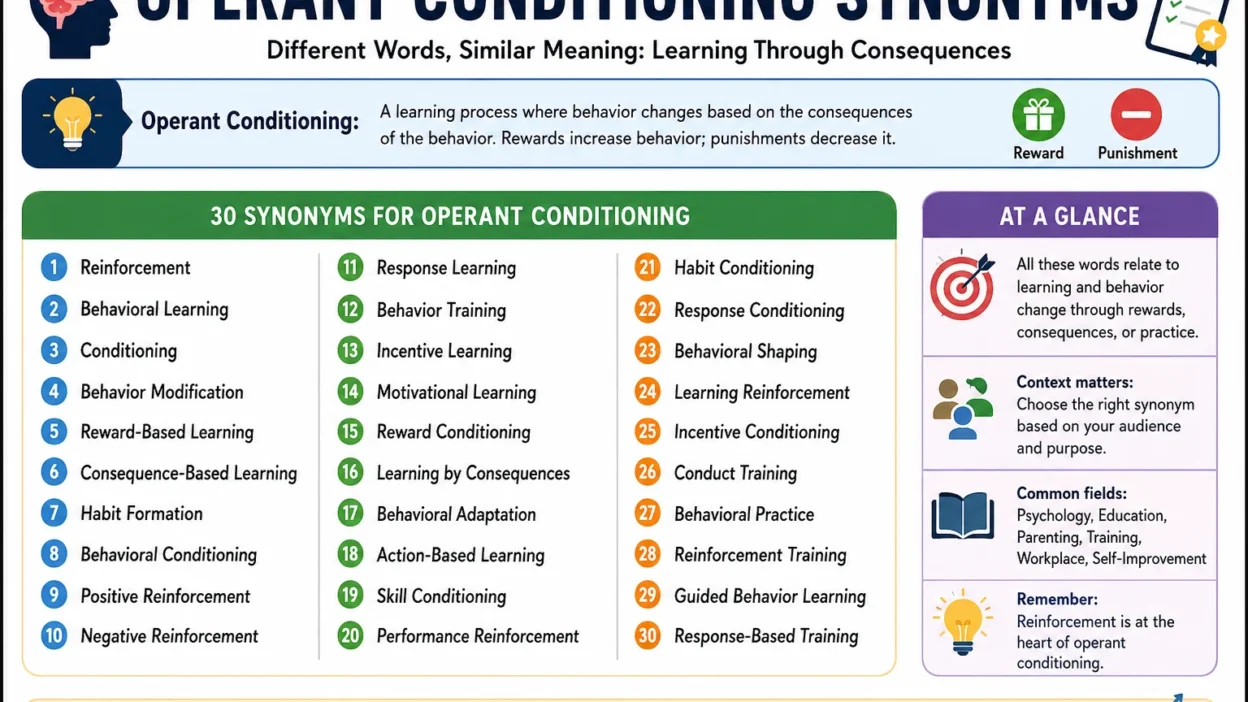
Operant conditioning is a learning process in which behavior changes because of its consequences. When a behavior is rewarded, it is more likely to happen again. When a behavior is punished, it becomes less likely to occur.
This concept is widely used in psychology, education, parenting, animal training, and workplace management.
Simple example:
A student studies hard and receives good grades. Because the reward is positive, the student is more likely to study again in the future.
30 Operant Conditioning Synonyms
Although many of these are not perfect replacements, they are closely related terms or expressions that fit different situations involving behavioral learning.
1. Reinforcement
Meaning: Encouraging a behavior by giving a reward.
Example: Positive reinforcement helped the child complete homework regularly.
Best Usage Context: Psychology, education, behavior training.
2. Behavioral Learning
Meaning: Learning through actions and experiences.
Example: Behavioral learning improves skills through repeated practice.
Best Usage Context: Education and psychology.
3. Conditioning
Meaning: Training someone or something to respond in a certain way.
Example: Dogs learn commands through conditioning.
Best Usage Context: General psychology and animal training.
4. Behavior Modification
Meaning: Changing behavior using rewards or consequences.
Example: The therapist used behavior modification techniques.
Best Usage Context: Therapy, schools, counseling.
5. Reward-Based Learning
Meaning: Learning by receiving rewards.
Example: Reward-based learning motivates children to participate.
Best Usage Context: Teaching and parenting.
6. Consequence-Based Learning
Meaning: Learning from the results of actions.
Example: Consequence-based learning teaches responsibility.
Best Usage Context: Psychology and education.
7. Habit Formation
Meaning: Developing regular behaviors over time.
Example: Daily reading encourages habit formation.
Best Usage Context: Self-improvement and education.
8. Behavioral Conditioning
Meaning: Training behavior through repeated experiences.
Example: Behavioral conditioning improved workplace safety.
Best Usage Context: Psychology and training.
9. Positive Reinforcement
Meaning: Rewarding good behavior.
Example: Praise is a form of positive reinforcement.
Best Usage Context: Parenting and education.
10. Negative Reinforcement
Meaning: Encouraging behavior by removing something unpleasant.
Example: Negative reinforcement increased attendance.
Best Usage Context: Psychology.
11. Response Learning
Meaning: Learning through reactions to situations.
Example: Response learning develops problem-solving skills.
Best Usage Context: Educational psychology.
12. Behavior Training
Meaning: Teaching desired behaviors.
Example: Behavior training improved customer service.
Best Usage Context: Workplace and schools.
13. Incentive Learning
Meaning: Learning through motivation and rewards.
Example: Incentive learning boosted employee performance.
Best Usage Context: Business and education.
14. Motivational Learning
Meaning: Learning encouraged by motivation.
Example: Motivational learning inspires better results.
Best Usage Context: Personal development.
15. Reward Conditioning
Meaning: Conditioning using rewards.
Example: Reward conditioning works well with young learners.
Best Usage Context: Animal and child training.
16. Learning by Consequences
Meaning: Learning from outcomes.
Example: Children often learn by consequences.
Best Usage Context: Everyday language.
17. Behavioral Adaptation
Meaning: Adjusting behavior over time.
Example: Behavioral adaptation helped employees adjust.
Best Usage Context: Psychology and biology.
18. Action-Based Learning
Meaning: Learning through doing.
Example: Action-based learning increases engagement.
Best Usage Context: Education.
19. Skill Conditioning
Meaning: Building skills through repeated practice.
Example: Athletes improve through skill conditioning.
Best Usage Context: Sports and training.
20. Performance Reinforcement
Meaning: Improving performance through rewards.
Example: Bonuses are performance reinforcement tools.
Best Usage Context: Workplace.
21. Habit Conditioning
Meaning: Building habits through repetition.
Example: Habit conditioning supports healthy routines.
Best Usage Context: Self-improvement.
22. Response Conditioning
Meaning: Developing consistent responses.
Example: Response conditioning improved emergency drills.
Best Usage Context: Psychology.
23. Behavioral Shaping
Meaning: Gradually teaching desired behavior.
Example: Behavioral shaping helped the puppy learn commands.
Best Usage Context: Animal training and therapy.
24. Learning Reinforcement
Meaning: Strengthening learning through encouragement.
Example: Learning reinforcement improves classroom success.
Best Usage Context: Education.
25. Incentive Conditioning
Meaning: Influencing behavior with incentives.
Example: Incentive conditioning increased productivity.
Best Usage Context: Business and management.
26. Conduct Training
Meaning: Teaching proper behavior.
Example: Conduct training reduced workplace conflicts.
Best Usage Context: Corporate training.
27. Behavioral Practice
Meaning: Repeating behaviors to improve them.
Example: Behavioral practice strengthens communication skills.
Best Usage Context: Coaching and education.
28. Reinforcement Training
Meaning: Training through consistent rewards.
Example: Reinforcement training improved team performance.
Best Usage Context: Sports and education.
29. Guided Behavior Learning
Meaning: Learning behavior with instruction.
Example: Guided behavior learning benefits young children.
Best Usage Context: Early education.
30. Response-Based Training
Meaning: Training according to responses.
Example: Response-based training improved customer interactions.
Best Usage Context: Professional development.
Comparison Guide: When to Use Different Operant Conditioning Synonyms
| Synonym | Best For | Formality |
|---|---|---|
| Reinforcement | Psychology, education | High |
| Positive Reinforcement | Parenting, teaching | High |
| Behavior Modification | Therapy | High |
| Behavioral Learning | Academic writing | High |
| Conditioning | General discussions | Medium |
| Habit Formation | Self-help | Medium |
| Reward-Based Learning | Education | Medium |
| Consequence-Based Learning | Psychology | Medium |
| Behavioral Shaping | Animal training | High |
| Action-Based Learning | Education | Medium |
How to Choose the Right Synonym
For Academic Writing
Use:
- Reinforcement
- Behavior Modification
- Behavioral Learning
- Conditioning
- Positive Reinforcement
These terms are commonly used in psychology textbooks and research papers.
For Teachers and Students
Choose:
- Reward-Based Learning
- Habit Formation
- Learning by Consequences
- Action-Based Learning
- Learning Reinforcement
These expressions are easy to understand and suitable for classrooms.
For Parenting and Child Development
Good choices include:
- Positive Reinforcement
- Behavior Training
- Reward Conditioning
- Behavioral Shaping
- Habit Conditioning
These terms describe methods for encouraging positive behavior in children.
For Workplace and Professional Settings
Use:
- Incentive Learning
- Performance Reinforcement
- Conduct Training
- Incentive Conditioning
- Response-Based Training
These fit discussions about employee performance and organizational development.
For Everyday Conversation
Simple alternatives include:
- Learning by Consequences
- Habit Formation
- Behavior Training
- Reward-Based Learning
- Conditioning
These are easier for general audiences and ESL learners to understand.
Frequently Asked Questions
Is there an exact synonym for operant conditioning?
Not exactly. Operant conditioning is a specialized psychology term. Most alternatives are closely related concepts rather than perfect replacements.
Is reinforcement the same as operant conditioning?
No. Reinforcement is one important part of operant conditioning, but operant conditioning also includes punishment and the overall process of learning through consequences.
Which synonym is best for students?
“Behavioral learning,” “reinforcement,” and “behavior modification” are excellent choices because they are commonly used in educational materials.
Can I use conditioning instead of operant conditioning?
Sometimes. However, “conditioning” is a broader term that includes both operant conditioning and classical conditioning. Use it only when the specific type is not important.
Conclusion
Understanding operant conditioning synonyms helps you communicate psychological concepts more effectively.
While there is no single perfect replacement for the term, related expressions such as reinforcement, behavior modification, behavioral learning, reward-based learning, and habit formation can make your writing more varied and engaging.
if you’re a student preparing assignments, an ESL learner expanding your vocabulary, a writer improving readability, or a content creator producing educational articles, selecting the right synonym depends on your audience and purpose.
Use the comparison guide and usage tips above to choose the most appropriate term for every situation and make your writing both accurate and easy to understand.