If you are looking for psyop synonyms, you may have noticed that the word “psyop” has a more specific meaning than ordinary words such as “propaganda” or “persuasion.”
A psyop, short for psychological operation, generally refers to an organized effort to influence how a target audience thinks, feels, or behaves.
Understanding related words can help students, ESL learners, writers, and content creators choose vocabulary more accurately.
For example, “propaganda” may fit a discussion about biased information, while “psychological operation” is more appropriate in a military or strategic context.
This guide explains 30 useful psyop synonyms and closely related terms in simple English.
Each word includes an easy definition, an example sentence, and a note about when it works best.
What Does “Psyop” Mean?
Simple Definition of Psyop
Psyop is an informal short form of psychological operation. It describes a planned activity designed to influence the emotions, beliefs, attitudes, or behavior of a particular audience.
The word is most often associated with military, intelligence, political, or strategic communication. In everyday conversation, however, people sometimes use “psyop” more loosely to describe something they believe is deliberately designed to manipulate public opinion.
Tone and Usage
“Psyop” can sound serious, political, military, or suspicious depending on the context. In formal writing, psychological operation is usually clearer than the shortened form.
For general audiences, words such as influence, propaganda, manipulation, or persuasion may be easier to understand. However, these words are not always exact replacements.
30 Psyop Synonyms and Related Words
1. Psychological Operation
Meaning: A planned activity intended to influence the thoughts, emotions, or behavior of a particular audience.
Example: The report examined how psychological operations can affect public attitudes during a conflict.
Best usage: Formal, military, intelligence, and academic writing.
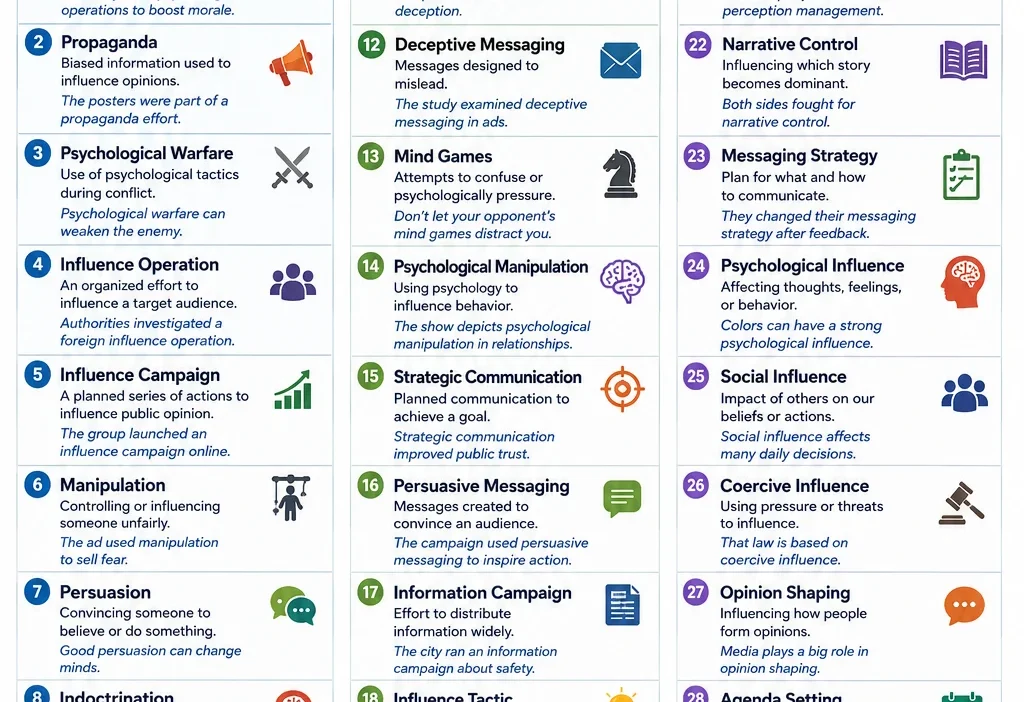
2. Propaganda
Meaning: Information or messaging designed to influence people’s opinions, often in a biased or one-sided way.
Example: The documentary explored how propaganda shaped public opinion during the war.
Best usage: Politics, history, media studies, and discussions of biased messaging.
3. Psychological Warfare
Meaning: The use of psychological methods to weaken an opponent’s confidence or influence their behavior.
Example: Psychological warfare has played a role in many historical conflicts.
Best usage: Military history, conflict studies, and strategic discussions.
4. Influence Operation
Meaning: An organized effort to influence how people think, feel, or act.
Example: Investigators studied the suspected influence operation online.
Best usage: Politics, social media, cybersecurity, and current affairs.
5. Influence Campaign
Meaning: A planned series of messages or activities intended to change people’s opinions or behavior.
Example: The organization launched an influence campaign to increase public awareness.
Best usage: Public relations, politics, marketing, and communications.
6. Manipulation
Meaning: The act of controlling or affecting someone unfairly or indirectly.
Example: The article discussed the manipulation of public emotions through misleading headlines.
Best usage: Everyday writing, psychology, media criticism, and social discussions.
7. Persuasion
Meaning: The process of convincing someone to accept an idea or take an action.
Example: Effective persuasion can change the way an audience views an issue.
Best usage: Neutral or positive contexts, especially writing, marketing, and communication.
8. Indoctrination
Meaning: Teaching someone to strongly accept a particular set of beliefs, often without encouraging independent thinking.
Example: The book examined the role of indoctrination in extremist organizations.
Best usage: Education, politics, religion, history, and social science.
9. Disinformation
Meaning: False or misleading information that is deliberately created or spread.
Example: Researchers tracked a network responsible for spreading disinformation online.
Best usage: Journalism, social media, politics, and information studies.
10. Misinformation
Meaning: False or inaccurate information that is shared without necessarily intending to deceive.
Example: Misinformation about the event spread rapidly on social media.
Best usage: General discussions of false information.
11. Deception
Meaning: The act of making someone believe something that is not true.
Example: The investigation focused on deception used to influence the audience.
Best usage: General, academic, legal, and psychological contexts.
12. Deceptive Messaging
Meaning: Communication that deliberately creates a false or misleading impression.
Example: The researchers analyzed deceptive messaging used in online campaigns.
Best usage: Media analysis, communications, and digital culture.
13. Mind Games
Meaning: Actions or words intended to confuse, pressure, or psychologically influence another person.
Example: The negotiator refused to be distracted by the other side’s mind games.
Best usage: Informal conversation and fictional writing.
14. Psychological Manipulation
Meaning: The use of psychological techniques to influence another person’s thoughts, emotions, or actions.
Example: The novel explores psychological manipulation between the two main characters.
Best usage: Psychology, fiction, relationships, and social commentary.
15. Strategic Communication
Meaning: Carefully planned communication designed to achieve a particular goal.
Example: Strategic communication helped the organization explain its position to the public.
Best usage: Business, government, public relations, and academic writing.
16. Persuasive Messaging
Meaning: Communication created to convince an audience of an idea or encourage a particular response.
Example: The campaign relied on persuasive messaging to attract public support.
Best usage: Marketing, advertising, campaigns, and communications.
17. Information Campaign
Meaning: An organized effort to distribute information to a particular audience.
Example: The health department created an information campaign about disease prevention.
Best usage: Public education, government communication, and nonprofit work.
18. Influence Tactic
Meaning: A specific method used to affect another person’s thoughts, feelings, or decisions.
Example: Repetition can be an effective influence tactic in advertising.
Best usage: Psychology, marketing, communication, and everyday analysis.
19. Public Opinion Campaign
Meaning: An organized effort to change or shape what a large group of people thinks about an issue.
Example: The group organized a public opinion campaign before the election.
Best usage: Politics, advocacy, journalism, and public relations.
20. Propaganda Campaign
Meaning: A coordinated effort to spread persuasive or biased information.
Example: Historians identified a large propaganda campaign during the conflict.
Best usage: History, politics, war studies, and media analysis.
21. Perception Management
Meaning: An effort to shape how people understand or interpret a person, event, or organization.
Example: The company used careful perception management after the controversial announcement.
Best usage: Public relations, politics, business, and communications.
22. Narrative Control
Meaning: An effort to influence which story or interpretation becomes dominant.
Example: Both groups attempted narrative control during the public debate.
Best usage: Journalism, politics, media studies, and cultural analysis.
23. Messaging Strategy
Meaning: A planned approach to deciding what information should be communicated and how.
Example: The campaign changed its messaging strategy after receiving public criticism.
Best usage: Marketing, politics, business, and communications.
24. Psychological Influence
Meaning: The ability or process of affecting someone’s thoughts, feelings, or behavior.
Example: Advertising can have a powerful psychological influence on consumers.
Best usage: Psychology, advertising, education, and general writing.
25. Social Influence
Meaning: The way people or groups affect another person’s beliefs, decisions, or behavior.
Example: Social influence can affect how young people respond to trends.
Best usage: Psychology, sociology, education, and everyday discussion.
26. Coercive Influence
Meaning: Influence that uses pressure, threats, or fear to encourage a particular response.
Example: The study examined the effects of coercive influence on decision-making.
Best usage: Psychology, law, politics, and social science.
27. Opinion Shaping
Meaning: The process of influencing how people form or change their views.
Example: News coverage can play a role in opinion shaping.
Best usage: Media studies, journalism, politics, and communications.
28. Agenda Setting
Meaning: The process of influencing which issues people consider important.
Example: The theory of agenda setting explains how media attention can affect public priorities.
Best usage: Journalism, communications, political science, and academic writing.
29. Information Warfare
Meaning: Strategic competition involving the use, protection, or disruption of information to gain an advantage.
Example: Information warfare has become an important subject in modern security studies.
Best usage: Military, cybersecurity, geopolitics, and technology writing.
30. Cognitive Influence
Meaning: An attempt to affect how people process information, form beliefs, or make decisions.
Example: The researchers investigated cognitive influence in online communication.
Best usage: Psychology, behavioral science, research, and academic writing.
Psyop Synonyms: Quick Comparison Guide
Different alternatives to “psyop” carry different meanings. Choosing the right word depends on what you want to emphasize.
| Term | Main Idea | Tone | Best Context |
|---|---|---|---|
| Psychological operation | Planned psychological influence | Formal | Military, academic |
| Propaganda | Biased persuasive information | Often negative | Politics, history |
| Psychological warfare | Psychological pressure during conflict | Serious | Military |
| Influence campaign | Organized attempt to influence | Neutral | Politics, media |
| Manipulation | Unfair or indirect control | Negative | General, psychology |
| Persuasion | Convincing someone | Neutral | Writing, marketing |
| Disinformation | Deliberately false information | Negative | Media, politics |
| Misinformation | Incorrect information | Neutral | News, education |
| Deception | Making someone believe something false | Negative | General, academic |
| Strategic communication | Planned communication for a goal | Formal/neutral | Business, government |
| Perception management | Shaping how something is viewed | Formal | PR, politics |
| Narrative control | Shaping the dominant story | Neutral/critical | Media, politics |
| Information warfare | Strategic use of information | Serious | Security, geopolitics |
| Social influence | Affecting people’s behavior or views | Neutral | Psychology |
| Agenda setting | Influencing which issues receive attention | Academic | Media studies |
How to Choose the Right Psyop Synonym
For Formal or Academic Writing
Choose psychological operation, strategic communication, perception management, cognitive influence, or agenda setting when you want a professional and precise tone.
These terms work well in essays, research papers, reports, and educational articles.
For Politics and Media
Use propaganda, influence campaign, public opinion campaign, disinformation, narrative control, or opinion shaping.
The best choice depends on the exact meaning. For example, “disinformation” specifically suggests deliberately false information, while “influence campaign” is broader.
For Military or Conflict Topics
Psychological warfare, psychological operation, and information warfare are usually more appropriate.
These expressions sound more precise when discussing military history, national security, or conflicts.
For Everyday English
If your audience is unfamiliar with specialized terminology, use simpler words such as persuasion, influence, manipulation, deception, or mind games.
These terms are easier for ESL learners and general readers to understand.
For Negative or Critical Situations
When you want to emphasize dishonesty or unfair influence, manipulation, deception, disinformation, propaganda, or coercive influence may be suitable.
However, do not automatically use a negative synonym simply because “psyop” sounds suspicious. Always check whether the context supports that meaning.
Psyop vs. Propaganda: What Is the Difference?
Psyop
A psyop usually refers to a planned psychological operation intended to influence a specific audience. The term is closely associated with military and strategic contexts.
Propaganda
Propaganda is broader. It generally refers to information or communication designed to promote a particular viewpoint, often through selective, biased, or emotionally persuasive messaging.
In simple terms, a psyop can involve propaganda, but the two words are not always interchangeable.
Psyop vs. Manipulation
Psyop
A psyop describes an organized operation or campaign designed to influence a target audience.
Manipulation
Manipulation is a broader word for influencing someone in an unfair, deceptive, or indirect way.
For example, a fictional character might manipulate another person, but calling that situation a “psyop” would usually be inappropriate unless there is an organized operation behind it.
Psyop vs. Misinformation and Disinformation
Misinformation
Misinformation is incorrect information that is shared without necessarily intending to deceive.
Disinformation
Disinformation is false or misleading information that is deliberately created or spread.
Psyop
A psyop is an organized psychological influence effort. It may use information, but the central idea is the planned attempt to influence an audience, not simply whether the information is true or false.
Why Understanding Psyop Synonyms Matters
Better Vocabulary
Learning related terms gives students and ESL learners more ways to express subtle differences in meaning.
More Precise Writing
Writers can avoid repeating “psyop” when another term communicates the idea more accurately.
Stronger Reading Skills
Understanding words such as propaganda, disinformation, persuasion, and perception management makes it easier to understand news articles, academic texts, and political commentary.
Better Content Creation
Content creators can choose vocabulary that matches their audience. A technical article may need “psychological operation,” while a beginner-friendly article may simply use “psychological influence.”
Common Mistakes When Using Psyop Synonyms
Treating Every Related Word as an Exact Synonym
Not every word in this list means exactly the same thing as “psyop.” Some are broader concepts, while others describe techniques or specific types of messaging.
Using “Propaganda” for Every Influence Effort
Propaganda often has a negative or biased meaning. A neutral public information campaign is not necessarily propaganda.
Confusing Misinformation With Disinformation
The key difference is usually intent. Misinformation can be shared accidentally, while disinformation involves deliberate deception.
Using “Psyop” Too Casually
In informal internet language, people sometimes call unusual events or marketing campaigns “psyops.” In formal writing, it is better to use the term carefully and explain what you mean.
Frequently Asked Questions About Psyop Synonyms
What is the closest synonym for psyop?
The closest formal alternative is psychological operation, because “psyop” is simply a shortened form of that phrase. Depending on context, psychological warfare or influence operation may also be appropriate.
Is propaganda a synonym for psyop?
Not exactly. Propaganda can be a component of a psychological operation, but propaganda is a broader term for persuasive or biased information.
What is a simple synonym for psyop?
For general readers, psychological influence, influence campaign, or manipulation may communicate the basic idea, although each has a slightly different meaning.
What is the difference between psyop and manipulation?
A psyop is generally an organized influence effort, while manipulation is a broader term for influencing someone through indirect, unfair, or deceptive methods.
Is “psychological operation” formal English?
Yes. Psychological operation is the formal expression behind the informal abbreviation “psyop” and is suitable for academic and professional contexts.
Which psyop synonym is best for ESL learners?
Influence, persuasion, and psychological influence are usually easier for ESL learners than specialized terms such as “perception management” or “information warfare.”
Final Thoughts on Psyop Synonyms
Understanding psyop synonyms is really about understanding differences in meaning, tone, and context.
The closest formal term is psychological operation, while words such as propaganda, manipulation, persuasion, disinformation, and influence describe related but distinct ideas.
For formal writing, choose precise terms such as psychological operation or strategic communication.
For general audiences, simpler words such as influence and persuasion may be clearer.
When discussing false information, distinguish carefully between misinformation and disinformation.
The most important rule is simple: do not choose a synonym only because it sounds similar.
Choose the word that matches the exact idea you want to communicate.
This approach will make your writing clearer, more natural, and more useful for readers.