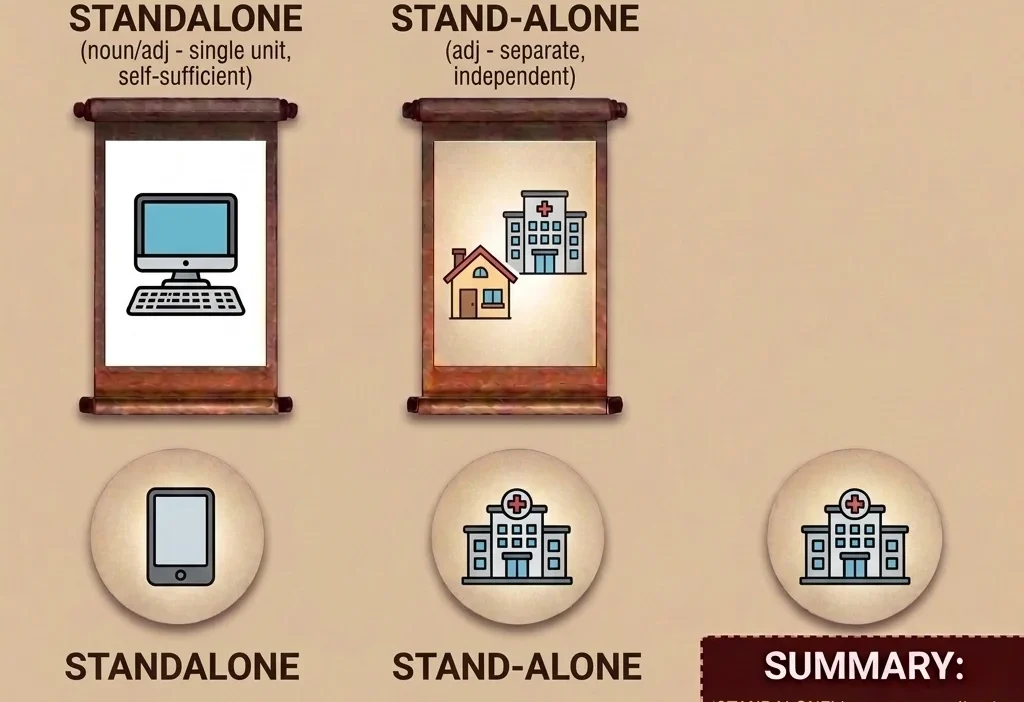
The correct form depends on how you use the word in a sentence.
For example, “This is a standalone application.” Stand alone is written as two words when stand is a verb and alone describes how someone or something stands. For example, “The statue can stand alone.”
Both forms are therefore correct, but they perform different grammatical jobs. Standalone commonly describes something that works independently without needing another product, system, or component.
It is especially common in phrases such as standalone product, standalone application, standalone device, and standalone solution. Stand alone, on the other hand, is a verb phrase and is used when someone or something physically or figuratively remains by itself.
Learning whether the phrase is acting as an adjective, noun, or verb phrase makes the spelling much easier to choose.
Quick Answer
Standalone is usually one word when it functions as an adjective or noun meaning independent or separate. Stand alone is two words when stand is the verb and alone describes it. Use “a standalone device” but “the device can stand alone.”
Why People Confuse It
People confuse standalone and stand alone because they come from the same words and have closely related meanings.
The key difference is grammatical:
- Standalone = usually an adjective or noun
- Stand alone = verb phrase
- Standalone describes something that functions independently.
- Stand alone describes the action or state of standing independently.
Compare:
This is a standalone program.
Here, standalone describes the program.
This program can stand alone.
Here, stand is the verb and alone describes the program’s independent state.
First Word: Standalone
Standalone is generally written as one word when it functions as an adjective.
It means independent, separate, or able to operate without relying on something else.
Standalone as an adjective
Examples include:
- standalone application
- standalone device
- standalone computer
- standalone product
- standalone system
- standalone solution
- standalone article
- standalone feature
For example:
We bought a standalone printer.
This means the printer is an independent device rather than something built into another system.
Standalone as a noun
Standalone can also be used as a noun, especially in technical or business contexts.
The company offers both integrated systems and standalones.
Here, standalones refers to products or systems that operate independently.
However, the adjective use is much more common.
Second Word: Stand Alone
Stand alone is written as two words when it functions as a verb phrase.
The verb is stand, while alone is an adverb describing the state or manner of standing.
Examples:
The lamp can stand alone without support.
She learned to stand alone financially.
The expression can be literal or figurative.
Literal meaning
The sign is strong enough to stand alone.
This means it can physically remain upright without additional support.
Figurative meaning
His argument cannot stand alone.
This means the argument cannot succeed or remain convincing without additional evidence.
She learned to stand alone after leaving home.
Here, it means becoming independent rather than literally standing.
Comparison Table
| Form | Grammatical Role | Meaning | Example |
|---|---|---|---|
| Standalone | Adjective | Independent or separate | This is a standalone device. |
| Standalone | Noun | An independent product or system | The company sells several standalones. |
| Stand alone | Verb phrase | Remain or function independently | The device can stand alone. |
When to Use Each
Use “standalone” when it describes a noun
If the word comes directly before a noun and means independent, standalone is usually the right choice.
Examples:
- a standalone application
- a standalone website
- a standalone machine
- a standalone product
- a standalone course
- a standalone chapter
You can usually test this by asking:
Does the word describe a thing?
If yes, standalone is likely appropriate.
Use “stand alone” when “stand” is the verb
If the sentence describes something or someone being able to remain independently, use stand alone.
Examples:
The machine can stand alone.
The building does not stand alone.
She is strong enough to stand alone.
Here, stand carries the action, so the words remain separate.
14 Examples of Standalone and Stand Alone
- This is a standalone application.
Standalone describes the application. - The application can stand alone without additional software.
Stand alone is the verb phrase. - We purchased a standalone computer.
The computer operates independently. - The computer can stand alone without being connected to the network.
The computer can function independently. - The company released a standalone product.
Standalone describes the product. - The product is designed to stand alone.
The product can operate independently. - This is a standalone device.
The device is independent. - The device can stand alone or connect to the larger system.
Stand alone describes its ability to function independently. - The novel works as a standalone story.
The story can be understood independently. - The story does not stand alone because it depends on the previous chapter.
The verb phrase describes independence. - The course is available as a standalone program.
The course is offered independently. - This feature can stand alone without the main platform.
The feature can operate independently. - The company sells standalone software.
The software is independent rather than integrated. - Her explanation cannot stand alone without supporting evidence.
The explanation requires additional support.
Common Mistakes
Mistake 1: Writing “stand alone” as an adjective
❌ We bought a stand alone device.
When standalone directly describes device, the standard modern spelling is:
✅ We bought a standalone device.
Mistake 2: Writing “standalone” when it is a verb phrase
❌ The device can standalone.
✅ The device can stand alone.
After the modal verb can, stand is the verb, so stand alone should remain two words.
Mistake 3: Confusing adjective and verb forms
Compare:
This is a standalone system.
This system can stand alone.
The first describes the system. The second describes what the system can do.
Mistake 4: Assuming “standalone” is always one word
Standalone is generally the standard spelling when it functions as an adjective or noun, but the original verb phrase remains stand alone.
The grammatical role determines the form.
Memory Trick
Use this simple rule:
Standalone = describes a thing.
Stand alone = describes an action or ability.
Think:
A standalone product → one word.
The product can stand alone → two words.
A quick test is to look at the word before it:
- a/the/this + standalone + noun → usually standalone
- can/will/should/to + stand alone → usually stand alone
American vs British English
Standalone and stand alone are used in both American and British English.
The basic distinction is the same:
- standalone = independent, usually an adjective or noun
- stand alone = verb phrase meaning to remain or function independently
You may occasionally encounter stand-alone, especially in older writing or particular style guides. However, standalone is now widely used as the one-word form, particularly when it functions as an adjective.
Similar Words
Independent
Independent means not controlled by or dependent on something else.
The organization is independent.
A standalone system is often an independent system.
Self-contained
Self-contained describes something that has everything necessary to function by itself.
The unit is self-contained.
Separate
Separate means apart from something else.
The device is separate from the main system.
Self-sufficient
Self-sufficient means able to provide what is needed without outside help.
The community became self-sufficient.
This can describe people, organizations, or systems and is broader than standalone.
Stand-alone
Stand-alone is a hyphenated form that is also found in English, especially in some established compounds or older usage.
The report is a stand-alone document.
In current general usage, standalone is commonly preferred when the word is functioning as an adjective.
Final Verdict
Standalone and stand alone are both correct, but they are used differently. Use standalone as one word when it describes an independent product, system, device, application, story, or other thing. Use stand alone as two words when stand is the verb.
The easiest examples to remember are “a standalone device” and “the device can stand alone.” If the word describes a noun, choose standalone. If it describes the action of remaining or functioning independently, choose stand alone.
Frequently Asked Questions
Is “standalone” one word or two?
Standalone is normally written as one word when it functions as an adjective or noun.
This is a standalone application.
Is “stand alone” grammatically correct?
Yes. Stand alone is correct when stand functions as a verb.
The device can stand alone.
Which is correct: “standalone device” or “stand alone device”?
Standalone device is the standard modern form because standalone is functioning as an adjective describing device.
Which is correct: “can standalone” or “can stand alone”?
Can stand alone is correct. After can, use the verb stand, followed by alone.
Is “standalone” an adjective?
Yes. Standalone commonly functions as an adjective meaning independent or able to operate separately.
We need a standalone system.
Is “standalone” the same as “independent”?
They are often similar, but not always identical. Standalone commonly emphasizes that something can operate or exist separately from another system, while independent has a broader meaning.
Is “stand-alone” also correct?
Yes, stand-alone is an established hyphenated form and may still appear in some writing. However, standalone is widely used as the modern one-word form.
Remember This
- Standalone = usually one word when it describes something independent.
- Stand alone = two words when stand is the verb.
- Standalone device ✔️
- Standalone application ✔️
- The device can stand alone ✔️
- The device can standalone ❌
- Stand-alone is also found, especially in some established or older usage.
Conclusion
The choice between standalone and stand alone depends mainly on grammar. Standalone is normally one word when it acts as an adjective or noun and means independent or separate. Stand alone remains two words when stand is the verb and alone describes the state of remaining independently.
Remember the contrast: “a standalone product” but “the product can stand alone.” This simple distinction will help you use the expression naturally in technical writing, business communication, academic work, and everyday English.

Liam Henry is a content author at Synonymed, specializing in vocabulary enrichment and synonym guides. He creates clear, engaging resources that help learners improve English word knowledge and language fluency.