If you are confused about tide vs tied, you are not alone.
These two words sound exactly the same, but they have completely different meanings and spellings.
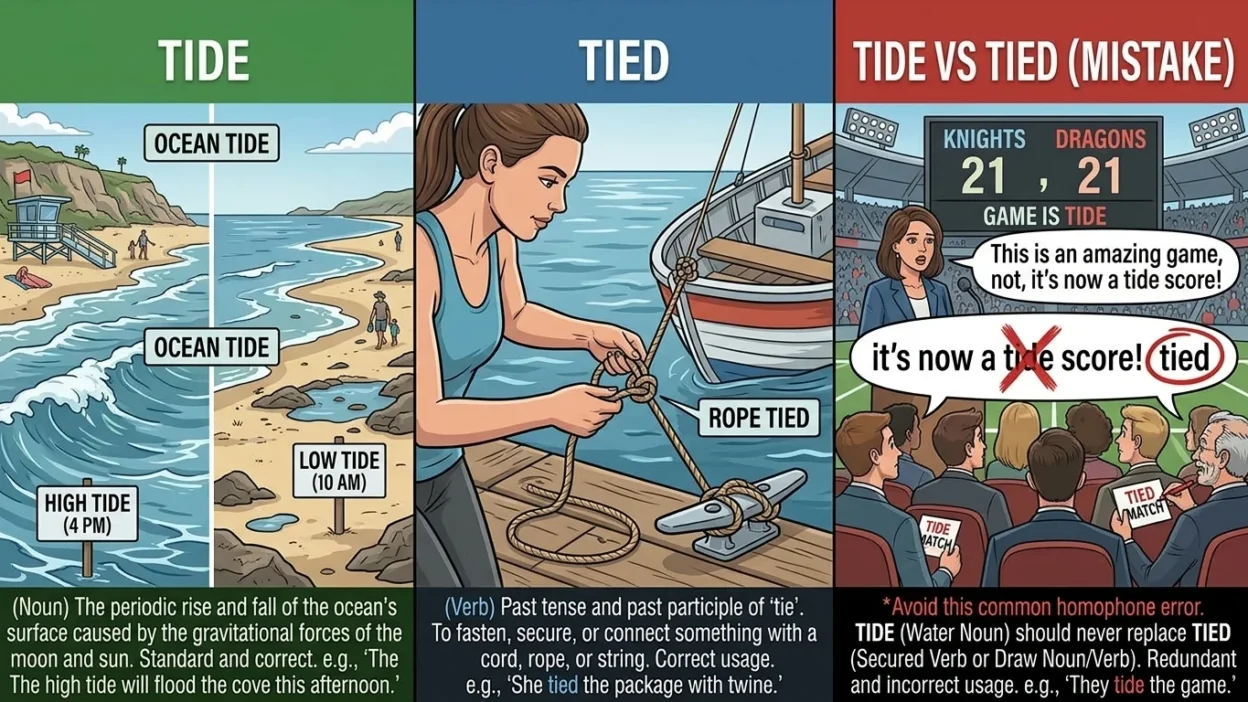
Tide is usually a noun related to the rise and fall of ocean water, while tied is the past tense and past participle of tie, meaning fastened, attached, or unable to move freely.
For example, “The tide is high” and “She tied her shoes” use two different words.
Understanding the difference between tide and tied is important for students, ESL learners, writers, and anyone who wants to avoid common spelling mistakes.
Because both words are pronounced /taɪd/, you cannot always identify the correct spelling by listening alone. The context of the sentence tells you which word you need.
Once you learn their meanings and a simple memory trick, choosing between tide and tied becomes much easier.
Quick Answer: Tide vs Tied
Tide usually means the regular rise and fall of sea or ocean water, and it can also mean a trend or period of change. Tied is the past tense of tie, meaning fastened, attached, or equal in a competition. They sound alike but have different meanings and spellings.
Why Do People Confuse Tide and Tied?
People confuse tide and tied because they are homophones. Homophones are words that have the same pronunciation but different meanings and spellings.
- Tide → the rise and fall of ocean water
- Tied → past tense of tie
- Tide → “The tide is coming in.”
- Tied → “He tied the package with string.”
The spelling difference becomes especially important in writing because pronunciation alone cannot tell you which word is correct.
What Does “Tide” Mean?
Tide is most commonly a noun referring to the regular rise and fall of the sea caused mainly by the gravitational effects of the Moon and the Sun.
Examples of “tide”
- The tide is coming in.
- We waited for the tide to go out.
- The boat was carried by the tide.
- The beach looks different at low tide.
“Tide” can also have a figurative meaning. It may describe a strong trend or movement.
For example:
- Public opinion began to turn the tide.
- The new team hopes to turn the tide in its favor.
The phrase turn the tide means to cause a situation to change, especially from an unfavorable direction to a more favorable one.
What Does “Tied” Mean?
Tied is the past tense and past participle of the verb tie.
To tie means to fasten, attach, or secure something using a knot, string, rope, or similar method.
Examples of “tied”
- She tied her shoes.
- He tied the rope to the post.
- I tied the package with string.
- The dog was tied to a tree.
“Tied” can also mean that two people or teams have the same score.
For example:
- The game was tied at 2–2.
- The two players are tied for first place.
It can also describe being strongly connected or restricted.
- She feels tied to her responsibilities.
- The two events are closely tied together.
Tide vs Tied: Comparison Table
| Word | Meaning | Part of Speech | Example |
|---|---|---|---|
| Tide | The regular rise and fall of sea water | Noun | The tide is high. |
| Tide | A changing trend or movement | Noun | The tide of public opinion changed. |
| Tied | Fastened or secured | Verb/adjective | He tied the rope. |
| Tied | Equal in a competition | Verb/adjective | The teams are tied at 3–3. |
When Should You Use “Tide” or “Tied”?
- high tide
- low tide
- rising tide
- falling tide
- ocean movement
- changing circumstances or trends
- tied shoes
- tied ropes
- tied packages
- tied animals
- tied scores
- people or things connected to something
A simple test
Ask yourself:
Is the sentence about fastening something or equal scores?
→ Use tied.
Is it about the ocean or a changing trend?
→ Use tide.
10+ Examples of Tide and Tied
Examples with “tide”
- The tide was unusually high this morning.
- We went to the beach at low tide.
- The boat moved with the tide.
- The incoming tide covered the rocks.
- Check the tide before walking along the shore.
- The fishermen waited for the right tide.
- The rising tide reached the lower part of the beach.
- A change in public opinion turned the tide of the debate.
Examples with “tied”
- She tied her hair before exercising.
- He tied the box with a piece of string.
- The horse was tied near the fence.
- I tied my shoelaces before running.
- The two teams were tied at halftime.
- The runners were tied for second place.
- The package was securely tied.
- Their scores were tied after the final round.
Common Mistakes with Tide and Tied
Mistake 1: Using “tied” for ocean water
Incorrect:
“The tied is coming in.”
Correct:
“The tide is coming in.”
Mistake 2: Using “tide” for fastening
Incorrect:
“She tide her shoes.”
Correct:
“She tied her shoes.”
Mistake 3: Confusing “tied” with “tie”
Remember that tie is the base form, while tied is the past tense.
- Present: I tie my shoes.
- Past: I tied my shoes.
- Past participle: I have tied my shoes.
Mistake 4: Choosing based only on pronunciation
Because tide and tied sound the same, listening is not enough. Look at the meaning and context.
Easy Memory Trick for Tide vs Tied
Here is a simple way to remember the difference:
Tide = water.
Think of the tide moving in and out of the ocean.
Tied = tie + d.
If you tie something and the action happened in the past, you tied it.
You can remember:
Tide moves. Tied fastens.
And for sports:
Tied = same score.
For example:
- The tide moves along the shore.
- I tied my shoes.
- The teams are tied at 1–1.
American vs British English
There is no meaningful difference between American and British English in the basic meanings or spellings of “tide” and “tied.” Both varieties use tide for the rise and fall of sea levels and tied as the past tense of tie.
Pronunciation is also essentially the same in standard varieties, so learners in both American and British English need to rely on context when distinguishing the words in writing.
Similar Words to Tide and Tied
Several other English words can cause similar confusion because they sound alike or have related meanings.
Words related to “tide”
- wave — a moving ridge of water
- current — a continuous movement of water or air
- ebb — the movement of the tide away from the land
- flow — movement in a particular direction
- surge — a sudden strong movement
Words related to “tied”
- tie — to fasten something
- fasten — to attach or secure something
- attach — to connect one thing to another
- bind — to hold things together
- secure — to make something firmly fixed
Other common homophones include:
- there / their / they’re
- to / too / two
- sea / see
- right / write
- one / won
Final Verdict: Tide or Tied?
The correct word depends on what you mean.
Choose tide when you mean the rise and fall of ocean water or a figurative trend or movement.
Choose tied when you mean something was fastened, secured, connected, or when two competitors have the same score.
Remember the simplest distinction: tide is about movement, especially water; tied is related to tie, fastening, or equal scores.
Frequently Asked Questions
Is “tide” and “tied” the same word?
No. Tide and tied are different words with different meanings and spellings. They are homophones because they are pronounced the same way.
What is the difference between tide and tied?
Tide usually refers to the rise and fall of ocean water. Tied is the past tense of tie and can mean fastened or equal in a competition.
Is it “the tide is high” or “the tied is high”?
The correct sentence is “The tide is high.” Here, tide refers to the level or movement of the sea.
Is it “I tide my shoes” or “I tied my shoes”?
The correct past-tense sentence is “I tied my shoes.” The verb is tie, and its past tense is tied.
Are tide and tied homophones?
Yes. Tide and tied are homophones because they have the same pronunciation but different spellings and meanings.
What does “tied” mean in sports?
In sports, tied means that two teams or competitors have the same score. For example, “The teams were tied at 2–2.”
What does “turn the tide” mean?
Turn the tide means to change the direction or outcome of a situation, especially when it has been developing unfavorably.
What is the past tense of “tie”?
The past tense of tie is tied. For example: “I tie my shoes every morning” becomes “I tied my shoes yesterday.”
Remember This
Tide = ocean water or a changing trend.
Tied = fastened, connected, or equal in score.
They sound the same, but their meanings are different. When writing, use the meaning of the sentence to choose the correct spelling.
The easiest rule is: If something was fastened, it was tied. If you are talking about the sea, it is the tide.
Conclusion
Understanding tide vs tied is simple once you focus on meaning rather than pronunciation. Tide refers mainly to the rise and fall of ocean water and can also describe a changing trend. Tied, meanwhile, is the past tense of tie and describes something that was fastened or two competitors with equal scores.
Since these words are homophones, spelling mistakes are easy to make, especially for English learners. Keep the memory trick in mind: tide moves, tied fastens. With a little practice and attention to context, you can confidently use the correct word in everyday English.