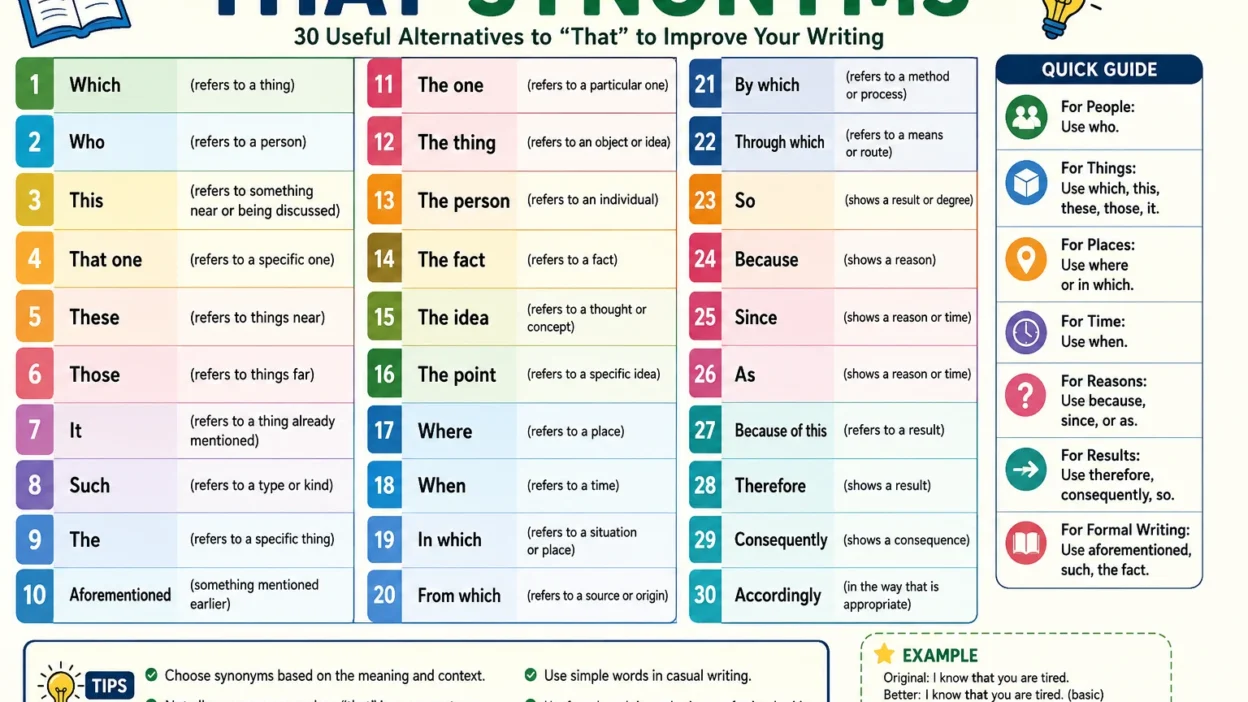
Finding the right that synonyms can make your writing clearer, smoother, and more precise. The word “that” is extremely common in English, but its meaning and grammatical role can change depending on the sentence.
For students, ESL learners, writers, and content creators, understanding alternatives to “that” is especially useful. Sometimes “that” points to a specific thing.
Sometimes it introduces additional information, connects ideas, or refers to a person or object already mentioned.
The important point is that “that” does not have one universal synonym. The best alternative depends on how “that” is being used in a sentence. This guide explains 30 useful alternatives and related expressions in simple English.
What Does “That” Mean?
“That” is a common English word with several grammatical functions. It can work as a determiner, pronoun, conjunction, or relative pronoun.
As a determiner, it identifies a particular person or thing.
Example:
“That book belongs to Maria.”
As a pronoun, “that” can refer to something already mentioned.
Example:
“I don’t want that.”
As a conjunction, “that” can introduce information or a statement.
Example:
“She said that she was tired.”
As a relative pronoun, “that” can connect a noun with additional information.
Example:
“The movie that we watched was excellent.”
Because “that” has several jobs, you should choose an alternative based on its meaning and grammatical function.
30 Synonyms and Alternatives for “That”
Here are 30 useful words and expressions that can replace or perform a similar function to “that” in the right context.
1. Which
Meaning: Refers to a thing or idea that has already been mentioned.
Example: “She bought a new laptop, which was on sale.”
Best usage context: Formal and general writing, especially when adding extra information.
2. Who
Meaning: Refers to a person or people.
Example: “The teacher who helped me was very patient.”
Best usage context: Use when referring to people instead of things.
3. This
Meaning: Refers to a particular person, thing, idea, or situation that is usually closer in context.
Example: “This is the book I told you about.”
Best usage context: Everyday speech, explanations, and writing when referring to something currently being discussed.
4. Those
Meaning: Refers to specific people or things that are farther away or already identified.
Example: “Those are the shoes I wanted.”
Best usage context: Use for plural nouns when pointing to specific things.
5. These
Meaning: Refers to specific people or things that are near or currently being discussed.
Example: “These are the results we expected.”
Best usage context: Useful when discussing several specific items or ideas.
6. It
Meaning: Refers to a previously mentioned thing, situation, or idea.
Example: “I found a useful website. It has many free resources.”
Best usage context: Use to avoid repeating the same noun.
7. Such
Meaning: Refers to something of the type or kind already described.
Example: “Such behavior is unacceptable.”
Best usage context: Formal, academic, and professional writing.
8. The
Meaning: Identifies a particular person, thing, or idea.
Example: “The book you recommended was helpful.”
Best usage context: Use when the reader or listener knows which specific thing you mean.
9. Aforementioned
Meaning: Refers to something mentioned earlier.
Example: “The aforementioned study produced interesting results.”
Best usage context: Formal or academic writing. Avoid it in casual conversation.
10. The aforementioned
Meaning: Means “the thing or person mentioned earlier.”
Example: “The aforementioned author published another article.”
Best usage context: Legal, academic, technical, or highly formal writing.
11. The one
Meaning: Refers to a particular person or thing among several possibilities.
Example: “I chose the one that had the lowest price.”
Best usage context: Everyday English when identifying one specific item.
12. The thing
Meaning: Refers to an object, idea, fact, or situation.
Example: “The thing I like most is the simple design.”
Best usage context: Informal speech and conversational writing.
13. The person
Meaning: Refers specifically to an individual already identified or understood from context.
Example: “The person who called you left a message.”
Best usage context: Useful when clarity about a human subject is important.
14. The fact
Meaning: Refers to a specific fact or piece of information.
Example: “The fact that she succeeded surprised everyone.”
Best usage context: Academic, explanatory, and formal writing.
15. The idea
Meaning: Refers to a thought, concept, or suggestion previously discussed.
Example: “The idea that everyone should participate is reasonable.”
Best usage context: Essays, discussions, and analytical writing.
16. The point
Meaning: Refers to a specific argument, fact, or idea.
Example: “The point that he made was important.”
Best usage context: Discussions, essays, presentations, and persuasive writing.
17. Where
Meaning: Refers to a place or situation.
Example: “This is the restaurant where we first met.”
Best usage context: Use when referring to a location.
18. When
Meaning: Refers to a time or period.
Example: “I remember the day when we first spoke.”
Best usage context: Use when the relative clause describes a time.
19. In which
Meaning: Means “where” or refers to the setting or situation in which something happens.
Example: “She described the situation in which the problem occurred.”
Best usage context: Formal and academic writing.
20. From which
Meaning: Indicates the source, starting point, or origin of something.
Example: “The village from which he came was very small.”
Best usage context: Formal writing and precise descriptions of origin.
21. By which
Meaning: Describes the method, process, or means used to do something.
Example: “They explained the process by which the data was collected.”
Best usage context: Academic, scientific, and professional writing.
22. Through which
Meaning: Shows the route, process, or means through which something happens.
Example: “The program created a system through which students could communicate.”
Best usage context: Formal and explanatory writing.
23. So
Meaning: Can replace “that” in certain expressions, especially when showing a result.
Example: “The weather was so cold that we stayed indoors.”
Best usage context: Common expressions involving degree and result.
24. Because
Meaning: Explains the reason something happens.
Example: “She stayed home because she was sick.”
Best usage context: Use when “that” would otherwise introduce a reason-related clause incorrectly or less clearly.
25. Since
Meaning: Can introduce a reason or indicate a starting time.
Example: “Since the road was closed, we took another route.”
Best usage context: Use for reasons or time, depending on the sentence.
26. As
Meaning: Can introduce a reason, time, or comparison depending on context.
Example: “As it was raining, we canceled the trip.”
Best usage context: Formal and general writing when the relationship between ideas is clear.
27. Because of this
Meaning: Refers back to a previously mentioned situation and shows its result.
Example: “The roads were flooded. Because of this, the school closed.”
Best usage context: Clear transitions between sentences.
28. Therefore
Meaning: Means “for that reason” or “as a result.”
Example: “The evidence was incomplete. Therefore, the researchers continued their investigation.”
Best usage context: Formal, academic, and professional writing.
29. Consequently
Meaning: Means “as a result of something.”
Example: “The company lost several clients and consequently reduced its expenses.”
Best usage context: Formal and academic writing.
30. Accordingly
Meaning: Means “in a way that is appropriate because of what happened or was said.”
Example: “The instructions were unclear, so the team acted accordingly after receiving clarification.”
Best usage context: Formal, professional, and business writing.
Quick Comparison Guide for “That” Alternatives
Not every alternative can replace “that” directly. The following guide helps you choose an option based on meaning.
| If you mean… | Useful alternative | Example |
|---|---|---|
| A thing with extra information | Which | The car, which was expensive, broke down. |
| A person | Who | The student who won smiled. |
| A nearby idea or object | This | This is the answer. |
| Several specific things | These | These are the results. |
| Several distant or previously mentioned things | Those | Those are the examples I meant. |
| A previously mentioned object | It | I bought a phone. It works well. |
| A previously mentioned type | Such | Such behavior is unusual. |
| A location | Where | This is the place where we met. |
| A time | When | I remember the year when it happened. |
| A formal situation | In which | The situation in which he worked was difficult. |
| A reason | Because | We left because it was late. |
| A result | Therefore | It was late; therefore, we left. |
| A consequence | Consequently | Sales fell; consequently, costs were reduced. |
| Something mentioned earlier | Aforementioned | The aforementioned study supports this claim. |
How to Choose the Right Synonym
Choosing an alternative to “that” becomes easier when you first identify what you want the word to do.
For People: Use “Who”
When “that” refers to a person, who is often a natural alternative.
Example:
“The writer that won the award…”
“The writer who won the award…”
In standard English, “who” is generally the clearest choice when referring to people.
For Things: Use “Which”
When referring to a thing and adding extra information, which can be appropriate.
Example:
“She bought a camera, which was very expensive.”
“Which” is especially common when the information is additional rather than essential.
For Places: Use “Where”
When the noun refers to a location, where can often make the sentence more natural.
Example:
“This is the school where I studied.”
This is usually smoother than repeatedly using “that” in location-related sentences.
For Time: Use “When”
When discussing a particular time, when can be useful.
Example:
“I remember the year when we moved.”
It clearly tells the reader that the following information relates to time.
For Formal Writing: Use “In Which,” “By Which,” or “Through Which”
Academic and professional writing sometimes requires more precise relationships.
Examples:
“The environment in which children learn affects their development.”
“The method by which the information was collected was carefully documented.”
“The system through which payments are processed is secure.”
These expressions should be used when they improve precision, not simply to make writing sound complicated.
For Referring Back: Use “This,” “It,” “Such,” or “The Aforementioned”
If you have already introduced an idea, you can often avoid repeating “that.”
Example:
“The company changed its policy. This affected many employees.”
Or:
“The company changed its policy. As a result, many employees had to adapt.”
These choices can make paragraphs flow more naturally.
For Showing a Reason: Use “Because,” “Since,” or “As”
When the intended meaning is a reason, choose a word that clearly expresses cause.
Example:
“Because the train was late, we missed the meeting.”
“Since the train was late, we missed the meeting.”
“As the train was late, we missed the meeting.”
The choice depends partly on tone and sentence structure.
For Showing a Result: Use “Therefore” or “Consequently”
When you want to show a result, transitional words can make the relationship between ideas clearer.
Example:
“The evidence was weak. Therefore, the conclusion was reconsidered.”
These words work particularly well in essays, reports, and professional writing.
Common Mistakes When Replacing “That”
A common mistake is assuming that every synonym can replace “that” in every sentence.
This is not true.
For example:
“I know that she is busy.”
You cannot simply replace “that” with “which”:
“I know which she is busy.”
The meaning and grammar change.
Another common mistake is using formal alternatives when simple English would be better.
For example, “the aforementioned” may be correct in a legal document, but it can sound unnecessarily complicated in a friendly blog post.
Good writing is not about replacing common words with difficult words. It is about choosing the most accurate and natural expression for the situation.
“That” Synonyms for Different Writing Styles
Casual Writing
For everyday communication, prefer simple words such as:
- This
- These
- Those
- It
- Who
- Which
- Where
- When
These options are easy to understand and sound natural.
Academic Writing
Academic writing may benefit from:
- Which
- In which
- By which
- Through which
- Therefore
- Consequently
- Such
- The fact
Use them only when they make the relationship between ideas clearer.
Professional Writing
Professional communication often benefits from precision.
Useful choices include:
- This
- Such
- Therefore
- Accordingly
- Consequently
- The fact
- In which
The goal is clarity rather than unnecessarily formal language.
Creative Writing
Creative writers usually have more freedom.
Instead of repeatedly using “that,” you can restructure sentences using:
- This
- It
- Which
- Who
- Where
- When
- The thing
- The idea
Changing sentence structure can make prose more varied and engaging.
Why Learning “That” Alternatives Matters
Learning alternatives to “that” can improve vocabulary, but the bigger benefit is better sentence control.
ESL learners can use these words to understand how English connects ideas. Writers can use them to avoid repetition. Students can use them to make essays clearer and more organized.
However, remember that “that” itself is not a bad word. It is one of the most useful words in English. The goal is not to remove it from your writing.
The goal is to understand when another word communicates your meaning more precisely.
Frequently Asked Questions About “That” Synonyms
What is the best synonym for “that”?
There is no single best synonym. Which, who, this, those, where, when, such, and other alternatives may work depending on the grammatical role and meaning of “that.”
Can “which” replace “that”?
Sometimes. “Which” can replace “that” when referring to a thing in a relative clause, but the grammar and meaning of the sentence determine whether it is appropriate.
What can I use instead of “that” in academic writing?
Depending on the meaning, you can use which, in which, by which, through which, such, therefore, consequently, or the fact that.
What is a simple alternative to “that”?
Simple alternatives include this, those, these, it, who, which, where, and when, but each has a different grammatical function.
Is “that” formal or informal?
“That” is neutral and extremely common. It can be used in casual, professional, and academic English.
Conclusion
Understanding that synonyms is less about memorizing replacement words and more about understanding meaning, grammar, and context.
Use who for people, which for many references to things, where for places, and when for times.
For formal relationships between ideas, expressions such as in which, by which, therefore, and consequently can provide greater precision.
Most importantly, do not replace “that” simply because you want a more sophisticated word. Choose an alternative only when it makes your sentence clearer, more natural, or more precise.
For students and ESL learners, mastering these distinctions can lead to stronger vocabulary and better sentence construction.
For writers and content creators, they can also help create smoother, more varied, and reader-friendly content.