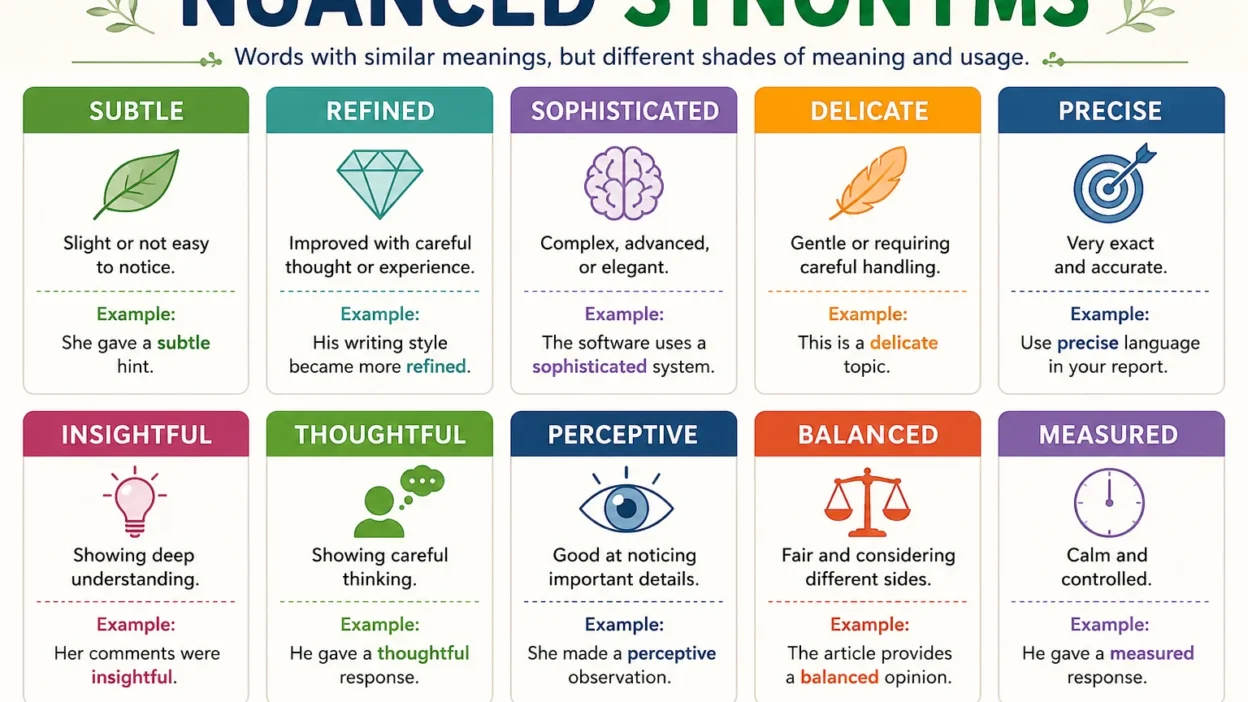
Language becomes more powerful when you choose words that express exactly what you mean. If you have ever searched for nuanced synonyms, you are probably looking for words that carry similar meanings but fit different situations, emotions, or writing styles.
Understanding nuanced synonyms helps students, ESL learners, writers, bloggers, and content creators communicate more clearly. Instead of repeating the same word, you can select one that better matches your purpose, making your writing more natural, engaging, and professional.
What Does “Nuanced” Mean?
The word nuanced describes something that has small but important differences, details, or shades of meaning. A nuanced idea is not completely simple—it includes subtle distinctions that make it more accurate or expressive.
For example:
- Her explanation was nuanced and considered different viewpoints.
- The movie gives a nuanced picture of modern life.
In everyday English, nuanced is often used to describe opinions, discussions, emotions, writing, art, and communication that are thoughtful and detailed.
Why Learn Nuanced Synonyms?
Learning nuanced synonyms can help you:
- Improve your vocabulary
- Avoid repeating the same words
- Write more naturally
- Express ideas more accurately
- Sound more fluent in English
- Choose the best word for every situation
30 Nuanced Synonyms with Meanings and Examples
1. Subtle
Meaning: Slight or not easy to notice.
Example: She gave a subtle hint during the meeting.
Best Usage: Hidden meanings or small differences.
2. Refined
Meaning: Improved with careful thought or experience.
Example: His writing style became more refined over time.
Best Usage: Formal writing and skills.
3. Sophisticated
Meaning: Complex, advanced, or elegant.
Example: The software uses a sophisticated system.
Best Usage: Technology, ideas, or style.
4. Delicate
Meaning: Gentle or requiring careful handling.
Example: This is a delicate topic to discuss.
Best Usage: Sensitive conversations.
5. Detailed
Meaning: Including many important facts.
Example: She wrote a detailed report.
Best Usage: Reports and explanations.
6. Precise
Meaning: Very exact and accurate.
Example: Use precise language in academic writing.
Best Usage: Technical and formal writing.
7. Specific
Meaning: Clearly defined or particular.
Example: Please give specific instructions.
Best Usage: Directions and explanations.
8. Complex
Meaning: Made of many connected parts.
Example: Human emotions are complex.
Best Usage: Ideas and systems.
9. Layered
Meaning: Having several levels of meaning.
Example: The novel has layered characters.
Best Usage: Literature and storytelling.
10. Insightful
Meaning: Showing deep understanding.
Example: Her comments were insightful.
Best Usage: Reviews and discussions.
11. Thoughtful
Meaning: Showing careful thinking.
Example: He gave a thoughtful response.
Best Usage: Conversations and writing.
12. Perceptive
Meaning: Good at noticing important details.
Example: She made a perceptive observation.
Best Usage: Analysis.
13. Discerning
Meaning: Able to judge carefully.
Example: A discerning reader notices hidden themes.
Best Usage: Reviews and criticism.
14. Fine
Meaning: Very small or subtle.
Example: There is a fine difference between the two.
Best Usage: Comparisons.
15. Intricate
Meaning: Very detailed and complicated.
Example: The design is intricate.
Best Usage: Art and architecture.
16. Elaborate
Meaning: Carefully developed with many details.
Example: They created an elaborate plan.
Best Usage: Projects and planning.
17. Careful
Meaning: Done with attention.
Example: She gave a careful explanation.
Best Usage: Everyday communication.
18. Balanced
Meaning: Fair and considering different sides.
Example: The article provides a balanced opinion.
Best Usage: Journalism.
19. Measured
Meaning: Calm and controlled.
Example: He gave a measured response.
Best Usage: Professional communication.
20. Qualified
Meaning: Limited or carefully explained.
Example: She gave qualified support to the proposal.
Best Usage: Academic and business writing.
21. Diplomatic
Meaning: Careful not to offend others.
Example: He gave a diplomatic answer.
Best Usage: Workplace conversations.
22. Sensitive
Meaning: Showing understanding of emotions.
Example: The teacher handled the issue in a sensitive way.
Best Usage: Emotional topics.
23. Expressive
Meaning: Showing feelings clearly.
Example: She is an expressive speaker.
Best Usage: Creative writing.
24. Meaningful
Meaning: Full of importance or value.
Example: They had a meaningful conversation.
Best Usage: Personal discussions.
25. Rich
Meaning: Full of detail or depth.
Example: The story has rich descriptions.
Best Usage: Literature.
26. Deep
Meaning: Showing serious thought or emotion.
Example: The poem has deep meaning.
Best Usage: Philosophy and literature.
27. Intelligent
Meaning: Showing good understanding.
Example: She asked an intelligent question.
Best Usage: Education.
28. Articulate
Meaning: Able to express ideas clearly.
Example: He is an articulate speaker.
Best Usage: Public speaking.
29. Considered
Meaning: Carefully thought about.
Example: They reached a considered decision.
Best Usage: Formal writing.
30. Thought-Provoking
Meaning: Making people think deeply.
Example: The documentary was thought-provoking.
Best Usage: Books, films, and speeches.
Comparison Guide: When to Use Different Nuanced Synonyms
| Synonym | Best For | Tone |
|---|---|---|
| Subtle | Small differences | Neutral |
| Refined | Improved quality | Formal |
| Sophisticated | Advanced ideas | Formal |
| Delicate | Sensitive topics | Gentle |
| Detailed | Full explanations | Neutral |
| Precise | Exact information | Formal |
| Specific | Clear instructions | Everyday |
| Complex | Difficult ideas | Academic |
| Insightful | Smart observations | Professional |
| Thoughtful | Careful opinions | Friendly |
| Diplomatic | Avoiding conflict | Professional |
| Balanced | Fair discussions | Neutral |
| Expressive | Creative work | Creative |
| Rich | Descriptive writing | Literary |
| Deep | Serious ideas | Reflective |
How to Choose the Right Synonym
For Academic Writing
Choose words like:
- Precise
- Refined
- Sophisticated
- Considered
- Detailed
These words make essays and research papers sound accurate and professional.
For Creative Writing
Use words such as:
- Rich
- Layered
- Expressive
- Deep
- Intricate
These add emotion, imagery, and depth to stories and poems.
For Business Communication
Good choices include:
- Diplomatic
- Measured
- Balanced
- Careful
- Qualified
These help your communication sound professional and respectful.
For Everyday English
Simple alternatives include:
- Thoughtful
- Specific
- Careful
- Meaningful
- Sensitive
These are easy to understand and suitable for daily conversations.
Tips for Using Nuanced Synonyms Naturally
- Think about your audience before choosing a word.
- Match the word to the tone of your writing.
- Avoid replacing words with difficult vocabulary unless it improves clarity.
- Read example sentences to understand real-life usage.
- Practice using one new synonym each day.
Common Mistakes to Avoid
- Using difficult words only to sound smarter.
- Choosing a synonym without checking its exact meaning.
- Ignoring the context of the sentence.
- Repeating the same advanced word throughout your writing.
- Using formal synonyms in casual conversations.
Conclusion
Learning nuanced synonyms helps you become a stronger writer and more confident English speaker. Although many words have similar meanings, each one carries its own tone, purpose, and level of formality. By understanding these subtle differences, you can communicate more clearly, write with greater precision, and choose vocabulary that fits every situation.
if you are a student, an ESL learner, a blogger, or a professional writer, expanding your vocabulary with nuanced synonyms will make your writing richer, more engaging, and easier for readers to understand. Keep practicing these words in everyday conversations and writing, and they will soon become a natural part of your vocabulary.