The word “to” is one of the most common words in English. It can show direction, purpose, a relationship, a destination, or an infinitive verb.
Because it has so many uses, finding a perfect synonym for “to” is not always simple.
For students, ESL learners, writers, and content creators, understanding to synonyms can make writing more varied and precise.
However, the best alternative depends on what “to” means in the sentence.
In this guide, you will find 30 words and phrases that can replace or express meanings commonly associated with “to.”
Each option includes a simple meaning, an example sentence, and a note explaining when it works best.
What Does “To” Mean?
Simple meaning of “to”
“To” is a preposition and also part of the infinitive form of a verb. It commonly indicates movement toward a place or person, a destination, a purpose, or an action.
For example:
- She walked to school.
- I gave the book to Sarah.
- He went outside to exercise.
- I want to learn English.
The meaning changes according to the sentence. This is why there is no single word that can replace “to” everywhere.
Why learn synonyms for “to”?
Learning alternatives can help you avoid repetitive writing and choose words that communicate your exact meaning.
For ESL learners, these alternatives also make it easier to understand different sentence structures. For writers, they can improve clarity and style.
30 To Synonyms and Alternatives
1. Toward
Meaning: In the direction of a person, place, or thing.
Example: The children ran toward the playground.
Best usage context: Use “toward” when describing movement in a particular direction.
2. Towards
Meaning: Moving or facing in the direction of something.
Example: She walked towards the door.
Best usage context: “Towards” has the same basic meaning as “toward” and is especially common in British English.
3. Into
Meaning: Moving from outside to inside something.
Example: He walked into the room.
Best usage context: Use “into” when movement ends inside a place or space.
4. Onto
Meaning: Moving to a position on a surface.
Example: The cat jumped onto the table.
Best usage context: Use “onto” when something moves to a surface.
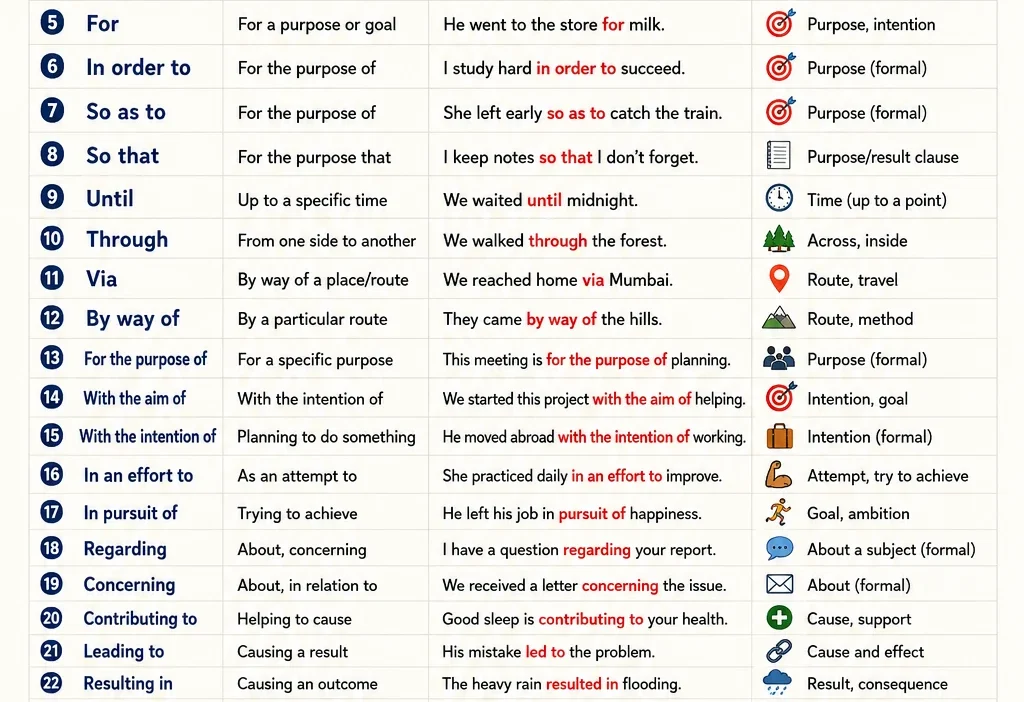
5. For
Meaning: Intended for a person, purpose, or goal.
Example: She went to the library for research.
Best usage context: “For” can express purpose or intended use, but it cannot replace every use of “to.”
6. In order to
Meaning: For the purpose of doing something.
Example: He studied hard in order to pass the exam.
Best usage context: Use this phrase when you want to clearly explain purpose.
7. So as to
Meaning: With the purpose of doing something.
Example: She spoke quietly so as to avoid disturbing others.
Best usage context: Useful in formal or careful writing when expressing purpose.
8. So that
Meaning: For the purpose or result that something happens.
Example: I wrote down the address so that I would not forget it.
Best usage context: Use “so that” when a purpose clause needs a subject and verb.
9. Until
Meaning: Up to a particular time.
Example: We waited until noon.
Best usage context: Use “until” when “to” is connected with an ending point in time, such as in “from Monday to Friday.”
10. Through
Meaning: From one side or point to another, often passing inside something.
Example: The train traveled through the tunnel.
Best usage context: Use “through” for movement across or inside a space.
11. Via
Meaning: By way of a particular place, route, or method.
Example: We traveled to the island via London.
Best usage context: Common in travel, business, technology, and formal writing.
12. By way of
Meaning: Using a particular route or passing through a particular place.
Example: They reached the village by way of the mountain road.
Best usage context: Useful when explaining a route or method.
13. For the purpose of
Meaning: With a particular aim or reason.
Example: The meeting was arranged for the purpose of discussing the new project.
Best usage context: Best for formal and professional writing.
14. With the aim of
Meaning: With the intention of achieving something.
Example: The company changed its policy with the aim of improving customer service.
Best usage context: Useful for academic, business, and analytical writing.
15. With the intention of
Meaning: Planning or intending to do something.
Example: He moved abroad with the intention of finding better opportunities.
Best usage context: Appropriate when explaining someone’s clear intention.
16. In an effort to
Meaning: As an attempt to achieve something.
Example: The school introduced new programs in an effort to improve student performance.
Best usage context: Common in news, academic, business, and professional writing.
17. In pursuit of
Meaning: Trying to achieve or obtain something.
Example: She moved to the city in pursuit of a better career.
Best usage context: Best for goals, ambitions, opportunities, and formal writing.
18. Regarding
Meaning: About or concerning something.
Example: I contacted the office regarding your application.
Best usage context: Use “regarding” when “to” appears in expressions such as “questions to the manager” and the intended meaning is about a subject.
19. Concerning
Meaning: About a particular topic or matter.
Example: We received several complaints concerning the new policy.
Best usage context: Useful in formal and professional communication.
20. Contributing to
Meaning: Helping to cause or produce a result.
Example: Regular exercise is an important factor contributing to good health.
Best usage context: Use this when describing something that helps produce an outcome.
21. Leading to
Meaning: Causing or resulting in something.
Example: Poor planning can result in mistakes leading to financial losses.
Best usage context: Useful when explaining cause and effect.
22. Resulting in
Meaning: Causing a particular outcome.
Example: Heavy rainfall caused flooding, resulting in major traffic delays.
Best usage context: Excellent for academic, technical, and explanatory writing.
23. Compared with
Meaning: Considered alongside another thing to show similarities or differences.
Example: The new model is cheaper compared with the older version.
Best usage context: Use when making comparisons.
24. Relative to
Meaning: In relation or comparison to something.
Example: The price is low relative to similar products.
Best usage context: Common in academic, business, scientific, and analytical writing.
25. According to
Meaning: As stated or reported by a person, source, or authority.
Example: According to the teacher, the test will begin at nine.
Best usage context: Use when referring to information from a source.
26. As a result of
Meaning: Because something happened.
Example: The event was canceled as a result of heavy rain.
Best usage context: Use when explaining a cause or reason.
27. Due to
Meaning: Because of something.
Example: The flight was delayed due to bad weather.
Best usage context: Common in formal, professional, and informational writing.
28. Because of
Meaning: For the reason that something happened.
Example: We stayed home because of the storm.
Best usage context: A natural and easy choice for everyday English.
29. In addition to
Meaning: As well as something else.
Example: In addition to English, she speaks Spanish.
Best usage context: Use when adding another person, thing, or activity.
30. Alongside
Meaning: Together with or next to something.
Example: The company works alongside local communities.
Best usage context: Useful when expressing cooperation, association, or physical position.
Quick Comparison of To Synonyms
| Alternative | Main meaning | Best context |
|---|---|---|
| Toward | Direction | Movement |
| Towards | Direction | Movement, especially British English |
| Into | Movement inside | Places and spaces |
| Onto | Movement to a surface | Physical movement |
| For | Purpose or intended use | General English |
| In order to | Purpose | Academic and general writing |
| So as to | Purpose | Formal writing |
| So that | Purpose or result | Complete clauses |
| Until | Ending time | Time expressions |
| Via | By a route or method | Travel and formal writing |
| Regarding | About | Business and professional writing |
| Concerning | About | Formal communication |
| Leading to | Causing a result | Cause and effect |
| Resulting in | Producing an outcome | Academic and technical writing |
| Relative to | In comparison with | Analytical writing |
| According to | Based on a source | Reports and references |
| Due to | Because of | Formal writing |
| Because of | Because | Everyday English |
| In addition to | As well as | Adding information |
| Alongside | Together with | Cooperation and association |
How to Choose the Right Synonym
For direction
When “to” shows movement toward a destination, consider:
- Toward
- Towards
- Into
- Onto
- Via
For example:
She walked to the building.
Depending on the intended meaning, you could write:
She walked toward the building.
Or:
She walked into the building.
These sentences are not identical. “Toward” emphasizes direction, while “into” shows that she entered the building.
For purpose
When “to” explains why someone does something, use:
- In order to
- So as to
- So that
- For the purpose of
- With the aim of
- In an effort to
For example:
He exercises to stay healthy.
A more formal version could be:
He exercises in order to stay healthy.
The second version makes the purpose especially clear.
For formal writing
Academic and professional writing may benefit from:
- Regarding
- Concerning
- Relative to
- According to
- With the aim of
- In pursuit of
- For the purpose of
These expressions can make writing more precise, but they should not be used simply to make a sentence sound complicated.
For cause and effect
If the idea behind “to” involves an outcome or consequence, consider:
- Leading to
- Resulting in
- Due to
- Because of
- As a result of
- Contributing to
These choices are particularly useful in essays, reports, articles, and explanations.
For adding information
When the meaning is “as well as,” useful alternatives include:
- In addition to
- Alongside
For example:
In addition to studying, she works part-time.
This gives a clearer meaning than simply trying to replace “to” with another word.
To Synonyms: Important Grammar Note
Not every alternative can replace “to”
This is one of the most important points for ESL learners.
You cannot simply replace “to” with any synonym in every sentence.
For example:
I want to learn English.
You cannot normally write:
I want toward learn English.
Here, “to” is part of the infinitive structure: to + base verb.
Similarly:
She went to school.
Here, “to” is a preposition showing destination.
The two uses are grammatically different.
Context matters more than word replacement
Instead of asking, “What is another word for to?” ask:
“What does ‘to’ mean in this sentence?”
Is it showing:
- Direction?
- Destination?
- Purpose?
- Time?
- A relationship?
- An infinitive verb?
Once you understand the meaning, you can choose an appropriate alternative.
Common Examples of “To” and Better Alternatives
Showing direction
Original:
The boy ran to his mother.
Alternative:
The boy ran toward his mother.
The alternative works when the focus is on the direction of movement.
Showing purpose
Original:
She studied hard to pass the exam.
Alternative:
She studied hard in order to pass the exam.
This version emphasizes the purpose of studying.
Showing a destination
Original:
We traveled to Paris.
Alternative:
We traveled via Paris.
Be careful: these sentences have different meanings. The first says Paris was the destination. The second says Paris was part of the route.
Showing a reason
Original:
The match was canceled due to heavy rain.
Here, “due to” expresses the cause rather than simply replacing the preposition “to.”
Better Vocabulary Without Overcomplicating Your Writing
Using synonyms does not mean replacing every common word with a more difficult one.
Simple English is often better English.
For example:
She went to the store because she needed food.
There is no need to rewrite this sentence with several formal expressions. It is already clear and natural.
However, in an academic report, you might write:
The program was introduced with the aim of improving access to education.
The more formal expression fits the context.
Good vocabulary is not about using the longest or most impressive word. It is about choosing the right word for the right situation.
Tips for ESL Learners
Learn synonyms by meaning
Do not memorize 30 alternatives as if they were interchangeable.
Instead, group them by meaning:
- Direction → toward, towards
- Movement inside → into
- Movement to a surface → onto
- Purpose → in order to, so as to
- Cause → because of, due to
- Route → via
- Comparison → relative to
- Source → according to
This makes the vocabulary much easier to remember.
Study synonyms in sentences
A word is easier to understand when you see it in context.
Instead of memorizing:
Via = by way of
Remember:
We traveled via Rome.
The sentence shows exactly how the word works.
Check the grammar
Before replacing “to,” check the words around it.
If “to” is followed by a base verb, as in:
to write
to read
to understand
it is probably part of an infinitive structure.
If “to” is followed by a noun or destination, it may be functioning as a preposition:
to school
to the office
to London
This simple check can prevent many grammar mistakes.
Frequently Asked Questions About To Synonyms
What is the best synonym for “to”?
There is no single best synonym for “to.” The correct alternative depends on its meaning. Toward works for direction, in order to works for purpose, and via can describe a route.
What can I use instead of “to” in formal writing?
Depending on the sentence, formal alternatives include regarding, concerning, relative to, according to, with the aim of, in pursuit of, and for the purpose of.
Is “toward” a synonym for “to”?
Sometimes. “Toward” can replace “to” when the sentence describes movement in a direction. However, it does not replace every use of “to.”
Can “in order to” replace “to”?
Yes, when “to” expresses purpose.
For example:
She studies to improve her English.
can become:
She studies in order to improve her English.
Are “to” and “towards” always interchangeable?
No. They can be similar when describing direction, but they are not universal replacements. Always consider the meaning and grammar of the complete sentence.
Final Thoughts on To Synonyms
The word “to” may be short and simple, but it performs several important jobs in English. This is why finding one universal synonym is impossible.
The best approach is to identify the meaning of “to” first. If it shows direction, toward or towards may work.
If it expresses purpose, in order to or so as to may be useful. For causes, alternatives such as because of and due to can provide the intended meaning.
For students and ESL learners, the most important lesson is not to replace “to” automatically.
Instead, understand the sentence, identify the intended meaning, and then select the expression that fits naturally.
Good vocabulary is about precision, context, and clarity. When you learn to choose the right alternative instead of simply searching for a replacement word, your English becomes more natural and effective.

Liam Henry is a content author at Synonymed, specializing in vocabulary enrichment and synonym guides. He creates clear, engaging resources that help learners improve English word knowledge and language fluency.