
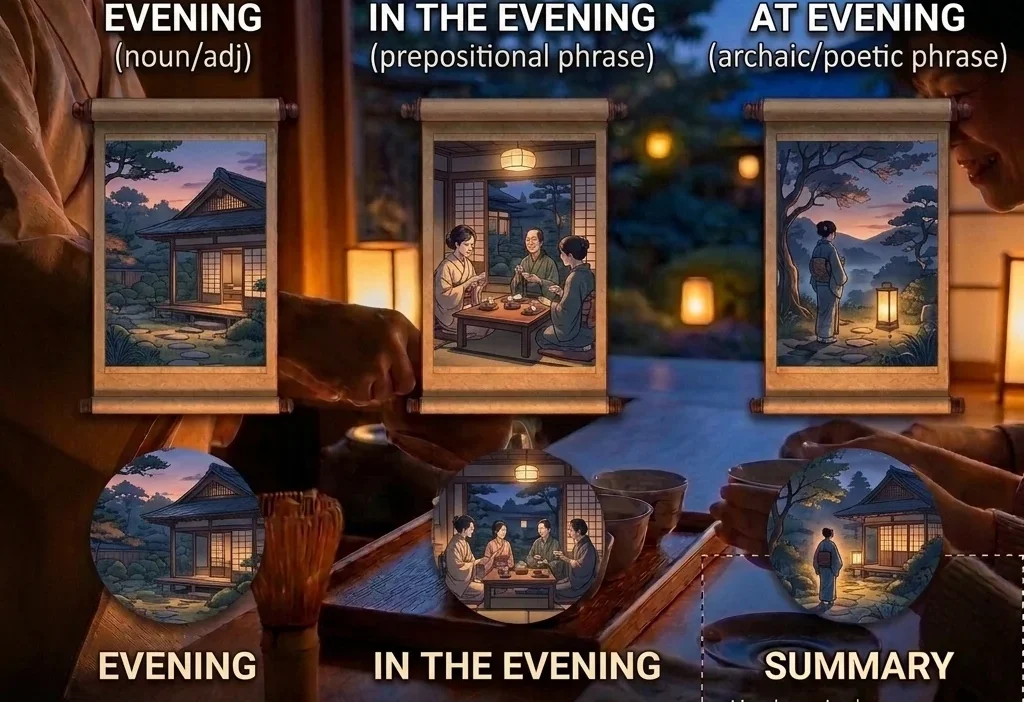
The correct expression in most situations is “in the evening.”
We use in the evening when talking generally about the time of day, for example, “I usually study in the evening.”
On the evening is also correct, but it is normally used when referring to a specific evening, especially with a particular date or event:
“We met on the evening of June 10.” At evening is not normally used in modern standard English.
These expressions can be confusing because English uses different prepositions with different time expressions.
We say in the morning, in the afternoon, and in the evening, but at night. Meanwhile, on is used with specific days and dates, so on the evening of Friday is possible.
Learning the basic pattern makes it much easier to choose the right preposition naturally in everyday conversation, academic writing, and formal English.
Quick Answer
Use in the evening for the evening generally: “I work in the evening.” Use on the evening when referring to a particular evening or event: “On the evening of July 5, we went out.” At evening is generally incorrect in modern standard English. For normal everyday use, choose in the evening.
Why Do People Confuse “In the Evening,” “On the Evening,” and “At Evening”?
The confusion comes from English using several prepositions for time.
Compare:
- in the evening → a general time period
- on the evening of May 12 → a specific evening
- at evening → not normally used
English learners may also notice expressions such as at night, which makes at evening seem logical. However, standard English does not normally use at with evening in this way.
The best choice depends on whether you mean evening as a general period or one particular evening.
First Word: “In the Evening”
In the evening is the standard expression when talking about the evening as a general part of the day.
Use it for:
- routines
- habits
- general times
- activities that regularly happen during the evening
Examples:
- I exercise in the evening.
- She studies in the evening.
- We usually eat dinner in the evening.
- He watches television in the evening.
- They often go for a walk in the evening.
This is the expression you will use most often in everyday English.
“In the evening” with regular activities
When describing a routine, in the evening is especially natural:
I usually read in the evening.
She works in the evening.
We have English classes in the evening.
The phrase does not identify one particular date. It simply describes a general time of day.
Second Word: “On the Evening”
On the evening is correct when evening refers to a particular day or occasion.
It is commonly followed by:
- a date
- a day
- a holiday
- a specific event
- a particular occasion
Examples:
- On the evening of June 10, we had dinner together.
- On the evening of the wedding, it started to rain.
- On the evening of Friday, May 3, the concert took place.
- On the evening before the exam, I studied for several hours.
The word on connects the evening to a particular day or date.
Why is “on” correct here?
English commonly uses on with specific days and dates:
- on Monday
- on Friday evening
- on June 10
- on the evening of June 10
So:
specific day/date + evening → on
Third Word: “At Evening”
At evening is generally not correct in modern standard English.
You may occasionally encounter at evening in older, literary, poetic, or highly unusual writing, but it is not the normal expression for modern everyday English.
Instead, use:
- in the evening
- on the evening of…
- sometimes by evening, depending on the meaning
For example:
❌ I usually study at evening.
✅ I usually study in the evening.
If you are writing for school, work, exams, or general communication, avoid at evening.
In the Evening vs On the Evening vs At Evening
| Expression | Correct? | Main use | Example |
|---|---|---|---|
| in the evening | ✅ Yes | General evening time | I study in the evening. |
| on the evening | ✅ Yes | A specific evening | We met on the evening of June 10. |
| at evening | ❌ Generally no | Not standard modern usage | Use “in the evening” instead. |
When Should You Use Each Expression?
Use “in the evening” for general time
Choose in the evening when you are not talking about one particular evening.
- I go running in the evening.
- She often calls me in the evening.
- We usually eat at home in the evening.
Use “on the evening” for a specific evening
Choose on the evening when the evening is connected to a particular date, day, or event.
- On the evening of April 20, we went to a restaurant.
- On the evening of the festival, thousands of people attended.
- On Friday evening, I stayed at home.
Avoid “at evening”
In ordinary modern English, do not say:
- ❌ at evening
- ❌ I work at evening.
- ❌ We met at evening.
Say:
- ✅ in the evening
- ✅ I work in the evening.
- ✅ We met in the evening.
12 Examples of “In the Evening” and “On the Evening”
- I usually read in the evening.
This describes a regular habit. - She goes to the gym in the evening.
The time is general, not a particular date. - We often have dinner together in the evening.
- He studies English in the evening.
- They usually watch a movie in the evening.
- On the evening of June 15, we attended a concert.
This refers to one specific evening. - On the evening of the wedding, everyone looked excited.
- On Friday evening, I visited my grandparents.
Friday identifies a specific day. - On the evening before the exam, she reviewed her notes.
- On the evening of the festival, the streets were crowded.
- I prefer to exercise in the evening rather than in the morning.
- On the evening of his birthday, his friends surprised him.
Common Mistakes
Mistake 1: “At evening”
❌ I go jogging at evening.
✅ I go jogging in the evening.
Use in, not at, for the general evening period.
Mistake 2: Using “on” for a general routine
❌ I usually study on the evening.
✅ I usually study in the evening.
A routine does not identify one particular evening, so in is appropriate.
Mistake 3: Forgetting “the”
For the general time period, standard English normally says:
✅ in the evening
Not:
❌ in evening
Mistake 4: Using “in” with a specific date
Compare:
❌ In the evening of June 10, we met.
✅ On the evening of June 10, we met.
A specific date calls for on.
Mistake 5: Confusing “evening” and “night”
English commonly uses:
- in the evening
- at night
For example:
I study in the evening, but I usually sleep at night.
The exact boundary between evening and night can vary according to context, location, season, and personal usage, but the preposition patterns remain standard.
A Simple Memory Trick
Remember:
IN = general part of the day
- in the morning
- in the afternoon
- in the evening
ON = specific day/date
- on Monday evening
- on Friday evening
- on the evening of June 10
AT = specific clock time / night
- at 7 p.m.
- at midnight
- at night
So think:
General evening → IN
Specific evening → ON
AT evening → avoid
American vs British English
The basic rule is the same in American and British English.
Both commonly use:
- in the evening for a general time
- on Friday evening for a particular day
- on the evening of June 10 for a specific date
- at night for nighttime
There is no major American-British difference that changes the basic rule.
You may notice differences in how people describe schedules or whether they use evening and night in particular situations, but these differences do not make at evening a standard alternative.
Similar Time Expressions
Understanding in the evening becomes easier when you compare it with related expressions.
In the morning
- I exercise in the morning.
In the afternoon
- We have classes in the afternoon.
In the evening
- I usually relax in the evening.
At night
- I usually sleep at night.
On Friday evening
- We went out on Friday evening.
On the evening of…
- We met on the evening of July 4.
By evening
By evening means no later than or before the evening.
- I will finish the work by evening.
This is different from in the evening:
- I will finish the work in the evening. → The finishing will happen during the evening.
- I will finish the work by evening. → It will be finished no later than evening.
Final Verdict: In the Evening, On the Evening, or At Evening?
For most situations, the answer is in the evening.
Use in the evening when speaking generally:
I usually work in the evening.
Use on the evening when referring to a particular day, date, or occasion:
We met on the evening of June 10.
Avoid at evening in normal modern English.
The easiest rule is:
General time → in the evening
Specific day/date → on the evening
Not normally used → at evening
Frequently Asked Questions
Is it “in the evening” or “at evening”?
The standard expression is in the evening. For example: “I usually study in the evening.” At evening is not normally used in modern standard English.
Is “on the evening” grammatically correct?
Yes. On the evening is correct when referring to a specific evening, especially when it is connected to a particular day, date, or event. For example: “On the evening of May 5, we attended a concert.”
Can I say “on Friday evening”?
Yes. On Friday evening is completely natural and standard. The word on is used because Friday is a specific day.
Should I say “in Friday evening”?
No. Say on Friday evening. For example: “We went shopping on Friday evening.”
Why do we say “in the evening” but “at night”?
These are standard English time expressions. English normally uses in with parts of the day such as morning, afternoon, and evening, while at night is the conventional expression for nighttime.
Is “in the evening” correct for a specific date?
Usually, when a date is explicitly stated, use on: “On the evening of August 12, we went out.” However, in the evening is correct when the date is not the grammatical focus: “I arrived in the evening.”
Is “at evening” ever correct?
It can appear in archaic, poetic, or unusual language, but it is not the normal modern English expression. In everyday, academic, and professional writing, use in the evening or on the evening of… instead.
What is the difference between “in the evening” and “on the evening”?
In the evening refers to the evening generally, while on the evening normally identifies a particular evening. For example, “I exercise in the evening” is general, while “We met on the evening of June 10” is specific.
Remember This
The simplest rule is:
IN THE EVENING → general time
ON THE EVENING → specific evening
AT EVENING → generally incorrect
Examples:
- I study in the evening.
- I study on Friday evening.
- I studied on the evening of Friday, June 10.
- I do not normally say at evening.
Conclusion
The correct choice depends on whether you are talking about the evening generally or identifying a particular evening. In the evening is the normal expression for routines, habits, and general time references. For example, “I usually read in the evening” does not point to one specific date.
On the evening is also correct when the evening is connected to a particular day, date, or event, as in “On the evening of June 10, we attended a concert.” At evening, however, is not normally used in modern standard English. Remembering in = general period and on = specific day or date will help you choose the correct expression naturally.

Liam Henry is a content author at Synonymed, specializing in vocabulary enrichment and synonym guides. He creates clear, engaging resources that help learners improve English word knowledge and language fluency.