If you are learning English, you may wonder whether to say “reside in,” “reside on,” or “reside at.”
All three expressions are grammatically correct, but they are used with different kinds of places.
The choice depends mainly on whether you are talking about a city, country, street, island, building, or specific address.
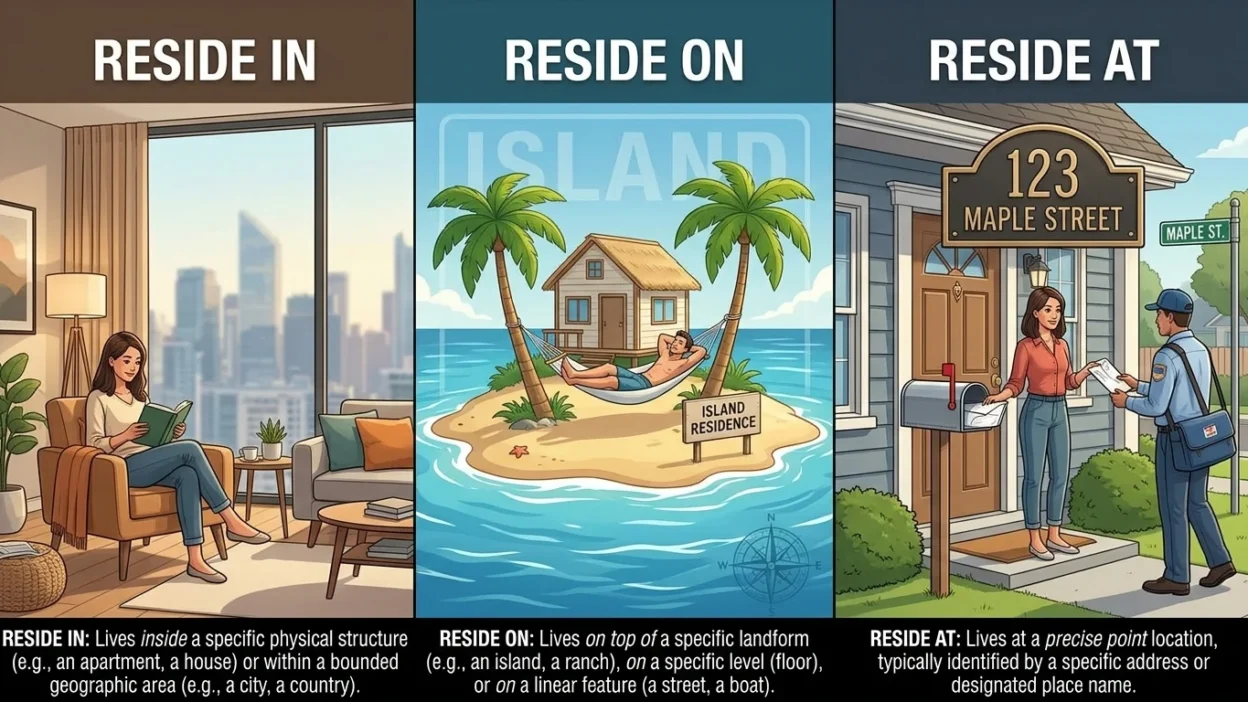
In simple terms, reside in is normally used for larger areas or places viewed as an enclosed location, such as a country, city, neighborhood, apartment, or building.
Reside on is commonly used with streets, roads, avenues, islands, and some other surfaces or geographical locations.
Reside at usually points to a specific place or exact address. Understanding this pattern will help you choose the right preposition naturally and avoid common mistakes.
Quick Answer
Use reside in for cities, countries, neighborhoods, buildings, and enclosed places; reside on for streets, roads, and islands; and reside at for a specific address or precise location. For example: “She resides in London,” “He resides on King Street,” and “They reside at 25 Park Road.”
Why Do People Confuse “Reside In,” “Reside On,” and “Reside At”?
The confusion happens because reside means essentially “live” or “have your home in a particular place,” but English uses different prepositions depending on the type of location.
The same pattern appears with the verb live:
- I live in Canada.
- I live on Oxford Street.
- I live at 15 Oxford Street.
Because reside is more formal than live, learners sometimes assume that it follows different grammar. Usually, it does not.
The main question is:
What kind of location are you describing?
First Word: “Reside In”
Reside in is generally used when someone lives within a larger geographical area or an enclosed place.
Common examples include:
- countries
- cities
- towns
- states and provinces
- regions
- neighborhoods
- villages
- buildings
- apartments
- houses
Examples
- She resides in Pakistan.
- He resides in Karachi.
- They reside in a quiet neighborhood.
- My aunt resides in London.
- The family resides in a large apartment.
- Several students reside in the university dormitory.
Think of in as meaning inside or within an area.
For example:
She resides in Canada.
Canada is a large geographical area, and she lives within its borders.
Similarly:
He resides in the city.
The city is treated as an area in which he lives.
Second Word: “Reside On”
Reside on is commonly used when the location is understood as a street, road, avenue, island, or similar geographical surface/location.
Common examples include:
- streets
- roads
- avenues
- highways
- islands
Examples
- She resides on Main Street.
- He resides on Park Avenue.
- They reside on a small island.
- My grandparents reside on Oak Road.
- Several families reside on the island.
With streets and roads, on is especially common because English traditionally treats a street as a surface or route on which buildings are located.
Compare:
She resides in New York.
She resides on Fifth Avenue.
The first identifies the city; the second identifies the street.
“Reside At”
Reside at is normally used for a specific location, particularly an exact address or a clearly identified place.
Examples include:
- a house number and street
- a specific property
- a particular residence
- a precise location
For example:
He resides at 25 Green Street.
The address identifies one particular place.
You can also use at when the location is treated as a specific point rather than a broad area:
- She resides at the family residence.
- The tenant resides at the property.
- He resides at 14 King Road.
In everyday English, live at is much more common than reside at, but reside at is grammatically correct and often sounds formal or official.
Reside In vs Reside On vs Reside At: Comparison Table
| Expression | Typical use | Example |
|---|---|---|
| reside in | Country, city, town, region, neighborhood, building, apartment | She resides in Toronto. |
| reside on | Street, road, avenue, island | He resides on Baker Street. |
| reside at | Exact address or specific location | She resides at 18 Baker Street. |
A useful way to remember the difference is:
in = area or enclosed place
on = street, road, island, or surface
at = exact point or address
When Should You Use “Reside In”?
Use reside in when the place is a geographical area or an enclosed location.
Use “reside in” with:
- countries: reside in India
- cities: reside in Karachi
- towns: reside in Oxford
- regions: reside in northern England
- states: reside in Texas
- neighborhoods: reside in the city center
- apartments: reside in an apartment
- buildings: reside in the building
- houses: reside in a house
Example
Many international students reside in the city during the academic year.
Here, in is correct because “the city” represents a geographical area.
When Should You Use “Reside On”?
Use reside on when you are referring to a street, road, avenue, or island.
Use “reside on” with:
- Main Street
- King Road
- Park Avenue
- the highway
- an island
Examples
My uncle resides on Main Street.
They reside on a small island near the coast.
She resides on Park Avenue.
Notice the difference:
She resides in Boston.
She resides on Beacon Street.
Both can describe the same person’s home, but they identify different levels of location.
When Should You Use “Reside At”?
Use reside at when you give an exact address or identify one particular location.
Examples
The applicant resides at 42 Queen Street.
He currently resides at the address listed below.
The family resides at 18 Park Road.
At focuses on the specific location rather than the larger area surrounding it.
You can combine the prepositions naturally when giving a complete location:
She resides at 18 King Street in London.
Here:
- at 18 King Street = exact address
- in London = city
15 Examples of “Reside In,” “Reside On,” and “Reside At”
- She resides in Canada.
- He resides in Karachi.
- My brother resides in a small apartment.
- They reside in the northern part of the country.
- Several students reside in the university dormitory.
- She resides on Main Street.
- My grandparents reside on Oak Avenue.
- The family resides on an island.
- He resides on King Road.
- The couple resides at 25 Park Street.
- She resides at the address provided on the form.
- The tenant resides at 14 Green Avenue.
- He resides in New York but works in New Jersey.
- She resides at 10 Baker Street in London.
- They reside on Baker Street in London.
These examples show how the preposition changes according to the location being identified.
Common Mistakes
1. “She resides at London.”
Usually, this is incorrect.
Say:
She resides in London.
London is a city, so in is normally used.
2. “He resides in Main Street.”
Usually, this is incorrect when referring to the street where someone lives.
Say:
He resides on Main Street.
3. “They reside in 25 King Street.”
When 25 King Street is an exact address, at is more appropriate.
Say:
They reside at 25 King Street.
4. Thinking “reside” requires “in”
Although reside in is very common, reside can also take on and at depending on the location.
Correct:
She resides in Paris.
She resides on King Street.
She resides at 12 King Street.
5. Using “at” for every address
English normally distinguishes between the street and the exact address:
He resides on Main Street.
He resides at 100 Main Street.
Both can be correct, but they provide different levels of detail.
Memory Trick: Area, Surface, Point
Remember the simple pattern:
IN = AREA
ON = STREET/SURFACE
AT = POINT
Think of a location as becoming more specific:
in London → on Baker Street → at 25 Baker Street
This gives you a quick mental shortcut:
- IN = inside an area
- ON = on a street, road, or island
- AT = at one specific location
American vs British English
The basic rules for reside in, reside on, and reside at are broadly the same in American and British English.
For example, both varieties commonly use:
She resides in London.
He resides on King Street.
They reside at 20 King Street.
However, reside itself is relatively formal in both varieties. In ordinary conversation, people are much more likely to say live.
For example:
I live in Manchester.
sounds more natural in everyday conversation than:
I reside in Manchester.
Reside is more common in formal documents, legal writing, official forms, academic contexts, and professional descriptions.
Similar Words
Several words are related to reside, but they are not always interchangeable in every situation.
Live
Live is the most common everyday alternative.
I live in Karachi.
She lives on Main Street.
They live at 20 Park Road.
Dwell
Dwell can mean “live,” but it is more formal or literary and is less common in ordinary conversation.
Few people dwell in this remote region.
Stay
Stay often refers to a temporary situation rather than permanent residence.
I am staying in London for two weeks.
This does not necessarily mean London is your permanent home.
Occupy
Occupy means to use or be present in a particular space. It does not always mean “live.”
The family occupies the house.
Therefore, occupy is not a direct everyday replacement for reside.
Final Verdict
The easiest way to distinguish these expressions is to focus on the type of location.
- Reside in → a city, country, region, neighborhood, building, apartment, or other area/enclosed place.
- Reside on → a street, road, avenue, island, or similar location.
- Reside at → a specific address or precise location.
For example:
I reside in London, on Baker Street, at number 25.
This single sentence demonstrates all three patterns.
Remember that reside is formal. In normal conversation, live in, live on, and live at will usually sound more natural.
Frequently Asked Questions
1. Is it correct to say “reside in” a city?
Yes. Reside in is correct for cities.
She resides in Chicago.
2. Should I say “reside on” or “reside in” a street?
Use reside on for a street.
He resides on Oxford Street.
However, reside at is appropriate when you give the exact street address:
He resides at 50 Oxford Street.
3. Is “reside at” grammatically correct?
Yes. Reside at is commonly used with exact addresses or specific locations.
She resides at 15 Park Road.
It is more formal than the everyday expression lives at.
4. Can I say “reside in an apartment”?
Yes.
They reside in an apartment near the university.
An apartment is treated as an enclosed place, so in is appropriate.
5. Can I say “reside on an island”?
Yes.
The family resides on a small island.
English commonly uses on with islands.
6. Is “reside” more formal than “live”?
Yes. Reside is generally more formal and is especially common in official, legal, administrative, and formal written contexts.
7. What is the difference between “reside at” and “reside in”?
Reside in usually identifies a broader area or enclosed place, while reside at usually identifies a specific location or address.
She resides in London.
She resides at 20 King Street.
8. Which is more natural: “reside” or “live”?
In everyday English, live is usually more natural.
I live in Canada.
Reside is useful when a more formal tone is appropriate.
Remember This
Reside in = area or enclosed place
Reside on = street, road, or island
Reside at = exact address or specific point
The quickest example to remember is:
I reside in London, on Baker Street, at 25 Baker Street.
If you understand area → street → exact address, you can usually choose the correct preposition confidently.
Conclusion
The difference between reside in, reside on, and reside at is mainly determined by the type of location. Use in for cities, countries, regions, neighborhoods, and enclosed places; use on for streets, roads, avenues, and islands; and use at for specific addresses or precise locations.
Although reside is grammatically useful and perfectly correct, remember that it sounds more formal than live. In everyday conversation, people normally say “I live in London” rather than “I reside in London.” Knowing both forms helps you communicate naturally while also understanding formal English.