If you have ever wondered if you should say “marinade the chicken” or “marinate the chicken,” you are not alone.
Marinade and marinate are closely related words, but they have different grammatical roles and meanings. One is mainly a noun, while the other is a verb.
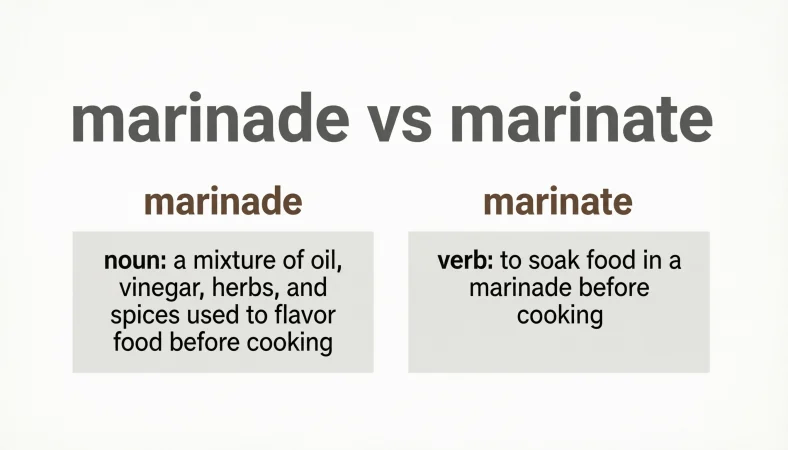
The easiest way to remember the difference is this: a marinade is the mixture used to flavor or tenderize food, while marinate means to soak or leave food in that mixture for a period of time.
Understanding this small difference can help you write recipes correctly, speak more naturally, and avoid a common English mistake.
Quick Answer
Marinade is usually a noun: it is the sauce or mixture in which food is soaked. Marinate is a verb: it means to soak food in a marinade. For example, “Prepare a marinade for the chicken” but “Marinate the chicken for two hours.”
Why Do People Confuse “Marinade” and “Marinate”?
The words are confusing because they are related in meaning and look almost identical. Both are connected with preparing food by soaking it in a flavored liquid or mixture.
The main difference is grammatical:
- Marinade = the mixture
- Marinate = the action
- Marinade is generally a noun
- Marinate is a verb
Think of it this way: You make a marinade, and you marinate food in it.
What Does “Marinade” Mean?
Marinade is a noun. It refers to a seasoned liquid or mixture used to flavor, soften, or prepare food before cooking.
A marinade may contain ingredients such as:
- Oil
- Vinegar or lemon juice
- Soy sauce
- Herbs
- Spices
- Garlic
- Salt
- Yogurt
- Other flavoring ingredients
Examples of “Marinade”
- This marinade has garlic, lemon juice, and olive oil.
- Pour the marinade over the chicken.
- I made a spicy marinade for the beef.
- The fish was covered in a simple herb marinade.
- Save some of the marinade for the recipe if it has not touched raw meat.
In these examples, marinade names a thing—the mixture itself.
What Does “Marinate” Mean?
Marinate is a verb. It means to put food in a marinade and leave it there for a period of time so that it can absorb flavor and, depending on the ingredients, change in texture.
Examples of “Marinate”
- Marinate the chicken for two hours.
- I usually marinate beef overnight.
- She marinated the vegetables before grilling them.
- You can marinate the fish in lemon and herbs.
- The recipe says to marinate the meat before cooking.
Here, marinate describes an action.
Marinade vs. Marinate: Comparison Table
| Word | Part of Speech | Meaning | Example |
|---|---|---|---|
| Marinade | Noun | A seasoned mixture used to soak food | “The marinade contains garlic and lemon.” |
| Marinate | Verb | To soak food in a marinade | “Marinate the chicken for two hours.” |
| Marinated | Adjective/past participle | Describes food that has been soaked in a marinade | “We ate marinated vegetables.” |
| Marinating | Present participle | The process of soaking food in a marinade | “The chicken is marinating.” |
When Should You Use “Marinade” and “Marinate”?
Use marinade when you are talking about the mixture.
The marinade smells delicious.
Use marinate when you are talking about the action of soaking food.
Marinate the chicken overnight.
A useful sentence containing both words is:
Prepare a marinade, then marinate the chicken in it.
This sentence makes the distinction especially clear.
12 Examples of Marinade and Marinate
Here are practical examples showing how the two words work in everyday English:
- The marinade contains olive oil, garlic, and herbs.
- Marinate the chicken for at least one hour.
- I prepared a spicy marinade for the steak.
- The vegetables are marinating in a mixture of lemon juice and spices.
- This marinade gives the meat a rich flavor.
- She marinated the fish before putting it on the grill.
- Add the chicken to the marinade and refrigerate it.
- We marinated the tofu in soy sauce and ginger.
- The recipe uses a simple yogurt marinade.
- You should marinate the beef before grilling it.
- The meat was left in the marinade overnight.
- While the chicken is marinating, prepare the vegetables.
A Simple Pattern to Remember
You can use these sentence patterns:
- make + a marinade
- add food + to the marinade
- marinate + food
- food + is marinating
- marinated + food
For example:
Make a marinade → Put the chicken in it → Marinate the chicken → Cook the marinated chicken.
Common Mistakes With Marinade and Marinate
Mistake 1: Using “marinade” as a verb
Incorrect:
Marinate the chicken in the marinade.
(Not “Marinade the chicken.”)
Correct:
Marinate the chicken in the marinade.
Although you may occasionally encounter marinade used as a verb in informal or specialized usage, marinate is the standard verb for this meaning and is the safest choice for learners.
Mistake 2: Using “marinate” for the mixture
Incorrect:
Add the marinate to the chicken.
Correct:
Add the marinade to the chicken.
The mixture is the marinade.
Mistake 3: Confusing “marinated” with “marinade”
Correct:
We served marinated chicken.
Here, marinated describes the chicken after it has been soaked in a marinade.
Correct:
We prepared a marinade for the chicken.
Here, marinade refers to the mixture.
What Is an Easy Memory Trick?
Remember:
MARINADE = MIXTURE
MARINATE = ACTION
You can also remember the final letters:
- marinade → sounds like a thing
- marinate → ends in -ate, a common verb ending
Another useful sentence is:
A marinade is what you use; marinate is what you do.
American vs. British English: Is There a Difference?
There is essentially no major American-versus-British difference in the basic distinction between these words.
Both American and British English use:
- marinade as a noun for the seasoned mixture
- marinate as a verb for soaking food in that mixture
For example, speakers of both varieties can say:
“Prepare the marinade.”
and:
“Marinate the chicken for two hours.”
Pronunciation can vary slightly between individual speakers or accents, but the grammatical distinction remains the same.
Similar Words You Should Know
Several related forms come from the same word family:
Marinated
Marinated describes food that has been soaked in a marinade.
We ordered marinated chicken.
Marinating
Marinating refers to the ongoing action.
The steak is marinating in the refrigerator.
Marination
Marination is a noun referring to the process of marinating.
The recipe recommends several hours of marination.
However, in everyday English, marinating is often more natural than marination.
Season
To season food means to add salt, herbs, spices, or other ingredients to improve its flavor. Seasoning does not necessarily involve soaking food in a liquid.
Season the vegetables with salt and pepper.
Sauce
A sauce is a liquid or semi-liquid food preparation served with or added to food. A marinade is specifically used to soak food before or during preparation.
Final Verdict
The difference is simple:
Marinade = a mixture.
Marinate = an action.
If you are naming the flavored mixture, use marinade. If you are telling someone to soak food in that mixture, use marinate.
The clearest example is:
Make a marinade and marinate the chicken in it.
Once you remember “marinade is the mixture; marinate is the action,” it becomes much easier to choose the correct word.
Frequently Asked Questions
Is “marinade” a noun or a verb?
Marinade is primarily a noun in standard modern English. It refers to the seasoned mixture used to soak food.
The marinade contains garlic and lemon.
Is “marinate” a noun or a verb?
Marinate is a verb. It means to soak food in a seasoned mixture for a period of time.
Marinate the chicken for two hours.
Is it correct to say “marinade the chicken”?
For standard English, marinate the chicken is the preferred form when you mean “soak the chicken in a marinade.”
Correct: Marinate the chicken overnight.
Can “marinade” and “marinate” be used in the same sentence?
Yes. In fact, using them together is a useful way to understand the difference.
Prepare a marinade and marinate the chicken in it.
What is the difference between “marinated” and “marinade”?
Marinated describes food that has been soaked in a marinade. Marinade is the mixture itself.
The marinade is ready.
The marinated chicken is ready.
What is the verb form of “marinade”?
The standard verb is marinate.
Marinate the vegetables before grilling them.
Is “marinating” correct English?
Yes. Marinating is the present participle or gerund form of marinate.
The beef is marinating in the refrigerator.
What is the difference between marinating and seasoning?
Marinating involves soaking food in a marinade for a period of time. Seasoning generally means adding ingredients such as salt, pepper, herbs, or spices to give food flavor. Seasoning does not necessarily involve soaking.
Remember This
Marinade = the mixture.
Marinate = the action.
You make a marinade. You marinate the food.
That one sentence is enough to remember the basic difference.
Conclusion
“Marinade” and “marinate” are easy to confuse because they come from the same word family and are closely connected with food preparation.
When you are writing or speaking, ask yourself one simple question: Am I talking about the mixture or the action?
With that distinction in mind, sentences such as “Prepare a marinade” and “Marinate the chicken” become easy to use correctly.