
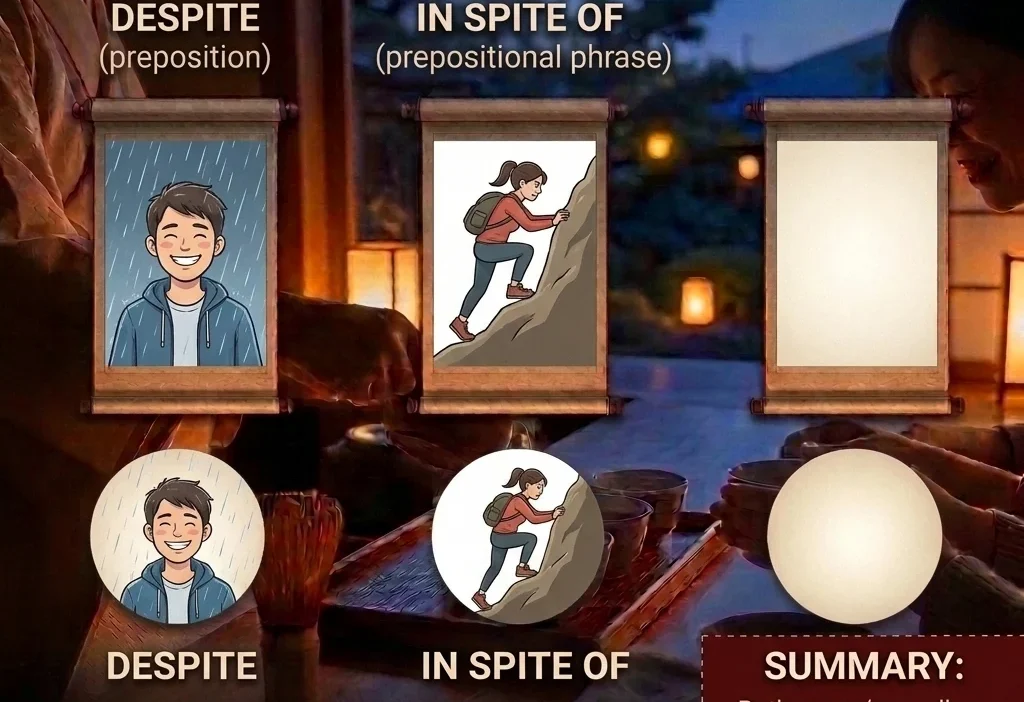
Despite and in spite of have the same basic meaning: they show a contrast between two situations.
Both can mean “even though something happened” or “although something was true.”
For example, “Despite the rain, we went outside” and “In spite of the rain, we went outside” mean essentially the same thing.
The main difference is grammatical form and style, not meaning. Despite is a single preposition, while in spite of is a three-word prepositional phrase.
Both are followed by a noun, pronoun, or verb ending in -ing, rather than a complete clause directly.
They are extremely useful for connecting contrasting ideas and are common in both spoken and written English.
Learning a few simple patterns will help you use both expressions naturally and avoid common mistakes.
The choice between despite and in spite of usually depends on personal preference, sentence structure, and style.
Despite is shorter and often sounds slightly more concise or formal, while in spite of can sound more conversational or emphatic.
Neither expression is inherently more correct than the other.
However, the grammar after them is important.
\You can say “despite the difficulty” or “in spite of the difficulty,” but you cannot normally say “despite it was difficult.”
Instead, use “despite the fact that it was difficult.”
This article explains the difference, shows the correct structures, and provides practical examples so you can confidently choose the right expression.
Quick Answer
Despite and in spite of have almost exactly the same meaning: they introduce a contrast. Both are followed by a noun, pronoun, or -ing form. Use despite the rain or in spite of the rain. Before a full clause, use despite the fact that or in spite of the fact that.
Why People Confuse It
People often wonder whether despite and in spite of have different meanings because they look completely different.
In reality, they normally express the same relationship:
Something happens despite a difficulty.
Something happens in spite of a difficulty.
Both mean that the second situation happens even though the first situation might have prevented it.
For example:
Despite the cold, we went swimming.
In spite of the cold, we went swimming.
Both sentences mean that the cold weather did not stop us from swimming.
The biggest challenge is usually not meaning but grammar.
First Word: Despite
Despite is a preposition. It introduces something that contrasts with the main idea of the sentence.
The basic structure is:
despite + noun
Examples:
- despite the rain
- despite the problem
- despite his age
- despite the difficulties
- despite the warning
You can also use:
despite + pronoun
Despite this, she continued working.
And:
despite + verb-ing
Despite feeling tired, he finished the assignment.
Despite with a full clause
You cannot normally put a complete clause directly after despite.
Incorrect:
Despite he was tired, he continued working.
Correct:
Despite being tired, he continued working.
Or:
Despite the fact that he was tired, he continued working.
The expression despite the fact that allows a complete clause to follow.
Second Word: In Spite of
In spite of is a prepositional phrase with the same basic meaning as despite.
The standard structure is:
in spite of + noun
Examples:
- in spite of the rain
- in spite of the difficulty
- in spite of her illness
- in spite of the traffic
- in spite of the warning
You can also use:
in spite of + pronoun
In spite of this, they continued.
And:
in spite of + verb-ing
In spite of having little experience, she got the job.
In spite of with a full clause
Like despite, in spite of cannot normally be followed directly by a complete clause.
Incorrect:
In spite of he was tired, he kept working.
Correct:
In spite of being tired, he kept working.
Or:
In spite of the fact that he was tired, he kept working.
Despite vs In Spite of: Comparison Table
| Feature | Despite | In spite of |
|---|---|---|
| Meaning | Although something happened or was true | Although something happened or was true |
| Grammar | Preposition | Prepositional phrase |
| Followed by noun | Yes | Yes |
| Followed by pronoun | Yes | Yes |
| Followed by -ing | Yes | Yes |
| Followed directly by a full clause | No | No |
| Full clause option | despite the fact that | in spite of the fact that |
| Example | Despite the rain, we left. | In spite of the rain, we left. |
| Style | Concise and widely used | Slightly longer and often conversational |
When to Use Each
Use “despite” before a noun
Despite the heavy traffic, we arrived on time.
This is one of the most common structures.
Use “in spite of” before a noun
In spite of the heavy traffic, we arrived on time.
This is equally grammatical.
Use “despite” before an -ing form
Despite working hard, she failed the exam.
Use “in spite of” before an -ing form
In spite of working hard, she failed the exam.
Again, both sentences have the same basic meaning.
Use “despite the fact that” before a full clause
Despite the fact that he was tired, he continued working.
Use “in spite of the fact that” before a full clause
In spite of the fact that he was tired, he continued working.
These longer constructions are useful when you need a complete subject-and-verb clause.
14 Examples of Despite and In Spite of
- Despite the rain, we went for a walk.
- In spite of the rain, we went for a walk.
- She passed the exam despite being nervous.
- He continued playing in spite of his injury.
- Despite the traffic, we arrived early.
- In spite of having little money, they enjoyed their trip.
- She smiled despite feeling tired.
- He accepted the job in spite of the low salary.
- Despite the warning, they entered the building.
- In spite of the difficulties, the team completed the project.
- Despite the fact that it was late, they continued talking.
- In spite of the fact that she disagreed, she supported the decision.
- He remained calm despite the pressure.
- They won the match in spite of several injuries.
These examples show that the expressions can usually replace each other without changing the central meaning.
Common Mistakes
Mistake 1: Using “despite of”
A very common error is:
Despite of the rain, we went outside.
This is incorrect.
Use either:
Despite the rain, we went outside.
Or:
In spite of the rain, we went outside.
Remember: despite does not need of.
Mistake 2: Putting a full clause directly after “despite”
Incorrect:
Despite it was raining, we went outside.
Correct:
Despite the rain, we went outside.
Or:
Despite the fact that it was raining, we went outside.
Mistake 3: Putting a full clause directly after “in spite of”
Incorrect:
In spite of she was tired, she continued working.
Correct:
In spite of being tired, she continued working.
Or:
In spite of the fact that she was tired, she continued working.
Mistake 4: Confusing “despite” with “although”
Although is a conjunction, so it can be followed directly by a clause.
Although it was raining, we went outside.
But despite normally needs a noun, pronoun, or -ing form.
Despite the rain, we went outside.
This distinction is important for English learners.
Mistake 5: Using “despite of” because “in spite of” has “of”
The words look related, but their grammatical patterns are different:
- despite + noun
- in spite of + noun
Not:
- ❌ despite of + noun
- ❌ despite + full clause
Memory Trick
Use this simple rule:
Despite = no “of.”
In spite of = always “of.”
Think of these two patterns:
Despite the rain
In spite of the rain
If you remember “despite has no of,” you can avoid one of the most common mistakes.
Another useful trick is:
Although + clause
Despite/In spite of + noun or -ing
For example:
Although it was raining, we left.
Despite the rain, we left.
In spite of the rain, we left.
American vs British English
Despite and in spite of are standard in both American and British English. Their meanings and basic grammatical rules are the same.
Both forms are widely understood and accepted.
You may notice that despite often feels shorter and more direct:
Despite the problem, we continued.
In spite of can sound slightly more conversational:
In spite of the problem, we continued.
However, this is a tendency rather than a strict rule. Neither expression is incorrect or limited to one variety of English.
Similar Words
Several other expressions can introduce a contrast.
Although
Although means roughly the same thing, but it is followed by a clause.
Although he was tired, he continued working.
Compare:
Despite being tired, he continued working.
Even though
Even though also introduces a complete clause and often gives stronger emphasis.
Even though it was raining, they went outside.
Though
Though can work similarly to although, especially in informal English.
Though she was tired, she kept working.
Nevertheless
Nevertheless means “despite that” or “however,” but its grammatical use is different.
It was raining. Nevertheless, we went outside.
You cannot simply replace despite with nevertheless in the same sentence structure.
Regardless of
Regardless of means that something does not affect the decision or result.
We will continue regardless of the difficulties.
It is similar to despite, but the emphasis can be slightly different.
Final Verdict
Despite and in spite of have essentially the same meaning. Both express a contrast and can be followed by a noun, pronoun, or -ing form.
The main grammatical difference is simple: despite does not take of, while in spite of always includes of.
Use:
- despite + noun
- despite + -ing
- despite the fact that + clause
- in spite of + noun
- in spite of + -ing
- in spite of the fact that + clause
For most sentences, you can choose either form based on style and preference.
Frequently Asked Questions
Is “despite” the same as “in spite of”?
Yes. Despite and in spite of generally have the same meaning. Both introduce a contrasting fact or condition.
Which is correct: “despite” or “in spite of”?
Both are correct. The choice usually depends on style and sentence structure. For example, both “despite the rain” and “in spite of the rain” are correct.
Can I say “despite of”?
No. Despite of is incorrect in standard English.
Say:
Despite the rain.
Or:
In spite of the rain.
Can “despite” be followed by a verb?
Yes, if the verb is in the -ing form.
Despite feeling tired, she continued working.
A complete clause cannot normally follow despite directly.
What is the difference between “despite” and “although”?
Although is followed by a clause, while despite is normally followed by a noun, pronoun, or -ing form.
Although he was tired, he worked.
Despite being tired, he worked.
Can “in spite of” be followed by a sentence?
Not directly. Use a noun, pronoun, or -ing form. To introduce a complete clause, use in spite of the fact that.
In spite of the fact that he was tired, he worked.
Is “despite the fact that” correct?
Yes. Despite the fact that is a standard construction used when a complete clause follows.
Despite the fact that it was expensive, she bought it.
Is “in spite of” more informal than “despite”?
Not necessarily. Both are standard English. In spite of is longer and can sound more conversational in some contexts, while despite is more concise. The difference is not a strict formality rule.
Remember This
The easiest rule is:
Despite + noun/-ing
In spite of + noun/-ing
For a complete clause:
Despite the fact that + clause
In spite of the fact that + clause
And remember:
Never say “despite of.”
Conclusion
Despite and in spite of are two standard ways to express contrast. They usually mean the same thing and can often be used interchangeably. The key difference is their grammatical form: despite is followed directly by a noun, pronoun, or -ing form, while in spite of uses the same structures with of included.
The most important rule for learners is to avoid “despite of.” Use “despite the problem” or “in spite of the problem.” If you need to introduce a complete clause, choose “despite the fact that” or “in spite of the fact that.” Once these patterns become familiar, choosing between the two expressions becomes easy and natural.

Liam Henry is a content author at Synonymed, specializing in vocabulary enrichment and synonym guides. He creates clear, engaging resources that help learners improve English word knowledge and language fluency.