If you are confused about beside vs. besides, you are not alone.
These two words look and sound almost identical, but they usually have different meanings and grammatical uses.
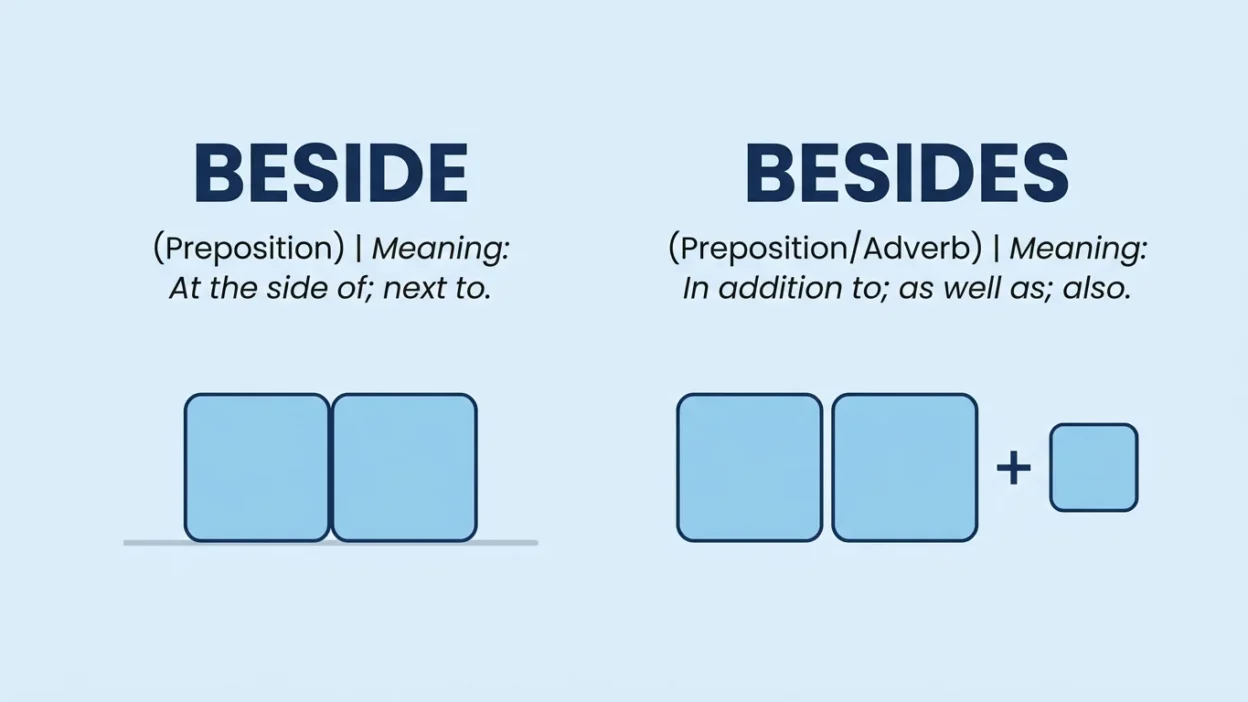
Beside generally means “next to” or “by the side of,” while besides usually means “in addition to” or “apart from.” Choosing the right word depends on what you want to say.
For example, “She sat beside me” means she sat next to me.
However, “Besides English, he speaks Spanish” means he speaks Spanish in addition to English.
Understanding this small difference can make your English clearer and more natural.
This guide explains the meanings, grammar, examples, common mistakes, and practical differences between beside and besides so that you can use both confidently.
Quick Answer
Beside usually means next to, near, or at the side of something or someone. Besides usually means in addition to, as well as, or apart from. Compare: “The lamp is beside the bed” and “Besides English, she studies French.” A simple memory trick is: beside = next to; besides = extra or in addition.
Why Do People Confuse Beside and Besides?
People often confuse these words because beside and besides differ by only one letter. They also have similar pronunciations and both can function as prepositions.
The important difference is meaning:
- Beside → describes location or position.
- Besides → describes addition or exclusion, depending on context.
Compare these sentences:
- The car is parked beside the house. → location
- Besides the car, we have a bicycle. → addition
The extra s in besides can be a useful reminder that something extra is being added.
Beside: Meaning and Use
Beside is mainly a preposition meaning next to, by, or at the side of.
It tells us where a person or thing is located in relation to another person or thing.
Examples of Beside
- She sat beside her mother.
- The pharmacy is beside the bank.
- Put the chair beside the table.
- He stood beside the door.
- A small river runs beside the road.
In each sentence, beside describes a physical position.
Beside Can Also Mean “Next to”
When you can replace beside with next to without changing the basic meaning, beside is usually the correct choice.
The dog is beside the sofa.
This means:
The dog is next to the sofa.
Besides: Meaning and Use
Besides has two common uses.
First, it can mean in addition to or as well as.
- Besides English, she speaks Arabic.
- Besides John, three other students attended.
- What other subjects do you study besides mathematics?
Second, besides can function as an adverb meaning in addition or moreover.
- I don’t want to go. Besides, it’s raining.
- We have enough food. Besides, the restaurant is nearby.
So, besides is commonly connected with the idea of adding information or something extra.
Beside vs. Besides: Comparison Table
| Word | Main meaning | Common grammatical role | Example |
|---|---|---|---|
| beside | next to; by the side of | Preposition | She sat beside me. |
| besides | in addition to; apart from | Preposition/adverb | Besides English, he speaks French. |
| beside | physical position | Usually location | The keys are beside the phone. |
| besides | additional information or thing | Addition | Besides, we have another option. |
When Should You Use Beside or Besides?
Use beside when you are talking about position or location.
Pattern:
beside + person/place/thing
Examples:
- beside the bed
- beside my friend
- beside the road
- beside the window
Use besides when you mean in addition to or apart from.
Pattern:
besides + person/thing/activity
Examples:
- besides English
- besides coffee
- besides your parents
- besides studying
Use besides as an adverb when you want to add another reason, fact, or point.
- I don’t need a taxi. Besides, the station is close.
12 Examples of Beside vs. Besides
- The cat is sleeping beside the sofa.
- Besides tea, would you like some coffee?
- She stood beside her brother.
- Besides Sarah, everyone arrived on time.
- There is a parking lot beside the hotel.
- What do you do besides studying?
- He placed his phone beside the computer.
- Besides being inexpensive, the restaurant is convenient.
- The child sat beside his father.
- Besides English, Maria is learning German.
- I don’t want to leave now. Besides, it’s getting dark.
- A tall tree stands beside the house.
A Useful Pair to Compare
- She sat beside me. → She sat next to me.
- Besides me, Tom was there. → In addition to me, Tom was there.
The first sentence describes where she sat. The second tells us who else was there.
Common Mistakes With Beside and Besides
Mistake 1: Using “besides” for physical location
Incorrect:
The chair is besides the table.
Correct:
The chair is beside the table.
The intended meaning is “next to,” so use beside.
Mistake 2: Using “beside” when you mean “in addition to”
Incorrect:
Beside English, I speak French.
Correct:
Besides English, I speak French.
Here, French is an additional language, so besides is appropriate.
Mistake 3: Forgetting the adverbial use of “besides”
Besides can introduce an additional point:
I don’t want to buy it. Besides, it’s too expensive.
Here, besides does not mean “next to.” It means something like “also” or “in addition.”
Mistake 4: Assuming the extra “s” is optional
The words are not interchangeable simply because they look similar.
- beside = next to
- besides = in addition to / apart from
Memory Trick: “Beside = Side”
Think of the word side inside beside.
Beside → by the side → next to
Think of the extra s in besides as adding something extra.
Besides → extra information or an additional thing
For example:
The book is beside the lamp.
Besides the book, there is a magazine.
American vs. British English
The distinction between beside and besides is generally the same in American and British English.
In both varieties:
- beside commonly means “next to.”
- besides commonly means “in addition to” or “apart from.”
Both words are standard English and can be used in formal and informal contexts. The difference is mainly about meaning and grammatical function, not nationality.
Similar Words
Several words can have meanings related to beside or besides, but they are not always interchangeable.
Next to
Next to is very close in meaning to beside.
The school is next to the library.
The school is beside the library.
Near
Near means close to, but it does not necessarily mean immediately adjacent.
Our house is near the park.
In addition to
In addition to is often a more formal alternative to besides.
In addition to English, she speaks French.
Apart from
Apart from can sometimes mean “besides” or “excluding,” depending on context.
Apart from John, everyone agreed.
Because apart from can have more than one interpretation, context matters.
Final Verdict
The easiest way to distinguish beside and besides is to focus on their core meanings.
Beside = next to or at the side of something.
Besides = in addition to, apart from, or additionally.
If you are describing where someone or something is, choose beside. If you are adding another person, thing, fact, or reason, choose besides.
Frequently Asked Questions
Is “beside” the same as “next to”?
Yes. Beside commonly means next to or at the side of something or someone.
The lamp is beside the bed.
This means the lamp is next to the bed.
Is “besides” the same as “in addition to”?
Often, yes. Besides can mean in addition to or as well as.
Besides English, he speaks Spanish.
This means he speaks Spanish in addition to English.
Should I say “beside me” or “besides me”?
It depends on the meaning.
- Beside me = next to me.
- Besides me = in addition to me / apart from me.
She sat beside me.
Besides me, three people attended.
Can “besides” start a sentence?
Yes. Besides can be used at the beginning of a sentence as an adverb meaning “in addition” or “moreover.”
Besides, we don’t have enough time.
Is “beside” a preposition?
Yes. Beside is commonly used as a preposition to show the position of one person or thing in relation to another.
He stood beside the door.
Is “besides” a preposition or an adverb?
It can be either. As a preposition, it can mean “in addition to.” As an adverb, it can mean “in addition” or “moreover.”
Besides English, she studies French.
Besides, she studies mathematics.
What is the easiest way to remember beside and besides?
Remember:
Beside = side = next to.
Besides = extra = in addition.
This simple association works for many everyday examples.
Remember This
Beside → next to
The bag is beside the chair.
Besides → in addition to / additionally
Besides the bag, I bought a wallet.
When in doubt, ask yourself: Am I talking about position, or am I adding something?
- Position → beside
- Addition → besides
Conclusion
Although beside and besides differ by only one letter, their meanings are different. Beside is mainly used for physical position and means “next to” or “by the side of.” Besides is used when adding something or introducing another point and commonly means “in addition to,” “as well as,” or “moreover.”
The quickest way to remember the difference is to connect beside with side and besides with something extra. With a little practice, sentences such as “She sat beside me” and “Besides English, she speaks French” become easy to distinguish.