The word some is one of the most common words in English.
We use it to talk about an unspecified amount, number, or group of people or things.
For example, we might say, “I need some help” or “Some students prefer online classes.”
Because some is so common, writers and English learners may want alternatives that express a more specific meaning.
Learning some synonyms can make your writing clearer, more natural, and less repetitive.
However, not every alternative has exactly the same meaning, so context is important.
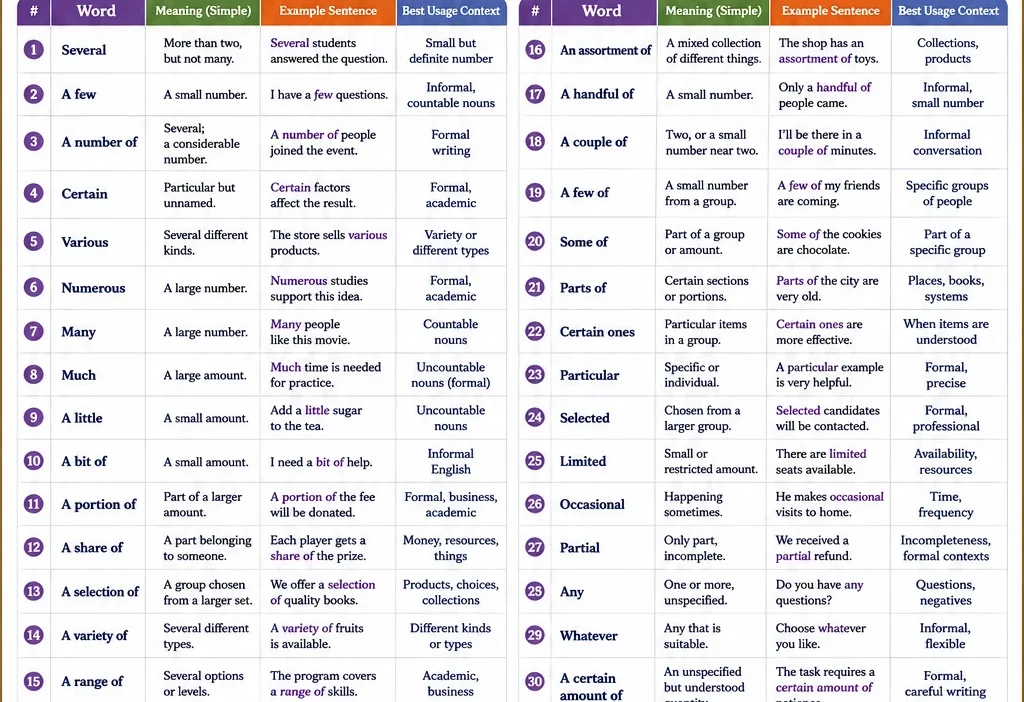
This guide explores 30 useful words and phrases related to some, including their simple meanings, example sentences, and best usage contexts.
It is designed for students, ESL learners, writers, bloggers, and content creators who want to choose words more accurately.
What Does “Some” Mean?
Simple definition
Some usually means an unspecified amount or number of something. We use it when we know there is more than zero, but we do not say exactly how much or how many.
Examples:
I bought some apples.
She needs some advice.
Some people enjoy working at night.
The exact meaning changes slightly depending on the sentence.
“Some” for an amount
When used with an uncountable noun, some refers to an unspecified quantity.
Could I have some water?
Here, we know the person wants water, but the exact amount is not given.
“Some” for a number
With plural countable nouns, some refers to an unspecified number.
Some students stayed after class.
The sentence tells us that a number of students stayed, but it does not tell us exactly how many.
“Some” with a positive or informal tone
In certain sentences, some can also emphasize that something is impressive or notable.
That was some performance!
Here, some does not simply mean an unspecified amount. It expresses admiration or emphasis.
30 Some Synonyms and Related Alternatives
1. Several
Meaning: More than two but not many.
Example sentence:
Several students volunteered for the project.
Best usage context: Use it when you mean a small but definite number.
2. A few
Meaning: A small number of people or things.
Example sentence:
I have a few questions about the assignment.
Best usage context: Informal and friendly situations involving countable nouns.
3. A number of
Meaning: Several or a considerable number of people or things.
Example sentence:
A number of employees attended the meeting.
Best usage context: Formal and academic writing.
4. Certain
Meaning: Particular people or things that are not specifically named.
Example sentence:
Certain factors can affect the final result.
Best usage context: Formal writing when referring to specific but unnamed examples.
5. Various
Meaning: Several different kinds or examples.
Example sentence:
The website provides various resources for learners.
Best usage context: Useful when emphasizing variety or different types.
6. Numerous
Meaning: A large number of people or things.
Example sentence:
Numerous studies have examined this issue.
Best usage context: Formal or academic writing when the number is relatively large.
7. Many
Meaning: A large number of people or things.
Example sentence:
Many students use online resources to study.
Best usage context: Countable plural nouns when you want to suggest a substantial number.
8. Much
Meaning: A large amount of something.
Example sentence:
The project requires much attention to detail.
Best usage context: Formal writing with uncountable nouns. In everyday English, “a lot of” is often more natural.
9. A little
Meaning: A small amount.
Example sentence:
Add a little salt to the soup.
Best usage context: Uncountable nouns when referring to a small quantity.
10. A bit of
Meaning: A small amount of something.
Example sentence:
I need a bit of time to finish the report.
Best usage context: Informal, conversational English.
11. A portion of
Meaning: Part of a larger amount.
Example sentence:
A portion of the profits will support local charities.
Best usage context: Formal, business, financial, or academic writing.
12. A share of
Meaning: A part or amount belonging to someone or something.
Example sentence:
Each employee received a share of the annual bonus.
Best usage context: Money, resources, responsibilities, or things divided among people.
13. A selection of
Meaning: A group chosen from a larger collection.
Example sentence:
The library offers a selection of useful language-learning books.
Best usage context: Products, books, resources, choices, or collections.
14. A variety of
Meaning: Several different types or kinds.
Example sentence:
The restaurant serves a variety of international dishes.
Best usage context: When you want to highlight differences or diversity.
15. A range of
Meaning: Several different options, types, or levels.
Example sentence:
The course covers a range of writing skills.
Best usage context: Professional, academic, educational, and business writing.
16. An assortment of
Meaning: A mixed collection of different things.
Example sentence:
The shop sells an assortment of handmade gifts.
Best usage context: Collections of different objects, especially in descriptive or commercial writing.
17. A handful of
Meaning: A small number.
Example sentence:
Only a handful of students completed the optional exercise.
Best usage context: Informal writing when emphasizing that the number is small.
18. A couple of
Meaning: Two, or sometimes a small number close to two.
Example sentence:
I’ll be there in a couple of minutes.
Best usage context: Informal conversation. In careful writing, use “two” when the exact number matters.
19. A few of
Meaning: A small number from a particular group.
Example sentence:
A few of the students asked for extra practice.
Best usage context: Specific groups of people or things.
20. Some of
Meaning: Part of a particular group or amount.
Example sentence:
Some of the information was difficult to understand.
Best usage context: When referring to a specific group or previously mentioned amount.
21. Parts of
Meaning: Certain sections or portions of something.
Example sentence:
Parts of the book are especially useful for beginners.
Best usage context: Books, documents, places, systems, and larger subjects.
22. Certain ones
Meaning: Particular people or things within a larger group.
Example sentence:
Certain ones are more suitable for advanced learners.
Best usage context: When the specific items are understood from the surrounding context.
23. Particular
Meaning: Specific or individual rather than general.
Example sentence:
A particular section of the report needs revision.
Best usage context: Formal and precise writing when focusing on one specific example.
24. Selected
Meaning: Chosen from a larger group.
Example sentence:
Selected students were invited to join the competition.
Best usage context: Formal announcements, research, education, and professional writing.
25. Limited
Meaning: Small in amount or availability.
Example sentence:
Only a limited number of places are available.
Best usage context: When emphasizing that an amount or number is restricted.
26. Occasional
Meaning: Happening sometimes but not regularly.
Example sentence:
She makes occasional visits to the library.
Best usage context: Time, events, visits, or actions that happen from time to time.
27. Partial
Meaning: Only part of something, not complete.
Example sentence:
The company offered a partial refund.
Best usage context: Money, information, results, completion, or other things that can be whole or incomplete.
28. Any
Meaning: One or more, without specifying which; often used in questions and negative statements.
Example sentence:
Do you have any questions?
Best usage context: Questions, negatives, and situations where the exact choice does not matter.
29. Whatever
Meaning: Any thing or things that are appropriate or available.
Example sentence:
Choose whatever option works best for you.
Best usage context: Informal or flexible situations where the specific choice is unimportant.
30. A certain amount of
Meaning: An unspecified but understood quantity.
Example sentence:
The task requires a certain amount of patience.
Best usage context: Formal or careful writing when discussing an unmeasured quantity.
Comparison Guide: When Should You Use Different Some Synonyms?
The best alternative depends on what you want to communicate.
| Word or phrase | Main meaning | Best context |
|---|---|---|
| Some | Unspecified amount or number | General English |
| Several | More than two, but not many | Countable nouns |
| A few | Small number | Everyday English |
| A number of | Several | Formal writing |
| Certain | Particular but unnamed | Academic/formal writing |
| Various | Different types | Variety and diversity |
| Numerous | Large number | Academic/formal writing |
| Many | Large number | Countable nouns |
| A little | Small amount | Uncountable nouns |
| A bit of | Small amount | Informal English |
| A portion of | Part of a whole | Formal writing |
| A selection of | Chosen group | Products/resources |
| A variety of | Different kinds | General/formal writing |
| A range of | Several options or levels | Academic/business writing |
| A handful of | Very small number | Informal English |
| A couple of | Around two | Informal English |
| Selected | Specifically chosen | Formal/professional contexts |
| Limited | Restricted amount | Availability/resources |
| Occasional | Happening sometimes | Time/frequency |
| Partial | Incomplete or only part | Formal/technical contexts |
| Any | One or more, unspecified | Questions/negatives |
How to Choose the Right Synonym
For a small number
Use a few, several, a handful of, or a couple of.
These options are useful when you want to make the number sound smaller than “many.”
Example:
A few students stayed after class.
If you want to suggest an even smaller group:
A handful of students stayed after class.
For a large number
Use many, numerous, or a number of.
Many is common and natural.
Numerous sounds more formal and often appears in academic writing.
Example:
Numerous researchers have studied the subject.
For different types
Use various, a variety of, a range of, or an assortment of.
These words are better than some when the important idea is not simply quantity but difference.
Example:
The course provides a variety of learning activities.
For a specific but unnamed group
Use certain, selected, particular, or certain ones.
These choices are useful when you have specific people or things in mind but do not identify them.
Example:
Certain students may need additional support.
For a small amount
Use a little, a bit of, or a portion of, depending on the context.
Example:
We still have a little time.
For a more formal sentence:
A portion of the budget was allocated to training.
For formal and academic writing
Choose a number of, numerous, various, a range of, a portion of, selected, or certain.
These alternatives can make formal writing more precise without making it unnecessarily complicated.
For casual conversation
Choose a few, a couple of, a bit of, or simply some.
These expressions sound natural in everyday English.
Example:
I need a couple of minutes.
Could you give me a bit of help?
Some vs. Several
What is the difference?
Some gives no clear idea about the number.
Some people attended the event.
Several suggests more than two but usually not a very large number.
Several people attended the event.
If you want to emphasize that there were a small number of people, several is more informative.
Some vs. A Few
What is the difference?
Some is broad and does not tell us whether the number is small or large.
A few specifically suggests a small number.
Compare:
Some students completed the assignment.
A few students completed the assignment.
The second sentence suggests that only a small number completed it.
Some vs. Various
What is the difference?
Some focuses on an unspecified amount or number.
Various focuses on different types or kinds.
Compare:
We discussed some topics.
We discussed various topics.
The second sentence emphasizes that the topics were different from one another.
Some vs. Numerous
What is the difference?
Some is neutral about quantity.
Numerous tells the reader that there are many.
Compare:
Some studies support this idea.
Numerous studies support this idea.
The second sentence communicates a much stronger sense of quantity.
Common Mistakes With Some Synonyms
Using “several” when the number is huge
Several normally suggests a relatively small number. If you mean a very large number, many or numerous is usually better.
Using “much” with countable nouns
Do not normally say:
much students
Use:
many students
Much is generally used with uncountable nouns:
much information
much time
Using “many” with uncountable nouns
Avoid:
many information
Instead, say:
much information
or, more naturally in everyday English:
a lot of information
Treating “a few” and “few” as identical
There is an important difference.
A few means a small number, but usually suggests that the number is enough for the situation.
I have a few friends in the city.
Few can suggest an insufficient or surprisingly small number.
Few students understood the difficult question.
This distinction is especially important for ESL learners.
Why Learning Some Synonyms Matters
It makes your writing more precise
Instead of repeatedly writing some, you can communicate whether the quantity is small, large, varied, selected, or restricted.
It helps avoid repetition
Repeating the same word too often can make writing sound flat. Carefully chosen alternatives can make your sentences more varied.
It improves academic writing
Academic writers often need to communicate quantity and uncertainty carefully. Words such as numerous, several, various, certain, and a range of can help.
It improves everyday English
Understanding phrases such as a few, a couple of, and a bit of makes conversational English easier to understand and use naturally.
Quick Reference for Writers and ESL Learners
Use this simple guide when you need an alternative to some:
- Unspecified amount: some
- Small number: a few
- More than two: several
- Large number: many
- Very large/formal quantity: numerous
- Different types: various
- Several different options: a range of
- Different kinds: a variety of
- Small amount: a little
- Small informal amount: a bit of
- Small group: a handful of
- About two: a couple of
- Specific but unnamed: certain
- Chosen group: selected
- Restricted quantity: limited
- Part of a whole: a portion of
- Part of a specific group: some of
- Incomplete amount: partial
- Happening from time to time: occasional
- Unspecified choice: any
Frequently Asked Questions About Some Synonyms
What is the best synonym for “some”?
There is no single best synonym. Several, a few, various, certain, many, and a little can all replace some in particular contexts, but their meanings are different.
What is a formal synonym for “some”?
Depending on the sentence, certain, various, numerous, selected, a number of, or a range of can provide a more formal alternative.
What is an informal synonym for “some”?
A few, a couple of, and a bit of are common informal alternatives when they match the intended meaning.
Is “several” the same as “some”?
Not exactly. Some is less specific about quantity, while several generally suggests more than two but not a large number.
What can I use instead of “some” in academic writing?
Consider a number of, numerous, various, certain, selected, or a range of, depending on what you mean.
What is the difference between “some” and “a few”?
Some can describe an unspecified number, while a few specifically indicates a small number.
Conclusion
Learning some synonyms is a simple way to make English more precise and natural. The key is not to replace some automatically, but to choose an alternative that communicates the exact idea you want.
Use a few or several for small numbers, many or numerous for larger numbers, and various or a variety of when you want to emphasize differences. For formal writing, expressions such as a number of, certain, selected, and a range of can provide greater precision.
For ESL learners, students, writers, and content creators, the most useful lesson is simple: learn the meaning behind each synonym, not just the synonym itself. When you understand quantity, tone, formality, and context, you can choose better words and communicate your ideas with greater confidence.