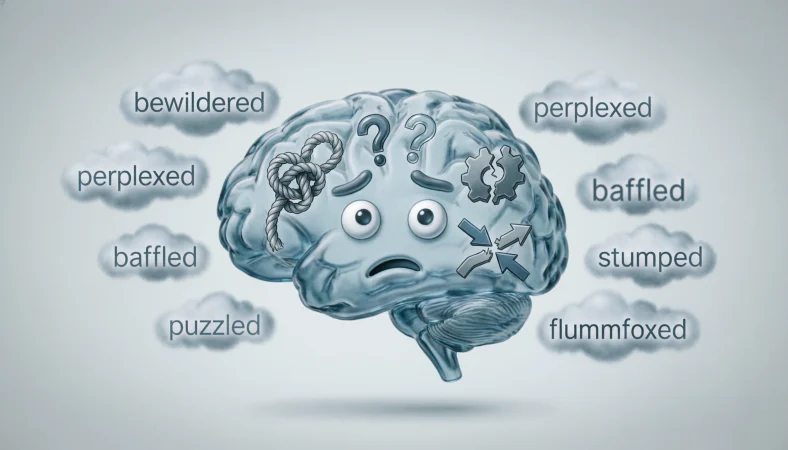
When someone feels confuzzled, they are usually both confused and puzzled.
The word is informal, playful, and often used when a person cannot understand something clearly.
Because “confuzzled” is not suitable for every situation, knowing its synonyms can help you choose a more accurate word.
Learning confuzzled synonyms is useful for students, ESL learners, writers, and content creators. Different words can describe different levels and types of confusion.
For example, you may be puzzled by a difficult question, bewildered by a surprising situation, or simply uncertain about what to do.
What Does “Confuzzled” Mean?
Simple meaning of confuzzled
Confuzzled is an informal word that combines the ideas of confused and puzzled. It describes a state where someone does not understand something and may feel unsure about what it means.
Example:
“I was completely confuzzled by the instructions.”
The word has a light, humorous feeling. It is common in casual conversations, social media, blogs, and informal writing.
When should you use “confuzzled”?
Use confuzzled when you want to sound friendly, playful, or humorous. Avoid it in formal academic, professional, or official writing. In those situations, words such as confused, uncertain, perplexed, or bewildered are usually better choices.
30 Confuzzled Synonyms
Here are 30 useful words that can replace “confuzzled,” depending on the meaning and tone you want.
1. Confused
Meaning: Unable to understand something clearly or know what to think.
Example: “I was confused by the teacher’s explanation.”
Best usage context: General situations; the most common and natural choice.
2. Puzzled
Meaning: Unsure about something because it is difficult to understand.
Example: “She looked puzzled when she saw the strange message.”
Best usage context: Questions, problems, mysteries, or unusual situations.
3. Perplexed
Meaning: Very confused because something is difficult or complicated.
Example: “The complicated instructions left him perplexed.”
Best usage context: Formal or descriptive writing.
4. Bewildered
Meaning: Extremely confused and unsure about what is happening.
Example: “The sudden change in plans left everyone bewildered.”
Best usage context: Strong confusion, especially after something unexpected.
5. Baffled
Meaning: Completely unable to understand or solve something.
Example: “The difficult puzzle left me baffled.”
Best usage context: Problems, puzzles, mysteries, and difficult questions.
6. Uncertain
Meaning: Not sure about something.
Example: “I am uncertain about which answer is correct.”
Best usage context: Decisions, choices, opinions, or situations where you lack confidence.
7. Unsure
Meaning: Not certain or confident about something.
Example: “She was unsure about how to respond.”
Best usage context: Everyday speech and simple writing.
8. Mystified
Meaning: Very confused because you cannot understand something.
Example: “He was mystified by the unusual behavior.”
Best usage context: Strange, surprising, or difficult-to-explain situations.
9. Perplexed
Meaning: Confused because something seems complicated or difficult.
Example: “The student was perplexed by the advanced mathematics problem.”
Best usage context: Academic, formal, or thoughtful writing.
10. Lost
Meaning: Unable to understand what is happening or what you should do.
Example: “I felt completely lost during the technical presentation.”
Best usage context: Casual language and situations involving unclear instructions.
11. Disoriented
Meaning: Confused about where you are, what is happening, or what to do.
Example: “After waking up suddenly, he felt disoriented.”
Best usage context: Physical surroundings, sudden changes, or confusing situations.
12. Flummoxed
Meaning: So confused that you do not know what to do.
Example: “The unexpected question left the speaker flummoxed.”
Best usage context: Informal or expressive writing; often suggests strong confusion.
13. Stumped
Meaning: Unable to find an answer or solution.
Example: “The final question completely stumped me.”
Best usage context: Questions, riddles, puzzles, and problems.
14. At a loss
Meaning: Unsure about what to say or do.
Example: “I was at a loss for words after hearing the news.”
Best usage context: Emotional or difficult situations.
15. Confounded
Meaning: Extremely confused or surprised by something difficult to understand.
Example: “The strange results confounded the researchers.”
Best usage context: Formal writing, academic contexts, and complicated problems.
16. Dumbfounded
Meaning: So surprised or shocked that you cannot think clearly or respond.
Example: “She was dumbfounded by the unexpected announcement.”
Best usage context: Strong surprise combined with confusion.
17. Dazed
Meaning: Unable to think clearly, often because of shock, surprise, tiredness, or injury.
Example: “He stood there looking dazed after hearing the news.”
Best usage context: Shock, exhaustion, sudden events, or physical effects.
18. Distracted
Meaning: Unable to concentrate because your attention is focused on something else.
Example: “I was too distracted to understand the lesson.”
Best usage context: Lack of concentration rather than lack of understanding.
19. Unclear
Meaning: Difficult to understand or not explained clearly.
Example: “The instructions were unclear.”
Best usage context: Information, instructions, explanations, and communication.
20. Ambiguous
Meaning: Having more than one possible meaning or interpretation.
Example: “The wording of the question was ambiguous.”
Best usage context: Academic, professional, legal, and analytical writing.
21. Vague
Meaning: Not clear or specific enough to understand easily.
Example: “His answer was too vague to be helpful.”
Best usage context: Explanations, descriptions, instructions, and statements.
22. Hesitant
Meaning: Unsure about doing or saying something.
Example: “She was hesitant to choose an answer.”
Best usage context: Decisions and actions where a person lacks confidence.
23. Confounded
Meaning: Confused or unable to understand something.
Example: “The unusual evidence confounded the investigators.”
Best usage context: Formal descriptions of difficult or surprising problems.
24. Nonplussed
Meaning: So surprised or confused that you do not know how to react.
Example: “He was nonplussed by the unexpected question.”
Best usage context: Formal or sophisticated writing.
25. Flustered
Meaning: Nervous, confused, or upset because you are under pressure.
Example: “She became flustered when everyone started asking questions.”
Best usage context: Stressful or embarrassing situations.
26. Disconcerted
Meaning: Unsettled or confused because something unexpected has happened.
Example: “He looked disconcerted by the sudden change.”
Best usage context: Formal writing and situations involving surprise or discomfort.
27. Befuddled
Meaning: Very confused and unable to think clearly.
Example: “The complicated directions left me befuddled.”
Best usage context: Informal, humorous, or expressive writing.
28. Mixed up
Meaning: Confused about facts, details, people, or events.
Example: “I got the two dates mixed up.”
Best usage context: Casual everyday English.
29. Confounding
Meaning: Causing confusion because something is difficult to explain or understand.
Example: “The scientist faced a confounding problem.”
Best usage context: Academic, analytical, and formal writing.
30. At sea
Meaning: Completely unsure about what to do or how to understand something.
Example: “Without clear instructions, I was completely at sea.”
Best usage context: Idiomatic and somewhat literary English.
Confuzzled Synonyms Comparison Guide
Quick comparison table
| Synonym | Strength of confusion | Tone | Best for |
|---|---|---|---|
| Confused | Medium | Neutral | General situations |
| Puzzled | Mild–medium | Neutral | Questions and mysteries |
| Perplexed | Strong | Formal | Difficult problems |
| Bewildered | Strong | Descriptive | Unexpected situations |
| Baffled | Strong | Neutral | Problems and puzzles |
| Unsure | Mild | Casual | Decisions |
| Uncertain | Mild | Formal | Academic/professional writing |
| Mystified | Strong | Descriptive | Strange situations |
| Lost | Medium | Casual | Instructions or explanations |
| Disoriented | Strong | Neutral/formal | Places or sudden changes |
| Flummoxed | Strong | Informal | Difficult situations |
| Stumped | Strong | Casual | Questions and problems |
| Dumbfounded | Very strong | Descriptive | Shock and surprise |
| Flustered | Medium | Neutral | Stress and pressure |
| Ambiguous | Not exactly a feeling | Formal | Unclear meanings |
| Vague | Not exactly a feeling | Neutral | Unclear information |
| Befuddled | Strong | Informal | Humorous confusion |
| Nonplussed | Strong | Formal | Surprise and uncertainty |
| Mixed up | Mild | Casual | Everyday mistakes |
How to Choose the Right Synonym
For everyday conversation
Choose confused, unsure, puzzled, lost, or mixed up.
These words are easy to understand and sound natural in everyday English.
Example:
“I’m confused about the homework.”
For academic writing
Choose perplexed, uncertain, ambiguous, unclear, or confounded.
These words are more suitable when discussing complex ideas, research, arguments, or information.
Example:
“The ambiguous wording of the question confused several students.”
For strong confusion
Choose bewildered, baffled, mystified, flummoxed, befuddled, or perplexed.
These words suggest that the person has significant difficulty understanding something.
Example:
“The complicated instructions left the new employees bewildered.”
For confusion caused by pressure
Choose flustered or dazed.
These words are useful when emotions, stress, shock, or pressure affect someone’s ability to think clearly.
Example:
“She became flustered when she had to answer immediately.”
For surprise and confusion
Choose dumbfounded, nonplussed, or bewildered.
These words work well when something unexpected causes a person to struggle with how to react.
Example:
“He was dumbfounded by the sudden announcement.”
For unclear information
Choose unclear, vague, or ambiguous.
These words describe the information itself rather than the person’s mental state.
Example:
“The instructions were vague.”
This is different from saying:
“The students were confused.”
The first sentence describes the instructions. The second describes the students’ reaction.
Confuzzled vs. Confused
What is the difference?
Confused is the standard English word. It can be used in casual, academic, and professional contexts.
Confuzzled is informal and playful. It usually makes the situation sound lighter or more humorous.
Confused:
“I am confused by this question.”
Confuzzled:
“I’m totally confuzzled by this question!”
If you are writing an essay, report, application, or professional email, confused is usually the safer choice.
Confuzzled vs. Puzzled
When should you use each word?
Puzzled often suggests that something is unusual, difficult, or mysterious.
Confused is broader and can describe almost any situation where understanding is difficult.
Puzzled:
“She was puzzled by the strange behavior.”
Confused:
“She was confused by the instructions.”
A person can be puzzled without being deeply confused. Puzzled often carries a sense of curiosity.
Confuzzled vs. Perplexed
Which word sounds more formal?
Perplexed is more formal and sophisticated than confuzzled.
Use perplexed when you want your writing to sound polished or descriptive.
Example:
“The researchers were perplexed by the unexpected results.”
For a casual conversation, however, confused or puzzled may sound more natural.
Common Mistakes When Using Confuzzled Synonyms
Using a synonym without checking its tone
Not every synonym has the same feeling.
For example, dumbfounded suggests strong surprise, while unsure suggests mild uncertainty.
Choose the word that matches the situation.
Using formal words in casual conversation
Words such as perplexed, nonplussed, and disconcerted can sound more formal.
In everyday conversation, confused, unsure, or puzzled may be easier and more natural.
Confusing unclear information with personal confusion
Remember that unclear, vague, and ambiguous often describe information.
Example:
“The instructions were unclear.”
Words such as confused, puzzled, and bewildered usually describe a person’s reaction.
Example:
“The students were confused.”
Tips for ESL Learners
Start with the most common words
If you are learning English, begin with confused, unsure, puzzled, and uncertain.
These words are useful in many situations.
Learn synonyms by situation
Instead of memorizing all 30 words at once, group them by meaning.
General confusion: confused, puzzled, perplexed
Strong confusion: bewildered, baffled, flummoxed, befuddled
Uncertainty: unsure, uncertain, hesitant
Unclear information: vague, unclear, ambiguous
Shock and confusion: dumbfounded, dazed, nonplussed
This makes vocabulary easier to remember.
Pay attention to tone
A synonym may be grammatically correct but still sound unnatural in a particular situation.
For example, “I am befuddled about my lunch choice” is grammatically possible, but “I’m unsure what to eat” sounds much more natural.
Frequently Asked Questions About Confuzzled Synonyms
What is the closest synonym for confuzzled?
Confused is the closest general synonym. Puzzled is also very close because “confuzzled” combines ideas associated with being confused and puzzled.
Is “confuzzled” a real word?
Yes. Confuzzled is an informal, playful word used to describe someone who is confused or puzzled. It is not normally preferred in formal writing.
Is confuzzled formal or informal?
Confuzzled is informal. It is most suitable for casual conversations, humorous writing, social media, and friendly content.
What is a formal synonym for confuzzled?
Depending on the situation, perplexed, bewildered, uncertain, disconcerted, or confounded can work in formal writing.
What is a simple synonym for confuzzled?
Confused is the simplest and most widely useful synonym.
What is a stronger word for confused?
Depending on the situation, bewildered, baffled, perplexed, mystified, or flummoxed can express stronger confusion.
Conclusion
Understanding confuzzled synonyms helps you choose vocabulary that matches the exact situation.
While confuzzled is a fun and informal way to describe confusion, it is not always the best choice for formal or academic writing.
The key is not simply to find a replacement for “confuzzled.” The goal is to understand the difference in meaning, strength, and tone so you can select the right word naturally and confidently.