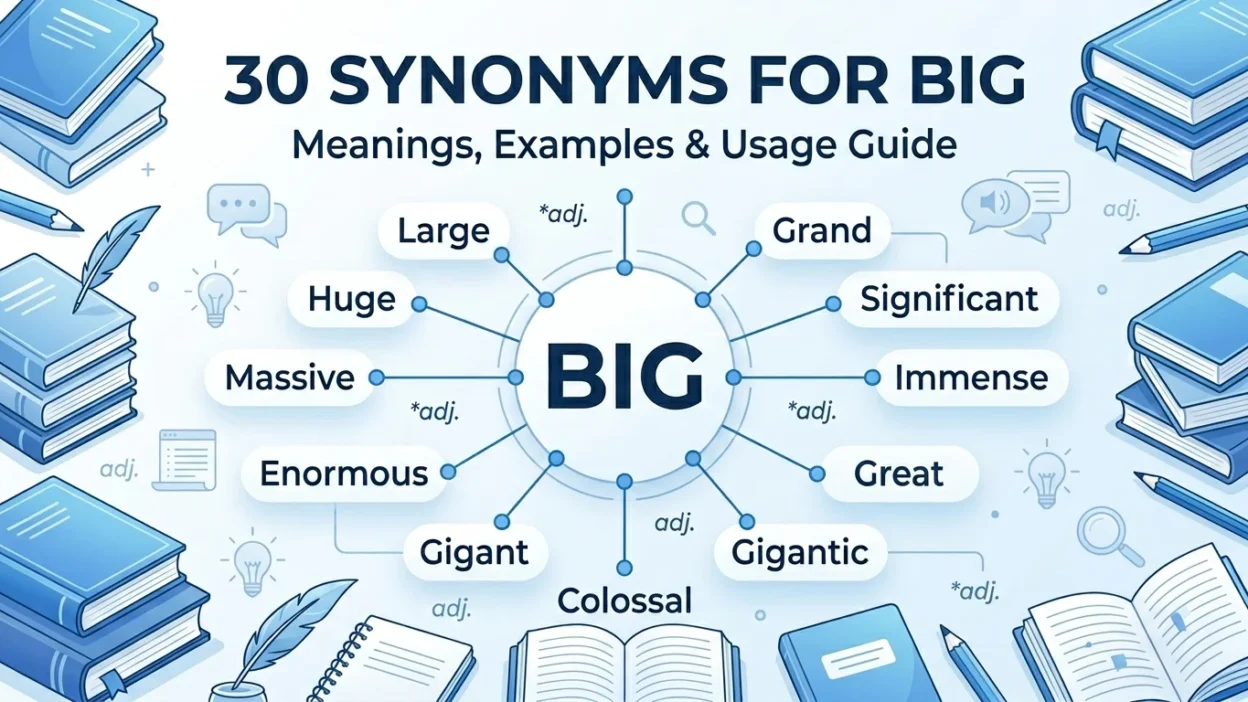
The word big is one of the most common words in English.
We use it to describe something large in size, importance, amount, impact, or significance.
While it is a useful word, using the same word repeatedly can make writing sound repetitive and less engaging.
Learning different synonyms for big can help students, ESL learners, writers, and content creators improve their vocabulary and express ideas more clearly.
Each synonym has its own meaning, tone, and best usage situation. Some words describe physical size, while others emphasize importance, power, or quantity.
In this guide, you will discover 30 useful synonyms for big, their meanings, example sentences, and the best contexts for using them.
By the end, you’ll know exactly which word to choose for different situations.
What Does “Big” Mean?
The word big generally means large in size, amount, importance, or degree. It can describe physical objects, events, achievements, problems, opportunities, and much more.
Common Examples
- A big house
- A big decision
- A big city
- A big mistake
- A big success
Because “big” can have many meanings, choosing a more specific synonym often makes communication clearer and more effective.
30 Synonyms for Big
1. Large
Meaning: Greater than average in size.
Example Sentence: They live in a large house near the beach.
Best Usage Context: Physical size and general descriptions.
2. Huge
Meaning: Extremely large.
Example Sentence: A huge crowd gathered for the concert.
Best Usage Context: Emphasizing impressive size.
3. Giant
Meaning: Very large and powerful.
Example Sentence: A giant tree stood in the middle of the forest.
Best Usage Context: Nature, objects, and businesses.
4. Massive
Meaning: Very large, heavy, or important.
Example Sentence: The company announced a massive investment.
Best Usage Context: Size, impact, or scale.
5. Enormous
Meaning: Extremely large.
Example Sentence: They faced an enormous challenge.
Best Usage Context: Formal and descriptive writing.
6. Immense
Meaning: Exceptionally large or great.
Example Sentence: The project required immense effort.
Best Usage Context: Size, effort, or importance.
7. Vast
Meaning: Covering a very large area.
Example Sentence: The desert stretched across a vast region.
Best Usage Context: Land, space, and knowledge.
8. Colossal
Meaning: Extremely large and impressive.
Example Sentence: The building was a colossal structure.
Best Usage Context: Dramatic descriptions.
9. Gigantic
Meaning: Extremely large.
Example Sentence: They discovered a gigantic cave.
Best Usage Context: Informal and vivid writing.
10. Mammoth
Meaning: Huge in size or effort.
Example Sentence: Completing the task was a mammoth undertaking.
Best Usage Context: Projects and challenges.
11. Monumental
Meaning: Very important or large.
Example Sentence: It was a monumental achievement.
Best Usage Context: Achievements and events.
12. Tremendous
Meaning: Very great in amount or degree.
Example Sentence: She made tremendous progress.
Best Usage Context: Results and improvements.
13. Grand
Meaning: Impressive, large, or important.
Example Sentence: They planned a grand celebration.
Best Usage Context: Events and designs.
14. Major
Meaning: Important or significant.
Example Sentence: This is a major issue for the company.
Best Usage Context: Importance rather than size.
15. Considerable
Meaning: Fairly large in amount.
Example Sentence: The repair required considerable time.
Best Usage Context: Formal writing.
16. Substantial
Meaning: Large in amount or value.
Example Sentence: The business earned substantial profits.
Best Usage Context: Money, resources, and support.
17. Significant
Meaning: Important and meaningful.
Example Sentence: The study revealed significant findings.
Best Usage Context: Academic and professional writing.
18. Extensive
Meaning: Covering a wide area or range.
Example Sentence: The library has an extensive collection.
Best Usage Context: Collections and research.
19. Broad
Meaning: Wide or covering many subjects.
Example Sentence: She has broad knowledge of history.
Best Usage Context: Knowledge and scope.
20. Expansive
Meaning: Wide-ranging and extensive.
Example Sentence: The hotel offers expansive views.
Best Usage Context: Landscapes and ideas.
21. Bulky
Meaning: Large and difficult to handle.
Example Sentence: The bulky package barely fit in the car.
Best Usage Context: Objects and equipment.
22. Hefty
Meaning: Large, heavy, or substantial.
Example Sentence: The company paid a hefty fine.
Best Usage Context: Costs, weights, and amounts.
23. Oversized
Meaning: Larger than normal.
Example Sentence: He wore an oversized jacket.
Best Usage Context: Clothing and products.
24. Towering
Meaning: Very tall and impressive.
Example Sentence: Towering buildings lined the street.
Best Usage Context: Height and structures.
25. Powerful
Meaning: Strong and influential.
Example Sentence: She gave a powerful speech.
Best Usage Context: Influence and impact.
26. Influential
Meaning: Having a strong effect on others.
Example Sentence: He became an influential leader.
Best Usage Context: People and organizations.
27. Weighty
Meaning: Important and serious.
Example Sentence: They discussed several weighty matters.
Best Usage Context: Serious topics.
28. Magnificent
Meaning: Extremely impressive and grand.
Example Sentence: The palace was magnificent.
Best Usage Context: Beauty and excellence.
29. Extraordinary
Meaning: Beyond what is usual.
Example Sentence: She showed extraordinary talent.
Best Usage Context: Achievements and abilities.
30. Remarkable
Meaning: Worth noticing because it is impressive.
Example Sentence: The athlete achieved remarkable success.
Best Usage Context: Accomplishments and performance.
Comparison Guide: When to Use Different Synonyms
| Synonym | Best For | Tone |
|---|---|---|
| Large | General size | Neutral |
| Huge | Very large objects | Informal |
| Massive | Size and impact | Strong |
| Enormous | Extremely large | Formal |
| Vast | Areas and spaces | Descriptive |
| Major | Importance | Professional |
| Significant | Meaning and importance | Academic |
| Substantial | Amount and value | Formal |
| Grand | Impressive events | Positive |
| Powerful | Influence and effect | Strong |
| Magnificent | Beauty and greatness | Positive |
| Remarkable | Achievement | Positive |
How to Choose the Right Synonym
For Physical Size
Use:
- Large
- Huge
- Giant
- Massive
- Enormous
- Gigantic
- Colossal
These words focus mainly on actual size.
For Importance
Use:
- Major
- Significant
- Monumental
- Weighty
- Influential
These words emphasize importance rather than physical dimensions.
For Amount or Quantity
Use:
- Considerable
- Substantial
- Extensive
- Tremendous
- Hefty
These words work well for money, resources, time, and effort.
For Beauty and Impressiveness
Use:
- Grand
- Magnificent
- Remarkable
- Extraordinary
These words add admiration and positivity.
For Space and Scope
Use:
- Vast
- Broad
- Expansive
These words describe large areas, knowledge, or coverage.
Common Mistakes When Using Synonyms for Big
Using Formal Words in Casual Situations
Words like “substantial” or “considerable” may sound too formal in everyday conversation.
Confusing Size with Importance
A major problem is important, but not necessarily physically large.
Overusing Strong Synonyms
Using words like “colossal” or “gigantic” too often can make writing sound exaggerated.
Ignoring Context
Choose a synonym that matches the situation, audience, and tone.
Why Learning Synonyms for Big Matters
A richer vocabulary helps you:
- Write more naturally
- Avoid repetition
- Improve academic writing
- Create engaging content
- Communicate ideas more precisely
- Sound more fluent in English
Whether you’re writing essays, blog posts, stories, or business content, knowing multiple synonyms for big can significantly improve your language skills.
Conclusion
The word big is useful, but English offers many alternatives that can make your writing clearer and more expressive.
From large, huge, and massive to significant, remarkable, and magnificent, each synonym carries a slightly different meaning and tone.
Understanding these differences helps students, ESL learners, writers, and content creators choose the most accurate word for every situation.
Practice using these synonyms in daily writing, and you’ll quickly develop a stronger and more versatile vocabulary.