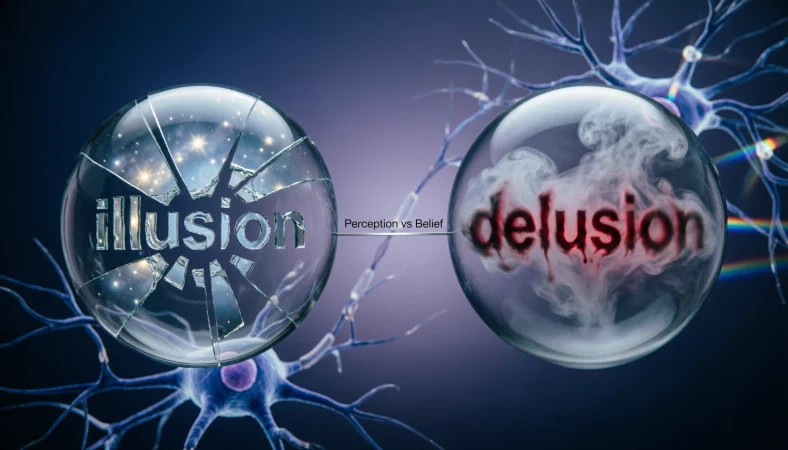
People often confuse illusion vs delusion because both words describe something that does not match reality.
However, they refer to very different situations. An illusion is a misleading appearance or perception, while a delusion is a strongly held false belief that remains despite evidence showing that it is untrue.
Understanding the difference is useful for English learners because these words appear in everyday English, ,ychology, and news writing.
The words are not interchangeable, even though both can involve a gap between what seems real and what is real.
Quick Answer
An illusion is something that appears different from reality, often because of perception, appearance, or deception. A delusion is a firmly held false belief that is not supported by reality or evidence. In simple terms: an illusion affects what you perceive; a delusion is a belief you hold as true.
Why Do People Confuse Illusion and Delusion?
The confusion comes from their shared connection with false or misleading ideas about reality.
Both words can describe situations in which someone’s understanding does not match what is actually happening. The important difference is the source:
- Illusion → something seems different from reality.
- Delusion → someone believes something that is not true.
- An illusion can be created intentionally, such as by a magician.
- A delusion is generally discussed as a belief rather than a visual trick.
- Illusion is common in everyday English.
- Delusion can have a specific clinical meaning in psychology and psychiatry.
First Word: Illusion
An illusion is a false or misleading appearance, perception, or impression.
Something may look, sound, or seem one way even though it is actually different.
Simple definition
Illusion = something that seems real or true but is not what it appears to be.
Examples
- The magician created an amazing illusion.
- The mirror gives the illusion of a larger room.
- The desert heat created the illusion of water in the distance.
- His confidence gave the illusion that he knew everything.
An illusion does not necessarily mean that a person has a false belief. It can simply mean that appearance and reality are different.
Second Word: Delusion
A delusion is a strongly held false belief. In clinical contexts, it refers to a fixed belief that is inconsistent with reality and is maintained despite evidence to the contrary.
Simple definition
Delusion = a false belief that a person firmly accepts as true.
Examples
- He had the delusion that strangers were constantly watching him.
- The character lived under the delusion that he was secretly famous.
- She was under the delusion that everyone admired her.
In mental-health contexts, delusion has a more specific meaning than simply being mistaken or believing something incorrect. A person being wrong about an ordinary fact does not automatically mean they have a delusion.
Illusion vs Delusion: Comparison Table
| Feature | Illusion | Delusion |
|---|---|---|
| Basic meaning | A misleading appearance or perception | A firmly held false belief |
| Main idea | Something seems different from reality | Someone believes something false is true |
| Usually involves | Appearance, perception, or impression | Belief or conviction |
| Can be intentional? | Yes, such as a magic trick | Not normally described as intentional deception |
| Everyday use | Very common | Common, but also has a clinical meaning |
| Example | A magician creates an illusion | A person believes an impossible claim despite evidence |
| Related idea | Perception | Belief |
When Should You Use Illusion or Delusion?
Use illusion when you are talking about an appearance, perception, impression, or deceptive effect.
Use illusion for:
- Magic tricks
- Optical effects
- Misleading appearances
- False impressions
- Things that seem different from reality
Use delusion when you are talking about a person’s strongly held false belief.
Use delusion for:
- A firmly held belief that conflicts with reality
- Certain psychological or psychiatric conditions
- Literary descriptions of unrealistic beliefs
- Situations where someone is convinced of something despite contradictory evidence
A useful test
Ask yourself:
“Is the problem with what something looks or seems like?”
→ Use illusion.
“Is the problem with what someone firmly believes?”
→ Use delusion.
10+ Examples of Illusion and Delusion
Examples of Illusion
- The magician created the illusion that the coin had disappeared.
- The painting gives the illusion of depth.
- The fog created the illusion that the trees were moving.
- The small room has an illusion of spaciousness because of its mirrors.
- The road looked wet, but it was an optical illusion caused by heat.
- His expensive clothes created the illusion of wealth.
Examples of Delusion
- He was under the delusion that he could control the weather.
- The novel describes a man living under the delusion that he is a king.
- She had the delusion that her neighbors were communicating with her through secret messages.
- His belief that he had supernatural powers was described as a delusion.
- The character’s delusion prevented him from accepting what had happened.
- The story explores the difference between reality and delusion.
Compare Them Directly
- The magician created an illusion.
- The magician’s audience knew it was a trick, but the character in the story developed a delusion that the magician possessed real supernatural powers.
The first concerns appearance; the second concerns belief.
Common Mistakes
1. Using “delusion” for every mistake
Not every incorrect belief is a delusion.
If someone says, “I thought the meeting was at three,” and the meeting was actually at two, they simply made a mistake.
2. Calling a magic trick a delusion
A magic trick is normally an illusion, because it creates a deceptive appearance.
Correct: The magician performed an illusion.
3. Assuming an illusion is always visual
An illusion can involve more than sight. You can also talk about a false impression or misleading sense of a situation.
For example:
His calm voice gave the illusion that he was not nervous.
4. Treating “delusion” as a casual synonym for “mistake”
In everyday conversation, people sometimes use delusion loosely. However, in mental-health contexts, the word has a specific meaning and should be used carefully.
5. Confusing “delusion” with “hallucination”
They are not the same.
A hallucination involves experiencing a perception without an external stimulus, such as hearing a voice when no one is speaking.
A delusion is a belief.
Memory Trick: Illusion vs Delusion
Use this simple memory trick:
ILLUSION → LOOKS
Think of something that looks different from reality.
DELUSION → BELIEF
Think of someone who believes something that is not true.
Another easy way to remember it:
Illusion = misleading appearance.
Delusion = false belief.
American vs British English
There is no major difference in meaning between American and British English for illusion and delusion.
Both varieties use:
- illusion for a misleading appearance, perception, or impression
- delusion for a false or firmly held belief
Spelling is also the same in both varieties:
- illusion
- delusion
The main difference is not regional English but context, especially when delusion is used in psychology or psychiatry.
Similar Words
Several words are related to illusion and delusion, but they are not exact synonyms.
Misconception
A misconception is an incorrect idea or understanding.
It is a common misconception that bats are blind.
Misunderstanding
A misunderstanding happens when someone interprets something incorrectly.
There was a misunderstanding about the meeting time.
Hallucination
A hallucination is a perception experienced without an external stimulus.
He reported hearing a voice when nobody else was present.
Deception
Deception involves deliberately causing someone to believe something that is not true.
The advertisement was accused of deception.
Fantasy
A fantasy is an imagined idea or situation, often understood as imaginary.
She enjoys imagining a fantasy world in her stories.
Delusion
A delusion, in its clinical sense, is a firmly held false belief that conflicts with reality.
These words overlap in some contexts, but they should not be treated as interchangeable.
Final Verdict: Illusion or Delusion?
The simplest distinction is:
An illusion is about appearance or perception. A delusion is about belief.
If something seems real but is actually different, illusion is usually the right word.
If someone firmly believes something that is false and disconnected from reality, delusion may be the appropriate word, particularly in a clinical context.
Remember: illusion = misleading appearance; delusion = false belief.
FAQs About Illusion vs Delusion
1. What is the main difference between illusion and delusion?
An illusion is a misleading appearance, perception, or impression. A delusion is a firmly held false belief. In short, an illusion concerns what something seems like, while a delusion concerns what someone believes.
2. Is an illusion the same as a hallucination?
No. An illusion involves misinterpreting something that actually exists or appears to exist. A hallucination involves experiencing a perception without an external stimulus.
3. Is a delusion always a mental illness?
No. The word can be used more generally in ordinary English to describe an unrealistic belief. However, delusion has a specific clinical meaning when used in mental-health contexts.
4. Is a magic trick an illusion or a delusion?
A magic trick is an illusion because it creates a misleading appearance or perception. The magician is not necessarily experiencing a false belief.
5. Can an illusion be a false belief?
An illusion can contribute to a mistaken impression, but the central meaning of illusion concerns appearance or perception. A firmly held false belief is more appropriately described as a delusion in the relevant context.
6. What is the opposite of an illusion?
There is no single perfect opposite in every context. Depending on the sentence, possible contrasts include reality, truth, or actual appearance.
7. What is the difference between delusion and misconception?
A misconception is simply an incorrect idea or understanding. A delusion, particularly in clinical use, refers to a much more firmly held false belief that persists despite evidence.
8. What is an easy way to remember illusion vs delusion?
Remember: illusion = appearance; delusion = belief. If something looks or seems different from reality, think illusion. If someone firmly believes something false, think delusion.
Remember This
Illusion = what seems real.
Delusion = what is believed to be real.
Illusion → appearance, perception, impression, trick
Delusion → belief, conviction, false idea
If you remember only one thing, remember “illusion is about appearance; delusion is about belief.”
Conclusion
Although illusion and delusion both involve a difference between reality and what someone experiences or believes, they describe different concepts.
An illusion is a misleading appearance or perception, while a delusion is a firmly held false belief, especially in its clinical sense.
For English learners, the easiest distinction is to focus on appearance versus belief. Use illusion for magic tricks, optical effects, and misleading impressions.
Use delusion when discussing a strongly held false belief. This simple distinction will help you choose the correct word naturally and confidently.