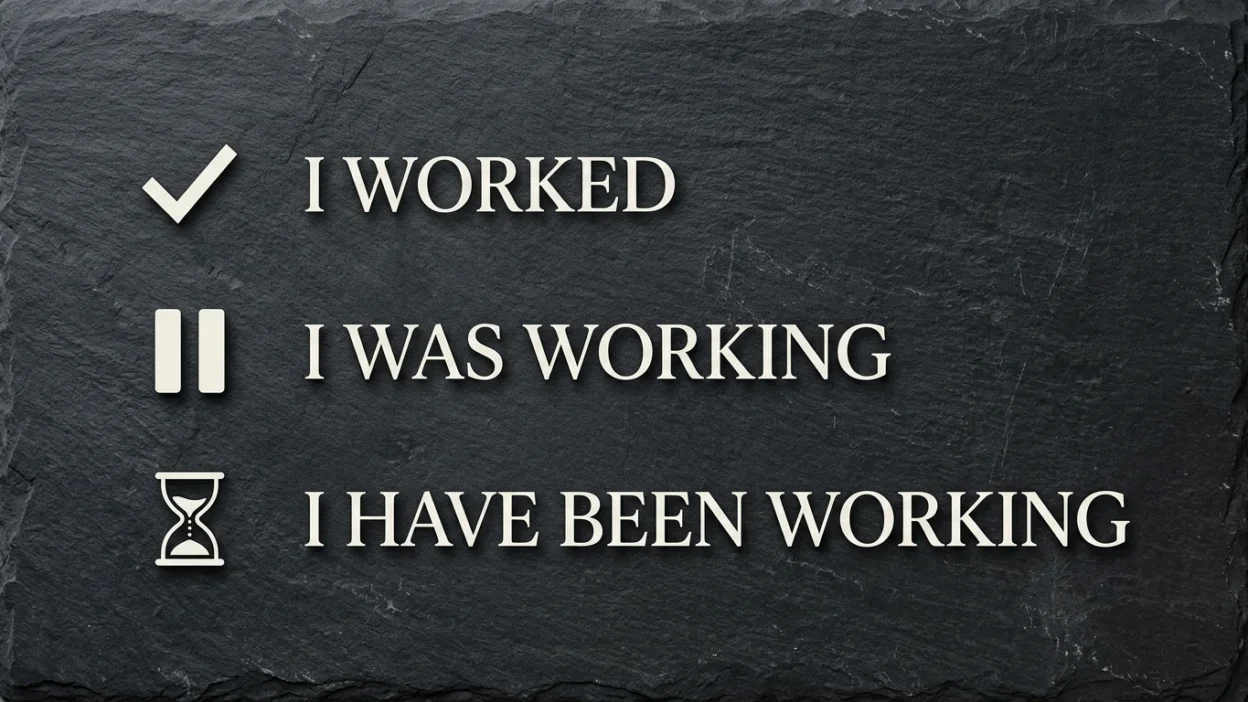
“I worked,” “I was working,” and “I have been working” all describe work, but they show different relationships between the action and time.
I worked usually describes a completed past action or a past period of work. I was working focuses on an action that was in progress at a particular time in the past.
I have been working describes an activity that started in the past and continued until recently or is still continuing now.
Understanding these forms is important because English verb tenses do more than tell us whether something happened in the past.
They also show whether an action was completed, in progress, repeated, or connected to the present. Compare:
“I worked yesterday,” “I was working when you called,” and “I have been working here for five years.”
The three sentences refer to work, but each gives the listener a different picture of time and duration.
Quick Answer
I worked = a completed past action or past period. I was working = an action in progress at a particular past time. I have been working = an activity that started in the past and continues now or has a recent connection to the present. Choose the form based on completion, ongoing action, and time reference.
Why Do People Confuse These Three Forms?
The confusion happens because all three expressions use the verb work, and all can describe something that began in the past.
The main difference is how the speaker views the action.
- I worked → looks at the past action as a completed event or period.
- I was working → looks at the action while it was happening.
- I have been working → connects past activity with the present and often emphasizes duration.
Consider these three sentences:
I worked yesterday.
The work happened in the past and is finished.
I was working at 8 p.m. yesterday.
The sentence focuses on what was happening at a particular moment.
I have been working since 8 a.m.
The action began in the past and continues up to now, or has just stopped with a present result.
“I Worked”: Simple Past
I worked is the simple past tense of “work.”
We use it mainly for completed actions, events, or periods in the past.
When Do We Use “I Worked”?
Use I worked when:
- The action is finished.
- You are talking about a completed past period.
- The exact past time is stated or understood.
- You are describing a past habit or repeated activity.
Examples
I worked yesterday.
I worked at a bank for three years.
I worked late last night.
I worked every Saturday when I was a student.
The important idea is that the speaker is looking at the work as a completed past event or period.
Common Time Expressions
“I worked” often appears with expressions such as:
- yesterday
- last night
- last week
- two days ago
- in 2020
- when I was younger
- for three years, when that period is finished
For example:
I worked in London from 2018 to 2021.
The period ended in 2021, so the simple past is appropriate.
“I Was Working”: Past Continuous
I was working is the past continuous tense.
It describes an action that was in progress at a particular time in the past.
When Do We Use “I Was Working”?
Use I was working when:
- An action was happening at a specific past moment.
- Another event interrupted or happened during the action.
- You want to provide background information.
- You want to emphasize that the activity was in progress rather than completed.
Examples
I was working at 9 p.m.
This focuses on what was happening at 9 p.m.
I was working when you called.
The work was already in progress when the call happened.
I was working while my brother was watching TV.
Both activities were happening at the same time.
Common Time Expressions
“I was working” often appears with:
- when
- while
- at 8 p.m. yesterday
- at that moment
- all morning
- all afternoon
For example:
I was working when the electricity went out.
The working was in progress; the power outage was the event that occurred during it.
“I Have Been Working”: Present Perfect Continuous
I have been working is the present perfect continuous tense.
It describes an activity that began in the past and continues to the present or has recently stopped with a result that matters now.
When Do We Use “I Have Been Working”?
Use it when:
- An activity started in the past and is still continuing.
- You want to emphasize the duration of an activity.
- A recent activity has a visible or important result in the present.
Examples
I have been working here for five years.
I started working here five years ago, and I still work here.
I have been working since 8 a.m.
The activity started at 8 a.m. and continues now, or has only recently stopped.
I’m tired because I have been working all day.
The past activity explains the speaker’s present condition.
Common Time Expressions
“I have been working” often appears with:
- for two hours
- for five years
- since Monday
- since 2022
- all day
- all morning
- recently
- lately
I Worked vs. I Was Working vs. I Have Been Working
| Form | Tense | Main idea | Example |
|---|---|---|---|
| I worked | Simple past | Completed past action or period | I worked yesterday. |
| I was working | Past continuous | Action in progress at a past time | I was working when you called. |
| I have been working | Present perfect continuous | Past activity continuing to now or recently connected to now | I have been working since morning. |
When Should You Use Each One?
Use “I Worked” for a Finished Past Action
I worked at the restaurant last summer.
The summer job is finished.
Use “I Was Working” for an Action in Progress
I was working when Sarah arrived.
The work was happening when Sarah arrived.
Use “I Have Been Working” for an Ongoing or Recently Connected Activity
I have been working here since January.
The activity started in January and continues into the present.
Compare the Meaning
I worked for three hours.
This presents the three-hour period as a completed period.
I was working for three hours.
This emphasizes the activity as something that was in progress during a past period. The exact meaning depends on context.
I have been working for three hours.
This normally means the three-hour period reaches up to the present or very recently.
12 Examples: I Worked vs. I Was Working vs. I Have Been Working
1. Yesterday
I worked yesterday.
A completed past activity.
2. At a Specific Time
I was working at 7 p.m.
The activity was in progress at that time.
3. Since Morning
I have been working since 7 a.m.
The activity started at 7 a.m. and connects to the present.
4. When Someone Called
I was working when you called me.
The call happened during the work.
5. A Finished Job
I worked on that project last month.
The project work is presented as a completed past activity.
6. Continuing Employment
I have been working for this company since 2022.
The employment began in 2022 and continues now.
7. Past Habit
I worked every weekend when I was at university.
This describes a repeated past activity.
8. Two Actions Happening Together
I was working while my sister was studying.
Both activities were in progress at the same time.
9. Present Result
I’m exhausted because I have been working all day.
The recent activity explains the speaker’s present condition.
10. A Finished Time Period
I worked for six hours yesterday.
The six-hour period is finished.
11. An Interrupted Action
I was working when the fire alarm went off.
The work was already in progress when the alarm sounded.
12. Continuing Duration
I have been working on this report for three hours.
The activity began three hours ago and is still continuing, or has only just stopped.
Common Mistakes
Mistake 1: Using “I have been working” with a Finished Past Time
Incorrect:
I have been working yesterday.
Correct:
I worked yesterday.
Yesterday is a finished past time, so the simple past is normally used.
Mistake 2: Using “I worked” When You Want to Show an Action in Progress
Less natural for the intended meaning:
I worked when you called.
Better:
I was working when you called.
The second sentence clearly shows that the work was already in progress when the call happened.
Mistake 3: Confusing “Since” and “For”
Use since with the starting point:
I have been working since Monday.
Use for with a duration:
I have been working for three days.
Mistake 4: Forgetting the Present Connection
Compare:
I worked here for five years.
This normally means the five-year period has ended.
I have been working here for five years.
This normally means the person still works here.
The choice of tense changes the time relationship.
Mistake 5: Using Present Perfect Continuous With a Specific Finished Past Time
Incorrect:
I have been working last night.
Correct:
I was working last night.
Or:
I worked last night.
The correct choice depends on whether you want to emphasize an activity in progress or a completed event.
Memory Trick
Remember these three simple ideas:
I worked = finished
I was working = happening then
I have been working = started before and connects to now
A useful timeline is:
Past → Now
- I worked → ● past event
- I was working → ⏳ action in progress at a past point
- I have been working → ─────────→ Now
Ask yourself:
Is the action finished? → I worked
Was it happening at a particular past moment? → I was working
Did it start in the past and continue or recently connect to now? → I have been working
American vs. British English
The basic distinction among these three forms is the same in American and British English.
Both varieties use:
- I worked for the simple past
- I was working for the past continuous
- I have been working for the present perfect continuous
One difference learners may notice is that American English sometimes uses the simple past in situations where British English more often uses a present perfect form. However, this does not change the core meaning of I worked, I was working, and I have been working.
For learners, the most important point is to focus on the time relationship and meaning, rather than trying to memorize an American-versus-British rule for these three forms.
Similar Words and Forms
I Have Worked
I have worked is the present perfect simple.
I have worked here for five years.
This can describe experience or a situation continuing to the present, while I have been working often puts more emphasis on the activity or duration.
I Had Worked
I had worked is the past perfect.
I had worked there for two years before I moved to London.
It describes an earlier past action or period in relation to another past event.
I Was Working
This is the past continuous:
I was working when he arrived.
It focuses on an activity that was in progress in the past.
I Had Been Working
This is the past perfect continuous:
I had been working for three hours when she called.
It describes an activity that had continued for some time before another past event.
Final Verdict
“I worked,” “I was working,” and “I have been working” are all correct, but they describe time differently.
- I worked → a completed past action or period.
- I was working → an action in progress at a particular past time.
- I have been working → an activity that began in the past and continues to now or has a recent connection with the present.
The key is not the verb work itself. The key is how you want to present the action in relation to time.
Frequently Asked Questions
What is the difference between “I worked” and “I was working”?
I worked usually presents a past action or period as a completed event. I was working focuses on an action that was in progress at a particular time in the past.
I worked yesterday.
I was working when you called.
What is the difference between “I worked” and “I have been working”?
I worked normally refers to a completed past action or period. I have been working connects a past activity to the present and often emphasizes its duration.
I worked there for three years.
I have been working there for three years.
The first usually suggests the job has ended; the second normally suggests it continues now.
Is “I have been working” present or past tense?
I have been working is the present perfect continuous tense. It refers to an activity that began in the past but has a connection with the present.
Can I say “I was working yesterday”?
Yes. I was working yesterday is grammatically correct. It emphasizes the activity as something that was in progress during a past period. For a simple statement about completed work, I worked yesterday is also natural.
Can I say “I worked when you called”?
It is grammatically possible in some contexts, but if you mean that the work was already in progress at the moment of the call, I was working when you called is the natural choice.
Should I use “for” or “since” with “I have been working”?
Use for for a duration:
I have been working for three hours.
Use since for a starting point:
I have been working since 9 a.m.
Which tense should I use with “yesterday”?
Normally, use the simple past:
I worked yesterday.
For an activity in progress during that period, you can also use the past continuous:
I was working yesterday when you called.
The present perfect continuous is generally not used with a finished-time expression such as yesterday.
Remember This
I worked = completed past action.
I was working = action in progress at a past time.
I have been working = activity started in the past and continues or has a present connection.
Think of the difference as:
Finished → I worked
In progress then → I was working
Past until now → I have been working
Conclusion
The three forms I worked, I was working, and I have been working are different because they give different perspectives on time. The simple past looks back at a completed event or period, while the past continuous focuses on an action that was happening at a particular moment in the past. The present perfect continuous connects an activity that began in the past with the present.
When choosing between them, first identify the time relationship. If the work is simply finished, use I worked. If it was happening at a particular past moment, use I was working. If it began in the past and continues now or has a recent effect, use I have been working. Once you focus on the timeline, the choice becomes much easier.