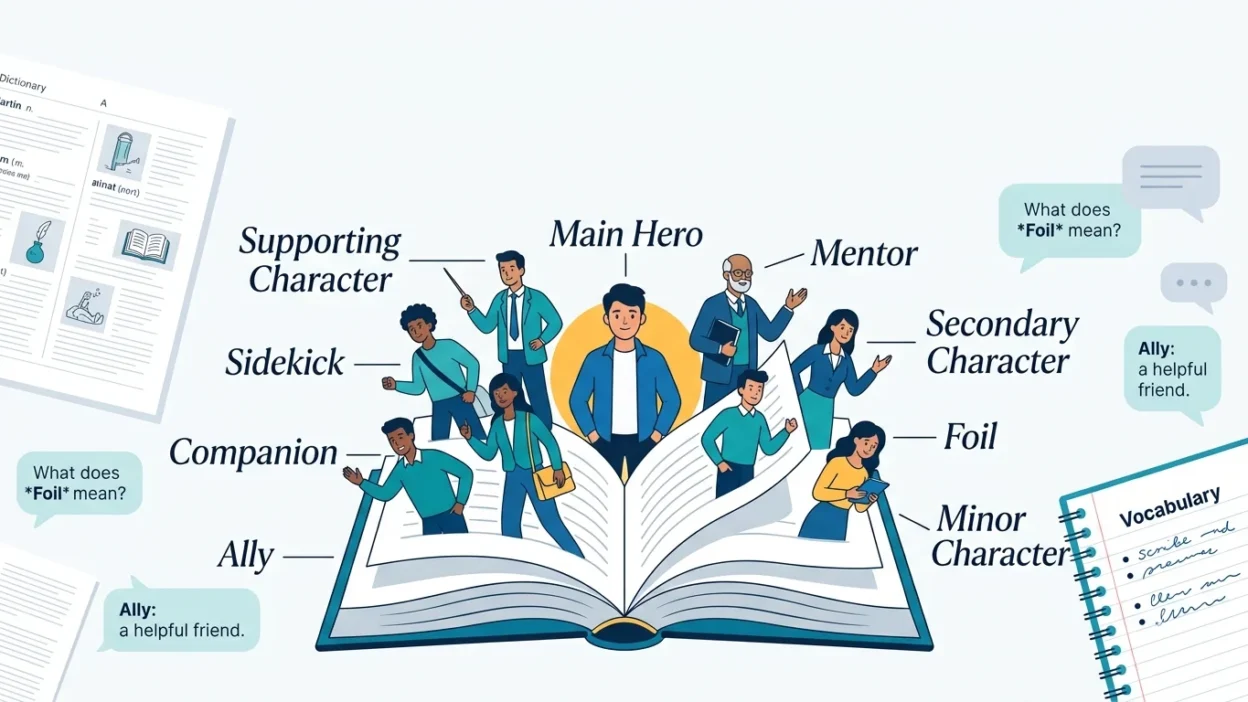
Whether you are writing a novel, studying English, creating content, or simply expanding your vocabulary, learning side character synonyms can make your writing more interesting and precise.
Instead of repeating the same term, you can choose different words that better match the role, importance, or personality of a character.
In stories, movies, TV shows, comics, and games, side characters play an important role.
They help move the story forward, support the main character, or make the fictional world feel more realistic. This guide explains the meaning of side character synonyms in simple English and introduces 30 useful alternatives with easy definitions, examples, and usage tips.
What Does “Side Character” Mean?
Simple Meaning
A side character is a person in a story who is not the main character but still has an important role. They support the main character, help develop the plot, provide humor, create conflict, or add emotional depth.
Usage Context
The term side character is commonly used in:
- Novels
- Short stories
- Movies
- TV series
- Anime and manga
- Video games
- Theater
- Creative writing discussions
While “side character” is a general term, different situations call for more specific words. That’s why knowing various side character synonyms is helpful.
30 Side Character Synonyms
1. Supporting Character
Meaning: A character who helps develop the story without being the main focus.
Example: The supporting character encouraged the hero throughout the journey.
Best Usage Context: General storytelling and fiction writing.
2. Secondary Character
Meaning: A character with an important but smaller role than the protagonist.
Example: The secondary character solved the mystery’s biggest clue.
Best Usage Context: Literary analysis and academic writing.
3. Minor Character
Meaning: A character who appears only occasionally.
Example: Even the minor character left a lasting impression.
Best Usage Context: Story analysis.
4. Background Character
Meaning: A character who mainly fills the setting.
Example: The background characters made the city feel alive.
Best Usage Context: Movies, games, and visual storytelling.
5. Supporting Role
Meaning: A character with a significant but non-leading role.
Example: She won an award for her supporting role.
Best Usage Context: Film and theater.
6. Ensemble Character
Meaning: A member of a larger group of equally important characters.
Example: Every ensemble character had a unique personality.
Best Usage Context: Group-centered stories.
7. Companion
Meaning: Someone who travels or stays with the main character.
Example: The companion never abandoned the hero.
Best Usage Context: Fantasy and adventure stories.
8. Ally
Meaning: A helpful friend or supporter.
Example: The knight became the prince’s strongest ally.
Best Usage Context: Action and fantasy fiction.
9. Confidant
Meaning: Someone trusted with personal secrets.
Example: Her confidant always offered wise advice.
Best Usage Context: Emotional and dramatic stories.
10. Sidekick
Meaning: A loyal helper who assists the main character.
Example: Every superhero needs a reliable sidekick.
Best Usage Context: Comics, action stories, and children’s fiction.
11. Foil
Meaning: A character whose personality highlights another character’s traits.
Example: The cheerful foil made the hero seem more serious.
Best Usage Context: Literary analysis.
12. Deuteragonist
Meaning: The second most important character.
Example: The deuteragonist played a key role in the final battle.
Best Usage Context: Literature and screenplay discussions.
13. Cast Member
Meaning: One of the characters in a story.
Example: Every cast member contributed something valuable.
Best Usage Context: Theater, TV, and film.
14. Recurring Character
Meaning: A character who appears repeatedly but is not the lead.
Example: The recurring character appeared in every season.
Best Usage Context: Television series.
15. Guest Character
Meaning: A character appearing briefly in a story.
Example: The guest character surprised viewers.
Best Usage Context: TV shows and animation.
16. Supporting Player
Meaning: Someone who supports the main storyline.
Example: Every supporting player added excitement.
Best Usage Context: Entertainment and reviews.
17. Bit Part
Meaning: A very small role.
Example: He started his career with a bit part.
Best Usage Context: Acting and film.
18. Walk-on Character
Meaning: A character with very little dialogue.
Example: The walk-on character appeared for only one scene.
Best Usage Context: Theater and movies.
19. Extra
Meaning: A person appearing in the background.
Example: Hundreds of extras filled the stadium scene.
Best UsageContext: Film production.
20. Neighboring Character
Meaning: A nearby character who supports the setting or plot.
Example: The neighboring character often gave helpful advice.
Best Usage Context: Casual storytelling.
21. Friend
Meaning: A companion who supports the main character.
Example: Her best friend stayed loyal through every challenge.
Best Usage Context: Everyday storytelling.
22. Partner
Meaning: Someone working closely with another character.
Example: The detective trusted his partner completely.
Best Usage Context: Mystery and action stories.
23. Associate
Meaning: Someone connected to the main character.
Example: The associate helped organize the mission.
Best Usage Context: Professional or crime fiction.
24. Mentor
Meaning: An experienced guide who teaches the protagonist.
Example: The mentor trained the young warrior.
Best Usage Context: Adventure and fantasy.
25. Advisor
Meaning: Someone who gives guidance or suggestions.
Example: The royal advisor warned the king.
Best Usage Context: Historical and political fiction.
26. Comic Relief
Meaning: A character who provides humor.
Example: The comic relief kept the audience laughing.
Best Usage Context: Comedy and adventure.
27. Love Interest
Meaning: A character involved in a romantic storyline.
Example: The love interest changed the hero’s priorities.
Best Usage Context: Romance fiction.
28. Rival
Meaning: Someone who competes with the main character.
Example: The rival pushed the hero to improve.
Best Usage Context: Sports and action stories.
29. Antagonist’s Assistant
Meaning: A helper working for the villain.
Example: The antagonist’s assistant carried out every order.
Best Usage Context: Villain-centered stories.
30. Peripheral Character
Meaning: A character who stays on the edge of the main story.
Example: The peripheral character appeared only during important moments.
Best Usage Context: Literary criticism.
Comparison Guide: When to Use Different Side Character Synonyms
Quick Comparison Table
| Synonym | Best For | Formality |
|---|---|---|
| Supporting Character | General writing | Neutral |
| Secondary Character | Academic writing | Formal |
| Sidekick | Adventure and comics | Casual |
| Companion | Fantasy and travel stories | Neutral |
| Ally | Action stories | Neutral |
| Confidant | Emotional scenes | Formal |
| Foil | Literary analysis | Formal |
| Mentor | Teaching or guiding roles | Neutral |
| Comic Relief | Funny characters | Casual |
| Minor Character | Story discussions | Neutral |
| Background Character | Film and games | Neutral |
| Peripheral Character | Literary criticism | Formal |
How to Choose the Right Synonym
For General Writing
Use:
- Supporting Character
- Secondary Character
- Minor Character
These are the safest and most widely understood choices.
For Creative Writing
Choose:
- Companion
- Sidekick
- Ally
- Mentor
- Rival
These words describe a character’s relationship with the main character.
For Literary Analysis
Use:
- Foil
- Deuteragonist
- Secondary Character
- Peripheral Character
These terms sound more professional and are commonly used in academic writing.
For Movies and TV
Good options include:
- Supporting Role
- Cast Member
- Recurring Character
- Guest Character
- Extra
These terms are common in entertainment discussions.
For Beginners and ESL Learners
The easiest words to understand are:
- Friend
- Ally
- Sidekick
- Companion
- Supporting Character
These are simple, common, and useful in everyday English.
Why Learning Side Character Synonyms Matters
Using different words instead of repeating “side character” can improve your writing in several ways:
- Makes writing more natural.
- Improves vocabulary.
- Helps explain character roles more clearly.
- Creates engaging essays and stories.
- Strengthens creative writing skills.
- Supports better SEO writing by using natural language variation.
Common Mistakes to Avoid
Using Every Synonym Interchangeably
Not all side character synonyms mean exactly the same thing. A mentor teaches, while a sidekick mainly helps. A foil highlights another character’s traits, and a background character may not influence the plot at all.
Ignoring the Story Context
Always choose the synonym that best fits the character’s role. Think about whether the character is helping, teaching, competing, or simply appearing briefly.
Conclusion
Learning side character synonyms helps you become a stronger writer, better reader, and more confident English learner. While supporting character remains the most common alternative, words like sidekick, companion, mentor, foil, secondary character, and peripheral character each describe different roles within a story.
By understanding their meanings, examples, and best usage contexts, you can choose the right word for every situation. Whether you’re writing fiction, analyzing literature, or creating online content, these synonyms will make your vocabulary richer and your writing more engaging.

Liam Henry is a content author at Synonymed, specializing in vocabulary enrichment and synonym guides. He creates clear, engaging resources that help learners improve English word knowledge and language fluency.