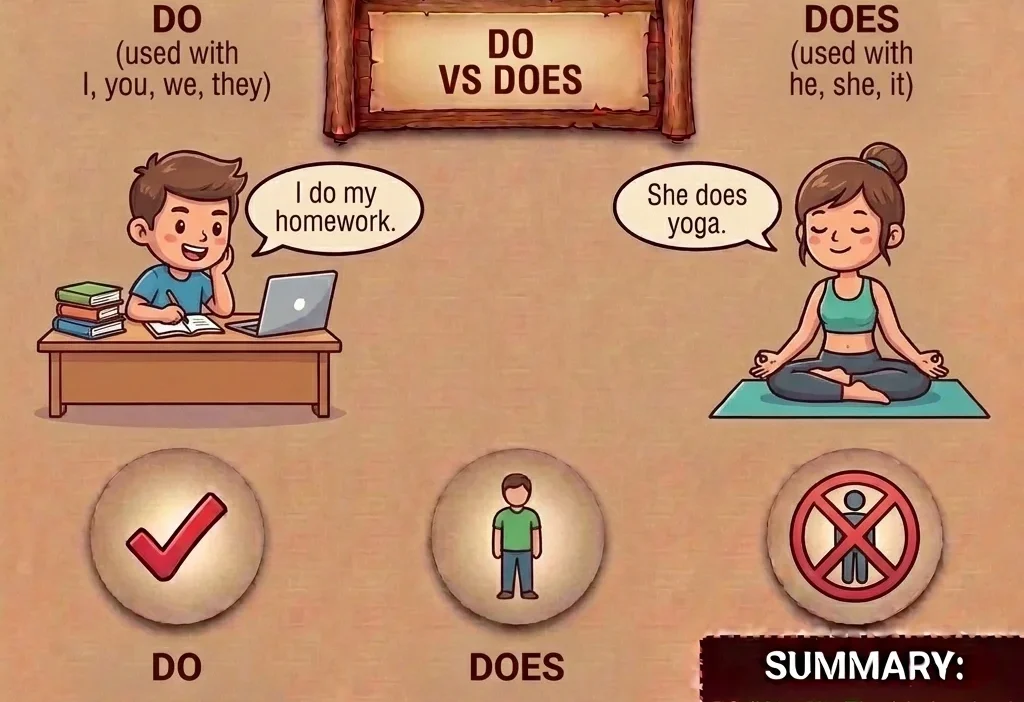
Do and does are both forms of the verb do, but they are used with different subjects. Use do with I, you, we, and they, while does is used with he, she, and it in the present simple tense.
For example, “I do my homework” and “She does her homework” are both correct.
Understanding when to use do and does is essential for forming correct English sentences, especially questions and negative sentences.
The main rule is simple, but learners sometimes make mistakes because do and does can work as both main verbs and helping verbs.
They can also appear in short answers and emphasis. Once you understand the subject-verb relationship, choosing between do and does becomes much easier.
Quick Answer
Use do with I, you, we, and they, and use does with he, she, and it in the present simple. Examples: “Do you like coffee?” and “Does she like coffee?” Remember that after does, the main verb stays in its base form: “Does he work?” not “Does he works?”
Why Do People Confuse “Do” and “Does”?
People often confuse do and does because they have the same basic meaning and both can function as helping verbs.
The difference mainly depends on the subject.
Compare:
- I do my work.
- You do your work.
- We do our work.
- They do their work.
- He does his work.
- She does her work.
- It does its job.
The key rule is:
Do → I, you, we, they
Does → he, she, it
This rule applies particularly to the present simple tense.
What Does “Do” Mean?
Do can be a main verb or a helping verb.
As a main verb, do can mean perform, complete, carry out, or engage in an activity.
Examples:
- I do my homework every evening.
- They do their work carefully.
- We do exercise every morning.
- You do a great job.
“Do” as a Helping Verb
Do is also used as an auxiliary, or helping, verb to form questions and negative sentences in the present simple.
Examples:
- Do you like music?
- Do they live here?
- I do not understand.
- We do not agree.
The short forms are:
- do not → don’t
- does not → doesn’t
“Do” With Different Subjects
Use do with:
- I
- you
- we
- they
- plural nouns
Examples:
- I do my homework.
- You do your best.
- We do our work.
- They do their homework.
- The students do their exercises.
What Does “Does” Mean?
Does is the third-person singular form of do in the present simple tense.
Use does with:
- he
- she
- it
- singular nouns
Examples:
- He does his homework.
- She does her job well.
- It does the work automatically.
- Ali does his exercises every day.
- The machine does its job efficiently.
“Does” as a Helping Verb
Does is commonly used to make present-simple questions and negative sentences with he, she, and it.
Examples:
- Does he speak English?
- Does she work here?
- Does it matter?
- He does not understand.
- She does not like coffee.
Remember that when does is used as a helping verb, the next verb stays in its base form.
Correct:
Does she like tea?
Incorrect:
Does she likes tea?
Do vs Does: Comparison Table
| Feature | Do | Does |
|---|---|---|
| Main use | Present simple | Present simple |
| Used with | I, you, we, they | He, she, it |
| Singular/plural | I/you and plural subjects | Third-person singular |
| Question | Do you work? | Does he work? |
| Negative | I don’t work. | He doesn’t work. |
| Main verb | I do my homework. | She does her homework. |
| Base verb after helping verb | Yes | Yes |
| Example | They do their work. | She does her work. |
When Should You Use “Do”?
Use do with I, you, we, and they in the present simple.
In Questions
- Do I need a ticket?
- Do you understand?
- Do we have enough time?
- Do they live nearby?
In Negative Sentences
- I do not know.
- You do not need to worry.
- We do not agree.
- They do not work here.
With Plural Subjects
Use do with plural nouns:
- The students do their homework.
- My parents do a lot of work.
- The children do their chores.
When Should You Use “Does”?
Use does with he, she, it, and singular nouns.
In Questions
- Does he play football?
- Does she speak French?
- Does it work?
- Does Ahmed live here?
In Negative Sentences
- He does not like coffee.
- She does not understand.
- It does not work.
- Ahmed does not drive.
With Singular Nouns
- The teacher does her work.
- My brother does his homework.
- The dog does what it is told.
10+ Examples of Do and Does
- Do you like English?
“Do” is used because the subject is you. - Does she like English?
“Does” is used because the subject is she. - I do my homework every night.
“Do” agrees with I. - He does his homework every night.
“Does” agrees with he. - Do they play cricket?
“Do” is used with they. - Does he play cricket?
“Does” is used with he. - We don’t understand the question.
“Do” is used with we. - She doesn’t understand the question.
“Does” is used with she. - Do your parents work here?
“Do” is used because parents is plural. - Does your father work here?
“Does” is used because father is singular. - The students do their exercises.
“Do” is used with the plural subject students. - The student does his exercise.
“Does” is used with the singular subject student. - Do you have a car?
“Do” is used with you. - Does your sister have a car?
“Does” is used with your sister, a singular subject.
Common Mistakes with Do and Does
Mistake 1: Using “does” with “I”
Incorrect:
I does my homework.
Correct:
I do my homework.
Use do with I.
Mistake 2: Using “do” with “he”
Incorrect:
He do his homework.
Correct:
He does his homework.
Use does with he.
Mistake 3: Adding “-s” after “does”
Incorrect:
Does she likes coffee?
Correct:
Does she like coffee?
When does is the helping verb, the main verb returns to its base form.
Mistake 4: Using “doesn’t” with a verb ending in “-s”
Incorrect:
He doesn’t likes football.
Correct:
He doesn’t like football.
The -s is already represented by does.
Mistake 5: Confusing “do” and “does” in questions
Incorrect:
Do she work here?
Correct:
Does she work here?
The subject she requires does.
Mistake 6: Forgetting that plural subjects use “do”
Incorrect:
The boys does their homework.
Correct:
The boys do their homework.
Boys is plural, so use do.
Memory Trick
Use this simple pattern:
DO → I, YOU, WE, THEY
DOES → HE, SHE, IT
You can remember it with this sentence:
I do, you do, we do, they do — he does, she does, it does.
For questions:
Do they work?
Does she work?
For negative sentences:
They don’t work.
She doesn’t work.
One important rule is:
Does + base verb
So say:
- Does he work?
- Does she like it?
- Does it help?
Not:
- Does he works?
- Does she likes it?
- Does it helps?
American vs British English
The basic difference between do and does is the same in American and British English.
Both varieties use:
- Do you…?
- Does he…?
- I don’t…
- She doesn’t…
There can be differences between American and British English in vocabulary, pronunciation, and some expressions, but the basic subject-verb rule for do and does remains the same.
For English learners, the important thing is to focus on the subject:
I/you/we/they → do
he/she/it → does
Similar Words
Did
Did is the past-tense form of do and is used with all subjects in simple past questions and negatives.
Examples:
- Did you go?
- Did she go?
- Did they go?
Notice that the main verb remains in its base form after did:
Did she go?
Not:
Did she went?
Don’t
Don’t is the contraction of do not.
Examples:
- I don’t know.
- You don’t need it.
- We don’t agree.
- They don’t live here.
Doesn’t
Doesn’t is the contraction of does not.
Examples:
- He doesn’t know.
- She doesn’t agree.
- It doesn’t matter.
Done
Done is the past participle of do.
Examples:
- I have done my homework.
- She has done the work.
Done is not interchangeable with do or does.
Final Verdict
The difference between do and does is mainly about the subject in the present simple tense.
Use do with I, you, we, and they. Use does with he, she, and it.
The same rule applies to singular and plural nouns:
- The students do their work.
- The student does his work.
When do or does acts as a helping verb, the main verb stays in its base form:
- Do you like tea?
- Does she like tea?
Never say “Does she likes?” because the third-person -s is already included in does.
Frequently Asked Questions
Should I use “do” or “does” with “you”?
Use do with you.
Do you like English?
Even when you refers to one person, the correct form is still do.
Should I use “do” or “does” with “he”?
Use does with he.
Does he play football?
Do we say “does she like” or “does she likes”?
The correct form is “Does she like?”
After does, use the base form of the main verb.
Does she like coffee?
Do we say “he do” or “he does”?
Use he does.
He does his homework every evening.
What is the difference between “do” and “does” in questions?
Use do with I, you, we, and they, and does with he, she, and it.
Examples:
Do they work here?
Does she work here?
Is “does” singular or plural?
Does is used with third-person singular subjects, such as he, she, it, and singular nouns.
She does her homework.
What is the difference between “don’t” and “doesn’t”?
Don’t means do not and is used with I, you, we, and they.
Doesn’t means does not and is used with he, she, and it.
Examples:
They don’t understand.
He doesn’t understand.
Can “do” and “does” be main verbs?
Yes. They can function as main verbs meaning perform, complete, or carry out an action.
Examples:
I do my homework.
She does her homework.
They can also function as helping verbs in questions and negative sentences.
Remember This
- I → do
- You → do
- We → do
- They → do
- He → does
- She → does
- It → does
- Singular noun → does
- Plural noun → do
- Does + base verb
- Do + base verb
- Don’t = do not
- Doesn’t = does not
The golden rule is:
Do with I, you, we, they; does with he, she, it.
Conclusion
Choosing between do and does is simple once you identify the subject. In the present simple tense, do goes with I, you, we, and they, while does goes with he, she, and it. The same pattern applies to nouns: plural nouns generally take do, while singular third-person nouns take does.
The most important additional rule is what happens after does. Because does already carries the third-person singular form, the main verb must remain in its base form. Therefore, say “Does she work?”, not “Does she works?” With regular practice, this subject-and-verb pattern becomes natural and will make your English questions, negatives, and everyday sentences much more accurate.