Finding the right vast synonyms can make your writing more vivid, accurate, and interesting.
The word “vast” is useful when you want to describe something extremely large, extensive, or seemingly without limits.
However, using the same word repeatedly can make writing feel dull.
For students, ESL learners, writers, and content creators, learning alternatives to “vast” is a simple way to build stronger vocabulary.
Different synonyms can describe physical size, large amounts, wide areas, broad knowledge, or something that seems endless.
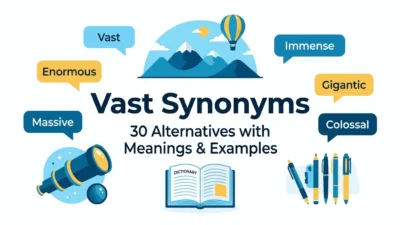
In this guide, you will find 30 useful synonyms for vast, along with simple meanings, example sentences, and the best context for each word.
By the end, you will know which alternative fits your sentence naturally.
What Does Vast Mean?
Simple Meaning of Vast
Vast means extremely large in size, area, amount, or range. It often describes something much bigger than usual.
Example:
“The explorers traveled across a vast desert.”
Here, “vast” tells us that the desert is very large and covers a wide area.
Tone and Usage of Vast
“Vast” has a neutral to slightly formal tone. It is common in essays, articles, books, academic writing, travel descriptions, and everyday conversations.
It can describe physical spaces, quantities, knowledge, opportunities, differences, and experiences.
Examples:
- a vast ocean
- a vast amount of information
- a vast empire
- vast experience
- vast opportunities
30 Vast Synonyms
1. Huge
Meaning: Extremely large in size or amount.
Example: “They built a huge shopping center near the city.”
Best usage: Everyday conversations and informal writing.
2. Enormous
Meaning: Very, very large.
Example: “The company made an enormous investment in technology.”
Best usage: General, academic, and professional writing.
3. Immense
Meaning: Extremely large or great.
Example: “The project required an immense amount of effort.”
Best usage: Formal and descriptive writing.
4. Massive
Meaning: Very large, heavy, or extensive.
Example: “The storm caused massive damage to the coastline.”
Best usage: Physical size, impact, quantities, and events.
5. Gigantic
Meaning: Extremely large in physical size.
Example: “A gigantic statue stood at the entrance.”
Best usage: Strong visual descriptions and informal writing.
6. Colossal
Meaning: Extremely large or impressive.
Example: “The construction project was a colossal undertaking.”
Best usage: Formal, dramatic, or emphatic descriptions.
7. Tremendous
Meaning: Very great in size, amount, strength, or degree.
Example: “The organization has made tremendous progress.”
Best usage: Abstract ideas, achievements, progress, and amounts.
8. Expansive
Meaning: Covering a large area or having a wide range.
Example: “The university has an expansive library collection.”
Best usage: Landscapes, collections, businesses, and ideas.
9. Extensive
Meaning: Covering a large area or involving a large amount.
Example: “The researchers conducted extensive studies.”
Best usage: Academic, professional, and formal writing.
10. Broad
Meaning: Covering a wide range or area.
Example: “She has a broad understanding of international business.”
Best usage: Knowledge, subjects, interests, and general areas.
11. Wide
Meaning: Covering a large distance from one side to another or including many possibilities.
Example: “The course offers a wide range of subjects.”
Best usage: Everyday English and general descriptions.
12. Spacious
Meaning: Having plenty of room or space.
Example: “The new apartment is bright and spacious.”
Best usage: Buildings, rooms, homes, offices, and physical spaces.
13. Boundless
Meaning: Having no clear limits or boundaries.
Example: “Children often have boundless imagination.”
Best usage: Imagination, energy, potential, creativity, and abstract ideas.
14. Limitless
Meaning: Having no apparent limit.
Example: “Modern technology offers almost limitless possibilities.”
Best usage: Opportunities, possibilities, potential, and abstract concepts.
15. Endless
Meaning: Continuing for a very long time or seeming to have no end.
Example: “We drove along an endless stretch of highway.”
Best usage: Time, distance, repetition, landscapes, and experiences.
16. Unbounded
Meaning: Not restricted by limits or boundaries.
Example: “The internet provides access to an unbounded amount of information.”
Best usage: Formal, academic, philosophical, and abstract writing.
17. Far-Reaching
Meaning: Having a wide range or affecting many people or areas.
Example: “The new law could have far-reaching effects.”
Best usage: Effects, consequences, policies, influence, and decisions.
18. Sweeping
Meaning: Covering a large area or involving many things.
Example: “The government introduced sweeping reforms.”
Best usage: Changes, reforms, movements, landscapes, and broad actions.
19. Extensive-Scale
Meaning: Existing or operating across a large range or area.
Example: “The company operates on an extensive scale.”
Best usage: Large projects, organizations, and operations.
20. Grand
Meaning: Large, impressive, or ambitious.
Example: “They developed a grand plan for the new cultural center.”
Best usage: Plans, buildings, ideas, events, and ambitions.
21. Monumental
Meaning: Extremely important, impressive, or large in scale.
Example: “Completing the bridge was a monumental achievement.”
Best usage: Achievements, projects, historical events, and major efforts.
22. Astronomical
Meaning: Extremely large, especially when describing numbers, costs, or amounts.
Example: “The company faced astronomical repair costs.”
Best usage: Numbers, prices, expenses, and statistics.
23. Substantial
Meaning: Large enough to be important or significant.
Example: “The organization received substantial financial support.”
Best usage: Money, amounts, evidence, changes, and resources.
24. Considerable
Meaning: Fairly large or important in size or amount.
Example: “The project requires considerable financial investment.”
Best usage: Formal, academic, and professional writing.
25. Plentiful
Meaning: Existing in large quantities.
Example: “Fresh water is plentiful in this region.”
Best usage: Resources, supplies, food, opportunities, and natural items.
26. Abundant
Meaning: Existing in large quantities or more than enough.
Example: “The region has abundant natural resources.”
Best usage: Resources, nature, food, opportunities, and formal writing.
27. Myriad
Meaning: A very large or countless number of things.
Example: “The internet provides a myriad of learning resources.”
Best usage: Formal, literary, and academic writing.
28. Multitude
Meaning: A very large number or collection of people or things.
Example: “A multitude of factors influenced the decision.”
Best usage: Formal and academic writing.
29. Prodigious
Meaning: Extremely large, impressive, or remarkable.
Example: “She has a prodigious memory for names and dates.”
Best usage: Formal, literary, and sophisticated writing.
30. Far-Flung
Meaning: Spread over a very large geographical area.
Example: “The organization has offices in far-flung parts of the world.”
Best usage: Geography, travel, organizations, and descriptive writing.
Vast Synonyms Comparison Table
| Synonym | Main Idea | Tone | Best Context |
|---|---|---|---|
| Huge | Very large | Casual | Everyday use |
| Enormous | Extremely large | Neutral | General writing |
| Immense | Extremely great | Formal | Abstract and physical |
| Massive | Very large/heavy | Neutral | Size, damage, amounts |
| Gigantic | Extremely large physically | Informal | Visual descriptions |
| Colossal | Extremely large/impressive | Strong | Dramatic writing |
| Expansive | Wide or extensive | Formal | Areas and collections |
| Extensive | Large in range | Formal | Research and work |
| Broad | Wide in range | Neutral | Knowledge and topics |
| Boundless | Without limits | Literary | Ideas and potential |
| Limitless | Without apparent limits | Neutral | Possibilities |
| Endless | Seemingly without end | Neutral | Time and distance |
| Far-reaching | Affecting a wide range | Formal | Effects and policies |
| Sweeping | Broad in scope | Formal | Changes and reforms |
| Grand | Large and impressive | Neutral | Plans and events |
| Monumental | Extremely significant | Formal | Achievements |
| Astronomical | Extremely large numbers | Strong | Costs and figures |
| Substantial | Large and significant | Formal | Amounts and evidence |
| Considerable | Fairly large | Formal | Amounts and effort |
| Plentiful | Available in large quantities | Neutral | Resources |
| Abundant | More than enough | Neutral/Formal | Resources and nature |
| Myriad | Very large number | Formal | Things and possibilities |
| Multitude | Large number/group | Formal | People or things |
| Prodigious | Remarkably large | Literary | Ability or achievement |
| Far-flung | Widely spread geographically | Descriptive | Places and organizations |
Vast vs Huge
What Is the Difference?
Vast usually emphasizes a wide area, range, or amount, while huge simply means very large.
For example:
“The building is huge” focuses on its physical size.
“The desert is vast” emphasizes the enormous area it covers.
Both words are useful, but vast often sounds more descriptive and formal.
Vast vs Extensive
When Should You Use Each?
Vast emphasizes something extremely large or wide.
Extensive emphasizes the broad range or amount of something.
Compare:
“She has vast knowledge of history.”
“She has extensive knowledge of history.”
Both sentences work, but “extensive” sounds especially natural in academic and professional contexts.
Vast vs Immense
Understanding the Difference
Vast often suggests a large physical area, range, or quantity.
Immense can describe something extremely large in either physical or abstract terms.
Examples:
- a vast ocean
- an immense amount of pressure
- vast opportunities
- immense difficulty
“Immense” often gives a stronger feeling of scale or intensity.
Vast vs Expansive
When to Choose Each Word
Expansive suggests something broad, open, or covering a large area.
Vast simply emphasizes great size or range.
For example:
“The museum has a vast collection of paintings.”
“The museum has an expansive gallery.”
The first focuses on the size of the collection, while the second focuses more on the space.
How to Choose the Right Synonym
For Casual and Everyday Writing
Choose:
- Huge
- Enormous
- Wide
- Massive
- Spacious
These words are easy to understand and sound natural in everyday communication.
For Academic Writing
Choose:
- Extensive
- Considerable
- Substantial
- Broad
- Myriad
These alternatives work well in essays, reports, research papers, and educational content.
For Formal or Professional Writing
Choose:
- Immense
- Extensive
- Expansive
- Far-reaching
- Substantial
- Sweeping
These words can make professional writing more precise without sounding overly dramatic.
For Dramatic or Creative Writing
Choose:
- Gigantic
- Colossal
- Monumental
- Boundless
- Endless
- Prodigious
These words create a stronger visual or emotional effect.
For Numbers and Quantities
Choose:
- Abundant
- Plentiful
- Substantial
- Considerable
- Astronomical
- Myriad
These are especially useful when describing large amounts, resources, costs, or numbers.
For Geographical Areas
Choose:
- Vast
- Expansive
- Wide
- Far-flung
- Endless
- Sweeping
These words work well for deserts, oceans, landscapes, territories, and regions.
Examples of Vast Synonyms in Sentences
Describing a Place
“The travelers crossed an immense desert.”
Describing Knowledge
“She has extensive knowledge of environmental science.”
Describing Opportunities
“Technology creates limitless opportunities for learning.”
Describing Resources
“The country has abundant natural resources.”
Describing Costs
“The company faced astronomical expenses.”
Describing Effects
“The decision had far-reaching consequences.”
Describing a Number
“The website receives a myriad of questions every month.”
Describing a Building
“The new office has a spacious interior.”
Common Mistakes When Using Vast Synonyms
Using Every Synonym Interchangeably
Although these words have similar meanings, they are not always interchangeable. Spacious, for example, usually describes physical space, while astronomical is more appropriate for extremely large numbers or costs.
Choosing a Word That Is Too Formal
Words such as prodigious, unbounded, and colossal can sound overly formal or dramatic in simple everyday sentences.
Confusing Wide With Vast
“Wide” often describes distance from one side to another, while “vast” usually communicates a much greater sense of overall scale.
Using Astronomical for Physical Objects
“Astronomical” is commonly used figuratively for very large numbers, costs, or amounts. It is not normally the best replacement for “vast” when describing an ordinary physical object.
Why Learning Synonyms for Vast Is Useful
It Improves Vocabulary
Learning several alternatives helps students and ESL learners express size, quantity, and range more accurately.
It Makes Writing More Interesting
Repeating “vast” several times can make an article or essay feel repetitive. Choosing different words can create a smoother reading experience.
It Improves Precision
A good synonym does more than replace a word. It adds a specific meaning.
For example, boundless suggests no limits, while spacious suggests plenty of physical room.
It Helps With Academic Writing
Academic writers often need precise words to describe large amounts of research, evidence, data, resources, or effects. Words such as extensive, substantial, and considerable can be useful in these situations.
Frequently Asked Questions
What is the best synonym for vast?
The best synonym depends on context. Huge, enormous, immense, extensive, and expansive are strong general alternatives.
What is a simple synonym for vast?
Huge is one of the simplest and most common synonyms for “vast.”
What is a formal synonym for vast?
Extensive, immense, expansive, and substantial are useful formal alternatives, depending on the sentence.
What is the opposite of vast?
Common opposites include small, limited, narrow, tiny, restricted, and compact.
Can enormous and vast be used interchangeably?
Sometimes. Both describe something very large, but “vast” often emphasizes area, range, or extent, while “enormous” can emphasize overall size.
What is the best synonym for vast knowledge?
Extensive knowledge is one of the most natural alternatives. “Broad knowledge” is also common.
Conclusion
Learning vast synonyms gives you more ways to describe large size, wide areas, significant amounts, and broad ranges. Words such as huge, enormous, and massive are simple choices for everyday writing, while extensive, substantial, and considerable work especially well in academic and professional contexts.
For more expressive writing, words such as boundless, limitless, colossal, and monumental can create a stronger impression. The key is to choose a synonym based on the exact meaning, tone, and context of your sentence.
A strong vocabulary is not about using the most complicated word. It is about choosing the right word for the idea you want to express.