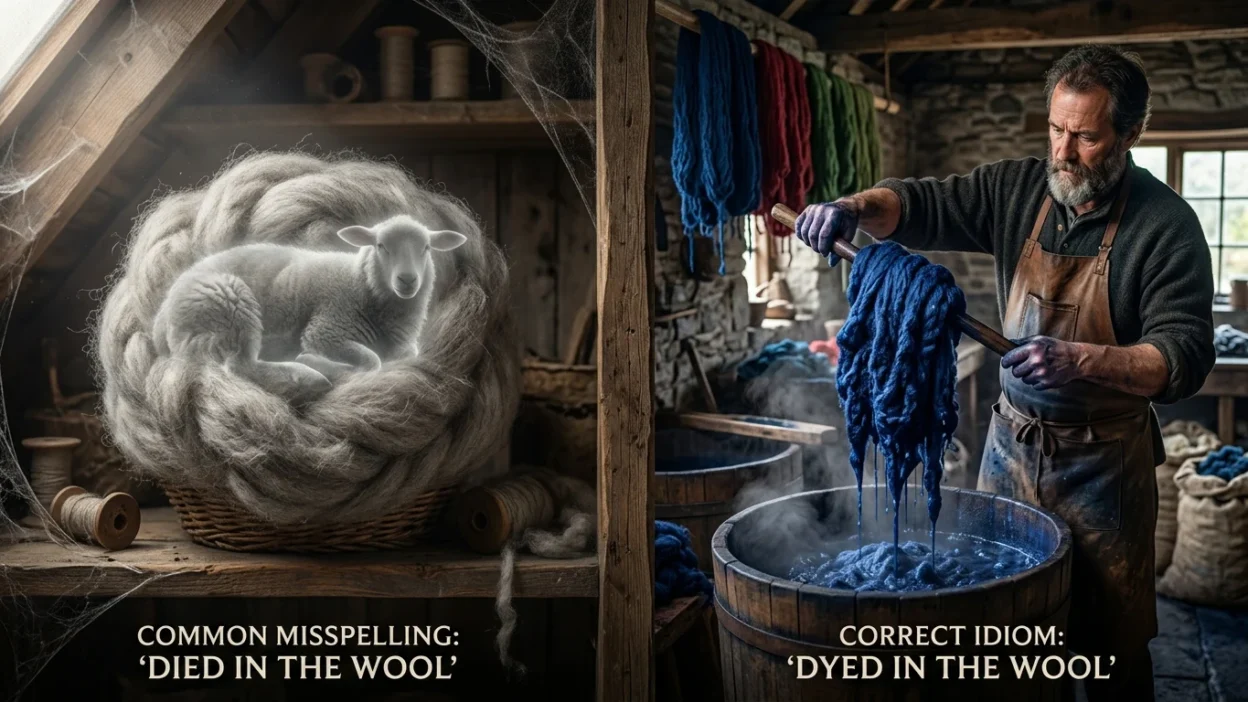
The correct expression is “dyed in the wool,” not “died in the wool,” when you mean that someone is deeply committed to a belief, habit, or way of thinking.
For example, “She is a dyed-in-the-wool traditionalist” means she is a strong and unchanging traditionalist.
The confusion is understandable because dyed and died sound exactly alike in many varieties of English.
However, they come from different words and have completely different meanings.
Dyed is the past tense of dye, meaning to change the color of something. Died is the past tense of die, meaning to stop living.
The idiom “dyed in the wool” comes from the idea of wool being colored before it is made into cloth, suggesting that a quality or belief is deeply fixed and difficult to change.
Quick Answer
The correct idiom is “dyed in the wool.” It describes someone who is deeply committed to a particular belief, habit, identity, or way of thinking. “Died in the wool” is normally a mistake when used with this meaning. The phrase comes from wool that has been dyed thoroughly so its color becomes deeply established.
Why Do People Confuse “Died in the Wool” and “Dyed in the Wool”?
The main reason is pronunciation.
Died and dyed are homophones in standard English: they sound alike but have different spellings and meanings.
- died → past tense of die
- dyed → past tense of dye
The idiom refers to dyeing wool, not dying.
So:
He is a dyed-in-the-wool conservative.
is correct.
The spelling “died-in-the-wool” is a common error caused by hearing the expression rather than seeing it written.
First Word: “Died”
Died is the past tense of die.
It means that a living person, animal, or organism stopped living.
Examples:
The plant died without water.
His grandfather died many years ago.
Several fish died in the pond.
The word died has nothing to do with the traditional idiom “dyed in the wool.”
Although died in the wool can technically form a sequence of English words, it does not express the established idiomatic meaning.
Second Word: “Dyed”
Dyed is the past tense and past participle of dye.
Dye means to change the color of something by using a coloring substance.
Examples:
She dyed her hair brown.
The fabric was dyed blue.
The wool was dyed red.
In the idiom “dyed in the wool,” the word dyed refers to coloring wool.
The expression later developed a figurative meaning: something that is deeply established, ingrained, or unlikely to change.
Died in the Wool vs Dyed in the Wool: Comparison Table
| Expression | Correct idiom? | Meaning | Example |
|---|---|---|---|
| Dyed in the wool | Yes | Deeply committed or firmly established | He is a dyed-in-the-wool traditionalist. |
| Died in the wool | No, for this idiom | Usually a spelling mistake | ❌ She is a died-in-the-wool fan. |
| Died | Yes, as a verb | Stopped living | The plant died. |
| Dyed | Yes, as a verb | Colored with dye | She dyed the fabric. |
When Should You Use “Dyed in the Wool”?
Use “dyed in the wool” when describing someone whose beliefs, preferences, habits, or identity are deeply rooted and firmly established.
It is often used with nouns describing people or their strongly held characteristics.
Common combinations include:
- dyed-in-the-wool traditionalist
- dyed-in-the-wool conservative
- dyed-in-the-wool liberal
- dyed-in-the-wool optimist
- dyed-in-the-wool skeptic
- dyed-in-the-wool fan
- dyed-in-the-wool supporter
- dyed-in-the-wool romantic
- dyed-in-the-wool professional
For example:
She is a dyed-in-the-wool book lover.
This means she is a very committed book lover and is unlikely to stop enjoying books.
The phrase can be positive, neutral, or mildly critical depending on context.
10+ Examples of “Dyed in the Wool”
- He is a dyed-in-the-wool football fan.
- She is a dyed-in-the-wool traditionalist.
- My grandfather was a dyed-in-the-wool gardener.
- They are dyed-in-the-wool supporters of the club.
- She remains a dyed-in-the-wool romantic.
- He is a dyed-in-the-wool skeptic.
- My father is a dyed-in-the-wool coffee lover.
- She is a dyed-in-the-wool professional who takes her work seriously.
- He has always been a dyed-in-the-wool reader.
- The professor is a dyed-in-the-wool advocate of classical education.
- She is a dyed-in-the-wool optimist.
- Even after years abroad, he remained a dyed-in-the-wool traditionalist.
Examples with the literal word “dyed”
Not every use of dyed is part of the idiom.
The wool was dyed blue.
She dyed the fabric by hand.
The artist used naturally dyed cotton.
Here, dyed has its literal meaning: colored with dye.
Common Mistakes
Mistake 1: Writing “died in the wool”
Incorrect:
He is a died-in-the-wool fan.
Correct:
He is a dyed-in-the-wool fan.
Mistake 2: Thinking the idiom is about death
The phrase has nothing to do with dying.
Dyed refers to coloring wool.
Mistake 3: Confusing “dye” and “die”
These are different verbs:
- dye → change the color
- die → stop living
Their past forms are also different:
- dye → dyed
- die → died
Mistake 4: Forgetting the hyphens
When the expression comes before a noun as a compound adjective, it is commonly written:
a dyed-in-the-wool traditionalist
When used after a linking verb, dictionaries and style guides may present the phrase without the same compound-adjective punctuation:
He is dyed in the wool.
The exact punctuation can vary with style and position, but dyed, not died, is the important spelling distinction.
Memory Trick
Remember:
DYE = COLOR
So:
DYED in the wool = colored deeply into the wool.
The image behind the idiom can help you remember its figurative meaning:
Dyed wool has a color that is deeply established.
In the same way, a dyed-in-the-wool person has beliefs or characteristics that are deeply established.
A simple memory sentence is:
“Dyed means colored, and dyed-in-the-wool means deeply fixed.”
American vs British English
“Dyed in the wool” is used in both American and British English with essentially the same figurative meaning.
The spelling is also the same in both varieties:
dyed-in-the-wool
There is no American/British spelling difference between dyed and died in this idiom.
The expression can appear in formal writing, journalism, books, and everyday conversation, although it has a somewhat traditional idiomatic flavor.
Similar Words and Expressions
Several expressions have meanings similar to dyed in the wool.
Deeply rooted
Something firmly established over a long period.
Her love of music is deeply rooted.
Set in one’s ways
Describes someone who is unwilling or unlikely to change their habits or opinions.
He is very set in his ways.
Firmly committed
Describes someone strongly dedicated to a person, cause, activity, or belief.
She is firmly committed to the project.
True-blue
An informal expression for someone who is extremely loyal or faithful.
He is a true-blue supporter of the team.
Ingrained
Describes a habit, belief, or attitude that has become deeply established.
The habit is deeply ingrained.
Die-hard
Describes someone who remains extremely loyal or enthusiastic, especially about a team, activity, or interest.
She is a die-hard basketball fan.
Notice that die-hard really does contain die, but it is a completely different expression from dyed in the wool.
Final Verdict
The correct phrase is “dyed in the wool.”
Use it to describe someone whose beliefs, characteristics, habits, or loyalties are deeply established and difficult to change.
“Died in the wool” is normally an incorrect spelling of the idiom. The difference comes from two homophones:
dyed = colored
died = stopped living
Remember the wool: it was dyed, not died.
Frequently Asked Questions
Is it “died in the wool” or “dyed in the wool”?
The established idiom is “dyed in the wool.” It means deeply committed to or firmly characterized by a particular belief, habit, or identity.
What does “dyed in the wool” mean?
It means deeply established or firmly committed. A dyed-in-the-wool person is unlikely to change their strongly held beliefs, preferences, or loyalties.
Why is it called “dyed in the wool”?
The expression comes from the literal process of dyeing wool. The image suggests that a color becomes deeply established in the wool, which developed into a metaphor for deeply fixed characteristics or beliefs.
Is “died in the wool” ever correct?
The sequence of words can occur literally in an unusual context, but “died in the wool” is not the standard spelling of the idiom meaning deeply committed or firmly established.
Is “dyed-in-the-wool” hyphenated?
When it functions as a compound adjective before a noun, it is commonly hyphenated:
a dyed-in-the-wool traditionalist
The punctuation may differ when the phrase is used in another grammatical position.
What is a synonym for “dyed in the wool”?
Depending on context, alternatives include deeply rooted, firmly committed, ingrained, set in one’s ways, true-blue, and die-hard.
Is “dyed in the wool” formal English?
It is an established English idiom and can appear in both formal and informal writing. However, it has a somewhat traditional or idiomatic tone, so simpler alternatives such as deeply committed may sometimes be clearer.
Remember This
The correct idiom is: DYED IN THE WOOL.
- Dyed = colored
- Died = stopped living
- Dyed-in-the-wool = deeply committed, firmly established, or unlikely to change
Think of wool being dyed deeply with color, and you will remember the correct spelling.
Conclusion
“Dyed in the wool” is the correct expression when you want to describe someone whose beliefs, preferences, habits, or loyalties are deeply established. The phrase comes from the literal idea of wool being thoroughly colored with dye and uses that image to describe something deeply ingrained.
The spelling mistake “died in the wool” happens because died and dyed sound alike. Remember that the idiom comes from dyeing wool, so the correct word is dyed. When you mean someone is strongly and consistently committed to something, write “dyed-in-the-wool.”

Liam Henry is a content author at Synonymed, specializing in vocabulary enrichment and synonym guides. He creates clear, engaging resources that help learners improve English word knowledge and language fluency.