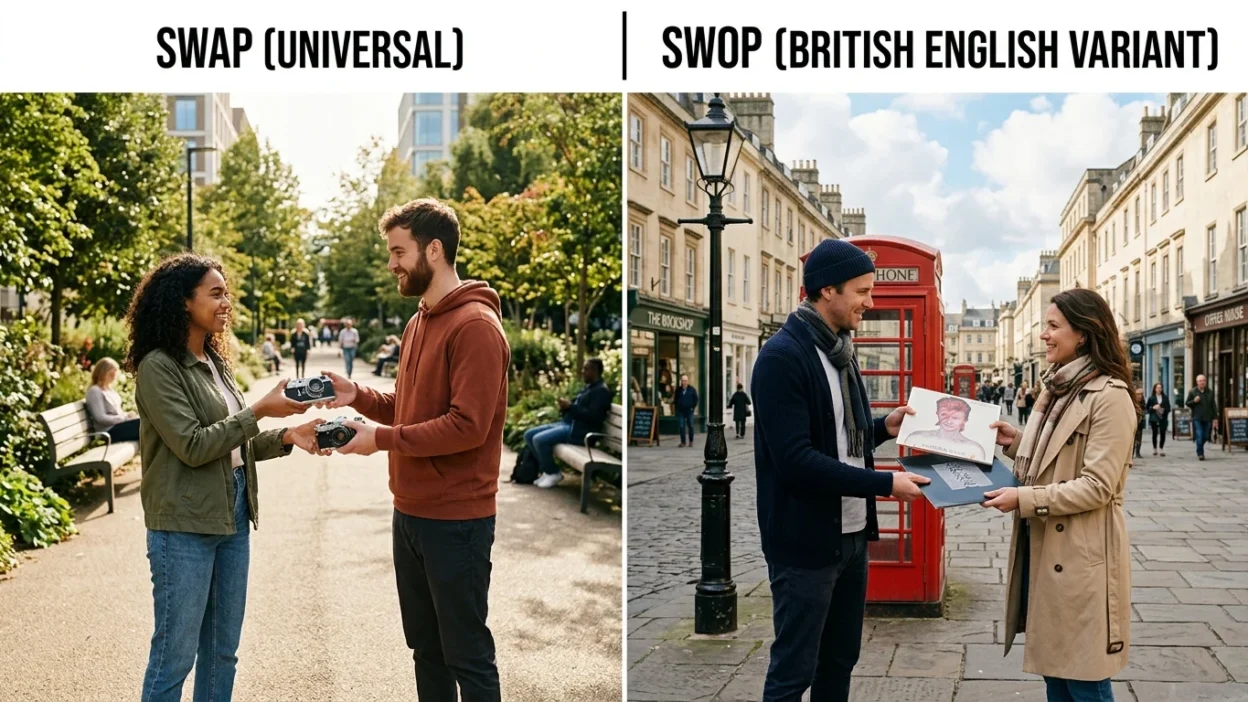
Swap and swop are both recognized English spellings, and they generally have the same meaning: to exchange one thing for another.
However, swap is by far the more common spelling in modern English, especially in American English and in international writing.
Swop is a less common variant, traditionally associated particularly with British English.
For example, you can say, “Would you like to swap seats?” or “We decided to swap books.”
The spelling swop can also be used in these sentences, but it is much less frequent.
If you are a student, ESL learner, or general writer wondering which form to choose, swap is normally the safest and most widely understood option.
The word can function as both a verb and a noun, and it is common in everyday conversation, business, technology, finance, and informal writing.
Quick Answer
Swap and swop mean essentially the same thing: to exchange one thing for another. Swap is the standard and much more common spelling, while swop is a less common variant, especially associated with British English. In most situations, choose swap for natural, widely accepted usage.
Why Do People Confuse “Swap” and “Swop”?
The two words have almost identical meanings and pronunciation.
The main difference is frequency and regional preference, not meaning.
Compare:
Can we swap seats?
Can we swop seats?
Both can mean that the speakers want to exchange seats, but swap is much more common.
The spelling swop can look unusual to many readers because swap is the form they are more accustomed to seeing.
For learners, the easiest approach is to remember:
Swap = the usual spelling.
Swop = an alternative spelling.
First Word: Swap
Swap means to exchange one thing, person, position, or service for another.
It can be used as both a verb and a noun.
“Swap” as a verb
I want to swap seats with you.
We swapped books after class.
She swapped her old phone for a newer one.
Here, swap means exchange.
“Swap” as a noun
Let’s do a swap.
We arranged a book swap.
The two players made a swap.
As a noun, swap refers to an exchange or arrangement in which things are exchanged.
Common expressions with “swap”
- swap places
- swap seats
- swap clothes
- swap stories
- swap ideas
- swap books
- swap gifts
- swap shifts
- swap roles
- swap one thing for another
Second Word: Swop
Swop is a variant spelling of swap.
It has essentially the same meaning:
They decided to swop houses.
Can we swop seats?
However, swop is considerably less common than swap in contemporary general English.
You may encounter swop in British English, older writing, regional usage, or individual preferences. It is not normally necessary to use it when writing for a broad international audience.
For most learners, swap is the better default.
Swap vs Swop: Comparison Table
| Feature | Swap | Swop |
|---|---|---|
| Meaning | Exchange one thing for another | Exchange one thing for another |
| Part of speech | Verb and noun | Verb and noun |
| Commonness | Very common | Less common |
| American English | Common | Rare |
| British English | Common | Used as a variant |
| International writing | Recommended default | Less familiar to some readers |
| Example | Let’s swap seats. | Let’s swop seats. |
When Should You Use Each?
Use “swap” in most situations
Swap is the safest choice for everyday English, academic writing, business communication, websites, and international audiences.
We can swap shifts next week.
Would you like to swap books?
They agreed to swap apartments.
Use “swop” when the variant fits your audience or style
Swop is not necessarily wrong. It is an established variant of swap.
You may see it in British English or in writing where the writer prefers that spelling.
The children decided to swop toys.
However, if you are learning English or writing for readers from different countries, swap is usually the clearer choice.
10+ Examples of Swap and Swop
Examples with “swap”
- Can we swap seats?
- I swapped my blue shirt for a black one.
- The students swapped books.
- We decided to swap gifts at Christmas.
- Can you swap shifts with me tomorrow?
- They swapped houses for the summer.
- Let’s swap ideas before the meeting.
- The children swapped toys.
- She swapped her old laptop for a newer model.
- The two teams agreed to swap players.
Examples with “swop”
- The children decided to swop toys.
- Would you like to swop seats?
- They agreed to swop houses for a week.
- We could swop books after the class.
The meaning in these pairs is essentially the same. The main difference is the spelling and how commonly each form is used.
Common Mistakes
Mistake 1: Thinking “swop” has a different meaning
In ordinary usage, swop is simply a variant of swap.
swap seats = swop seats
The basic meaning remains exchange.
Mistake 2: Assuming “swop” is always incorrect
Swop is a recognized English variant. It is less common, but it is not simply a spelling error.
Mistake 3: Using “swop” when you want the most widely understood form
Although correct in appropriate contexts, swop may look unfamiliar to some readers.
For general or international writing, swap is usually preferable.
Mistake 4: Confusing “swap” with “switch”
These words overlap but are not always identical.
Swap usually emphasizes an exchange:
We swapped seats.
Switch can mean changing from one thing to another:
I switched seats.
Both can be natural, but the emphasis can differ.
Memory Trick
Remember:
SWAP = the standard choice.
If you are unsure which spelling to use, choose swap.
You can also remember the meaning with:
Swap = exchange.
For example:
Swap my book for your book.
means:
Exchange my book for your book.
And if you see swop, simply remember that it is an alternative spelling of the same word.
American vs British English
The word swap is common in both American and British English.
Swop is also found in British English, where it has traditionally been used as a variant spelling, but it is much less common than swap.
In American English, swap is overwhelmingly the normal choice for general usage.
Therefore, if you are writing for an international audience, swap is the safest and most familiar form.
Similar Words
Exchange
To give one thing and receive another in return.
We exchanged gifts.
Exchange is often more formal than swap.
Trade
To exchange goods, services, or items.
They traded baseball cards.
Switch
To change from one thing, position, or option to another.
We switched seats.
Replace
To take the place of something or someone.
They replaced the old equipment.
Unlike swap, replace does not necessarily involve an exchange between two parties.
Barter
To exchange goods or services without using money.
They bartered food for tools.
Interchange
To exchange or use things in place of one another, often in more formal or technical contexts.
Final Verdict
Swap and swop generally mean the same thing: to exchange one thing for another.
The important difference is usage. Swap is the much more common spelling and is the best default for most situations. Swop is a recognized variant, particularly associated with British English, but it is less familiar and less frequently used.
So, if you are wondering which one to write, choose:
Swap ✅
Use swop when the context, audience, or style specifically supports that variant.
Frequently Asked Questions
Is “swap” or “swop” correct?
Both are recognized spellings with essentially the same meaning. Swap is much more common and is generally the preferred spelling.
Is “swop” British or American?
Swop is particularly associated with British English as a variant spelling. Swap is common in both British and American English.
Is “swop” a real word?
Yes. Swop is an established variant of swap, meaning to exchange one thing for another.
Which is more common, swap or swop?
Swap is considerably more common in contemporary English. It is the best default for students and international readers.
Can I use “swap” in formal writing?
Yes. Swap is a standard English word and can be used in formal writing when its meaning is appropriate. In particularly formal contexts, exchange may sometimes be preferred.
What is the difference between swap and exchange?
Both can mean giving one thing and receiving another. Swap is generally more informal and conversational, while exchange can sound more neutral or formal.
Does swap mean trade?
Sometimes. Swap and trade can overlap when people exchange items, but trade can also refer specifically to commercial activity or the buying and selling of goods and services.
Remember This
Swap = the usual spelling.
Swop = a less common variant spelling.
Both can mean exchange.
If you are unsure which form to use, write swap:
Let’s swap seats.
We swapped books.
Can we swap shifts?
Conclusion
The choice between swap and swop is mostly a matter of spelling preference and frequency. Both words can mean to exchange one thing for another, and both can function as nouns and verbs. However, swap is much more common in modern English and is widely used in American, British, and international English.
Swop remains a valid variant, particularly in British usage, but it is less familiar to many readers. For students, ESL learners, professional writers, and anyone writing for a broad audience, swap is the simplest and safest choice. When you see swop, remember that it generally means the same thing as swap.

Liam Henry is a content author at Synonymed, specializing in vocabulary enrichment and synonym guides. He creates clear, engaging resources that help learners improve English word knowledge and language fluency.