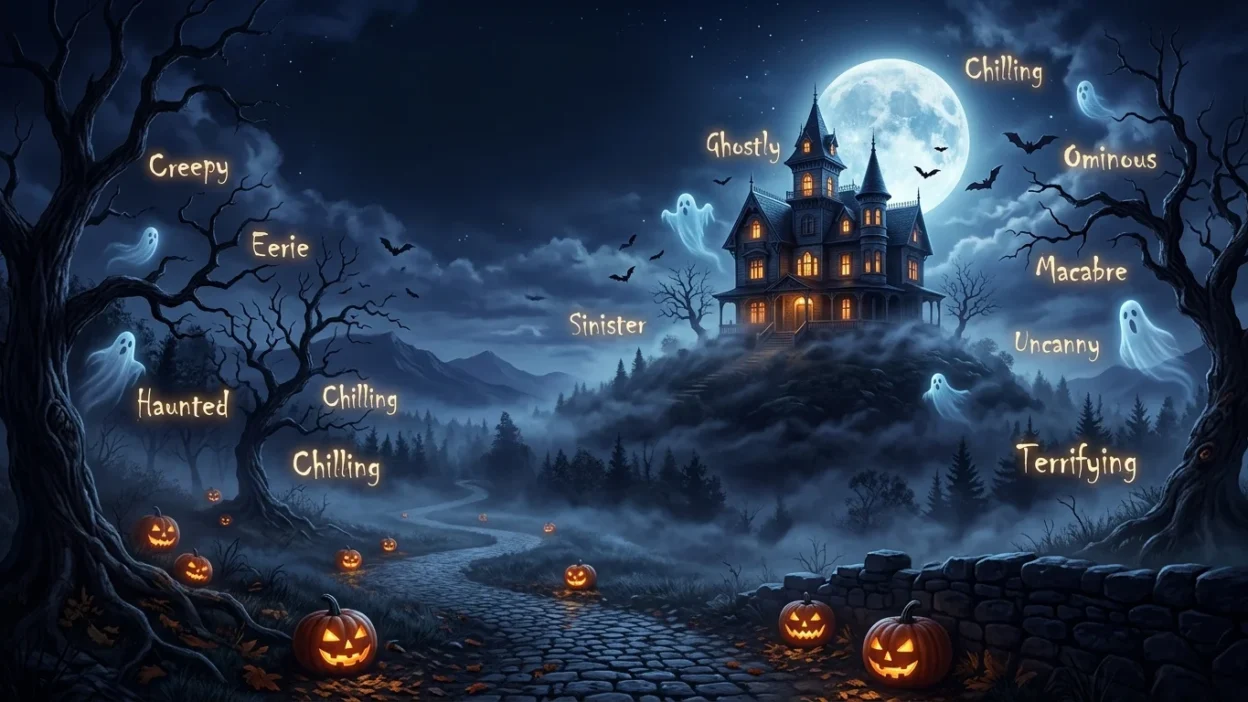
If you want to improve your vocabulary, learning spooky synonyms is a great place to start.
If you are a student, an ESL learner, a writer, or a content creator, using different words instead of repeating “spooky” can make your writing more interesting and natural.
Different synonyms carry different emotions and meanings. Some describe something slightly mysterious, while others create feelings of fear, darkness, or the supernatural.
Understanding these differences helps you choose the perfect word for every situation.
Understanding the Meaning of “Spooky”
What Does “Spooky” Mean?
The word spooky describes something that feels strange, frightening, mysterious, or connected with ghosts or supernatural events. It often creates a feeling of uneasiness without being extremely terrifying.
People use “spooky” to describe haunted houses, dark forests, mysterious sounds, ghost stories, unusual events, or even situations that seem strangely coincidental.
Example:
The old house looked spooky after sunset.
30 Spooky Synonyms with Meanings and Examples
1. Creepy
Meaning: Causing an uncomfortable feeling of fear.
Example Sentence: The empty hallway felt creepy at night.
Best Usage Context: Everyday conversations and horror stories.
2. Eerie
Meaning: Strange and frightening in a quiet way.
Example Sentence: An eerie silence filled the abandoned village.
Best Usage Context: Describing mysterious places.
3. Haunted
Meaning: Believed to have ghosts.
Example Sentence: Everyone avoided the haunted mansion.
Best Usage Context: Ghost stories and supernatural topics.
4. Ghostly
Meaning: Looking or feeling like a ghost.
Example Sentence: A ghostly figure appeared through the fog.
Best Usage Context: Paranormal writing.
5. Supernatural
Meaning: Beyond normal scientific explanation.
Example Sentence: The movie explored supernatural events.
Best Usage Context: Fantasy and horror.
6. Mysterious
Meaning: Difficult to explain or understand.
Example Sentence: A mysterious light appeared in the sky.
Best Usage Context: General writing.
7. Sinister
Meaning: Suggesting danger or evil.
Example Sentence: He smiled with a sinister expression.
Best Usage Context: Villains and dark settings.
8. Frightening
Meaning: Causing fear.
Example Sentence: The loud scream was frightening.
Best Usage Context: Everyday descriptions.
9. Chilling
Meaning: Creating a strong feeling of fear.
Example Sentence: The chilling story kept everyone awake.
Best Usage Context: Horror stories.
10. Ominous
Meaning: Suggesting something bad will happen.
Example Sentence: Dark clouds created an ominous mood.
Best Usage Context: Suspense writing.
11. Macabre
Meaning: Related to death in a disturbing way.
Example Sentence: The museum displayed macabre artwork.
Best Usage Context: Gothic literature.
12. Uncanny
Meaning: Strange because it seems unusually real.
Example Sentence: The doll had an uncanny resemblance to a child.
Best Usage Context: Psychological stories.
13. Hair-Raising
Meaning: Extremely frightening.
Example Sentence: The roller coaster was a hair-raising experience.
Best Usage Context: Exciting or scary experiences.
14. Bone-Chilling
Meaning: Extremely cold or frightening.
Example Sentence: The bone-chilling scream echoed through the woods.
Best Usage Context: Horror writing.
15. Dark
Meaning: Full of mystery, fear, or evil.
Example Sentence: The cave had a dark atmosphere.
Best Usage Context: General descriptions.
16. Grim
Meaning: Serious, gloomy, or depressing.
Example Sentence: The castle had a grim appearance.
Best Usage Context: Gothic settings.
17. Gloomy
Meaning: Dark and depressing.
Example Sentence: The gloomy forest looked deserted.
Best Usage Context: Describing weather or places.
18. Shadowy
Meaning: Full of shadows or unclear shapes.
Example Sentence: Shadowy figures moved through the alley.
Best Usage Context: Mystery writing.
19. Weird
Meaning: Very unusual or strange.
Example Sentence: That noise sounded weird.
Best Usage Context: Casual English.
20. Strange
Meaning: Unusual or unexpected.
Example Sentence: Something strange happened yesterday.
Best Usage Context: Everyday communication.
21. Scary
Meaning: Causing fear.
Example Sentence: The movie was really scary.
Best Usage Context: Informal conversations.
22. Terrifying
Meaning: Extremely frightening.
Example Sentence: The storm was terrifying.
Best Usage Context: Strong emotional descriptions.
23. Horrifying
Meaning: Causing horror or shock.
Example Sentence: The accident was horrifying.
Best Usage Context: Serious situations.
24. Phantom
Meaning: Like a ghost or spirit.
Example Sentence: People claimed to see a phantom rider.
Best Usage Context: Ghost stories.
25. Spectral
Meaning: Resembling a ghost.
Example Sentence: Spectral lights floated across the field.
Best Usage Context: Literary writing.
26. Otherworldly
Meaning: Seeming to belong to another world.
Example Sentence: The glowing cave looked otherworldly.
Best Usage Context: Fantasy and science fiction.
27. Menacing
Meaning: Appearing dangerous or threatening.
Example Sentence: The dog’s menacing growl frightened everyone.
Best Usage Context: Action and suspense.
28. Foreboding
Meaning: Creating a feeling that something bad is coming.
Example Sentence: A foreboding silence covered the town.
Best Usage Context: Suspenseful scenes.
29. Ghastly
Meaning: Shockingly unpleasant or ghost-like.
Example Sentence: The ghastly sight frightened the visitors.
Best Usage Context: Horror descriptions.
30. Spine-Tingling
Meaning: Giving a thrilling feeling of fear.
Example Sentence: It was a spine-tingling ghost story.
Best Usage Context: Entertainment and storytelling.
Comparison Guide for Spooky Synonyms
When Should You Use Each Synonym?
| Synonym | Best For | Strength |
|---|---|---|
| Creepy | Everyday scary situations | Mild |
| Eerie | Quiet mystery | Mild |
| Haunted | Ghost locations | Medium |
| Ghostly | Ghost-like appearance | Medium |
| Mysterious | Unknown situations | Mild |
| Sinister | Evil characters | Strong |
| Chilling | Horror stories | Strong |
| Ominous | Building suspense | Medium |
| Macabre | Death-related topics | Strong |
| Uncanny | Strange similarities | Medium |
| Terrifying | Extreme fear | Very Strong |
| Scary | Casual conversations | Mild |
| Foreboding | Suspense | Medium |
| Menacing | Threatening people or animals | Medium |
| Otherworldly | Fantasy settings | Mild |
How to Choose the Right Synonym
For Everyday Conversations
Choose words like:
- Scary
- Weird
- Strange
- Creepy
These are common, simple, and easy to understand.
For Horror Stories
Words that work best include:
- Chilling
- Bone-Chilling
- Terrifying
- Spine-Tingling
- Ghastly
These create stronger feelings of fear.
For Ghost and Supernatural Writing
Good choices are:
- Haunted
- Ghostly
- Phantom
- Spectral
- Supernatural
These fit stories about spirits and paranormal events.
For Mystery and Suspense
Use words such as:
- Eerie
- Ominous
- Foreboding
- Shadowy
- Mysterious
These build suspense without revealing too much.
For Literary or Creative Writing
Advanced options include:
- Macabre
- Uncanny
- Otherworldly
- Sinister
- Grim
These add depth and sophistication to your writing.
Why Learning Spooky Synonyms Matters
Improve Your Vocabulary
Using different words instead of repeating “spooky” makes your writing richer and more engaging.
Write More Naturally
Different situations require different words. Choosing the right synonym helps readers better understand the mood you want to create.
Sound More Fluent
ESL learners can sound more natural by learning several words with similar meanings and understanding when to use each one.
Create Better Stories
Writers can build suspense, mystery, or horror more effectively by selecting precise vocabulary.
Common Mistakes to Avoid
Using Every Synonym Interchangeably
Although these words are similar, they are not identical. Always consider the tone and context.
Choosing Words That Are Too Strong
If something is only slightly unsettling, “creepy” or “eerie” may fit better than “terrifying.”
Ignoring Your Audience
Simple words are best for beginners, while advanced readers may appreciate words like “macabre” or “uncanny.”
Conclusion
Learning spooky synonyms helps you become a stronger writer and communicator. Each synonym carries its own shade of meaning, from the mild mystery of eerie to the intense fear of terrifying. By understanding these subtle differences, you can write with greater precision, improve your English vocabulary, and make your stories, essays, and conversations more vivid and engaging. Keep practicing these words in different contexts, and you’ll soon feel more confident choosing the perfect synonym for every situation.