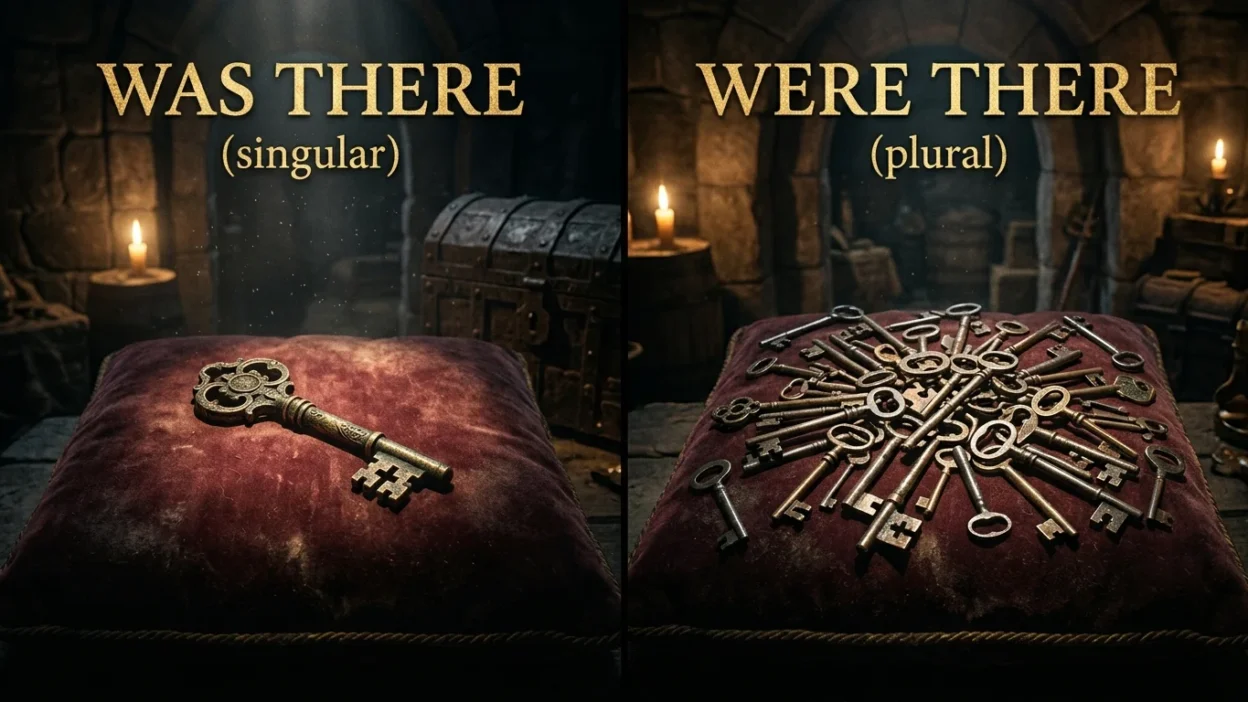
“Was there” and “were there” are both correct, but you use them with different kinds of nouns.
Use “was there” with a singular noun or an uncountable noun, and use “were there” with a plural noun. For example, “Was there a problem?” is correct because problem is singular, while “Were there any problems?” is correct because problems is plural.
This distinction becomes especially important in questions and sentences that begin with there was or there were
English learners sometimes choose was or were based on the word closest to the verb, but the better approach is to identify the noun whose existence you are describing.
Once you understand whether that noun is singular, plural, or uncountable, choosing between was there and were there becomes much easier.
Quick Answer
Use “was there” with a singular or uncountable noun: “Was there a mistake?” or “Was there enough food?” Use “were there” with a plural noun: “Were there any mistakes?” or “Were there enough chairs?” The noun after there determines whether you need was or were.
Why Do People Confuse “Was There” and “Were There”?
The confusion usually happens because there does not tell us whether the subject is singular or plural.
Compare:
Was there a student in the classroom?
Were there students in the classroom?
The word there stays the same. What changes is the noun:
- a student → singular → was
- students → plural → were
Another common source of confusion is that the sentence may begin with there, making the normal subject-verb pattern feel less obvious.
The same rule applies to statements:
There was a problem.
There were several problems.
When these statements become questions, they change to:
Was there a problem?
Were there several problems?
First Word: “Was”
Was is the past-tense form of be used with singular subjects such as I, he, she, it, and singular nouns.
In “Was there…?”, use was when the noun that follows is singular or uncountable.
Singular examples
Was there a reason?
Was there a mistake?
Was there a meeting yesterday?
Was there a restaurant nearby?
Uncountable examples
Uncountable nouns are treated as singular in standard English.
Was there enough water?
Was there any information available?
Was there enough time?
Was there much traffic?
So, although water, information, time, and traffic can refer to large amounts, they take was in these constructions.
Second Word: “Were”
Were is the past-tense form of be used with plural subjects.
In “Were there…?”, use were when the noun is plural.
Plural examples
Were there any problems?
Were there two meetings?
Were there enough chairs?
Were there many people at the event?
Were there any tickets left?
The important point is that were agrees with the plural noun, not with the word there.
Was There vs Were There: Comparison Table
| Expression | Use it with | Example |
|---|---|---|
| Was there | Singular nouns | Was there a problem? |
| Was there | Uncountable nouns | Was there enough water? |
| Were there | Plural nouns | Were there any problems? |
| Were there | Two or more countable things | Were there three students? |
| Was there | One person or thing | Was there a doctor? |
| Were there | Several people or things | Were there any doctors? |
When Should You Use “Was There” or “Were There”?
Use “was there” for one person or thing
If the noun is singular, use was there.
Was there a book on the table?
Was there a student outside?
Was there an accident?
A useful pattern is:
Was there + a/an + singular noun?
Use “was there” with uncountable nouns
Use was when the noun cannot normally be counted individually.
Was there enough milk?
Was there any sugar?
Was there useful information in the report?
Was there much noise?
Use “were there” for multiple people or things
If the noun is plural, use were there.
Were there books on the table?
Were there students outside?
Were there any accidents?
A useful pattern is:
Were there + plural noun?
10+ Examples of “Was There” and “Were There”
Examples with “was there”
- Was there a problem with the computer?
- Was there a meeting yesterday?
- Was there a message for me?
- Was there an accident on the road?
- Was there enough food for everyone?
- Was there any water in the bottle?
- Was there a reason for the delay?
- Was there much traffic this morning?
Examples with “were there”
- Were there any problems with the computer?
- Were there several meetings yesterday?
- Were there any messages for me?
- Were there any accidents on the road?
- Were there enough chairs for everyone?
- Were there many people at the station?
- Were there any students in the classroom?
- Were there three books on the desk?
Compare singular and plural
Was there a student in the room?
One student is mentioned, so was is correct.
Were there students in the room?
More than one student is mentioned, so were is correct.
Common Mistakes
Mistake 1: Using “was” with a plural noun
Incorrect:
Was there many people?
Correct:
Were there many people?
People is plural, so use were.
Mistake 2: Using “were” with a singular noun
Incorrect:
Were there a problem?
Correct:
Was there a problem?
A problem is singular.
Mistake 3: Choosing the verb based on “there”
Some learners think there is singular or plural.
It is neither. In this structure, there introduces the existence of something.
Look at the noun instead:
Was there a reason?
Were there several reasons?
Mistake 4: Using “was there” because the sentence starts with “there”
The position of there does not change the agreement.
There was a problem.
becomes:
Was there a problem?
And:
There were problems.
becomes:
Were there problems?
Mistake 5: Confusing “there” and “their”
These words sound similar in some varieties of English, but they have different meanings.
- there = refers to a place or introduces existence
- their = shows possession
Were there any students?
Their books were on the desk.
Memory Trick
Remember this simple rule:
One = WAS
More than one = WERE
Think:
Was there a cat? 🐈
One cat → was
Were there cats? 🐈🐈
More than one → were
For uncountable nouns, think of them as grammatically singular:
Was there enough water?
American vs British English
The basic rule is the same in American and British English.
Both varieties normally use:
Was there a problem?
and:
Were there any problems?
The same distinction applies to uncountable nouns:
Was there enough information?
Regional differences may sometimes affect informal speech or particular constructions, but they do not change the basic rule for standard English: singular and uncountable nouns take was; plural nouns take were.
Similar Words and Expressions
Several expressions are closely related to was there and were there.
There was
Used in statements with singular or uncountable nouns.
There was a problem.
There was enough food.
There were
Used in statements with plural nouns.
There were several problems.
There were many people.
Is there
Present-tense version for singular or uncountable nouns.
Is there a problem?
Is there enough time?
Are there
Present-tense version for plural nouns.
Are there any problems?
Are there enough chairs?
Was it there?
This has a slightly different structure. Here, it is the subject.
Was it there yesterday?
Final Verdict
Use “was there” when the noun is singular or uncountable:
Was there a problem?
Was there enough time?
Use “were there” when the noun is plural:
Were there any problems?
Were there enough chairs?
The easiest rule is: look at the noun that follows “there.” One or uncountable = was; more than one = were.
Frequently Asked Questions
Is it “was there” or “were there”?
Both are correct. Use was there with singular or uncountable nouns and were there with plural nouns.
Is “Was there any problems?” correct?
No, not in standard English. Because problems is plural, the correct form is:
Were there any problems?
Is “Were there a problem?” correct?
No. A problem is singular, so the correct question is:
Was there a problem?
Is it “was there any” or “were there any”?
It depends on the noun that follows.
Was there any water? — water is uncountable.
Were there any bottles? — bottles is plural.
Is “Was there people” grammatically correct?
In standard English, use:
Were there people at the party?
People is plural.
What is the difference between “there was” and “there were”?
There was is used with singular or uncountable nouns, while there were is used with plural nouns.
There was a book.
There were books.
How do you remember was there vs were there?
Use the simple rule one = was, more than one = were. Also remember that uncountable nouns are normally treated as singular and therefore take was.
Remember This
Was there + singular or uncountable noun
Was there a problem?
Was there enough water?
Were there + plural noun
Were there any problems?
Were there enough bottles?
Do not let the word there confuse you. Find the noun and decide whether it is singular, plural, or uncountable.
Conclusion
The difference between was there and were there is mainly a matter of subject-verb agreement. Use was there when you are asking about one person, one thing, or an uncountable amount. Use were there when you are asking about two or more people or things.
Once you focus on the noun rather than the word there, the choice becomes straightforward. Remember “one = was” and “more than one = were.” With this simple rule, you can confidently form questions about people, objects, events, places, amounts, and situations in the past.