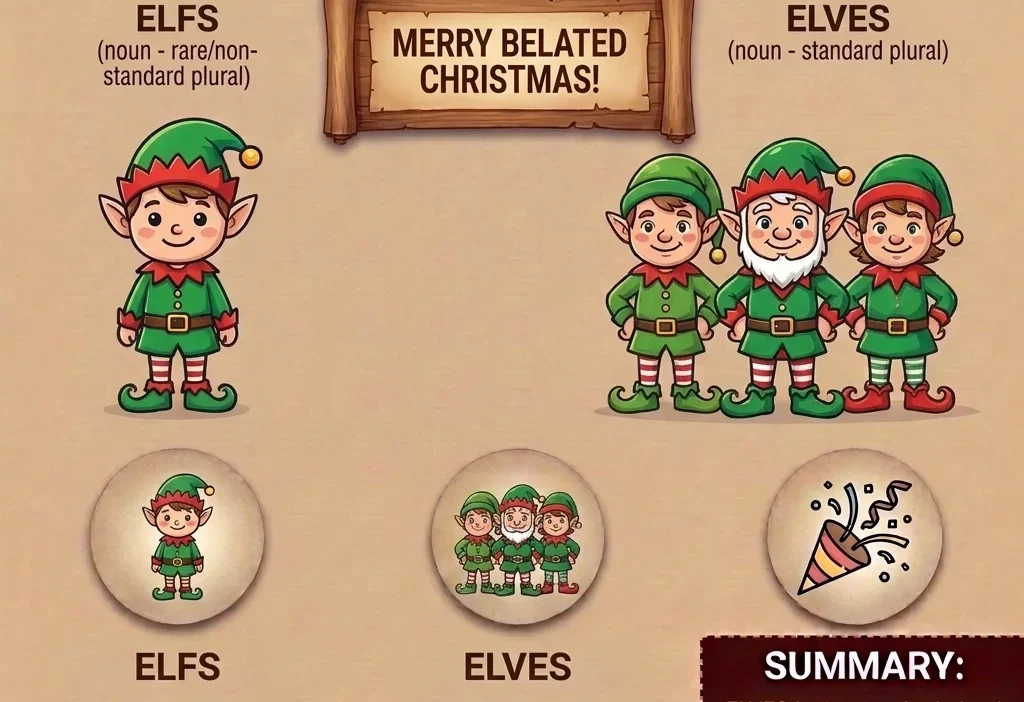
If you are wondering whether the plural of elf is “elfs” or “elves,” the standard and correct plural form is “elves.”
For example, you would write, “The elves live in the forest.” Elfs is generally considered incorrect in standard modern English when you mean more than one elf.
The word elf refers to a mythical or legendary creature, often described as a small magical being with pointed ears.
The plural spelling can be confusing because many English nouns ending in -f simply add -s, while others change -f to -ves.
For example, roof becomes roofs, but leaf becomes leaves. Elf belongs to the group that traditionally changes to elves.
Learning this spelling is useful for writing about fantasy stories, folklore, Christmas traditions, games, books, and fictional characters.
Quick Answer
The correct standard plural of elf is “elves.” Elfs is not normally used in standard modern English. Say one elf and two elves. The spelling follows a traditional English plural pattern in which -f changes to -ves.
Why People Confuse It
The confusion comes from English plural rules.
Many nouns ending in -f or -fe form their plurals by adding -s:
- roof → roofs
- chief → chiefs
- belief → beliefs
- safe → safes
However, some nouns change -f or -fe to -ves:
- leaf → leaves
- wolf → wolves
- knife → knives
- wife → wives
- life → lives
Elf follows the second pattern:
elf → elves
Because English has exceptions and different plural patterns, it is easy to assume that elfs should work like roofs or chiefs. In standard usage, however, elves is the form to use.
First Word: Elfs
Elfs is generally not the standard plural form of elf in modern English.
If you are writing ordinary English and mean multiple mythical creatures, use elves, not elfs.
For example:
Incorrect in standard usage: The elfs danced under the moon.
Correct: The elves danced under the moon.
Although elfs can occasionally appear in specialized, historical, or intentionally nonstandard contexts, it is not the normal plural spelling that students and general readers should use.
Second Word: Elves
Elves is the standard plural of elf.
- Singular: elf
- Plural: elves
An elf is a mythical or folkloric being. In modern fantasy, elves are often portrayed as magical creatures, sometimes with pointed ears and supernatural abilities.
Examples:
- One elf was sitting by the tree.
- Three elves entered the room.
- The story features a group of elves.
- Santa’s elves are busy making toys.
Comparison Table
| Word | Correct? | Meaning | Example |
|---|---|---|---|
| Elf | Yes | One mythical creature | An elf appeared in the story. |
| Elves | Yes | More than one elf | The elves helped the wizard. |
| Elfs | Generally no | Intended as plural of elf | Use elves instead. |
When to Use Each
Use “elf” for one
Use elf when you are talking about a single creature.
I saw an elf in the painting.
The elf was wearing a green coat.
Use “elves” for more than one
Use elves when you are talking about two or more elves.
The elves were preparing for the festival.
Several elves lived in the enchanted forest.
What about “elfs”?
For normal modern English, avoid elfs when you mean the plural of elf. In schoolwork, formal writing, articles, stories, and everyday communication, elves is the appropriate form.
12 Examples
- The elf lived in a magical forest.
- The elves helped the old wizard.
- I read a story about three elves.
- The Christmas elves were making toys.
- An elf appeared beside the door.
- The children dressed as elves for the school play.
- The fantasy game contains hundreds of elves.
- A friendly elf gave her a small gift.
- The elves gathered around the ancient tree.
- The book describes several different types of elves.
- The young elf wanted to become a great warrior.
- The village was protected by a group of elves.
Common Mistakes
Mistake 1: Writing “elfs” as the plural
Incorrect:
There were five elfs in the story.
Correct:
There were five elves in the story.
Mistake 2: Assuming every word ending in -f takes -s
English does not have one universal rule for nouns ending in -f.
Compare:
- roof → roofs
- chef → chefs
- elf → elves
- wolf → wolves
- leaf → leaves
The plural form must often be learned individually.
Mistake 3: Confusing “elves” with another word
Elves is simply the plural of elf. The -ves ending does not create a separate meaning.
One elf → two elves
Mistake 4: Using “elfs” because it sounds natural
English spelling does not always follow pronunciation or a simple plural rule. Even if elfs seems logical, the standard plural is elves.
Memory Trick
Remember:
One elf, two elves.
You can connect elf with leaf:
leaf → leaves
elf → elves
Both change -f to -ves.
American vs British English
There is no significant difference between American and British English here.
Both American and British English use elf as the singular and elves as the standard plural.
So whether you are writing for an American or British audience:
elf → elves
The spelling does not change based on the variety of English.
Similar Words
Dwarf → dwarfs / dwarves
The plural of dwarf has an interesting variation. Dwarfs is common in general modern usage, while dwarves is especially associated with fantasy and the works or influence of J. R. R. Tolkien.
Wolf → wolves
Like elf, wolf changes -f to -ves:
one wolf → two wolves
Leaf → leaves
This follows the same spelling pattern:
one leaf → several leaves
Knife → knives
Another familiar example is:
one knife → two knives
Wife → wives
The same change occurs here:
one wife → two wives
These examples can help you remember why elves, rather than elfs, is the standard plural.
Final Verdict
The correct standard plural of elf is elves.
Elf = one mythical creature.
Elves = two or more mythical creatures.
Elfs = generally not the standard modern plural.
So, if you are writing a sentence about multiple magical creatures, write:
The elves were hiding in the forest.
FAQs
Is “elfs” or “elves” correct?
Elves is the standard and correct plural form of elf in modern English.
What is the plural of elf?
The plural of elf is elves.
one elf → two elves
Why does elf become elves?
Elf follows a traditional English plural pattern in which some nouns ending in -f change to -ves in the plural.
Is “elfs” ever correct?
Elfs is not the normal standard plural of elf. It may occasionally appear in historical or specialized usage, but elves is the appropriate form for standard modern English.
What is the singular of elves?
The singular form of elves is elf.
one elf → many elves
Is “elves” used in both American and British English?
Yes. Elves is the standard plural in both American and British English.
How do you pronounce “elves”?
Elves is pronounced approximately like “elvz,” with a voiced v sound at the end.
Remember This
- One = elf
- More than one = elves
- Elfs is generally not the standard plural.
- Elf → elves, like leaf → leaves.
- American and British English both use elves.
Conclusion
If you are choosing between elfs and elves, use elves in standard modern English. The singular noun is elf, while the plural noun is elves. This spelling is used when talking about multiple mythical creatures in folklore, fantasy, Christmas stories, games, and literature.
The unusual plural can be remembered with a simple pattern: one elf, two elves. Although many English words ending in -f take -s, some change to -ves, and elf belongs to that group. When writing about more than one elf, elves is the clear and conventional choice.