
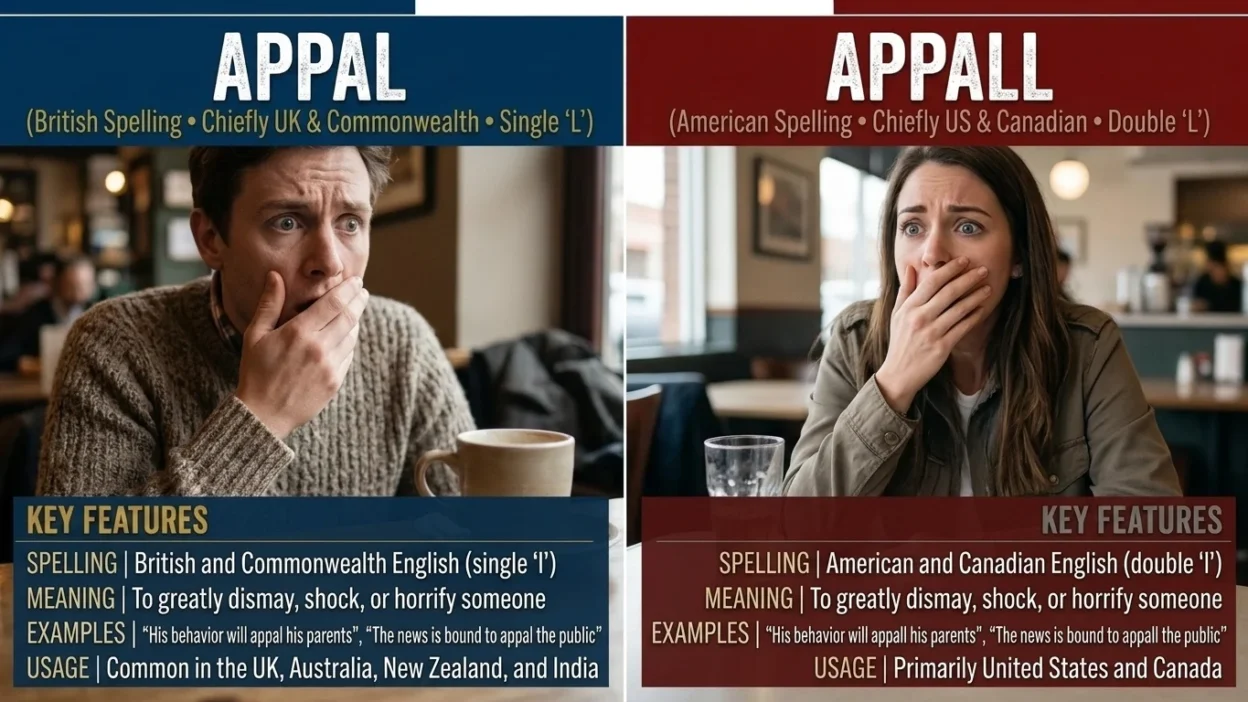
The words appal and appall have the same meaning, but they differ in spelling.
Both verbs mean to shock, horrify, or deeply upset someone. For example, “The news appalled everyone” means the news shocked everyone greatly.
Although these words look slightly different, neither is more correct than the other.
Understanding the difference between appal and appall can help you avoid spelling mistakes in essays, professional writing, emails, and everyday English.
The main challenge is knowing which spelling to choose for your audience.
British English commonly uses appal, while American English generally prefers appall.
Both forms are recognized English spellings, and their meanings and grammatical functions are the same.
Once you understand this regional spelling difference, you can use the word confidently in different contexts.
Learning its definition, pronunciation, related words, and common sentence patterns will also help you express strong feelings of shock or horror more accurately.
Quick Answer: Appal vs Appall
Appal and appall mean to shock, horrify, or deeply upset someone. The difference is regional spelling: appal is generally preferred in British English, while appall is standard in American English. For example, “The decision appalled the public” and “The decision appalled the public” have the same meaning and are both correct.
Why Do People Confuse Appal and Appall?
People confuse appal and appall because the words have identical meanings and pronunciation. The only difference is the spelling convention commonly followed in different varieties of English.
Both words describe a strong emotional reaction to something shocking, disturbing, or unacceptable.
Examples:
- The cruelty of the act appalled the witnesses.
- The cruelty of the act appalled the witnesses.
The sentences mean exactly the same thing. The spelling of the base verb differs between British and American usage, but the past-tense form appalled is spelled the same way in both varieties.
The easiest way to avoid confusion is to choose a spelling convention and use it consistently throughout your writing.
What Does “Appal” Mean?
Appal is a verb that means to shock, horrify, or cause someone to feel deep dismay or disgust. It is commonly used in British English.
You can use appal when describing a reaction to cruelty, injustice, shocking behavior, disturbing news, or an unacceptable situation.
Common Uses of Appal
The word appal is often used when something causes strong feelings of:
- Shock
- Horror
- Disgust
- Deep disappointment
- Moral outrage
Examples:
- The violence appalled the community.
- His rude behavior did not appal his friends.
- The report is likely to appal readers.
- The level of corruption appalled the public.
How to Use Appal in a Sentence
Use appal when the subject causes another person to feel shocked or horrified.
For example:
The treatment of the animals appalled the visitors.
This means the visitors felt deep shock or disgust because of how the animals were treated.
The word can appear in different grammatical forms:
- Base form: appal
- Third-person singular: appals
- Past tense: appalled
- Present participle: appalling
- Past participle: appalled
Examples:
- The incident may appal the public.
- The behavior appals her.
- The news appalled us.
- The appalling conditions shocked the workers.
In British English, these forms are standard.
What Does “Appall” Mean?
Appall is a verb that means to shock, horrify, or deeply upset someone. It has the same meaning and grammatical function as appal, but it is the preferred spelling in American English.
Use appall when describing something that produces an intense negative emotional reaction.
Common Uses of Appall
Examples include:
- The crime appalled the nation.
- The decision appalls many people.
- The discovery appalled the investigators.
- The conditions appall anyone who sees them.
How to Use Appall in a Sentence
Use appall when something causes someone to feel shocked, horrified, or deeply disturbed.
For example:
The news appalled the entire community.
This means the news caused widespread shock or horror.
The word has the following forms:
- Base form: appall
- Third-person singular: appalls
- Past tense: appalled
- Present participle: appalling
- Past participle: appalled
Examples:
- The proposal may appall voters.
- His behavior appalls me.
- The discovery appalled everyone.
- The appalling conditions required immediate action.
These spellings are standard in American English.
Appal vs Appall: Comparison Table
| Feature | Appal | Appall |
|---|---|---|
| Meaning | To shock or horrify | To shock or horrify |
| Preferred variety | British English | American English |
| Part of speech | Verb | Verb |
| Pronunciation | Same | Same |
| Present tense | Appals | Appalls |
| Past tense | Appalled | Appalled |
| Present participle | Appalling | Appalling |
| Example | The news appalled us. | The news appalled us. |
The key difference is spelling preference, not meaning. The past tense, appalled, and the present participle, appalling, are spelled the same way in both varieties.
When Should You Use Appal or Appall?
The correct choice depends mainly on the variety of English you are writing.
Use Appal in British English
Choose appal when following British English spelling conventions.
Examples:
- The injustice appalled the public.
- The discovery may appal the investigators.
- The conditions appal everyone who visits.
- His conduct appalled his colleagues.
This spelling is also commonly associated with other British English varieties that follow similar spelling conventions.
Use Appall in American English
Choose appall when following American English spelling conventions.
Examples:
- The scandal appalled the nation.
- The decision may appall voters.
- The photographs appall anyone who sees them.
- The behavior appalled her family.
The double l is the usual American spelling of the base verb.
Should You Use Appal or Appall in Formal Writing?
Both spellings are correct. The important point is consistency.
- For a British English essay, use appal.
- For an American English essay, use appall.
- If an institution or publication specifies a style guide, follow its preferred spelling.
Remember that both varieties use appalled and appalling.
15 Examples of Appal vs Appall in Sentences
The following examples demonstrate the meaning, grammatical forms, and regional spelling conventions of these words.
Examples Using Appal
1. The cruelty of the act appalled the witnesses.
The witnesses felt horrified by what happened. The past-tense spelling is the same in British and American English.
2. The report may appal readers.
This is the British English base form after the modal verb may.
3. His behavior appals his parents.
The present-tense verb describes an action that causes shock or disgust.
4. The conditions in the building appalled the inspectors.
The inspectors were deeply shocked by what they found.
5. Such dishonesty would appal most people.
The sentence describes a hypothetical reaction.
6. The documentary revealed appalling conditions.
Appalling describes something extremely shocking or disturbing.
7. The discovery is likely to appal the public.
This sentence predicts a strong public reaction.
Examples Using Appall
8. The crime appalled the entire community.
The crime caused widespread shock and horror.
9. His rude comments appall me.
The comments deeply upset or disgust the speaker.
10. The decision may appall voters.
The decision could cause voters to feel shocked or outraged.
11. The investigation revealed appalling neglect.
Appalling describes neglect that is extremely disturbing.
12. The photographs appalled everyone in the room.
The photographs caused a strong emotional reaction.
13. The level of corruption continues to appall citizens.
The corruption repeatedly shocks or disgusts people.
14. The proposal would appall many readers.
The sentence describes a possible future reaction.
15. I was appalled by the way the workers were treated.
The speaker felt deeply shocked or upset by the treatment.
These examples show that appal and appall have the same meaning. Their main difference is the spelling convention used for the base verb.
Common Mistakes When Using Appal and Appall
Although the difference is simple, a few mistakes are worth avoiding.
Mistake 1: Thinking One Spelling Is Incorrect
Incorrect assumption: Appal is always wrong because it has one l.
Correct understanding: Appal is a standard British English spelling, while appall is standard in American English.
Mistake 2: Mixing Spelling Conventions
Using appal in one paragraph and appall in another may look inconsistent if you are following a single spelling style.
Choose the variety appropriate for your audience and keep it consistent.
Mistake 3: Writing “Appaled” or “Appalled” Incorrectly
The correct past-tense spelling is appalled, with two ls followed by ed.
Incorrect: The news appaled everyone.
Correct: The news appalled everyone.
The same spelling applies in both British and American English.
Mistake 4: Confusing Appalling With Appalled
These words have related but different grammatical uses.
- Appalling: Describes something that causes shock or horror.
- Appalled: Describes the person who experiences shock or horror.
Examples:
- The conditions were appalling.
- The workers were appalled by the conditions.
Mistake 5: Using Appal for Mild Surprise
Appal and appall usually suggest a strong negative reaction, not simple surprise.
For a minor surprise, surprise or astonish may be more suitable. For a deeply disturbing event, appal or appall may be appropriate.
What Is the Easiest Memory Trick?
Use this simple memory trick:
Appal = British spelling.
Appall = American spelling.
Remember that the two words have the same meaning: to shock, horrify, or deeply upset someone.
You can also remember:
- British English often uses one l in appal.
- American English uses two ls in appall.
- Both use appalled for the past tense.
- Both use appalling for the present participle and adjective.
For example:
- British: The discovery may appal the public.
- American: The discovery may appall the public.
Both sentences communicate the same idea.
Is There a Difference Between American and British English?
Yes. The main difference between appal and appall is the regional spelling preference.
In British English, appal is the usual spelling. In American English, appall is the usual spelling.
However, their meanings, pronunciation, and grammatical roles remain the same.
Here are the main forms to remember:
| Word form | British English | American English |
|---|---|---|
| Base form | Appal | Appall |
| Third-person singular | Appals | Appalls |
| Past tense | Appalled | Appalled |
| Present participle | Appalling | Appalling |
| Past participle | Appalled | Appalled |
The distinction is similar to other regional spelling differences, where one variety prefers a particular spelling even though the meaning remains unchanged.
What Words Are Similar to Appal and Appall?
Several words express related feelings, but they differ slightly in intensity or context.
Shock
Meaning: To surprise or upset someone strongly.
Example: “The sudden announcement shocked everyone.”
Shock can describe positive or negative surprises, although it often has a negative meaning in serious contexts.
Horrify
Meaning: To cause intense fear, shock, or disgust.
Example: “The details of the crime horrified the public.”
Horrify is a close synonym of appal and appall.
Dismay
Meaning: To cause someone to feel worried, disappointed, or distressed.
Example: “The unexpected result dismayed the team.”
Dismay often emphasizes disappointment or distress rather than outright horror.
Outrage
Meaning: To cause strong anger or indignation.
Example: “The unfair decision outraged the residents.”
Outrage is especially suitable when the reaction involves anger about injustice or unacceptable behavior.
Repel
Meaning: To cause strong dislike or disgust, or to drive something away.
Example: “His dishonest behavior repelled the audience.”
Repel can describe disgust, but it does not always carry the same sense of shock as appal.
Disturb
Meaning: To upset someone or make them feel uncomfortable or worried.
Example: “The disturbing report upset many readers.”
Disturb can describe a less intense reaction than appal.
Final Verdict: Which Word Should You Use?
Use appal when following British English spelling conventions and appall when following American English spelling conventions. Both verbs mean to shock, horrify, or deeply upset someone.
For example, a British English writer might write, “The discovery may appal readers,” while an American English writer would typically write, “The discovery may appall readers.”
Remember that the past-tense form appalled and the word appalling are spelled the same way in both varieties. Once you know your audience and choose a consistent spelling style, using these words becomes straightforward.
Frequently Asked Questions
1. What is the difference between appal and appall?
There is no difference in meaning. Both words mean to shock, horrify, or deeply upset someone. Appal is the preferred British English spelling, while appall is the preferred American English spelling.
2. Is appal correct English?
Yes. Appal is a correct and standard spelling in British English. It is a verb used to describe something that causes shock, horror, or deep dismay.
3. Is appall American or British?
Appall is the standard American English spelling. British English generally prefers appal. Both spellings are correct in their respective conventions.
4. What is the past tense of appal or appall?
The past tense is appalled in both British and American English.
Example: “The shocking news appalled everyone.”
5. What is the difference between appalled and appalling?
Appalled describes a person or group experiencing shock or horror, while appalling describes something that causes that reaction.
Examples:
- The visitors were appalled.
- The conditions were appalling.
6. Are appal and appall pronounced the same way?
Yes. Both words have the same pronunciation. The difference is in spelling, not sound or meaning.
7. Can I use appal and appall in formal writing?
Yes. Both are appropriate in formal writing. Use appal for British English and appall for American English, and follow any specific style guide required by your institution or publication.
Remember This
- Appal: Preferred British English spelling.
- Appall: Preferred American English spelling.
- Both mean to shock, horrify, or deeply upset someone.
- Appalled: Correct past-tense spelling in both varieties.
- Appalling: Correct present participle and adjective in both varieties.
- Choose one spelling convention and use it consistently.
Conclusion
The difference between appal and appall is a regional spelling preference rather than a difference in meaning. Both words describe a strong feeling of shock, horror, or dismay caused by something disturbing or unacceptable. British English generally uses appal, while American English generally uses appall. Their pronunciation and grammatical functions are the same.
To use these words correctly, consider your audience and keep your spelling consistent. Remember that appalled and appalling are spelled the same in both varieties. With this simple rule, you can confidently use appal or appall in essays, professional writing, and everyday communication.