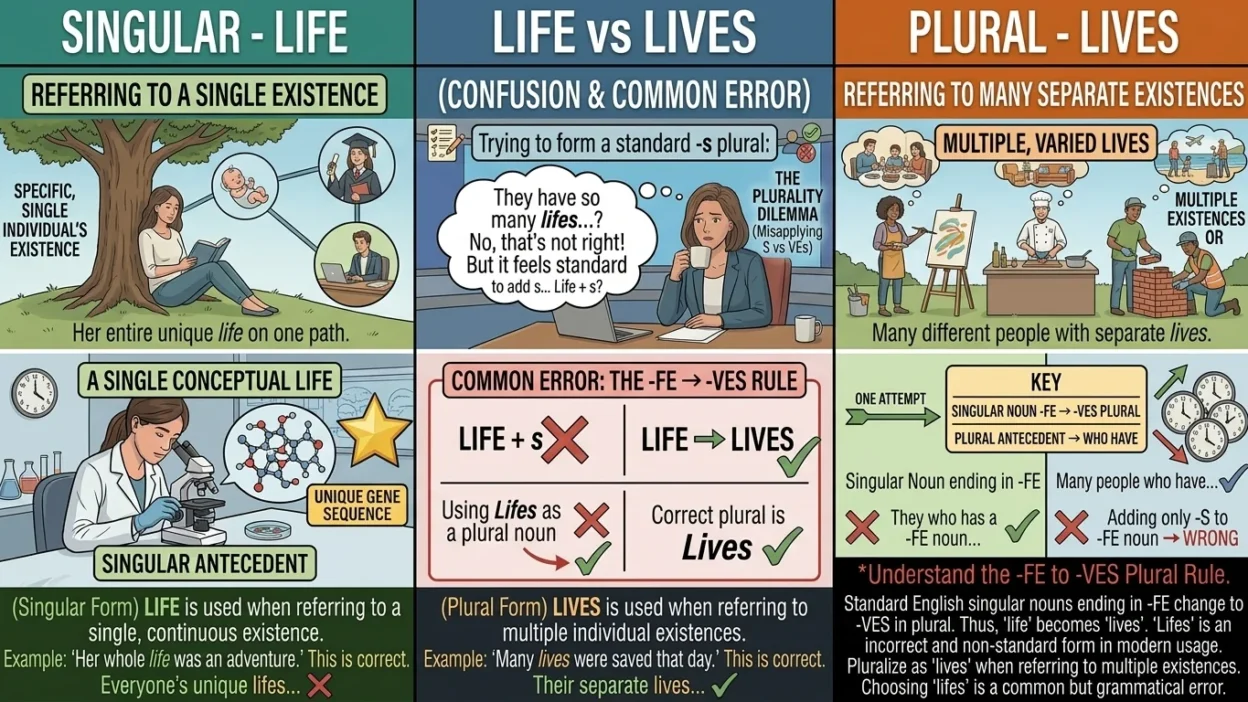
If you are wondering whether the correct plural of “life” is “lifes” or “lives,” the answer is “lives.” The word “lifes” is not the standard plural form of “life.” For example, we say, “
Many people lost their lives,” not “Many people lost their lifes.”
This spelling change happens because life is an irregular noun with a plural form that changes -fe to -ves.
The word lives can also have a different meaning and pronunciation. As a plural noun, lives means more than one person’s life.
As a verb, lives is the third-person singular form of live, as in “She lives in London.”
Understanding these two uses makes it easier to avoid spelling, pronunciation, and grammar mistakes.
Quick Answer
The correct plural of “life” is “lives,” not “lifes.” Use lives when talking about more than one life: “Their lives changed completely.” However, lives can also be a verb meaning “resides” or “exists,” as in “He lives in Canada.” The meaning depends on the sentence.
Why Do People Confuse “Lifes” and “Lives”?
The confusion usually comes from the common English plural rule of adding -s to a singular noun.
For example:
- book → books
- car → cars
- house → houses
It may seem logical to change:
life → lifes
But life follows a different spelling pattern. Its plural is:
life → lives
Other words ending in -fe or -f also change their spelling in the plural:
- wife → wives
- knife → knives
- wolf → wolves
- leaf → leaves
However, English spelling has exceptions, so not every word ending in -f follows this pattern.
First Word: “Lifes”
“Lifes” is not the standard plural form of “life.”
If you are referring to multiple lives, do not write:
❌ Many lifes were affected.
Write:
✅ Many lives were affected.
The spelling “lifes” is generally considered incorrect in standard English when intended as the plural of life.
Second Word: “Lives”
Lives has two important uses.
“Lives” as the plural of “life”
When lives is pronounced like “laivz,” it is the plural noun of life.
Many people lost their lives.
Their lives changed after the experience.
“Lives” as a verb
When lives is pronounced like “livz,” it is the third-person singular form of live.
She lives in Paris.
My brother lives nearby.
So the spelling is the same, but the meaning and pronunciation are different.
Lifes vs. Lives: Comparison Table
| Word | Correct? | Meaning | Example |
|---|---|---|---|
| life | Yes | One person’s existence or experience | Life can be difficult. |
| lives | Yes | Plural of “life” | They saved many lives. |
| lives | Yes | Third-person singular of “live” | She lives in Madrid. |
| lifes | No, in standard English | Incorrect plural of “life” | ❌ Many lifes were affected. |
When Should You Use “Lives”?
Use “lives” for more than one life
When talking about the lives of several people, use lives.
The accident changed many lives.
They risked their lives to save others.
Our lives are very different now.
Use “lives” as a verb with he, she, or it
When live is the main verb and the subject is third-person singular, use lives.
He lives in New York.
She lives with her parents.
The animal lives in the forest.
Remember that the pronunciation is different:
- lives = plural noun → /laɪvz/
- lives = verb → /lɪvz/
10+ Examples of “Lives”
“Lives” meaning more than one life
- The doctors saved several lives.
- The accident changed their lives forever.
- Many lives were affected by the disaster.
- They risked their lives to help the injured people.
- Technology has transformed our lives.
- The decision could save thousands of lives.
- Their lives became easier after they moved.
- We should respect the lives of others.
- The event brought many different lives together.
- The new law may affect millions of lives.
- They shared stories about their lives.
- Their lives changed after the birth of their child.
“Lives” meaning “resides”
- She lives in a small apartment.
- He lives near the university.
- My sister lives in Canada.
- The family lives in the countryside.
- The bird lives in tropical forests.
- He lives alone.
Common Mistakes
Mistake 1: Writing “lifes” as the plural
❌ The accident affected many lifes.
✅ The accident affected many lives.
Mistake 2: Using “life” after a plural number
❌ The rescue operation saved ten life.
✅ The rescue operation saved ten lives.
Mistake 3: Confusing “lives” with “live”
Live can be a verb, adjective, or part of other expressions, while lives can be either a plural noun or a third-person singular verb.
Compare:
They live in London.
She lives in London.
And:
Their lives are busy.
Mistake 4: Confusing pronunciation
The two uses of lives are pronounced differently.
Plural noun:
lives → sounds like “laivz”
Verb:
lives → sounds like “livz”
The spelling is identical, so context tells you which meaning is intended.
Memory Trick
Remember this simple rule:
One life → many lives
Think of the spelling change:
life → lives
The f changes to v, and then -es is added.
You can remember it with these similar pairs:
- wife → wives
- knife → knives
- life → lives
So when you mean more than one life, never write “lifes.”
American vs. British English
The spelling lives is the same in both American English and British English.
Both varieties use:
He lost his life.
and:
They lost their lives.
There is no standard American-British spelling difference for the plural noun lives.
The pronunciation distinction is also essentially the same in both varieties: the noun lives and the verb lives have different vowel sounds.
Similar Words
Life
Life is the singular noun.
Everyone deserves a good life.
Lives
Lives is the plural of life.
People have different lives.
Live
Live can be a verb meaning to exist or reside.
I live in Lahore.
It can also be an adjective with a different pronunciation:
a live broadcast
Living
Living can refer to being alive or to one’s way of life.
She is living a happy life.
Lifetime
A lifetime is the entire period during which someone is alive.
He achieved a lot during his lifetime.
Final Verdict
The correct plural of life is lives, not lifes.
Use:
one life → two lives
The word lives can also be the verb form of live:
She lives in London.
The two meanings have different pronunciations, but the spelling is the same.
If you are talking about multiple people’s existence, experiences, or periods of being alive, use lives. If you are describing where one person or animal resides, lives is also correct, but it functions as a verb.
Frequently Asked Questions
Is “lifes” correct?
No. “Lifes” is not the standard plural of “life.” The correct plural is “lives.”
What is the plural of “life”?
The plural of life is lives.
one life → many lives
Why does “life” become “lives”?
Life has an irregular plural spelling. The f changes to v, followed by -es:
life → lives
Is “lives” both a noun and a verb?
Yes. Lives is the plural noun of life, and it is also the third-person singular form of live.
They saved many lives.
She lives in Paris.
How do you pronounce “lives”?
As the plural noun of life, lives is pronounced approximately “laivz.”
As the verb form of live, it is pronounced approximately “livz.”
Is “lives” the same in American and British English?
Yes. Both American and British English use lives as the plural of life and as the third-person singular form of live.
Can I say “many lifes”?
No. The standard form is:
many lives
not:
❌ many lifes
Remember This
The easiest rule is:
Life → Lives
Never:
Life → Lifes
Also remember that lives has two meanings:
- lives = more than one life
- lives = he/she/it lives somewhere
Examples:
They have different lives.
She lives in London.
Conclusion
The correct spelling is lives, not lifes, when you want the plural of life. English has several nouns that change f to v when they become plural, and life → lives is one of the most common examples. Once you remember this pattern, you can avoid one of the most common spelling mistakes involving the word “life.”
It is also important to remember that lives has another grammatical function. It can be the third-person singular form of live, as in “He lives in Australia.” Although both uses have the same spelling, their pronunciation and meaning are different. Context makes the intended meaning clear.