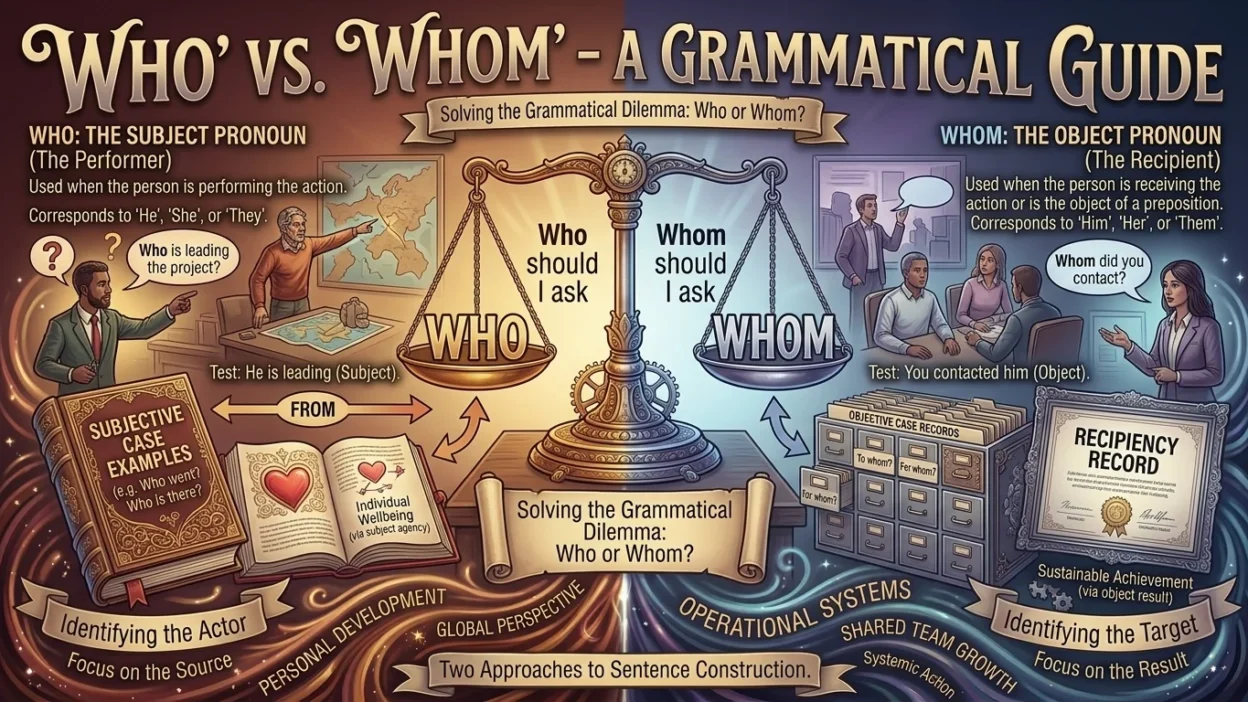
If you are unsure whether to say “who should I ask?” or “whom should I ask?”, you are dealing with one of the most common questions in English grammar.
The short answer is that “Who should I ask?” is the more natural and widely used choice in modern English, especially in everyday conversation. “
Whom should I ask?” is also grammatically correct and follows the traditional rule that uses whom for an object.
The difference is mainly about grammatical function and formality.
Traditional grammar distinguishes who as a subject pronoun and whom as an object pronoun.
However, modern English often uses who in situations where traditional grammar would prescribe whom.
Understanding both forms will help you write and speak confidently, whether you are communicating casually, writing professionally, or following formal grammatical conventions.
Quick Answer
“Who should I ask?” is the natural choice for most everyday situations. “Whom should I ask?” is the traditional, more formal version because the person being asked about is the object of ask. Modern English commonly uses who instead of whom, particularly in conversation and informal writing.
Why Do People Confuse “Who” and “Whom”?
The confusion exists because who and whom have similar meanings but traditionally serve different grammatical roles.
The basic rule is:
- Who = subject
- Whom = object
Consider:
Who called you?
Here, who performs the action of calling, so it is the subject.
Now consider:
Whom did you call?
Here, the person receives the action of call, so whom is the object.
The question “Who should I ask?” is slightly different from what traditional grammar might lead you to expect. The pronoun is technically the object of ask, so “whom should I ask?” follows the traditional rule. Nevertheless, “who should I ask?” is extremely common and natural in modern English.
Who: Meaning and Usage
Who is a pronoun used to refer to a person or people. Traditionally, it functions as the subject of a verb.
Examples
Who called the office?
Who wants to come with us?
Who made this decision?
Who is responsible for the project?
In each sentence, who refers to the person performing the action or serving as the subject.
However, modern English also uses who in many object positions:
Who did you call?
Who should I ask?
Who are you going to invite?
These forms are standard and natural in everyday English.
Whom: Meaning and Usage
Whom is traditionally the object form of who.
It is used when the person is receiving the action of a verb or follows a preposition in formal English.
Examples
Whom did you call?
Whom should I contact?
To whom should I send the documents?
With whom did you travel?
Whom is still correct, but it sounds more formal than who in many everyday sentences.
It is especially common in formal writing and fixed expressions such as:
To whom it may concern
Who Should I Ask or Whom Should I Ask?
Both forms are possible, but they create slightly different impressions.
| Expression | Traditional grammar | Modern usage | Typical tone |
|---|---|---|---|
| Who should I ask? | Less traditional | Very common | Natural and conversational |
| Whom should I ask? | Traditional | Correct but less common | Formal and careful |
For most everyday situations, “Who should I ask?” is the better choice because it sounds natural and immediately understandable.
For highly formal writing, “Whom should I ask?” may be preferred if you are deliberately following traditional grammar.
When Should You Use “Who”?
Use who when it is functioning as the subject.
For example:
Who is coming to dinner?
Who called earlier?
Who made the mistake?
Who wants to volunteer?
But you can also use who naturally in many object constructions in modern English.
Common everyday examples
Who should I ask about the schedule?
Who did you speak to?
Who did she invite?
Who are you looking for?
These sentences are normal in contemporary English.
When Should You Use “Whom”?
Use whom when you want the traditional object form, particularly in formal writing.
Examples include:
Whom did you invite?
Whom should I contact?
Whom did the committee select?
To whom should I send the application?
With whom did you discuss the issue?
A useful stylistic point is that whom is especially natural after a preposition in formal English.
For example:
To whom should I address this letter?
This sounds formal and polished.
In everyday English, however, many speakers would say:
Who should I address this letter to?
The Easy He-or-Him Test
One of the most useful traditional grammar tests is the he-or-him test.
Replace the unknown person with he or him.
If he works, use who.
If him works, use whom.
Example 1
Who called?
Answer:
He called.
Therefore, who is correct.
Example 2
Whom did you call?
Answer:
I called him.
Therefore, whom is traditionally correct.
What about “Who should I ask?”
The answer might be:
You should ask him.
That means traditional grammar would favor:
Whom should I ask?
But modern English commonly uses:
Who should I ask?
Both forms are understandable, but their tone differs.
10+ Examples of Who and Whom
Here are practical examples showing how both words work.
- Who called you this morning?
- Who is responsible for the report?
- Who wants to join the meeting?
- Who made this cake?
- Who should I ask about the application?
- Who did you meet at the conference?
- Who are you going to invite?
- Whom did you invite to the ceremony?
- Whom should I contact about the problem?
- To whom should I send the completed form?
- With whom did you discuss the proposal?
- Whom did the manager choose for the position?
- For whom was this package intended?
The first group demonstrates the natural use of who, while the later examples show traditional formal uses of whom.
Common Mistakes
Mistake 1: Thinking “whom” is always better
Some people assume that whom automatically makes a sentence more grammatically correct.
That is not how modern English works.
Who should I ask?
is completely natural and widely accepted.
Mistake 2: Thinking “who” is always correct
The opposite assumption can also cause problems in formal writing.
For example:
To whom should I send the letter?
is a traditional and grammatically appropriate construction.
Mistake 3: Using “whom” to sound overly formal
A sentence can become unnecessarily stiff if whom is used everywhere.
In normal conversation:
Who did you talk to?
sounds much more natural than:
Whom did you talk to?
Both can be understood, but the second has a distinctly formal tone.
Mistake 4: Forgetting the object rule
If you are specifically following traditional grammar, remember that whom is the object form.
Memory Trick
Use this simple rule:
Who = he
Whom = him
If you could answer with he, choose who.
If you could answer with him, traditional grammar favors whom.
For example:
Who called?
He called.
Whom did you call?
I called him.
For “Who should I ask?”:
You should ask him.
So the traditional form is:
Whom should I ask?
But everyday modern English usually prefers:
Who should I ask?
American vs British English
There is no major American-versus-British difference in the basic distinction between who and whom.
Both varieties use who extensively in everyday speech and whom in formal or traditional constructions.
For example:
Everyday:
Who did you speak to?
Formal:
To whom did you speak?
This pattern can be found in both American and British English.
The difference is therefore mainly about formality and grammatical tradition, rather than nationality.
Similar Words and Expressions
Who vs whoever
Whoever means “any person who” or “the person who.”
Whoever arrives first can choose a seat.
Whom vs whomever
Whomever is the traditional object form of whoever.
Choose whomever you prefer.
However, usage can become complicated in longer sentences, so clarity is often more important than forcing a formal construction.
Who’s vs whose
These words are completely different.
- Who’s = who is / who has
- Whose = belonging to whom
Examples:
Who’s coming tonight?
Whose phone is this?
Final Verdict
For ordinary conversation, emails, messages, and most everyday writing, “Who should I ask?” is the most natural choice. It is clear, common, and fully acceptable in contemporary English.
“Whom should I ask?” is also correct, particularly if you are following traditional grammar or writing in a highly formal style. Since whom traditionally functions as the object of ask, it is the formal grammatical form.
The important thing is to match the expression to your context. You do not need to force whom into casual conversations simply because it sounds more formal.
Frequently Asked Questions
Is “Who should I ask?” grammatically correct?
Yes. Who should I ask? is standard modern English and is extremely common in everyday communication.
Is “Whom should I ask?” correct?
Yes. Whom should I ask? follows the traditional rule that uses whom as the object of the verb ask.
Which is more natural: who or whom?
In most everyday situations, who is more natural. Whom tends to sound more formal or traditional.
Should I use “whom” in professional writing?
You can use whom in formal constructions, but professional writing does not require you to use whom every time it is technically possible. Clear, natural language is usually preferable.
How do I know when to use who or whom?
Use the traditional he/him test. If he fits, use who. If him fits, traditional grammar favors whom.
Is “Who should I ask?” better than “Whom should I ask?”
Neither is universally “better.” Who should I ask? is more natural for everyday communication, while whom should I ask? is more formal.
Is “whom” becoming less common?
Yes. In contemporary English, whom is less common in ordinary conversation than it was traditionally. It remains established in formal writing and certain fixed expressions.
Remember This
The traditional rule is:
Who = he
Whom = him
But modern English is flexible.
For everyday communication, choose:
Who should I ask?
For formal or traditional writing, you can choose:
Whom should I ask?
Conclusion
The choice between “who should I ask?” and “whom should I ask?” is not as complicated as it first appears. Traditional grammar uses who for subjects and whom for objects, which makes “whom should I ask?” the formal traditional version. However, modern English commonly uses who in object positions, making “who should I ask?” completely natural.
For most conversations and everyday writing, who should I ask? is the safest and most natural option. If you are writing something particularly formal or following traditional grammatical rules, whom should I ask? remains a correct choice. The key is to understand the difference rather than treating one form as universally right or w