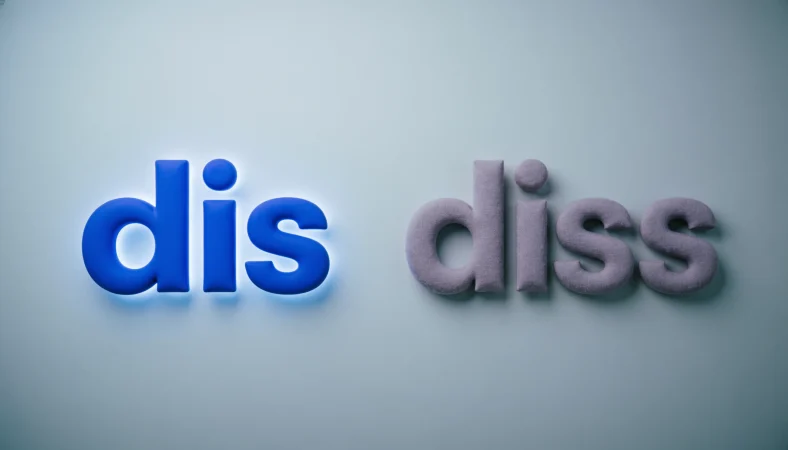
If you have seen dis and diss online, in songs, or in casual conversation, you may wonder if they mean the same thing.
They are closely related, but their spelling, history, and usage are slightly different.
“Diss” is the more common modern spelling when the word means to insult, disrespect, or criticize someone.
“Dis” is also used, especially as an informal spelling or in some established expressions.
For students and English learners, the easiest way to remember the difference is to look at the context. Diss is usually a verb or noun connected with disrespect: Don’t diss your classmates.
Dis can have the same slang meaning, but it can also appear as a prefix meaning “not,” “opposite,” or “apart,” as in disagree or disconnect.
The sections below explain both forms with clear examples so you can choose the right word confidently.
Quick Answer
Diss is the standard modern informal spelling for an insult or act of disrespect: He dissed my idea. Dis can also mean to insult or disrespect someone, but it is less common for this meaning. Dis- is also a productive English prefix with meanings such as “not,” “opposite,” or “apart.”
Why Do People Confuse It?
People confuse dis and diss because they can sound exactly the same when pronounced as slang.
Both forms are associated with the verb disrespect, and both can be used informally to mean insult, criticize, or show disrespect toward someone.
The main difference is spelling and usage:
- diss is the more common spelling for the modern slang verb and noun.
- dis is an alternative informal spelling of the same slang word.
- dis- without a second s is also a genuine English prefix found in many ordinary words.
- In formal writing, neither diss nor slang dis is usually the best choice when a more precise word such as insult, criticize, or disrespect is available.
What Does “Dis” Mean?
Dis can be an informal verb meaning to insult, disrespect, or criticize someone or something.
For example:
Why are you dissing my new shoes?
Here, dissing means making fun of or criticizing the shoes.
However, dis has another important role in English. The prefix dis- appears at the beginning of words such as:
- disagree — not agree
- disapprove — not approve
- disconnect — separate or break a connection
- dishonest — not honest
- dislike — not like
So, context matters.
Is “Dis” Correct?
Yes, dis can be correct in informal slang when it means insult or disrespect. However, diss is generally the more recognizable spelling for this particular slang meaning.
For formal English, consider using insult, disrespect, or criticize instead.
What Does “Diss” Mean?
Diss is an informal English verb meaning to insult, disrespect, mock, or criticize someone.
It can also be a noun referring to an insult or disrespectful comment.
Examples:
- Don’t diss your teacher.
- She dissed his new haircut.
- That was a serious diss.
- The rapper released a diss track.
The word is especially common in casual speech, social media, entertainment, and discussions about music.
What Is a “Diss Track”?
A diss track is a song, usually associated with hip-hop and rap, that attacks or criticizes another person, often another artist.
For example:
The artist released a diss track aimed at his rival.
Here, diss clearly means insult or publicly criticize.
Dis vs Diss: Comparison Table
| Feature | Dis | Diss |
|---|---|---|
| Common slang meaning | Insult or disrespect | Insult or disrespect |
| Part of speech | Informal verb/noun; also prefix | Informal verb/noun |
| Example | He dissed me. | He dissed me. |
| Modern slang spelling | Used, but less common | More common |
| Formal English | Usually avoid as slang | Usually avoid as slang |
| Prefix use | Yes: disagree, disconnect | No |
| Common expression | disrespect / dis someone | diss someone / diss track |
When Should You Use “Dis” or “Diss”?
Use diss when you are writing the modern slang word for insulting or disrespecting someone.
He dissed my outfit.
Use dis when you are using the informal alternative spelling:
He dissed my outfit.
In ordinary formal writing, choose a more standard word:
He criticized my outfit.
Use dis- as part of established words when it carries its appropriate meaning:
I disagree with you.
You generally should not replace diss with dis simply because the two words sound alike.
10+ Examples of Dis and Diss
Examples with “Diss”
- Don’t diss your friends just to make people laugh.
- She dissed his idea during the meeting.
- Why are you dissing my favorite movie?
- He thought the comment was a diss.
- The singer released a diss track.
- I wasn’t trying to diss you.
- They accused him of dissing their team.
- That joke sounded like a diss.
- She felt hurt because her classmates dissed her.
- The comedian didn’t mean to diss anyone personally.
- He used the interview to diss his former rival.
- That was more criticism than a personal diss.
Examples with “Dis”
- Don’t dis me in front of everyone.
- He felt that his friend had dissed him.
- She thought the comment was a dis.
These examples show why diss is usually the clearer spelling when you mean insult or disrespect.
Examples with the Prefix “Dis-”
- I disagree with that statement.
- Please disconnect the cable.
- She dislikes loud music.
- The evidence disproves the claim.
- He was dishonest about what happened.
In these words, dis- is not the slang word diss. It is part of the word’s structure.
Common Mistakes
1. Assuming “dis” and “diss” are always interchangeable
They are not.
I disagree with you.
Here, dis- is a prefix. You cannot replace it with diss-.
2. Using “diss” in formal writing
Although diss is a real English word, it is informal.
Instead of:
The report dissed the proposal.
Formal writing might use:
The report criticized the proposal.
3. Thinking “diss” means only “make fun of”
A diss can involve mocking someone, but it can also mean insulting, disrespecting, or criticizing them.
4. Confusing “diss” with “disrespect”
They are related, but they are not identical in every context.
He disrespected his coach.
He dissed his coach.
The second sentence is more informal.
5. Assuming the double “s” changes the pronunciation
In the slang word, dis and diss are generally pronounced the same.
Memory Trick
Think:
DISS = Disrespect + Insult
The double S can help you remember that diss is the slang word for an insult or act of disrespect.
For example:
DISS → disrespect
But remember:
DIS- → disagree, disconnect, dislike
If it is attached to the beginning of a normal English word, you are probably dealing with the prefix dis-, not slang diss.
American vs British English
The slang diss is widely understood in both American and British English. It is especially common in informal speech, popular culture, music, and online communication.
The spelling diss is generally the clearest choice when you mean insult or disrespect.
There is no major American-versus-British spelling difference comparable to pairs such as color/colour or center/centre. The important distinction is between informal slang and formal vocabulary, rather than between the two national varieties of English.
Similar Words
Several words are related to diss, but their meanings are not exactly the same.
- Insult — to say or do something offensive to someone.
- Disrespect — to treat someone without appropriate respect.
- Mock — to make fun of someone or something.
- Tease — to make playful or sometimes hurtful jokes about someone.
- Ridicule — to make someone or something appear foolish.
- Criticize — to point out faults or problems.
- Belittle — to make someone or something seem less important or valuable.
- Roast — to make jokes about someone, often humorously and sometimes with their participation.
- Put down — to criticize or insult someone, usually informally.
- Diss track — a song specifically made to insult or criticize another person.
Final Verdict
If you mean “insult, disrespect, or criticize” in modern informal English, “diss” is generally the clearest spelling.
Dis can also be used as an informal spelling of the same slang word, but it is less common in this use. Meanwhile, dis- is a separate and very common English prefix found in words such as disagree, disconnect, and dislike.
So, when writing a sentence such as “He insulted me,” the informal version is most naturally written:
He dissed me.
Frequently Asked Questions
Is “diss” a real word?
Yes. Diss is an established informal English word meaning to insult, disrespect, or criticize someone. It can function as both a verb and a noun.
Is “dis” also correct?
Yes, dis can be used informally with the meaning insult or disrespect, although diss is generally the more common spelling for this slang use.
Is “diss” short for “disrespect”?
The slang word is closely associated with disrespect, and dictionaries commonly describe diss as an informal shortening related to disrespect. However, it is now used as an independent English word.
Which is more common: “dis” or “diss”?
For the slang meaning insult or disrespect, diss is generally the more recognizable and conventional spelling.
Is “diss” formal English?
No. Diss is informal. In formal academic or professional writing, words such as insult, criticize, or disrespect are usually more appropriate.
What does “diss someone” mean?
To diss someone means to insult, disrespect, mock, or criticize them, usually in an informal context.
Example:
He was just trying to diss me.
What is a diss track?
A diss track is a song that deliberately insults or criticizes another person, particularly another artist. The expression is strongly associated with hip-hop and rap culture.
Is “diss” the same as “disrespect”?
They are closely related, but diss is informal slang. Disrespect is a standard English word and can be used in formal contexts.
Remember This
Diss = insult or disrespect someone.
Dis = can also mean insult or disrespect in informal slang, but diss is the clearer modern spelling.
Dis- = a prefix in words such as disagree, disconnect, and dislike.
When in doubt, write diss for the slang meaning and use dis- only as part of the appropriate word.
Conclusion
The difference between dis and diss is mainly about spelling, context, and the role of the word.
Both can appear as informal slang meaning to insult or disrespect, but diss is the more common spelling for that meaning.
In contrast, dis- is a productive English prefix found in many standard words.
For everyday communication, “She dissed me” clearly means “She insulted or disrespected me.”
For formal writing, however, a precise word such as criticized, insulted, or disrespected is usually a better choice.
Once you separate the slang diss from the prefix dis-, the difference becomes easy to remember.