
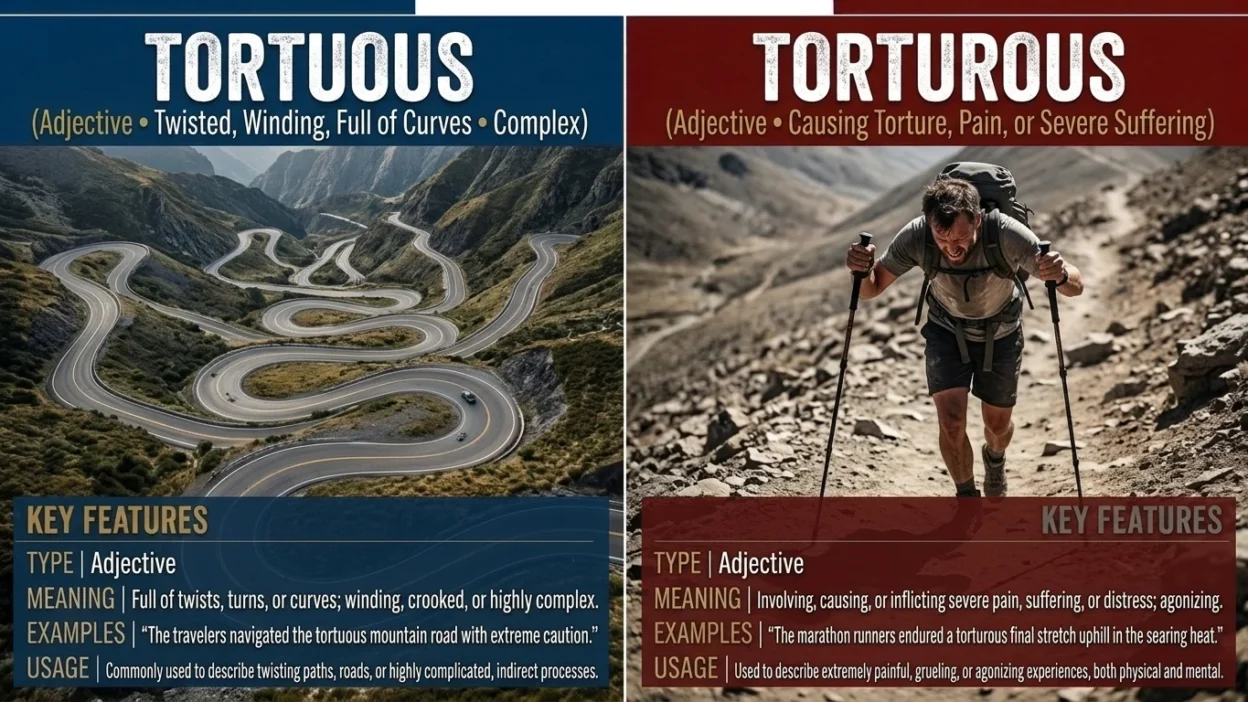
The words tortuous and torturous look almost identical, but they have different meanings.
Tortuous describes something full of twists, turns, or complications, such as a winding road or a complicated explanation.
Torturous describes something that causes extreme pain, suffering, or distress, such as a torturous wait or a painful experience.
Choosing the correct word helps make your writing clearer and more accurate.
These two adjectives are often confused because they share the same root and have similar spellings and pronunciations. However, their meanings are not interchangeable.
One focuses on twists, complexity, or indirectness, while the other focuses on suffering and discomfort.
In this guide, you will learn the definitions of tortuous and torturous, discover how to pronounce and remember them, and explore practical examples.
You will also find a comparison table, common mistakes, and answers to frequently asked questions so you can use both words confidently in everyday English, academic writing, and professional communication.
Quick Answer: What Is the Difference Between Tortuous and Torturous?
Tortuous means winding, twisting, complicated, or indirect. Torturous means causing severe physical pain, emotional suffering, or intense discomfort. For example, a tortuous road has many bends, while a torturous journey is extremely painful or unpleasant. Remember: tortuous describes twists or complexity; torturous describes suffering.
Why Do People Confuse Tortuous and Torturous?
People confuse tortuous and torturous because they look and sound similar. Both words are adjectives, share the same Latin root associated with twisting, and contain nearly identical letter patterns.
Their meanings, however, developed in different directions:
- Tortuous: Focuses on twisting, winding, complexity, or indirectness.
- Torturous: Focuses on torture, pain, suffering, or extreme discomfort.
The confusion becomes especially common when describing difficult experiences. For example, a long journey might be tortuous if the route has many twists and turns. It might be torturous if it causes extreme discomfort or suffering.
A useful way to choose the correct word is to ask yourself: Am I describing something complicated or winding, or something painful and distressing?
What Does Tortuous Mean?
Tortuous is an adjective that describes something full of twists, turns, complications, or indirect routes. It can refer to physical paths, complicated processes, difficult arguments, or explanations that are hard to follow.
1. Tortuous Means Winding or Twisting
Use tortuous to describe a road, path, river, or route that curves repeatedly rather than following a straight line.
Examples:
- We drove along a tortuous mountain road.
- A tortuous path led through the forest.
- The river followed a tortuous course through the valley.
In these examples, the word describes the shape or direction of something.
2. Tortuous Means Complicated or Indirect
Tortuous can also describe ideas, arguments, negotiations, or procedures that are difficult to understand because they involve many steps or complications.
Examples:
- The lawyer gave a tortuous explanation of the contract.
- The negotiations followed a tortuous course.
- His tortuous argument confused the audience.
Here, the word is figurative. It describes complexity or a lack of directness rather than a physical twist.
Simple definition: Tortuous means winding, twisting, complicated, or indirect.
What Does Torturous Mean?
Torturous is an adjective that describes something causing great pain, suffering, distress, or extreme discomfort. It is related to the word torture.
The word can describe both physical suffering and emotional experiences. It is also used informally to emphasize that something is extremely unpleasant.
1. Torturous Means Physically Painful
Use torturous when an experience causes intense physical pain or discomfort.
Examples:
- The injury made every step torturous.
- He endured a torturous recovery after the accident.
- The treatment was described as torturous by the patient.
The word emphasizes the severity of the discomfort or suffering.
2. Torturous Means Emotionally or Mentally Distressing
Torturous can also describe experiences that cause intense worry, uncertainty, frustration, or emotional pain.
Examples:
- Waiting for the results was torturous.
- The final minutes of the match were torturous for the fans.
- It was a torturous decision because both choices mattered deeply to her.
In everyday English, people may use torturous figuratively to describe something extremely boring, stressful, or unpleasant. The exact intensity depends on the context.
Simple definition: Torturous means causing severe pain, suffering, or distress.
Tortuous vs Torturous: Comparison Table
| Feature | Tortuous | Torturous |
|---|---|---|
| Part of speech | Adjective | Adjective |
| Main meaning | Winding, twisting, complicated, or indirect | Causing pain, suffering, or distress |
| Related word | Twist | Torture |
| Physical use | A tortuous road | A torturous injury experience |
| Figurative use | A tortuous argument | A torturous wait |
| Common context | Roads, paths, processes, explanations | Pain, recovery, waiting, distress |
| Example | The route was tortuous. | The journey was torturous. |
| Main idea | Twists or complexity | Suffering or discomfort |
The essential distinction is that tortuous describes the form or complexity of something, while torturous describes how painful or distressing something is.
When Should You Use Tortuous or Torturous?
Choose the word according to the quality you want to emphasize.
Use Tortuous for Twists, Turns, and Complexity
Choose tortuous when something is physically winding or figuratively difficult to follow.
Use it to describe:
- Roads and paths with many bends
- Rivers with winding courses
- Complicated legal arguments
- Indirect explanations
- Lengthy or complex negotiations
- Procedures with many confusing steps
Examples:
- The hikers followed a tortuous trail up the mountain.
- Understanding the regulations required navigating a tortuous process.
- Her tortuous explanation made a simple issue seem complicated.
Use Torturous for Pain and Suffering
Choose torturous when something causes intense physical pain, emotional suffering, or extreme discomfort.
Use it to describe:
- Painful physical experiences
- Difficult or distressing recoveries
- Long periods of anxious waiting
- Emotionally exhausting decisions
- Extremely unpleasant situations
Examples:
- The hours spent waiting for news were torturous.
- He described the painful recovery as torturous.
- The suspense made the final scene torturous to watch.
Can One Experience Be Both Tortuous and Torturous?
Yes. A single experience can be both tortuous and torturous, but for different reasons.
For example: “The tortuous mountain road made the journey torturous.”
The road is tortuous because it has many twists and turns. The journey is torturous because the difficult drive causes discomfort and exhaustion.
Tortuous vs Torturous: 14 Example Sentences
These examples show how each word works in different situations.
Examples Using Tortuous
- The bus climbed a tortuous mountain road with dozens of sharp bends.
- We followed a tortuous trail through the dense forest.
- The river took a tortuous route across the plain.
- The lawyer presented a tortuous argument that few people understood.
- The company went through a tortuous approval process before launching the product.
- Their tortuous negotiations continued for several months.
- The report explained the tortuous history of the dispute.
- His tortuous reasoning made it difficult to understand his conclusion.
Examples Using Torturous
- The injured athlete described the recovery as torturous.
- Waiting for the examination results was torturous.
- The long delay turned the airport experience into a torturous ordeal.
- She found the uncertainty torturous because she had no idea what would happen next.
- The final minutes of the close game were torturous for the supporters.
- He endured a torturous night with a severe toothache.
Examples Using Both Words
- The tortuous route through the mountains made an already torturous journey even more exhausting.
- The committee’s tortuous debate became torturous for everyone waiting for a decision.
These examples highlight the difference: one word describes twists or complexity, and the other describes suffering or distress.
Common Mistakes With Tortuous and Torturous
Even experienced English speakers sometimes mix up these words. The following mistakes are easy to avoid once you understand their meanings.
Mistake 1: Using Torturous for a Winding Road
Incorrect: We drove along a torturous road full of bends.
Better: We drove along a tortuous road full of bends.
Use tortuous because the sentence describes the road’s winding shape. If the road also caused extreme suffering or discomfort, torturous could describe the experience of driving on it.
Mistake 2: Using Tortuous for Extreme Pain
Incorrect: The patient endured a tortuous recovery filled with severe pain.
Better: The patient endured a torturous recovery filled with severe pain.
Use torturous because the sentence emphasizes suffering.
Mistake 3: Confusing Complexity With Difficulty
Incorrect: The torturous legal argument was difficult to follow because it had many complicated steps.
Better: The tortuous legal argument was difficult to follow because it had many complicated steps.
Tortuous is more precise when the problem is an indirect or complicated line of reasoning. Torturous would suggest that the argument itself caused intense distress.
Mistake 4: Assuming Torturous Always Refers to Physical Pain
Incorrect idea: Torturous can describe only physical injuries.
Correct understanding: Torturous can describe physical pain, emotional suffering, or an intensely unpleasant experience.
For example: “The wait for the final decision was torturous.”
Mistake 5: Thinking Tortuous Always Means Physically Winding
Incorrect idea: Tortuous describes only roads and rivers.
Correct understanding: Tortuous can also describe complicated arguments, indirect explanations, and complex processes.
For example: “The tortuous legal procedure delayed the case.”
Memory Trick: How to Remember Tortuous vs Torturous
Use these simple memory tricks to keep the words separate.
- Tortuous = Twists. Both words contain a connection to twisting. Think of a winding road or a complicated route.
- Torturous = Torture. The word torturous contains the letters in torture followed by an ending. Think of pain, distress, or suffering.
Remember this sentence:
“A tortuous road twists; a torturous experience hurts.”
You can also ask yourself two quick questions:
- Does it have bends, complications, or indirect steps? Use tortuous.
- Does it cause intense pain, suffering, or distress? Use torturous.
Tortuous vs Torturous in American and British English
The meanings and spellings of tortuous and torturous are the same in standard American and British English.
| Feature | American English | British English |
|---|---|---|
| Tortuous | Winding, complicated, or indirect | Winding, complicated, or indirect |
| Torturous | Causing pain or suffering | Causing pain or suffering |
| Spelling | Tortuous, torturous | Tortuous, torturous |
| Usage | Used for routes, arguments, and painful experiences | Used for routes, arguments, and painful experiences |
Neither word has a standard American-versus-British spelling variation. Pronunciation may vary slightly by accent, but the distinction in meaning remains the same.
Both words are suitable for academic writing, journalism, professional communication, and everyday conversation.
Similar Words to Tortuous and Torturous
Several English words have meanings related to tortuous or torturous. Understanding these alternatives can help you choose more precise vocabulary.
Words Similar to Tortuous
- Winding: Having many curves or bends. Example: We followed a winding road through the hills.
- Twisting: Turning repeatedly in different directions. Example: A twisting path led to the lake.
- Meandering: Following a winding or indirect course. Example: A meandering river crossed the valley.
- Complicated: Difficult to understand or deal with. Example: The instructions were complicated.
- Intricate: Made up of many connected or detailed parts. Example: The agreement contained an intricate set of conditions.
- Circuitous: Taking a longer or less direct route. Example: We took a circuitous route to avoid traffic.
These words overlap with tortuous, but they are not identical. For example, winding usually describes physical curves, while tortuous can also suggest figurative complexity or indirectness.
Words Similar to Torturous
- Painful: Causing physical or emotional pain. Example: The injury was painful.
- Agonizing: Causing extreme physical or emotional suffering. Example: The wait was agonizing.
- Excruciating: Extremely painful or distressing. Example: He experienced excruciating pain.
- Unbearable: So unpleasant or painful that it is difficult to tolerate. Example: The uncertainty became unbearable.
- Distressing: Causing worry, sadness, or emotional discomfort. Example: The news was distressing.
- Harrowing: Extremely upsetting or frightening. Example: They described their harrowing experience.
These words can replace torturous in some contexts, but their strength and meaning differ. Excruciating often emphasizes extreme pain, while distressing focuses more on emotional upset.
Final Verdict: Tortuous or Torturous?
The difference between tortuous and torturous comes down to complexity versus suffering.
- Use tortuous for winding roads, twisting paths, complicated arguments, and indirect processes.
- Use torturous for experiences that cause severe pain, emotional suffering, or extreme discomfort.
For example, “The tortuous road led to the village” describes a road with many bends. “The torturous wait for the results made everyone anxious” describes an emotionally difficult experience.
If you remember that tortuous relates to twists and torturous relates to torture, you can select the right word with confidence.
Frequently Asked Questions
1. What is the main difference between tortuous and torturous?
Tortuous means winding, twisting, complicated, or indirect. Torturous means causing intense pain, suffering, or distress. A road can be tortuous because it has many bends, while a wait can be torturous because it causes anxiety.
2. Is a tortuous journey the same as a torturous journey?
No. A tortuous journey follows a winding or complicated route. A torturous journey is extremely painful, uncomfortable, or distressing. A journey can be both if it follows a difficult route and causes great discomfort.
3. Can tortuous describe an argument or explanation?
Yes. Tortuous can describe an argument, explanation, or process that is complicated, indirect, or difficult to follow. For example: “The report presented a tortuous explanation of the financial dispute.”
4. Can torturous describe emotional pain?
Yes. Torturous can describe intense emotional suffering, anxiety, or distress, not just physical pain. For example: “Waiting for confirmation was torturous because she did not know what to expect.”
5. Are tortuous and torturous pronounced the same?
They are often pronounced very similarly, but they are not necessarily perfect homophones for every speaker. Pronunciation can vary by accent. Their main distinction is their meaning: twists and complexity versus pain and suffering.
6. Is tortuous a negative word?
Usually, tortuous has a negative or critical tone when describing complicated arguments, indirect processes, or difficult routes. However, it can simply describe a winding shape without implying that something is bad. A tortuous river, for example, is not necessarily dangerous.
7. What is a simple way to remember tortuous and torturous?
Remember “tortuous twists; torturous hurts.” Use tortuous for winding paths or complicated ideas. Use torturous for painful, distressing, or extremely unpleasant experiences.
8. Do American and British English use these words differently?
No major difference exists in their standard meanings or spellings. Both American and British English use tortuous for winding or complicated things and torturous for things that cause suffering.
Remember This
- Tortuous = winding, twisting, complicated, or indirect.
- Torturous = causing pain, suffering, or distress.
- A tortuous road has many bends.
- A torturous wait causes intense discomfort or anxiety.
- Both words are adjectives and have the same spelling in American and British English.
- Memory trick: Tortuous twists; torturous hurts.
Conclusion
Although tortuous and torturous look similar, they describe different things. Tortuous refers to winding routes, indirect paths, and complicated ideas or processes. Torturous refers to physical pain, emotional suffering, and extremely unpleasant experiences. Understanding this distinction helps you choose more accurate words in everyday conversation, academic assignments, and professional writing.
The easiest way to remember the difference is to connect tortuous with twists and torturous with torture. Before choosing either word, consider what your sentence emphasizes: complexity or suffering. With this simple rule and the examples in this guide, you can use both adjectives naturally and confidently.