
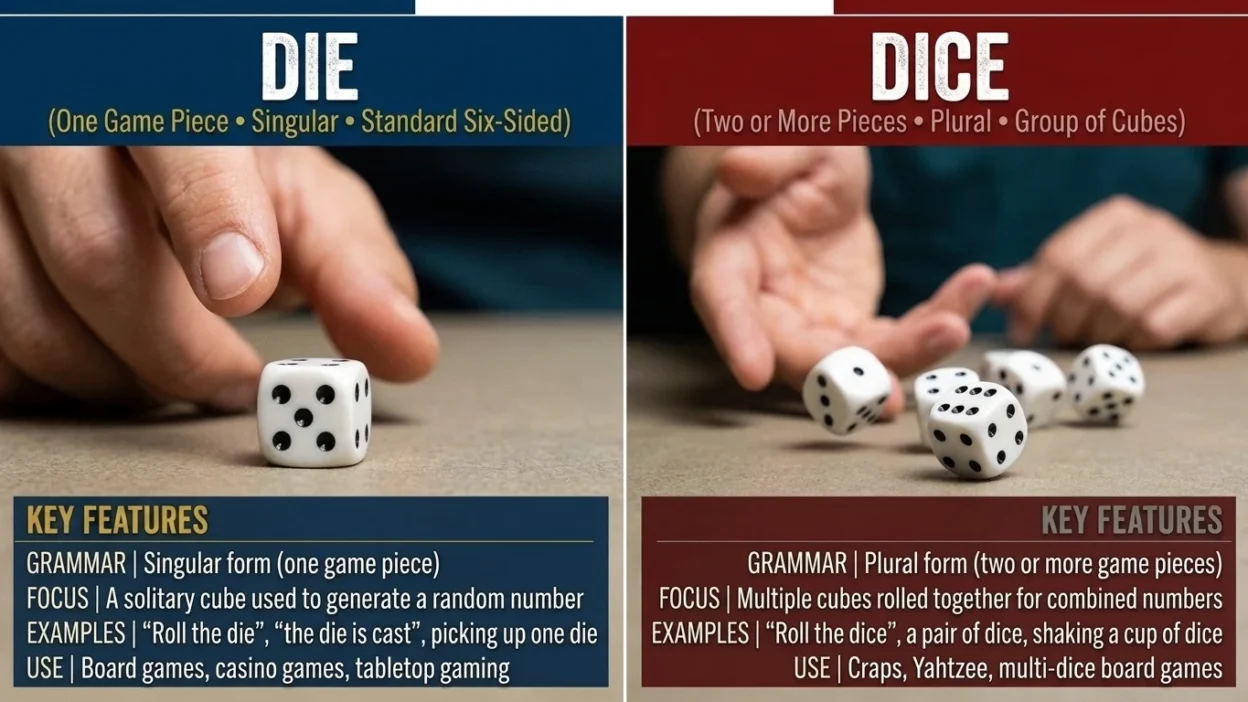
The words die and dice are closely related, but they are not always used in the same way.
Both refer to small objects used in games of chance, such as Ludo, Monopoly, and many board games.
The main difference is that die is traditionally the singular form, while dice is the plural form.
One die has several numbered faces, and two or more dice are used to play many games.
However, English usage has changed over time. In everyday conversation, many people use dice for both singular and plural, especially when talking about games.
Understanding the difference between die and dice will help you use these words correctly in writing, conversation, and grammar exercises.
It is also useful to know that die has another, unrelated meaning: to stop living.
Learning the context of each word makes the distinction much easier.
Quick Answer: Die vs Dice
Die is traditionally the singular noun for one small numbered cube used in games, while dice is its plural form. For example, “Roll one die” refers to a single cube, whereas “Roll two dice” refers to two cubes. In everyday English, however, dice is also widely used as a singular noun. Separately, die can mean to stop living.
Why Do People Confuse Die and Dice?
People confuse die and dice because the words are closely related and are often used when discussing the same games.
The main difference is grammatical:
- Die: Traditionally refers to one gaming cube.
- Dice: Traditionally refers to two or more gaming cubes.
For example:
- I rolled one die.
- I rolled two dice.
The confusion arises because many English speakers say “a dice” when referring to a single gaming cube. This usage is common in informal English, although a die is the traditional singular form.
Another reason for confusion is that die has a completely different meaning as a verb. In a sentence such as “Plants die without water,” the word has nothing to do with board games.
What Does “Die” Mean?
The word die has two main meanings: a singular noun referring to a gaming cube and a verb meaning to stop living.
Die as a Noun
A die is a small object, usually a cube, with numbered or marked faces. It is rolled to produce a random result in a game.
A standard six-sided die has the numbers 1 through 6, with one number on each face.
Examples:
- I need one die to play this game.
- The die landed on the number four.
- She rolled a die across the table.
- Each player takes one die.
In formal grammar, use die when you mean exactly one gaming cube.
Die as a Verb
As a verb, die means to stop living. It can describe people, animals, plants, or other living organisms.
Examples:
- Plants die without enough water.
- The flowers may die in extreme heat.
- The patient did not die from the illness.
- Some insects die shortly after reproduction.
The verb has different forms:
- Present: die
- Third-person singular: dies
- Past tense: died
- Present participle: dying
For example, “The plant died last week” uses the past tense of the verb die.
What Does “Dice” Mean?
Dice is traditionally the plural form of die. It refers to two or more small objects that are rolled to generate random results in games.
Each die has multiple faces, and the result depends on which face lands upward after the roll.
Dice in Board Games
Dice are used in many games, including Ludo, Monopoly, Yahtzee, and various tabletop role-playing games.
Examples:
- We need two dice to play the game.
- The dice landed on different numbers.
- He rolled the dice and moved his piece.
- All the dice are inside the box.
In these examples, dice refers to multiple gaming cubes.
Can “Dice” Be Singular?
Yes. Although dice is traditionally plural, it is widely used as a singular noun in modern everyday English, particularly in informal conversation.
For example:
- I rolled a dice.
- Pick up the dice and try again.
The first sentence is common in casual usage, but “I rolled a die” follows the traditional singular form.
The word dice can also be a verb meaning to cut food into small cubes.
Example: “Dice the onions before adding them to the pan.”
In cooking, dice is an action rather than a reference to gaming objects.
Die vs Dice: Comparison Table
| Feature | Die | Dice |
|---|---|---|
| Traditional meaning | One gaming cube | Two or more gaming cubes |
| Part of speech | Singular noun; also a verb | Plural noun; also a verb |
| Gaming example | Roll one die | Roll two dice |
| Common modern usage | Traditional singular form | Often used for both singular and plural |
| Other meaning | To stop living | To cut food into small cubes |
| Example sentence | The die landed on six. | The dice landed on six and two. |
The easiest rule is to use die for one gaming cube and dice for multiple gaming cubes in formal or traditional English. In everyday speech, dice can also refer to one cube.
When Should You Use Die or Dice?
Choosing between die and dice depends on the meaning and number of objects you are describing.
Use Die for One Gaming Cube
Use die when referring to a single gaming cube, especially in formal writing or when following traditional grammar.
Examples:
- Roll one die.
- The die has six faces.
- I found a die under the table.
- Each player receives one die.
Example: The player rolled a die and moved three spaces.
Only one gaming cube is involved, so die is the traditional choice.
Use Dice for Two or More Gaming Cubes
Use dice when referring to multiple gaming cubes.
Examples:
- Roll two dice.
- The dice are on the table.
- She bought a new set of dice.
- The player rolled three dice.
Example: He rolled two dice and added the numbers together.
Because there are two gaming cubes, dice is the traditional plural form.
Use Dice as a Singular Noun in Informal English
In everyday conversation, dice is often used for a single gaming cube.
For example:
- Can you pass me a dice?
- I need another dice for this game.
These expressions are common in informal English. If you are writing a grammar assignment or want to follow traditional usage, use a die instead.
Use Die When Talking About Life and Death
Use die as a verb when describing the end of life.
Examples:
- Plants die without sunlight.
- Some animals die during severe droughts.
- The flowers died after several days without water.
In these sentences, die is a verb and has no connection to gaming cubes.
15 Examples of Die vs Dice in Sentences
These examples show how both words work in different contexts.
Examples of Die
1. I rolled one die during the game.
Die refers to a single gaming cube.
2. The die landed on the number five.
Only one cube was rolled.
3. Each player receives one die at the beginning.
The sentence refers to one gaming object per player.
4. She found a die underneath the sofa.
One gaming cube was found.
5. The plant may die without enough water.
Here, die is a verb meaning to stop living.
6. Many flowers die when exposed to extreme heat.
The word describes what happens to living plants.
7. The old tree died during the drought.
Died is the past tense of the verb die.
Examples of Dice
8. We need two dice to play this game.
Dice is the plural form of die.
9. The dice landed on three and six.
Two gaming cubes produced different results.
10. She shook the dice before rolling them.
The sentence refers to multiple gaming cubes.
11. All the dice were placed in a small bag.
The plural noun refers to several cubes.
12. The children rolled the dice across the table.
Multiple gaming cubes were rolled.
13. He bought a new set of dice for his board games.
The set contains multiple gaming cubes.
14. Please pass me a dice.
This is common informal usage, where dice refers to one gaming cube.
15. Dice the carrots into small cubes.
Here, dice is a verb meaning to cut food into small, cube-shaped pieces.
Common Mistakes When Using Die and Dice
Understanding the basic rule can help you avoid several common errors.
Mistake 1: Using Dice as the Traditional Singular Form
Less traditional: I rolled one dice.
Traditional: I rolled one die.
In everyday English, the first sentence is widely used. However, die is the traditional singular form and is usually the better choice in formal writing or grammar tests.
Mistake 2: Using Die for Multiple Gaming Cubes
Incorrect in traditional usage: I rolled three die.
Correct: I rolled three dice.
Use dice when referring to two or more gaming cubes.
Mistake 3: Confusing the Gaming Noun With the Verb Die
Consider these sentences:
- The die landed on four.
- The plant will die without water.
In the first sentence, die is a noun referring to a gaming cube. In the second, it is a verb meaning to stop living.
The surrounding words help you identify the intended meaning.
Mistake 4: Assuming Dice Always Refers to a Game
The word dice can also be a verb in cooking.
Example: “Dice the potatoes into small cubes.”
Here, it means to cut the potatoes into small pieces, not to roll gaming cubes.
Mistake 5: Thinking “A Dice” Is Never Used
“A dice” is common in informal English, particularly in conversation. However, if you want to follow the traditional distinction, use a die for one gaming cube and dice for the plural.
What Is the Easiest Memory Trick?
Use this simple memory trick:
One die, two dice.
The word die refers to one gaming cube, while dice refers to more than one.
Remember these examples:
- One die
- Two dice
- Three dice
- A set of dice
You can also connect the words to familiar phrases:
- Die: “Roll one die.”
- Dice: “Roll the dice.”
- Die (verb): “Plants die without water.”
If you remember the phrase “one die, two dice,” you will usually choose the correct form in traditional English.
Is There a Difference Between American and British English?
The traditional distinction between die and dice is the same in American and British English: die is singular, and dice is plural.
However, dice is also widely used as a singular noun in both varieties, particularly in informal speech. The extent of this usage can vary by speaker and context.
Examples common to both varieties include:
- “Roll one die.”
- “Roll two dice.”
- “The dice are on the table.”
Both American and British speakers also use die as a verb meaning to stop living and dice as a verb meaning to cut food into small cubes.
There is no major spelling difference between the two varieties in these uses. The important distinction is grammatical function and context.
What Words Are Similar to Die and Dice?
Several related words can help you understand these terms more clearly.
Cube
Meaning: A three-dimensional shape with six equal square faces.
Example: “The gaming die is shaped like a cube.”
A standard six-sided die is usually cube-shaped.
Roll
Meaning: To move something by turning it over and over, or to throw dice so they tumble across a surface.
Example: “Roll the dice to determine your next move.”
Toss
Meaning: To throw something lightly into the air.
Example: “She tossed the die onto the table.”
Toss describes an action, not the gaming object itself.
Random
Meaning: Chosen or occurring without a predictable pattern.
Example: “The result of a fair die roll is random.”
Dice are often used to generate random results in games.
Chop
Meaning: To cut something into pieces.
Example: “Chop the vegetables before cooking.”
Chop is related to dice as a cooking verb, but chopped pieces are not necessarily cube-shaped.
Mince
Meaning: To cut food into very small pieces.
Example: “Mince the garlic before adding it to the sauce.”
Mince generally produces smaller pieces than dicing.
Final Verdict: Which Word Should You Use?
Use die when referring to one gaming cube in traditional English, and use dice when referring to two or more gaming cubes. Remember that die can also mean to stop living, while dice can mean to cut food into small cubes.
For example, you roll one die, roll two dice, and dice an onion before cooking. These words have different grammatical functions, so the context determines their meaning.
Although “a dice” is common in everyday conversation, “a die” remains the traditional singular form. Remembering “one die, two dice” will help you use the words accurately in schoolwork, formal writing, and everyday English.
Frequently Asked Questions
1. Is it one die or one dice?
In traditional English, one die is correct because die is the singular form of the gaming noun. However, dice is widely used as a singular noun in everyday conversation.
2. Is dice singular or plural?
Traditionally, dice is the plural of die. However, modern English commonly uses dice for both singular and plural, especially in informal contexts.
3. What is the plural of die?
The traditional plural of die, when referring to a gaming cube, is dice.
Example: “One die is on the table, and the other dice are in the box.”
4. What is the difference between die and dice in grammar?
Die is traditionally a singular noun for one gaming cube, while dice is its plural form. The word die can also function as a verb meaning to stop living, and dice can be a verb meaning to cut food into cubes.
5. Why do people say “a dice” instead of “a die”?
Many English speakers use dice as both singular and plural in everyday conversation. This usage is common, even though the traditional singular form remains die.
6. Is “roll the dice” grammatically correct?
Yes. “Roll the dice” is correct and is a common expression used in games. It usually refers to rolling one or more gaming cubes, depending on the context. The expression can also mean taking a risk.
7. What does “dice” mean in cooking?
As a verb, dice means to cut food into small, usually cube-shaped pieces.
Example: “Dice the tomatoes before adding them to the salad.”
Remember This
- One die: The traditional singular form for a gaming cube.
- Two or more dice: The traditional plural form.
- Die: Also means to stop living.
- Dice: Also means to cut food into small cubes.
- Everyday usage: Dice is often used for both singular and plural gaming objects.
- Memory trick: One die, two dice.
Conclusion
The difference between die and dice is simple once you understand their traditional grammatical roles. Die is the singular form of a gaming cube, while dice is the plural form. In modern everyday English, however, many speakers use dice for a single cube as well. The word die also has a separate meaning as a verb referring to the end of life, and dice can describe cutting food into small cubes.
To use these words confidently, remember the simple phrase “one die, two dice.” Pay attention to the context, because the same spelling can have different meanings depending on how it is used. With a little practice, you can distinguish these words easily in conversations, grammar exercises, and written English