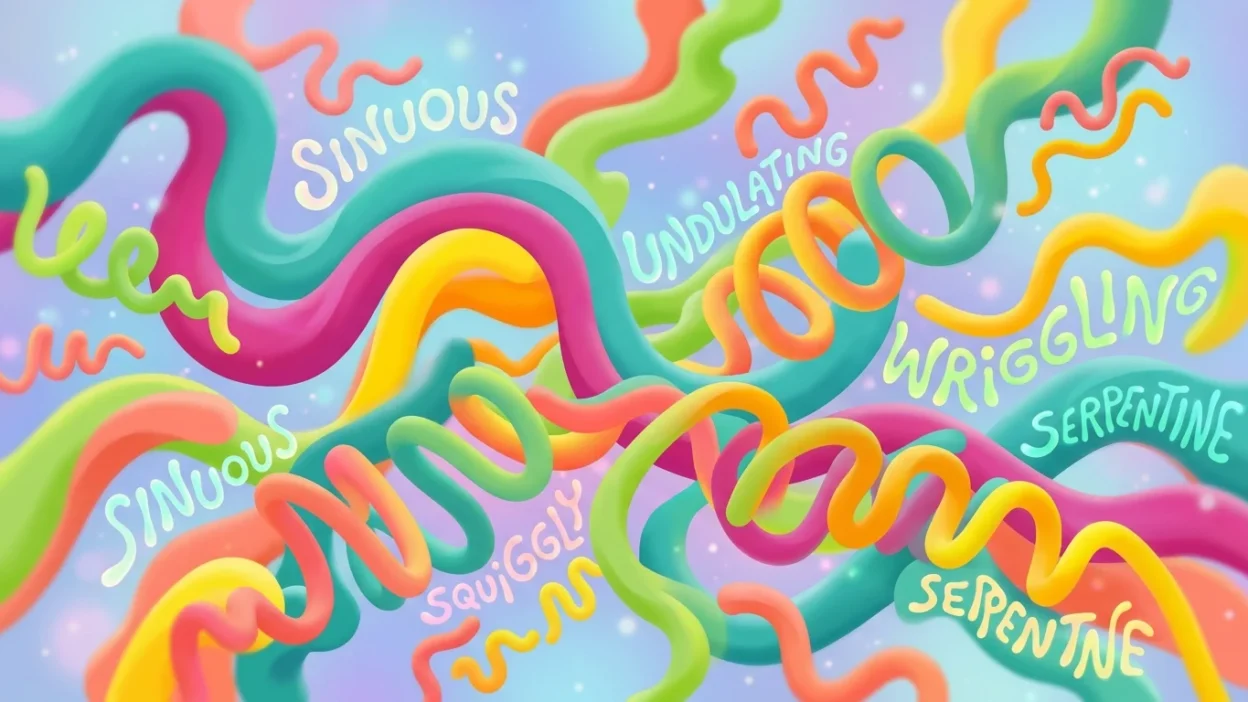
Have you ever needed a better word than “wiggly” to describe something moving from side to side, bending around, or refusing to stay still?
If you are writing an essay, helping students learn English, or creating engaging content, choosing the right synonym can make your writing much clearer.
The word wiggly is informal and descriptive. It can describe a child who cannot sit still, a worm moving across the ground, a loose line, or something with a curved and irregular shape.
However, different situations call for different words. Some alternatives focus on movement, while others describe shape, flexibility, or restlessness.
This guide explores 30 wiggly synonyms in simple English. Each word includes an easy meaning, an example sentence, and a short note explaining when it works best.
These alternatives can help ESL learners, students, writers, and content creators choose more precise vocabulary.
What Does “Wiggly” Mean?
Wiggly means moving with small, quick, twisting, or side-to-side movements. It can also describe something that has a curved, uneven, or irregular shape.
The word is usually informal and playful. For example, you might say, “The puppy has a wiggly tail,” or “The child was too wiggly to sit quietly.”
Depending on the situation, you can replace wiggly with words such as squirming, wriggling, twisting, swaying, shaky, winding, curvy, restless, or flexible.
30 Wiggly Synonyms With Meanings and Examples
1. Wriggling
Meaning: Moving by twisting or turning from side to side.
Example: The worm was wriggling across the wet ground.
Best usage: Use it for animals, people, or objects making twisting movements.
2. Squirming
Meaning: Moving around because you cannot stay still or are uncomfortable.
Example: The little boy was squirming in his chair.
Best usage: Best for people, especially children who are restless.
3. Twisting
Meaning: Turning or bending into different directions.
Example: The twisting vine climbed around the fence.
Best usage: Useful for physical movement, plants, ropes, and body movements.
4. Swaying
Meaning: Moving gently from one side to another.
Example: The tall grass was swaying in the breeze.
Best usage: Best for gentle, repeated side-to-side movement.
5. Shaking
Meaning: Moving quickly back and forth or up and down.
Example: His shaking hands made it difficult to write.
Best usage: Use when movement is rapid or caused by nervousness, cold, or instability.
6. Shaky
Meaning: Moving unsteadily or not firmly.
Example: She walked across the shaky bridge carefully.
Best usage: Best for instability rather than playful movement.
7. Restless
Meaning: Unable or unwilling to stay still.
Example: The restless child kept getting out of his seat.
Best usage: Excellent for people, especially when describing behavior.
8. Fidgety
Meaning: Frequently making small movements because of nervousness, boredom, or impatience.
Example: He became fidgety during the long meeting.
Best usage: Best for people and small repeated movements.
9. Jiggly
Meaning: Moving or shaking loosely when touched or disturbed.
Example: The jelly had a soft, jiggly texture.
Best usage: Common in casual English when describing soft or loose things.
10. Wobbly
Meaning: Moving from side to side because something is unstable.
Example: The table was wobbly after one of its legs became loose.
Best usage: Use for unstable objects or uncertain movement.
11. Waving
Meaning: Moving repeatedly from side to side.
Example: The flag was waving in the strong wind.
Best usage: Useful when something moves from side to side in a visible pattern.
12. Fluttering
Meaning: Moving lightly and quickly, often through the air.
Example: The butterfly was fluttering among the flowers.
Best usage: Best for wings, leaves, flags, curtains, and lightweight objects.
13. Flapping
Meaning: Moving up and down or back and forth quickly.
Example: The bird was flapping its wings.
Best usage: Commonly used for wings, fabric, and loose materials.
14. Bending
Meaning: Changing from a straight shape into a curved one.
Example: The flexible branch was bending in the wind.
Best usage: Best when the focus is on shape or flexibility.
15. Curvy
Meaning: Having many smooth curves rather than straight lines.
Example: The road followed a curvy path through the hills.
Best usage: Best for describing shapes, roads, designs, and outlines.
16. Winding
Meaning: Following a twisting or curved path.
Example: A winding trail led through the forest.
Best usage: Excellent for roads, paths, rivers, and routes.
17. Zigzagging
Meaning: Moving or extending repeatedly from one direction to another.
Example: The rabbit was zigzagging across the field.
Best usage: Use when movement changes direction sharply.
18. Undulating
Meaning: Moving in smooth waves or having a wave-like shape.
Example: The undulating hills stretched toward the horizon.
Best usage: A more formal or literary choice for waves, landscapes, and flowing movement.
19. Sinuous
Meaning: Curving and turning smoothly.
Example: A sinuous river flowed through the valley.
Best usage: A sophisticated choice for formal or descriptive writing.
20. Wavy
Meaning: Having a series of gentle curves or waves.
Example: She has naturally wavy hair.
Best usage: Common for hair, lines, water, and shapes.
21. Flexible
Meaning: Able to bend or move easily without breaking.
Example: The flexible wire could be shaped into a circle.
Best usage: Best when the important quality is the ability to bend.
22. Lively
Meaning: Full of energy and movement.
Example: The lively puppy ran around the garden.
Best usage: Good for people, animals, events, and energetic behavior.
23. Energetic
Meaning: Having a lot of energy and activity.
Example: The energetic child played outside all afternoon.
Best usage: Use for active people or animals rather than physical shape.
24. Restive
Meaning: Unable to remain still, often because of impatience or discomfort.
Example: The restive horse kept moving around the stable.
Best usage: More formal than restless and often used for people or animals.
25. Vibrating
Meaning: Moving rapidly with small repeated movements.
Example: The vibrating phone shook across the table.
Best usage: Best for machines, phones, surfaces, and objects producing rapid movement.
26. Shimmering
Meaning: Appearing to move or change slightly because of reflected light.
Example: The shimmering water looked beautiful under the sunlight.
Best usage: Best for visual movement caused by light.
27. Rippling
Meaning: Moving in small waves across a surface.
Example: The wind was rippling the surface of the lake.
Best usage: Excellent for water, fabric, and surfaces.
28. Jerky
Meaning: Moving suddenly and unevenly rather than smoothly.
Example: The old machine made a jerky movement.
Best usage: Use when movement is rough, sudden, or irregular.
29. Shuffling
Meaning: Moving with short, dragging, or irregular steps.
Example: The tired man was shuffling toward the door.
Best usage: Mainly used for walking or moving feet.
30. Wriggly
Meaning: Full of twisting, turning, or small movements.
Example: The wriggly puppy would not stay still for a photo.
Best usage: Very close to wiggly and useful in casual, playful writing.
Wiggly Synonyms Comparison Guide
Different synonyms for wiggly carry different meanings. The best choice depends on what is moving and why.
| Synonym | Main Idea | Tone | Common Use |
|---|---|---|---|
| Wriggling | Twisting movement | Casual | Animals, people |
| Squirming | Restless movement | Casual | Children, people |
| Fidgety | Small restless movements | Neutral | People |
| Swaying | Gentle side-to-side movement | Neutral | Trees, grass |
| Wobbly | Unstable movement | Neutral | Objects, walking |
| Jiggly | Loose movement | Casual | Food, soft objects |
| Wavy | Curved shape | Neutral | Hair, lines, water |
| Curvy | Having curves | Neutral | Shapes, roads |
| Winding | Twisting path | Neutral | Roads, rivers |
| Zigzagging | Sharp directional changes | Neutral | Movement, paths |
| Undulating | Smooth wave-like movement | Formal | Landscapes, water |
| Sinuous | Smooth curves and turns | Formal | Rivers, roads, writing |
| Restless | Unable to stay still | Neutral | People, animals |
| Energetic | Full of activity | Positive | People, animals |
| Jerky | Sudden uneven movement | Neutral | Machines, motion |
How to Choose the Right Synonym
For Restless People
Choose restless, fidgety, squirming, or restive when someone cannot sit still.
For example, fidgety suggests small repeated movements, while restless describes a broader inability to remain still.
For Animals
Words such as wriggling, wriggly, lively, squirming, and energetic often work well for animals.
For example, a puppy can be wriggly because it keeps moving its body excitedly.
For Gentle Movement
Use swaying, fluttering, rippling, or waving when movement is soft and repeated.
These words are especially useful for nature and descriptive writing.
For Curved Shapes
Choose wavy, curvy, winding, sinuous, or undulating when you are describing a shape rather than movement.
For example, a river may be winding, while a line may be wavy.
For Unstable Movement
Use wobbly, shaky, or jerky when something does not move smoothly or securely.
These words usually suggest instability rather than playful movement.
For Formal Writing
In academic, professional, or literary writing, consider undulating, sinuous, winding, flexible, or unstable, depending on the meaning.
Avoid replacing wiggly with a formal synonym unless the context actually requires a more sophisticated tone.
Wiggly vs. Wriggly: What Is the Difference?
Wiggly and wriggly are very similar, but they can have slightly different feelings.
Wiggly is a broad, informal word for something moving from side to side or having an uneven shape.
Wriggly more strongly suggests twisting and turning, especially when describing a small animal, child, or person who will not stay still.
For example:
- The wiggly line was difficult to draw.
- The wriggly worm disappeared into the soil.
Both are correct, but wriggly often creates a stronger sense of twisting movement.
Wiggly Synonyms for Different Writing Styles
Casual Writing
Use words such as wiggly, wriggly, jiggly, squirming, and fidgety.
These are natural in conversations, blogs, social media posts, and everyday writing.
Descriptive Writing
Choose swaying, rippling, fluttering, winding, wavy, or sinuous.
These words can make descriptions more vivid and specific.
Academic or Formal Writing
Consider undulating, flexible, unstable, sinuous, or irregular, depending on the exact meaning.
The goal is not simply to use a complicated word. The goal is to use the most accurate word.
Common Mistakes When Using Wiggly Synonyms
Using “Restless” for Shapes
Restless normally describes living beings or their behavior. It is not usually appropriate for a curved line.
Instead, use wavy, winding, or irregular.
Using “Wobbly” for Gentle Movement
Wobbly usually suggests instability. If something is moving gently from side to side, swaying is usually a better choice.
Using “Sinuous” in Casual Conversation
Sinuous is correct, but it sounds more formal or literary. In everyday conversation, curvy or winding may sound more natural.
Choosing a Synonym Without Checking Context
A synonym may be similar in meaning without being interchangeable in every sentence.
Always ask: What is moving? How is it moving? Why is it moving?
Frequently Asked Questions About Wiggly Synonyms
What is the best synonym for wiggly?
There is no single best synonym. Wriggly, squirming, fidgety, jiggly, wobbly, and wavy can all work depending on the context.
What is a synonym for wiggly in a person?
For a person, restless, fidgety, squirming, or restless are useful alternatives. The best choice depends on whether the movement is playful, nervous, uncomfortable, or energetic.
What is a synonym for wiggly in shape?
For shape, consider wavy, curvy, winding, irregular, or sinuous. These words focus more on appearance than behavior.
Is “wriggly” the same as “wiggly”?
They are very similar. Wriggly usually emphasizes twisting and turning, while wiggly can describe both movement and an irregular shape.
What is a formal word for wiggly?
Depending on the context, undulating or sinuous can be more formal alternatives. However, they should only be used when their specific meanings fit.
What is the opposite of wiggly?
Possible opposites include still, stationary, straight, rigid, steady, and motionless, depending on whether you are describing movement or shape.
Final Thoughts
Learning wiggly synonyms can help you make your English more precise, natural, and interesting. While wiggly is a friendly and informal word, alternatives such as wriggling, fidgety, swaying, wobbly, wavy, and sinuous describe specific types of movement or shape.
The key is to choose a synonym based on context. Use squirming for restless people, wriggling for twisting movement, swaying for gentle motion, wavy for curved shapes, and undulating for formal descriptions of wave-like movement.
For ESL learners and writers, understanding these small differences is an easy way to build stronger vocabulary and communicate ideas more clearly.

Liam Henry is a content author at Synonymed, specializing in vocabulary enrichment and synonym guides. He creates clear, engaging resources that help learners improve English word knowledge and language fluency.