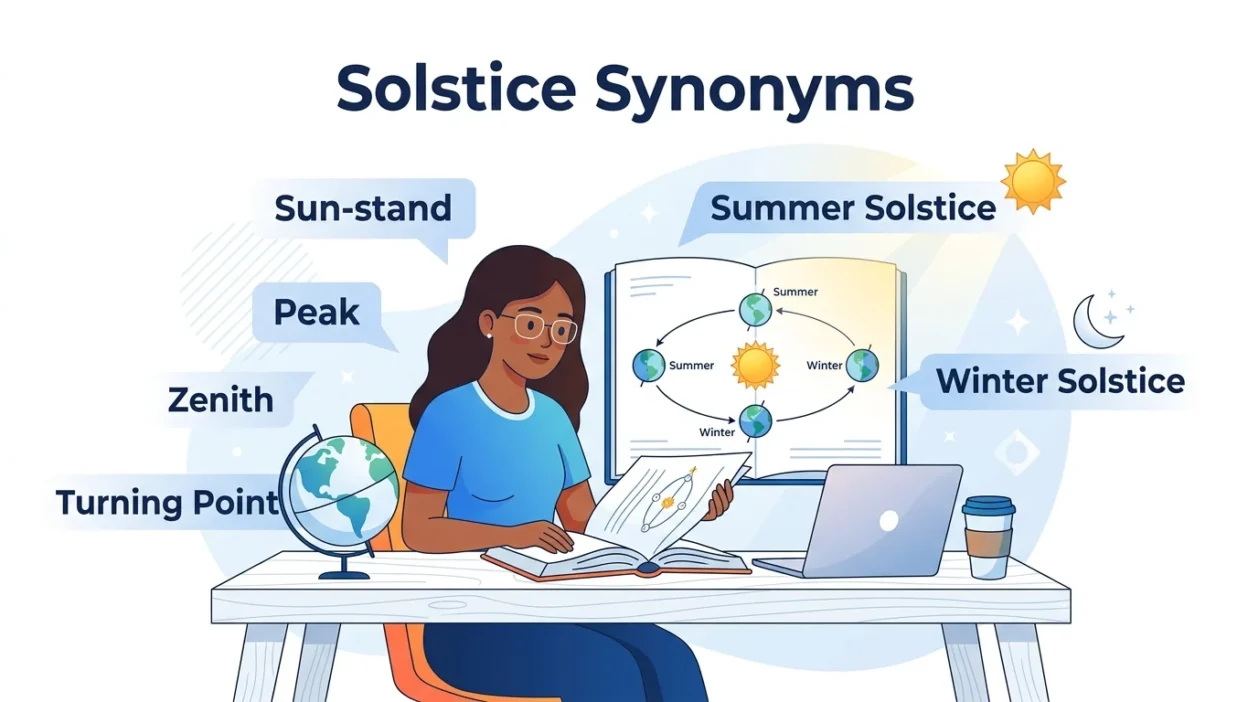
The phrase solstice synonyms is useful for students, ESL learners, writers, bloggers, and content creators who want to expand their vocabulary. While the word solstice has a specific astronomical meaning, several related words and expressions can be used depending on the context. Understanding these alternatives helps you write more naturally and choose the right word for different situations.
if you’re writing about astronomy, seasons, literature, or poetry, knowing words related to solstice can improve your communication.
This guide explains the meaning of the word, provides 30 related synonyms and alternatives, includes examples, and shows you when each one works best.
What Does “Solstice” Mean?
Meaning
A solstice is one of the two days each year when the Sun reaches its highest or lowest point in the sky at noon. These days mark the longest day (summer solstice) and the shortest day (winter solstice) of the year.
Usage Context
The word solstice is commonly used in:
- Astronomy
- Geography
- Science education
- Seasonal discussions
- Literature and poetry
- Cultural and religious celebrations
Although there is no perfect one-word replacement for solstice, many related words and expressions can be used depending on what you want to describe.
30 Solstice Synonyms and Related Words
1. Midwinter
Meaning: The middle of the winter season.
Example: The village celebrated midwinter with a traditional feast.
Best Usage Context: Winter solstice discussions.
2. Midsummer
Meaning: The middle of summer.
Example: People gathered during midsummer for outdoor celebrations.
Best Usage Context: Summer solstice events.
3. Seasonal Turning Point
Meaning: A major change between seasons.
Example: The solstice marks an important seasonal turning point.
Best Usage Context: Educational writing.
4. Solar Turning Point
Meaning: The moment the Sun changes its yearly path.
Example: Ancient cultures observed every solar turning point carefully.
Best Usage Context: Astronomy.
5. Sun Turning
Meaning: A poetic expression for the Sun’s changing direction.
Example: The festival honored the sun turning.
Best Usage Context: Poetry.
6. Longest Day
Meaning: The day with the most daylight.
Example: The longest day arrives in June.
Best Usage Context: Summer solstice.
7. Shortest Day
Meaning: The day with the least daylight.
Example: The shortest day occurs in December.
Best Usage Context: Winter solstice.
8. Solar Event
Meaning: An event involving the Sun.
Example: The solstice is an important solar event.
Best Usage Context: Science.
9. Astronomical Event
Meaning: A significant event in space.
Example: Students learned about this astronomical event.
Best Usage Context: Education.
10. Seasonal Milestone
Meaning: An important point in the yearly seasons.
Example: Farmers watched each seasonal milestone closely.
Best Usage Context: Agriculture.
11. Solar Milestone
Meaning: A key point in the Sun’s yearly movement.
Example: The solstice is a solar milestone.
Best Usage Context: Astronomy.
12. Celestial Event
Meaning: An event involving heavenly bodies.
Example: Many people enjoy watching celestial events.
Best Usage Context: Space topics.
13. Sun Festival
Meaning: A celebration connected to the Sun.
Example: The town hosted a colorful sun festival.
Best Usage Context: Cultural celebrations.
14. Seasonal Festival
Meaning: A festival celebrating a season.
Example: Families attended the seasonal festival together.
Best Usage Context: Cultural writing.
15. Solar Celebration
Meaning: A celebration based on solar events.
Example: The community planned a solar celebration.
Best Usage Context: Traditions.
16. Nature Festival
Meaning: A celebration of nature.
Example: The nature festival welcomed summer.
Best Usage Context: Lifestyle writing.
17. Seasonal Change
Meaning: The transition from one season to another.
Example: Birds react to seasonal change.
Best Usage Context: General writing.
18. Solar Transition
Meaning: A change in the Sun’s position.
Example: Scientists explained the solar transition.
Best Usage Context: Science.
19. Earth’s Seasonal Shift
Meaning: The Earth’s movement leading to seasonal changes.
Example: The Earth’s seasonal shift affects daylight.
Best Usage Context: Education.
20. Daylight Peak
Meaning: The highest amount of daylight.
Example: Daylight peak happens during the summer solstice.
Best Usage Context: Summer discussions.
21. Daylight Minimum
Meaning: The lowest amount of daylight.
Example: Daylight minimum comes in winter.
Best Usage Context: Winter topics.
22. Solar High Point
Meaning: The Sun’s highest yearly position.
Example: The solar high point marks summer.
Best Usage Context: Astronomy.
23. Solar Low Point
Meaning: The Sun’s lowest yearly position.
Example: The solar low point signals winter.
Best Usage Context: Science.
24. Seasonal Marker
Meaning: A point that marks a season.
Example: The solstice serves as a seasonal marker.
Best Usage Context: Educational content.
25. Annual Solar Point
Meaning: A yearly position of the Sun.
Example: The annual solar point is easy to observe.
Best Usage Context: Astronomy.
26. Turning of the Seasons
Meaning: The natural change between seasons.
Example: Many stories celebrate the turning of the seasons.
Best Usage Context: Literature.
27. Sun Cycle Marker
Meaning: A point within the Sun’s yearly cycle.
Example: The ceremony honored the sun cycle marker.
Best Usage Context: Educational writing.
28. Seasonal Balance Point
Meaning: An important point in the seasonal cycle.
Example: The seasonal balance point brings noticeable changes.
Best Usage Context: Nature writing.
29. Solar Calendar Event
Meaning: A significant date in the solar calendar.
Example: The solstice is a major solar calendar event.
Best Usage Context: History.
30. Seasonal Landmark
Meaning: An important seasonal moment.
Example: The solstice is a seasonal landmark celebrated worldwide.
Best Usage Context: General writing.
Comparison Guide: When to Use Different Solstice Synonyms
Comparison Table
| Word | Best Used For | Tone |
|---|---|---|
| Midwinter | Winter season | Everyday |
| Midsummer | Summer season | Everyday |
| Longest Day | Summer solstice | Informal |
| Shortest Day | Winter solstice | Informal |
| Solar Turning Point | Astronomy | Technical |
| Astronomical Event | Science | Academic |
| Celestial Event | Space topics | Formal |
| Seasonal Change | General writing | Neutral |
| Turning of the Seasons | Literature | Poetic |
| Seasonal Festival | Cultural events | Casual |
How to Choose the Right Synonym
For Scientific Writing
Use words like:
- Solar Turning Point
- Astronomical Event
- Celestial Event
- Solar Transition
- Solar Milestone
These are accurate and work well in educational or academic content.
For Everyday Writing
Choose:
- Longest Day
- Shortest Day
- Midwinter
- Midsummer
- Seasonal Change
These are easy to understand and suitable for most readers.
For Creative Writing
Good choices include:
- Turning of the Seasons
- Sun Turning
- Seasonal Landmark
- Nature Festival
- Sun Festival
These create vivid imagery and add a poetic touch.
For Educational Content
Use:
- Seasonal Marker
- Earth’s Seasonal Shift
- Annual Solar Point
- Solar Calendar Event
- Seasonal Turning Point
These make explanations clear for students and ESL learners.
Final Thoughts
Learning solstice synonyms helps you describe seasonal changes, astronomy, nature, and cultural traditions with greater variety. While solstice is a unique scientific term, many related words and expressions fit different situations.
Selecting the right alternative depends on whether you are writing for science, education, storytelling, or everyday conversation.
By understanding the meaning, examples, and best usage of these 30 related terms, you can improve your vocabulary, make your writing more engaging, and communicate your ideas more precisely.