If you’re learning English, writing essays, or improving your vocabulary, understanding peel support synonyms can help you communicate your ideas more clearly.
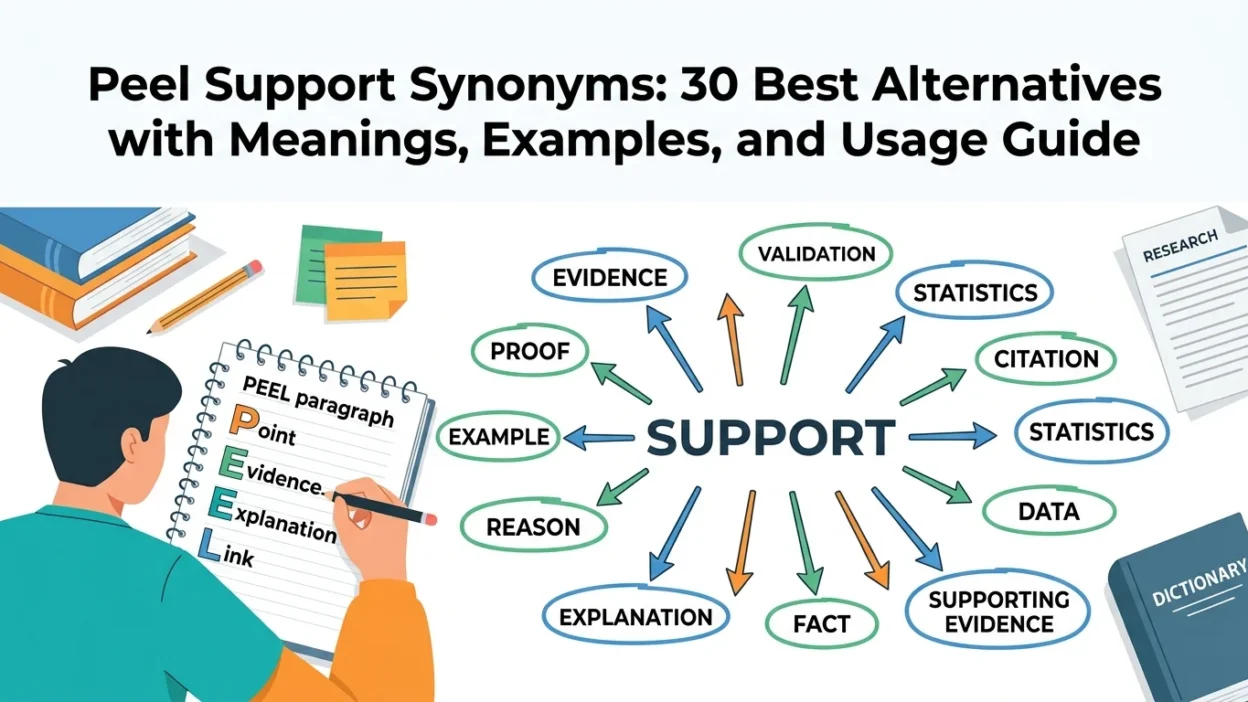
In essay writing especially when using the PEEL paragraph structure (Point, Evidence, Explain, Link)—the word support refers to the evidence, reasons, or examples that strengthen your main point.
Using different words instead of repeating “support” makes your writing sound more natural and professional.
Each synonym includes an easy definition, an example sentence, and the best situation to use it.
What Does “PEEL Support” Mean?
Simple Meaning
In the PEEL writing method, support means the evidence, reason, example, or explanation that proves or strengthens your main point. Good support helps readers understand why your argument is correct.
Usage Context
The word support is commonly used in:
- Academic essays
- PEEL paragraphs
- Reports
- Research papers
- Blog writing
- Business writing
- Persuasive writing
- Classroom assignments
Different situations require different words. Knowing various peel support synonyms allows you to write more clearly and avoid repetition.
30 Peel Support Synonyms
1. Evidence
Meaning: Facts or information that prove a point.
Example: The writer used strong evidence to support the argument.
Best Usage Context: Academic essays and research papers.
2. Proof
Meaning: Information that shows something is true.
Example: Scientific proof strengthened the claim.
Best Usage Context: Formal and persuasive writing.
3. Example
Meaning: A specific case that explains an idea.
Example: The teacher included an example to support the point.
Best Usage Context: Essays and educational writing.
4. Illustration
Meaning: An explanation or example that makes something easier to understand.
Example: The illustration helped readers understand the argument.
Best Usage Context: Formal writing.
5. Explanation
Meaning: A detailed reason that makes something clear.
Example: His explanation supported the main idea.
Best Usage Context: PEEL paragraphs.
6. Reason
Meaning: A cause or justification.
Example: She gave a strong reason for her opinion.
Best Usage Context: Opinion and argumentative essays.
7. Justification
Meaning: A valid reason for a decision or opinion.
Example: The student provided a clear justification.
Best Usage Context: Formal academic writing.
8. Confirmation
Meaning: Information that verifies something.
Example: The survey offered confirmation of the results.
Best Usage Context: Research writing.
9. Verification
Meaning: Proof that information is correct.
Example: Verification came from official records.
Best Usage Context: Reports and investigations.
10. Validation
Meaning: Evidence showing something is accurate or valuable.
Example: The experiment gave validation to the theory.
Best Usage Context: Scientific writing.
11. Corroboration
Meaning: Additional evidence that supports a claim.
Example: Witness statements provided corroboration.
Best Usage Context: Legal and formal writing.
12. Testimony
Meaning: A statement used as evidence.
Example: The testimony strengthened the argument.
Best Usage Context: Legal and historical contexts.
13. Citation
Meaning: A reference to a reliable source.
Example: Every claim included a proper citation.
Best Usage Context: Academic papers.
14. Reference
Meaning: Information taken from another source.
Example: The reference supported the discussion.
Best Usage Context: Research writing.
15. Fact
Meaning: Information known to be true.
Example: Facts make an argument stronger.
Best Usage Context: Essays and journalism.
16. Data
Meaning: Collected information used as evidence.
Example: The data supported the conclusion.
Best Usage Context: Research and reports.
17. Statistics
Meaning: Numerical information used as evidence.
Example: Statistics made the argument more convincing.
Best Usage Context: Academic and business writing.
18. Detail
Meaning: Extra information that explains an idea.
Example: The detail improved the paragraph.
Best Usage Context: Descriptive writing.
19. Instance
Meaning: A specific example or occurrence.
Example: This instance proves the author’s point.
Best Usage Context: Formal essays.
20. Case
Meaning: A real situation used as evidence.
Example: The case showed the effects clearly.
Best Usage Context: Case studies and reports.
21. Illustration Example
Meaning: A practical example that explains a concept.
Example: The illustration example made the lesson easier.
Best Usage Context: Teaching materials.
22. Demonstration
Meaning: A clear showing of how something works.
Example: The demonstration supported the explanation.
Best Usage Context: Education and presentations.
23. Backing
Meaning: Help or support for an idea.
Example: The proposal received strong backing.
Best Usage Context: General writing.
24. Reinforcement
Meaning: Additional support that strengthens a point.
Example: More reinforcement improved the argument.
Best Usage Context: Academic writing.
25. Substantiation
Meaning: Strong evidence proving a claim.
Example: The report lacked substantiation.
Best Usage Context: Formal writing.
26. Authentication
Meaning: Proof that something is genuine.
Example: Authentication confirmed the document.
Best Usage Context: Technical and legal writing.
27. Endorsement
Meaning: Public approval or support.
Example: The expert’s endorsement increased trust.
Best Usage Context: Marketing and persuasive writing.
28. Affirmation
Meaning: A statement confirming something.
Example: Her affirmation supported the conclusion.
Best Usage Context: Formal communication.
29. Supporting Detail
Meaning: Extra information that explains the main point.
Example: Every paragraph needs supporting details.
Best Usage Context: PEEL paragraphs and essays.
30. Supporting Evidence
Meaning: Evidence used to strengthen an argument.
Example: Supporting evidence makes essays more convincing.
Best UsageContext: Academic and persuasive writing.
Comparison Guide: When to Use Different Peel Support Synonyms
Quick Comparison Table
| Synonym | Best For | Formality |
|---|---|---|
| Evidence | Academic essays | Formal |
| Example | School writing | Neutral |
| Proof | Persuasive writing | Formal |
| Explanation | PEEL paragraphs | Neutral |
| Reason | Opinion essays | Neutral |
| Citation | Research papers | Formal |
| Statistics | Reports | Formal |
| Fact | Journalism and essays | Neutral |
| Supporting Detail | Classroom writing | Neutral |
| Supporting Evidence | Academic essays | Formal |
| Backing | General writing | Casual |
| Reinforcement | Professional writing | Formal |
How to Choose the Right Synonym
For PEEL Paragraphs
Use:
- Evidence
- Example
- Explanation
- Supporting Detail
- Supporting Evidence
These are the most common choices in school and college writing.
For Academic Writing
Choose:
- Citation
- Corroboration
- Substantiation
- Validation
- Verification
These words sound professional and are suitable for research papers.
For Everyday Writing
Use:
- Reason
- Example
- Fact
- Proof
- Backing
These words are easy to understand and commonly used.
For Research and Reports
Good options include:
- Data
- Statistics
- Evidence
- Reference
- Confirmation
These terms work well when discussing studies or factual information.
For ESL Learners
The easiest words to remember are:
- Example
- Reason
- Evidence
- Fact
- Proof
These are common in everyday English and classroom writing.
Why Learning Peel Support Synonyms Matters
Using different words instead of repeating support offers several benefits:
- Improves essay quality.
- Makes writing more engaging.
- Expands your English vocabulary.
- Helps avoid repetition.
- Creates more natural and professional writing.
- Improves readability and SEO by using varied language naturally.
Common Mistakes to Avoid
Using Every Synonym the Same Way
Not every synonym has the same meaning. Evidence usually refers to facts or research, while example describes a specific situation. Citation refers to a source, not the information itself.
Choosing Words That Don’t Fit the Context
Always think about your audience and purpose. Formal essays often require words like substantiation or corroboration, while classroom assignments usually work best with example or evidence.
Conclusion
Understanding peel support synonyms helps you write stronger essays, improve your vocabulary, and communicate ideas more effectively. Although support is the standard term in the PEEL paragraph structure, alternatives such as evidence, proof, example, reason, citation, and supporting evidence can make your writing clearer and more engaging.
By learning the meanings, examples, and best usage of these synonyms, you’ll be able to choose the most suitable word for every writing situation. Whether you’re writing an academic essay, creating blog content, or learning English, these alternatives will help you express your ideas with confidence.