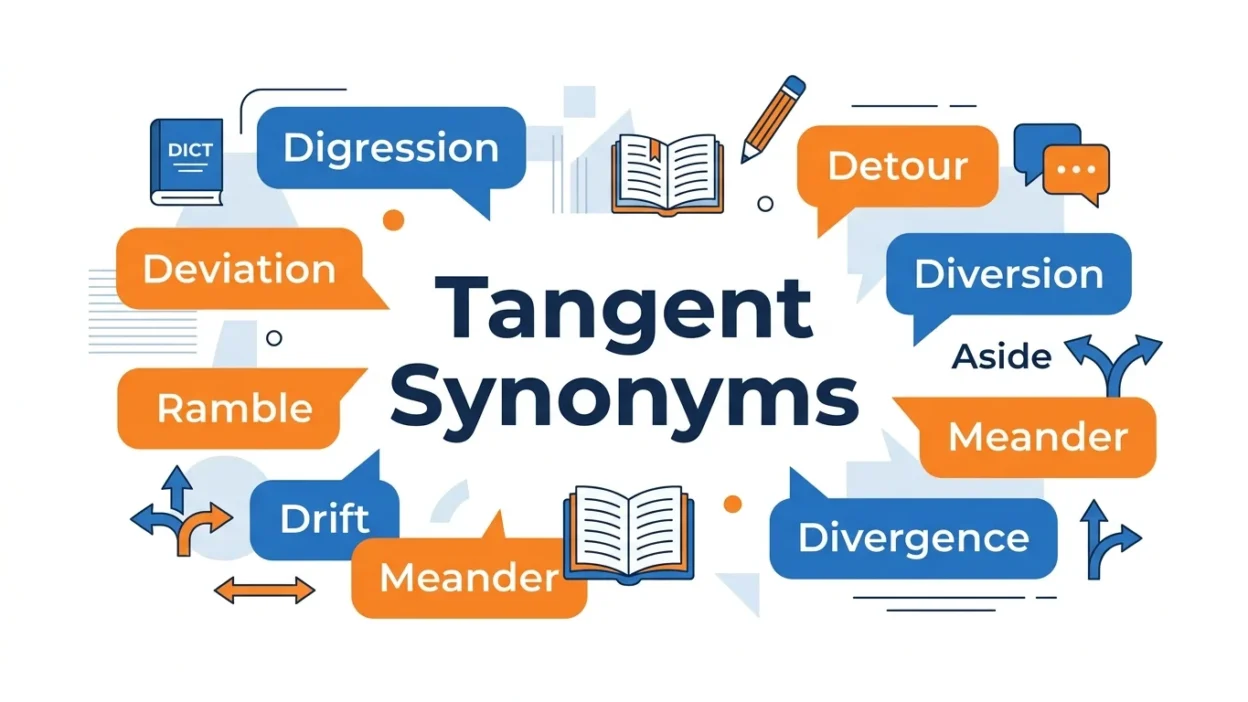
The word tangent has several meanings in English. In everyday conversations and writing, it usually describes a topic or idea that moves away from the main subject.
You may hear someone say, “He went off on a tangent,” meaning they started talking about something unrelated.
Understanding tangent synonyms helps you choose more accurate and natural words depending on the situation.
Whether you’re a student writing essays, an ESL learner building vocabulary, a writer creating engaging content, or a content creator improving communication, knowing different words similar to tangent can make your writing clearer and more varied.
This guide explains the meaning of tangent, introduces 30 useful synonyms, and shows when each one works best.
What Does “Tangent” Mean?
Simple Meaning
Tangent means something that is only slightly connected to the main topic or something that moves away from the original subject. It can refer to a conversation, idea, discussion, or thought that becomes unrelated.
In mathematics, tangent also refers to a line that touches a curve at exactly one point. However, this guide focuses on the everyday language meaning.
Usage Context
The word tangent is commonly used when talking about:
- Conversations
- Meetings
- Discussions
- Writing
- Speeches
- Thoughts
Example:
During the meeting, the manager went off on a tangent about his vacation.
30 Tangent Synonyms with Meanings and Examples
1. Digression
Meaning: A temporary move away from the main topic.
Example: The speaker’s digression lasted several minutes.
Best Usage: Essays, speeches, discussions.
2. Deviation
Meaning: A change from the usual path or subject.
Example: His deviation from the topic confused the audience.
Best Usage: Formal writing, reports.
3. Diversion
Meaning: Something that shifts attention elsewhere.
Example: The question became a diversion from the real issue.
Best Usage: Conversations, writing.
4. Detour
Meaning: An indirect route or change in direction.
Example: The discussion took a detour toward sports.
Best Usage: Informal speech, storytelling.
5. Side Track
Meaning: A different subject that interrupts the main one.
Example: Let’s avoid that side track and continue.
Best Usage: Meetings, conversations.
6. Aside
Meaning: A brief comment separate from the main point.
Example: She made a funny aside during the lecture.
Best Usage: Public speaking, writing.
7. Interruption
Meaning: Something that stops the main flow.
Example: The interruption delayed the discussion.
Best Usage: Meetings, conversations.
8. Departure
Meaning: Moving away from the original topic.
Example: That was a departure from today’s agenda.
Best Usage: Formal communication.
9. Divergence
Meaning: A movement in a different direction.
Example: The divergence weakened the argument.
Best Usage: Academic writing.
10. Offshoot
Meaning: A secondary idea or development.
Example: The project became an offshoot of the original plan.
Best Usage: Business, research.
11. Branch
Meaning: A connected but separate subject.
Example: History is one branch of social science.
Best Usage: Education, knowledge.
12. Spin-Off
Meaning: Something developed from another idea.
Example: The TV series became a successful spin-off.
Best Usage: Entertainment, business.
13. Distraction
Meaning: Something that takes attention away.
Example: Social media became a distraction.
Best Usage: Everyday English.
14. Shift
Meaning: A change in focus.
Example: The conversation shifted to travel.
Best Usage: General writing.
15. Change of Direction
Meaning: A move toward another topic.
Example: His sudden change of direction surprised everyone.
Best Usage: Formal and informal writing.
16. Twist
Meaning: An unexpected turn.
Example: The story took an interesting twist.
Best Usage: Creative writing.
17. Turn
Meaning: A movement toward something different.
Example: The discussion took a serious turn.
Best Usage: Conversations, storytelling.
18. Break
Meaning: A pause or interruption.
Example: Let’s take a break before continuing.
Best Usage: Meetings, presentations.
19. Interval
Meaning: A short pause between activities.
Example: There was a short interval before questions.
Best Usage: Events, performances.
20. Parenthesis
Meaning: A temporary interruption of the main idea.
Example: His comment was like a parenthesis in the discussion.
Best Usage: Formal writing.
21. Excursion
Meaning: A brief journey away from the main subject.
Example: The lecture included an interesting excursion into history.
Best Usage: Academic writing.
22. Ramble
Meaning: Talking without staying focused.
Example: He tends to ramble during meetings.
Best Usage: Informal conversations.
23. Drift
Meaning: Slowly moving away from the topic.
Example: The conversation drifted toward politics.
Best Usage: Everyday English.
24. Wander
Meaning: To move or speak without a clear direction.
Example: Her thoughts wandered during class.
Best Usage: Writing, conversations.
25. Sidestep
Meaning: To avoid the main issue.
Example: He sidestepped the difficult question.
Best Usage: Politics, interviews.
26. Avoidance
Meaning: Staying away from the main topic.
Example: His avoidance frustrated everyone.
Best Usage: Formal communication.
27. Redirection
Meaning: Guiding attention to another subject.
Example: The teacher used redirection effectively.
Best Usage: Education, communication.
28. Bypass
Meaning: Going around instead of addressing directly.
Example: They chose to bypass the issue.
Best Usage: Business, discussions.
29. Digress
Meaning: To move away from the main subject while speaking.
Example: Please don’t digress during your presentation.
Best Usage: Public speaking.
30. Meander
Meaning: To move or speak without a clear path.
Example: The conversation meandered for hours.
Best Usage: Storytelling, informal writing.
Comparison Guide: When to Use Different Tangent Synonyms
Quick Comparison Table
| Synonym | Best Used For | Tone |
|---|---|---|
| Digression | Essays, speeches | Formal |
| Deviation | Reports, research | Formal |
| Diversion | Conversations | Neutral |
| Detour | Informal speech | Casual |
| Aside | Public speaking | Neutral |
| Divergence | Academic writing | Academic |
| Ramble | Casual conversations | Informal |
| Drift | Everyday speech | Casual |
| Wander | Thoughts, stories | Neutral |
| Sidestep | Politics, interviews | Professional |
| Redirection | Teaching, communication | Professional |
| Meander | Creative writing | Descriptive |
| Offshoot | Projects, business | Professional |
| Shift | General writing | Neutral |
| Spin-Off | Entertainment | Informal |
How to Choose the Right Synonym
For Academic Writing
Choose:
- Digression
- Deviation
- Divergence
- Departure
- Parenthesis
These words sound formal and work well in essays and research papers.
For Everyday Conversations
Choose:
- Detour
- Drift
- Wander
- Ramble
- Shift
These are easy to understand and commonly used.
For Meetings and Business
Choose:
- Redirection
- Diversion
- Sidestep
- Offshoot
- Change of Direction
These words fit professional communication.
For Creative Writing
Choose:
- Meander
- Twist
- Excursion
- Branch
- Turn
These add variety and descriptive style to stories and narratives.
For Public Speaking
Choose:
- Aside
- Digress
- Digression
- Interruption
- Diversion
These describe moments when a speaker briefly leaves the main topic.
Why Learning Tangent Synonyms Matters
Knowing different tangent synonyms helps you describe conversations, writing, and ideas more accurately. Instead of always saying someone “went off on a tangent,” you can use words like digression, detour, ramble, or deviation depending on the tone and situation.
A stronger vocabulary also improves essays, presentations, blog posts, and everyday conversations. Choosing the right synonym makes your communication more precise, natural, and engaging.
Conclusion
Learning tangent synonyms is a simple way to improve your English vocabulary and writing skills. Although tangent commonly describes a shift away from the main topic, many alternative words express slightly different meanings. Words like digression, deviation, detour, ramble, and meander each suit different contexts and writing styles.
By understanding these 30 synonyms, their meanings, example sentences, and best usage contexts, you’ll be able to communicate more effectively and choose the most appropriate word for essays, conversations, business writing, and creative projects.

Liam Henry is a content author at Synonymed, specializing in vocabulary enrichment and synonym guides. He creates clear, engaging resources that help learners improve English word knowledge and language fluency.