The English word “small” is one of the most common adjectives used in everyday conversation and writing.
It describes something that has little size, amount, importance, or degree.
While it is a simple and useful word, using the same term repeatedly can make your writing sound repetitive.
Learning different synonyms for small helps students, ESL learners, writers, and content creators express ideas more accurately and naturally.
Some synonyms describe physical size, while others focus on quantity, importance, or intensity.
Choosing the right word can improve clarity and make your writing more engaging.
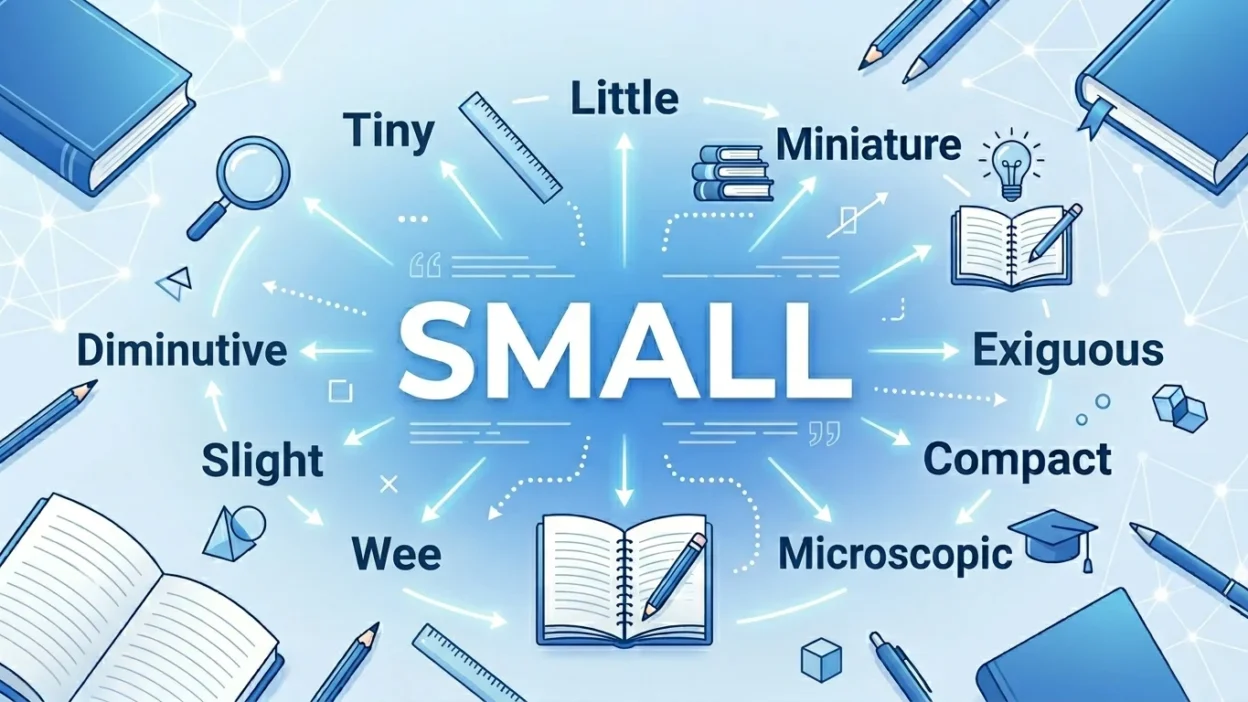
In this guide, you will learn the meaning of small, explore 30 useful synonyms, understand their meanings, see example sentences, and discover when each word works best.
Meaning of “Small”
The word small means something that is little in size, amount, number, or importance.
Simple Definition: Not large; little in size or quantity.
Example:
She lives in a small house near the lake.
Common Usage Contexts:
- Physical size (small room, small box)
- Quantity (small amount of money)
- Importance (small issue)
- Scale (small business)
30 Synonyms for Small
1. Tiny
Meaning: Extremely small in size.
Example Sentence:
A tiny insect landed on the leaf.
Best Usage Context: Very small objects or creatures.
2. Little
Meaning: Small in size or amount.
Example Sentence:
The little girl waved at us.
Best Usage Context: Everyday conversation.
3. Miniature
Meaning: Much smaller than normal.
Example Sentence:
He collects miniature cars.
Best Usage Context: Models and scaled-down objects.
4. Petite
Meaning: Small and attractively delicate.
Example Sentence:
She has a petite frame.
Best Usage Context: Describing people, especially body size.
5. Compact
Meaning: Small but efficiently designed.
Example Sentence:
The compact car fits easily in tight spaces.
Best Usage Context: Products, vehicles, and spaces.
6. Minute
Meaning: Extremely small.
Example Sentence:
Scientists studied minute particles under a microscope.
Best Usage Context: Scientific or formal writing.
7. Microscopic
Meaning: Too small to be seen without magnification.
Example Sentence:
The sample contained microscopic organisms.
Best Usage Context: Science and biology.
8. Diminutive
Meaning: Noticeably small.
Example Sentence:
The actor had a diminutive stature.
Best Usage Context: Formal descriptions.
9. Slight
Meaning: Small in amount or degree.
Example Sentence:
There was a slight delay in the meeting.
Best Usage Context: Changes, differences, or effects.
10. Modest
Meaning: Limited in size or extent.
Example Sentence:
They live in a modest home.
Best Usage Context: Homes, achievements, and lifestyles.
11. Narrow
Meaning: Small in width.
Example Sentence:
We walked through a narrow street.
Best Usage Context: Roads, passages, and spaces.
12. Short
Meaning: Small in length or height.
Example Sentence:
He wrote a short message.
Best Usage Context: Length, duration, or height.
13. Trim
Meaning: Small and neat.
Example Sentence:
The trim garden looked beautiful.
Best Usage Context: Appearance and design.
14. Puny
Meaning: Very small and weak.
Example Sentence:
The puny plant struggled to grow.
Best Usage Context: Weakness or lack of strength.
15. Meager
Meaning: Small and insufficient.
Example Sentence:
The workers received a meager salary.
Best Usage Context: Amounts, resources, and income.
16. Sparse
Meaning: Thinly distributed.
Example Sentence:
The area has sparse vegetation.
Best Usage Context: Nature and population.
17. Scant
Meaning: Barely enough.
Example Sentence:
There was scant evidence available.
Best Usage Context: Formal writing.
18. Limited
Meaning: Small in quantity or scope.
Example Sentence:
The company has limited resources.
Best Usage Context: Business and planning.
19. Minor
Meaning: Not very important.
Example Sentence:
It was only a minor mistake.
Best Usage Context: Problems, issues, and events.
20. Insignificant
Meaning: Too small to be important.
Example Sentence:
The difference was insignificant.
Best Usage Context: Analysis and comparisons.
21. Tiny-Weeny
Meaning: Extremely small.
Example Sentence:
She bought a tiny-weeny notebook.
Best Usage Context: Informal speech.
22. Wee
Meaning: Very small.
Example Sentence:
A wee cottage stood by the river.
Best Usage Context: Informal or British English.
23. Pocket-Sized
Meaning: Small enough to fit in a pocket.
Example Sentence:
I carry a pocket-sized dictionary.
Best Usage Context: Portable items.
24. Lilliputian
Meaning: Extremely small.
Example Sentence:
The garden featured lilliputian decorations.
Best Usage Context: Creative or literary writing.
25. Reduced
Meaning: Made smaller.
Example Sentence:
The image was reduced in size.
Best Usage Context: Measurements and editing.
26. Undersized
Meaning: Smaller than expected.
Example Sentence:
The shirt looked undersized.
Best Usage Context: Clothing and products.
27. Low
Meaning: Small in level or amount.
Example Sentence:
Sales remained low this month.
Best Usage Context: Numbers and statistics.
28. Fine
Meaning: Very thin or small.
Example Sentence:
The artist used a fine brush.
Best Usage Context: Details and textures.
29. Slender
Meaning: Small and thin.
Example Sentence:
The tree had a slender trunk.
Best Usage Context: Shape and appearance.
30. Mini
Meaning: Smaller than standard size.
Example Sentence:
She bought a mini backpack.
Best Usage Context: Fashion and products.
Comparison Guide: When to Use Different Synonyms
| Synonym | Best For | Tone |
|---|---|---|
| Tiny | Extremely small objects | Neutral |
| Little | Everyday use | Casual |
| Petite | Body size | Positive |
| Compact | Efficient design | Professional |
| Minute | Scientific details | Formal |
| Minor | Importance | Neutral |
| Meager | Insufficient amounts | Negative |
| Sparse | Distribution | Neutral |
| Pocket-Sized | Portable items | Practical |
| Mini | Smaller versions | Casual |
How to Choose the Right Synonym
For Physical Size
Use:
- Tiny
- Miniature
- Petite
- Compact
- Mini
These words describe actual size.
For Small Amounts
Use:
- Meager
- Scant
- Limited
- Low
- Slight
These words focus on quantity.
For Low Importance
Use:
- Minor
- Insignificant
- Slight
These words indicate something is not very important.
For Formal Writing
Use:
- Diminutive
- Minute
- Scant
- Insignificant
These synonyms work well in academic and professional content.
For Casual Conversation
Use:
- Little
- Tiny
- Wee
- Mini
These sound natural in everyday speech.
For Creative Writing
Use:
- Lilliputian
- Diminutive
- Petite
These add variety and style to descriptions.
Common Mistakes When Using Synonyms for Small
Using Every Synonym Interchangeably
Not all synonyms have the same meaning. For example, minor refers to importance, while tiny refers to physical size.
Ignoring Tone
Words like lilliputian may sound too formal or literary in casual writing.
Choosing Complex Words Unnecessarily
Simple words such as little or tiny are often clearer than advanced alternatives.
Why Learning Synonyms for Small Matters
Expanding your vocabulary helps you:
- Write more naturally
- Avoid repetition
- Improve essays and assignments
- Create engaging content
- Communicate with greater precision
- Strengthen English fluency
Whether you are a student, ESL learner, writer, or content creator, understanding different synonyms allows you to choose the most accurate word for every situation.
Conclusion
Learning the best synonyms for small can significantly improve your vocabulary and writing skills.
While small is a useful and versatile word, alternatives such as tiny, compact, petite, minor, and meager help communicate more specific meanings.
The key is understanding the context, tone, and purpose of each synonym.
By using the right word at the right time, you can make your writing clearer, more engaging, and more professional.
Keep practicing these synonyms in everyday conversation and writing to build confidence and express yourself more effectively.