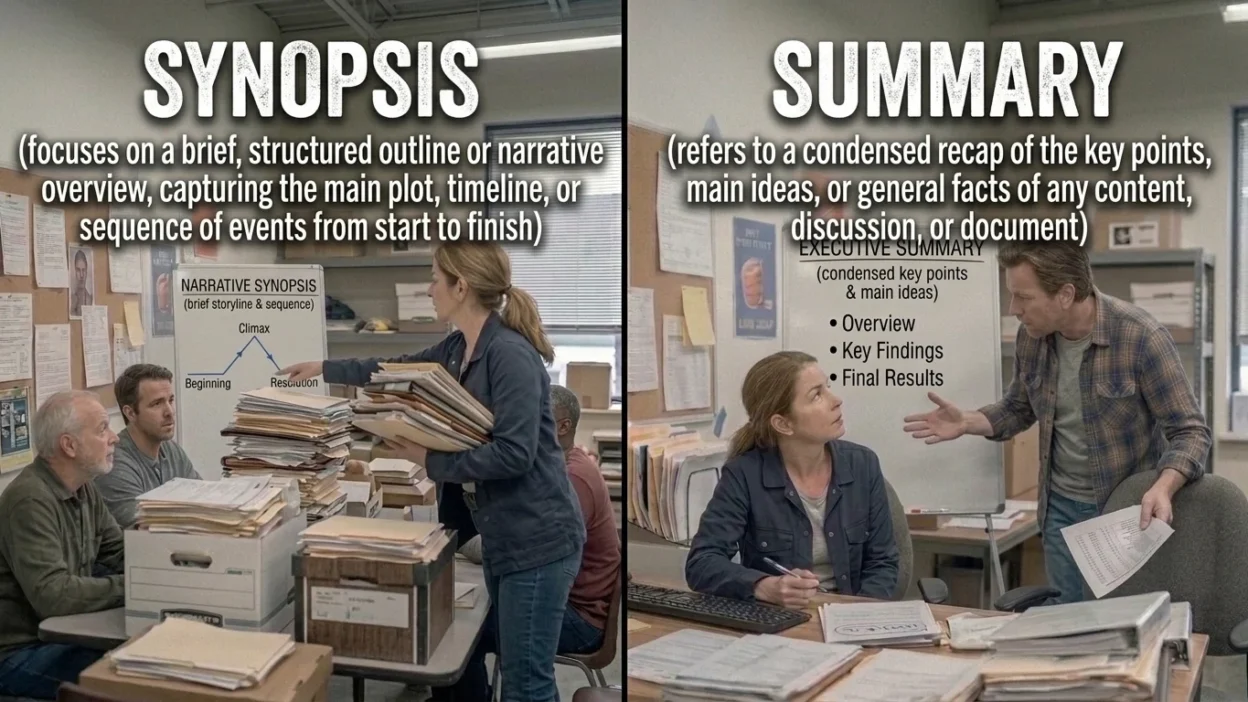
Have you ever wondered whether to use synopsis or summary?
Both words describe a shorter version of a longer piece of information, such as a book, movie, report, or article.
Because their meanings overlap, people often use them interchangeably.
However, there are some useful differences in how they are commonly used.
A summary gives a shortened version of the main points or important information in a longer text, speech, or event.
A synopsis usually provides a concise overview of the main storyline, plot, or central ideas of a work.
For example, you might write a summary of a research report but read a synopsis of a movie before watching it.
In this guide, you will learn the meaning of each word, understand their differences, explore practical examples, and discover when to use synopsis or summary in everyday English and formal writing.
Quick Answer: Synopsis vs. Summary
Synopsis is a brief outline of the main storyline, plot, or central ideas of a work. Summary is a shortened account of the main points or events of something longer.
- Synopsis: The movie synopsis introduces the main characters and central conflict.
- Summary: The movie summary explains the major events and how the story develops.
The words can overlap, especially when describing books and movies. However, synopsis often emphasizes an overview of a work, while summary emphasizes a condensed account of its important content.
Why Do People Confuse Synopsis and Summary?
People confuse synopsis and summary because both involve presenting information in a shorter form. Neither requires repeating every detail from the original material.
For example, both a synopsis and a summary of a novel might mention the main character, the central problem, and important events. The difference often lies in the purpose and level of detail.
A synopsis is commonly used to introduce a story or explain the structure of a work. A summary can be used more broadly to condense a book, meeting, report, article, speech, or conversation.
Compare these examples:
- Synopsis: A young detective investigates a mysterious disappearance in a small town.
- Summary: The detective discovers several clues, questions local residents, identifies the suspect, and solves the case.
The first gives a concise overview. The second recounts more of the important developments.
What Does Synopsis Mean?
Synopsis is a noun that means a brief outline or overview of the main points, storyline, or structure of a larger work.
It is frequently used for books, films, television shows, plays, academic projects, research proposals, and other works that need a concise introduction.
A synopsis usually helps readers understand what a work is about before they read, watch, or evaluate it. Depending on the purpose, it may reveal only the premise or include the major developments and ending.
Examples of Synopsis
- The publisher requested a synopsis of her novel.
- I read the movie synopsis before buying a ticket.
- The writer submitted a synopsis with the manuscript.
- The professor asked us to prepare a synopsis of our research project.
- The television guide provides a short synopsis of each episode.
How to Use Synopsis in a Sentence
Use synopsis when referring to a concise outline or overview of a work.
1. Synopsis of a book
- She prepared a synopsis of her new novel.
- The synopsis introduces the main characters and the central conflict.
2. Synopsis of a movie
- I read the synopsis before watching the film.
- The movie synopsis describes a family searching for a missing child.
3. Synopsis of a research project
- The student submitted a synopsis before beginning the research.
- The research synopsis outlines the topic, objectives, and proposed method.
4. Synopsis of a play or television show
- The program includes a synopsis of the final episode.
- The theater website provides a synopsis of the play.
5. Synopsis for a publisher
- The author sent a synopsis to a literary agent.
- The agent requested a synopsis before reviewing the full manuscript.
Remember that a synopsis is usually brief, but its exact length depends on its purpose. A movie listing may need only a few sentences, while a publishing synopsis may describe the full plot, including the ending.
What Does Summary Mean?
Summary is a noun that means a shortened account of the main points, ideas, or events of something longer.
A summary leaves out unnecessary details and focuses on the information that matters most. It can cover almost any type of content, including a story, article, report, meeting, lecture, book, or conversation.
Unlike a synopsis, which is often associated with outlining a work, a summary is useful whenever someone needs the essential information in a shorter form.
Examples of Summary
- She wrote a summary of the article.
- The manager requested a summary of the meeting.
- I read a summary of the report before the presentation.
- The teacher asked students to write a chapter summary.
- Please give me a short summary of the discussion.
How to Use Summary in a Sentence
Use summary when you want to describe the main points of a longer source in a condensed form.
1. Summary of a book
- He wrote a summary of the book’s main arguments.
- The chapter summary helped me review the material.
2. Summary of a report
- The executive summary explains the report’s main findings.
- We prepared a summary of the annual results.
3. Summary of a meeting
- She emailed a summary of the meeting to the team.
- The summary lists the main decisions and action items.
4. Summary of an article
- The website provides a summary of the news article.
- I wrote a summary of the author’s argument.
5. Summary of a lesson
- The teacher gave us a summary of the lesson.
- A short summary can help students revise important concepts.
The main goal of a summary is to preserve the most important information while removing unnecessary details.
Synopsis vs. Summary: Comparison Table
| Feature | Synopsis | Summary |
|---|---|---|
| Part of speech | Noun | Noun |
| Basic meaning | A brief outline or overview of a work | A shortened account of the main points or events |
| Common uses | Books, films, plays, research projects, manuscripts | Books, reports, articles, meetings, lessons, speeches |
| Main purpose | Introduce or outline a work | Condense important information |
| Typical focus | Premise, plot, structure, or central ideas | Main points, findings, arguments, or events |
| Length | Usually brief; depends on the purpose | Varies according to the source and purpose |
| Example | The synopsis introduces the novel’s plot. | The summary explains the novel’s key events. |
The main difference is one of emphasis rather than a strict rule. Both can describe a shortened version of a book or movie, but summary has broader everyday use.
When to Use Synopsis
Use synopsis when you want to provide a concise outline or overview of a work, particularly when introducing its premise, plot, or structure.
1. When Introducing a Book
- The author prepared a synopsis of the novel for the publisher.
- The synopsis explains the central conflict without describing every scene.
2. When Describing a Movie
- Read the synopsis to learn what the film is about.
- The streaming service includes a synopsis for each movie.
3. When Submitting a Manuscript
- The writer sent a synopsis to a literary agent.
- The publisher requested a synopsis before considering the book.
4. When Presenting a Research Proposal
- The student prepared a synopsis of the proposed research.
- The synopsis outlines the research question and planned approach.
5. When Outlining a Play or Series
- The theater program includes a synopsis of the play.
- The episode synopsis introduces the main conflict.
Quick test: If you are introducing a work or outlining its main storyline or structure, synopsis is often a suitable choice.
When to Use Summary
Use summary when you want to shorten a piece of information while preserving its most important points.
1. When Summarizing an Article
- I wrote a summary of the article’s main argument.
- The summary highlights the author’s key findings.
2. When Reporting a Meeting
- Please send a summary of today’s meeting.
- The summary includes the decisions and next steps.
3. When Explaining a Book
- The teacher asked us to write a summary of the chapter.
- Her summary covers the most important events in the novel.
4. When Reporting Research Findings
- The report begins with a summary of the results.
- The summary explains the main conclusions of the study.
5. When Reviewing a Lesson or Presentation
- He prepared a summary of the lecture.
- The final slide contains a summary of the main points.
Quick test: If you need to condense information from almost any source, summary is usually the best choice.
Synopsis vs. Summary: 15 Example Sentences
Here are 15 examples showing how the two words are commonly used.
- Synopsis: The publisher requested a synopsis of the novel.
- Summary: The student wrote a summary of the novel’s main events.
- Synopsis: I read the film synopsis before watching it.
- Summary: My friend gave me a summary of the movie after I missed it.
- Synopsis: The writer submitted a synopsis with the manuscript.
- Summary: The manager prepared a summary of the quarterly report.
- Synopsis: The theater website includes a synopsis of the play.
- Summary: The teacher asked for a summary of the reading assignment.
- Synopsis: The research synopsis outlines the proposed project.
- Summary: The research summary presents the study’s key findings.
- Synopsis: The episode synopsis introduces the main characters.
- Summary: The episode summary describes the major events.
- Synopsis: The agent read the synopsis before requesting the full manuscript.
- Summary: I reviewed the meeting summary before starting work.
- Summary: The report includes a short summary of its recommendations.
These examples illustrate the common patterns, but the words are not limited to these contexts. A synopsis can also summarize important ideas, and a summary can describe a story’s plot.
Common Mistakes With Synopsis and Summary
Mistake 1: Thinking the Words Have Completely Different Meanings
Incorrect assumption: A synopsis can never be a summary.
Correct understanding: Their meanings overlap. A synopsis is a kind of concise overview, while a summary is a broader category of shortened accounts.
Why? Both words describe ways of presenting the main information from a larger work.
Mistake 2: Using Synopsis for Every Shortened Text
Less natural: I wrote a synopsis of our staff meeting.
More natural: I wrote a summary of our staff meeting.
Why? Summary is the more usual word for condensing the decisions, discussions, and action items from a meeting.
Mistake 3: Assuming a Synopsis Must Hide the Ending
Incorrect assumption: A synopsis must never reveal how a story ends.
Correct understanding: A short promotional synopsis may avoid major spoilers, but a synopsis prepared for a publisher or editor may include the complete plot and ending.
Why? The purpose and intended audience determine how much detail a synopsis should include.
Mistake 4: Assuming Every Summary Must Be Very Short
Incorrect assumption: A summary must contain only one or two sentences.
Correct understanding: A summary can be a paragraph, several paragraphs, or longer, depending on the original material and the purpose.
Why? The goal is to preserve the main information, not to meet one universal word limit.
Mistake 5: Confusing Synopsis With Analysis
Incorrect assumption: A synopsis must explain whether a book or movie is good or bad.
Correct understanding: A synopsis generally outlines a work. An analysis interprets or evaluates it, while a review gives an assessment.
Why? Outlining, interpreting, and evaluating are different tasks.
Easy Memory Trick: Synopsis vs. Summary
Use this simple memory trick:
- Synopsis = Story outline: Think of a brief outline of a movie, novel, or project.
- Summary = Shortened information: Think of the main points from an article, meeting, report, or book.
For example:
- “Read the synopsis before watching the movie.”
- “Write a summary of the meeting.”
You can also remember this question:
Am I introducing a work, or condensing information?
If you are introducing a book’s premise or outlining a manuscript, synopsis may be the better choice. If you are shortening information from a report or conversation, summary is usually more natural.
Synopsis vs. Summary in American and British English
The meanings and spellings of synopsis and summary are essentially the same in American and British English. Both varieties use synopsis for an outline or overview and summary for a condensed account of the main information.
Examples used in both varieties include:
- The publisher requested a synopsis of the novel.
- The report includes a summary of the findings.
- The website provides a synopsis of the film.
There is no major regional spelling difference to remember. The choice depends mainly on the type of content and the purpose of the shortened version.
Similar Words: Synopsis, Summary, Abstract, Outline, and Overview
These words are related, but each has its own common use.
| Word | Meaning | Example |
|---|---|---|
| Synopsis | A concise outline or overview of a work | She submitted a synopsis of her novel. |
| Summary | A shortened account of the main points | He wrote a summary of the report. |
| Abstract | A brief overview of a scholarly paper or research study | The article begins with an abstract. |
| Outline | A structured list of the main sections or ideas | She prepared an outline for her presentation. |
| Overview | A general introduction to a topic or subject | The course begins with an overview of the subject. |
Synopsis vs. Abstract
A synopsis often outlines a story, manuscript, or project. An abstract is especially common in academic and scientific writing, where it briefly describes a study’s purpose, methods, results, and conclusions.
Synopsis vs. Outline
A synopsis usually presents a concise account in connected prose. An outline often organizes the main points into headings, sections, or bullet points.
Summary vs. Overview
A summary condenses the key information from a source. An overview gives a general picture of a topic and may introduce it without covering every important detail.
Frequently Asked Questions
1. What is the main difference between synopsis and summary?
A synopsis is usually a concise outline of a work, especially its storyline, premise, or structure. A summary is a shortened account of the main points or events of something longer. Their meanings overlap, but summary is used more broadly.
2. Is a synopsis the same as a summary?
Not exactly, although they can overlap. A synopsis is often used to introduce or outline a work, while a summary condenses its main information. In some contexts, particularly when discussing a story, the two terms can describe similar things.
3. Is a synopsis longer than a summary?
There is no universal length rule. Both can be short or relatively detailed, depending on their purpose. A synopsis for a publisher may need to cover the entire plot, while a movie synopsis may be only a few sentences.
4. What is a synopsis of a book?
A book synopsis is a concise account of the book’s premise, main characters, central conflict, and important developments. For a publishing submission, it may also reveal the ending so the reader can assess the complete story.
5. What is a summary of a book?
A book summary condenses the book’s main ideas, arguments, or events. Depending on the book, it may focus on the plot, the central message, or the most important information.
6. Should I write a synopsis or a summary of a research paper?
It depends on the instructions and the purpose. Summary is a broad term for a condensed account of a paper’s main points. Synopsis may be used for an outline of a proposed research project. For a published academic paper, abstract is often the standard term for its formal brief overview.
7. Can a synopsis contain spoilers?
Yes. A synopsis intended for a publisher, editor, or evaluator may include major plot developments and the ending. A promotional synopsis, however, may avoid spoilers to encourage people to read or watch the work.
8. Which word is more common in everyday English?
Summary is generally more common in everyday situations because people summarize meetings, conversations, reports, lessons, and articles. Synopsis is especially common when discussing the plot or outline of a book, film, play, or project.
Remember This
- Synopsis: A concise outline or overview of a work.
- Summary: A shortened account of the main points or events.
- Use synopsis when introducing a story, manuscript, or project.
- Use summary when condensing a report, meeting, article, or other information.
- The words can overlap, so consider the purpose and audience.
- An academic paper’s brief formal overview is often called an abstract.
Conclusion
The difference between synopsis and summary mainly comes down to their usual purpose. A synopsis often introduces or outlines a work, especially a story, film, manuscript, or research project. A summary condenses the important points or events from a wider range of sources, including reports, articles, meetings, lessons, and books. Because their meanings overlap, either word may sometimes be appropriate.
When choosing between them, think about what you want your writing to accomplish. If you are outlining a story or introducing a work, synopsis is often a good choice. If you are shortening information to highlight its main points, summary is usually the more natural option. Understanding this distinction will help you choose the right word in everyday communication, academic writing, and professional situations.