
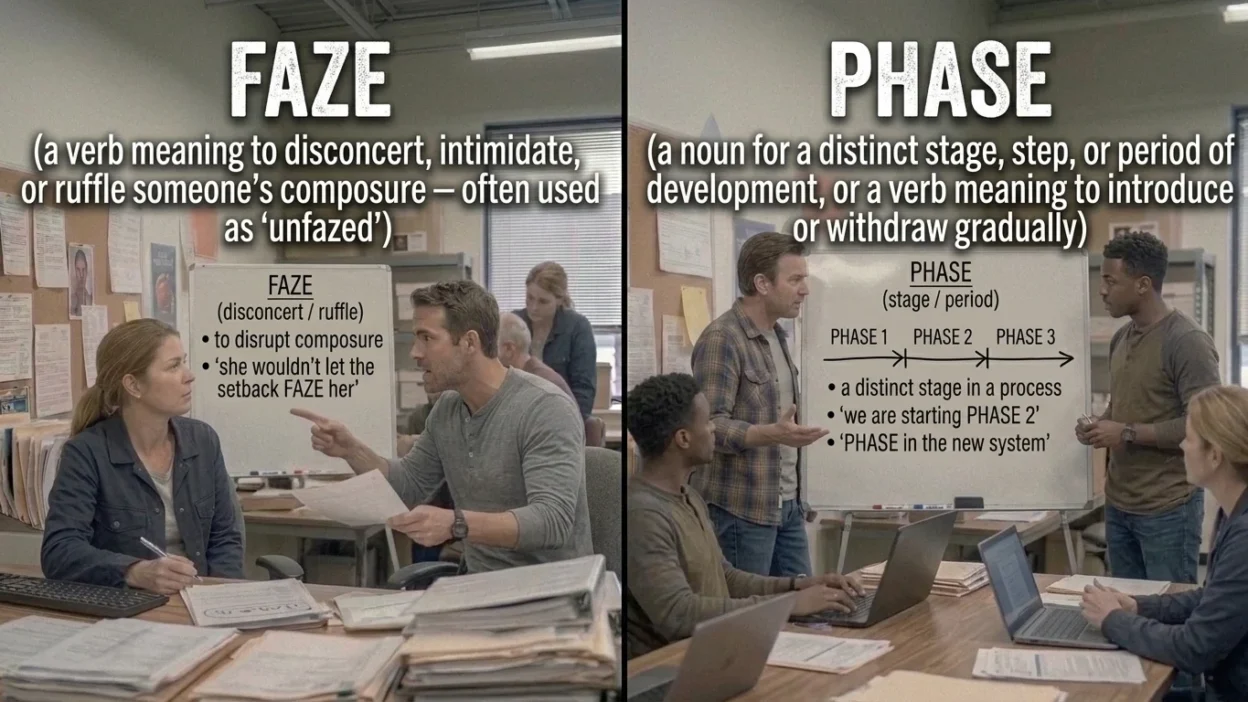
The words faze and phase sound exactly alike, but they have different meanings and uses.
Because they are homophones, it is easy to confuse them when writing, even if you understand what they mean when speaking.
Knowing the difference between faze and phase will help you avoid spelling mistakes and communicate more clearly in schoolwork, emails, professional writing, and everyday conversations.
Faze is a verb meaning to disturb, unsettle, or make someone feel nervous or confused.
For example, “The criticism did not faze her” means the criticism did not upset or discourage her.
Phase is usually a noun meaning a stage or period in a process, although it can also be a verb meaning to introduce, arrange, or carry something out in stages.
For example, “The project entered its final phase” refers to the last stage of the project.
In this guide, you will learn how to distinguish faze from phase, understand their meanings, and use both words correctly through simple explanations and practical examples.
Quick Answer: Faze vs. Phase
Faze means to disturb, unsettle, or bother someone. Phase means a stage or period in a process and can also mean to arrange something in stages. Use faze when describing someone’s reaction to a situation and phase when discussing stages, development, or gradual changes.
Why Do People Confuse Faze and Phase?
People confuse faze and phase because they have the same pronunciation but different spellings and meanings. These words are known as homophones.
When speaking, listeners cannot usually tell which word you mean from pronunciation alone. The context helps them understand your meaning, but in writing, choosing the wrong word can make a sentence confusing or incorrect.
For example:
- The noise did not faze him. This means the noise did not bother him.
- The project entered a new phase. This means the project moved into a new stage.
The words also appear in different common expressions. You might hear “nothing fazes her” when describing someone who remains calm, or “a difficult phase” when discussing a challenging period in life.
The easiest way to remember the difference is to connect faze with feelings and phase with stages.
1. Faze: Meaning, Definition, and Examples
Faze is a verb that means to disturb, unsettle, embarrass, or make someone feel nervous or uncomfortable. It is often used when someone remains calm despite a difficult, surprising, or unpleasant situation.
The word commonly appears in negative sentences, such as “It did not faze me,” and in expressions such as “Nothing seems to faze him.”
When Should You Use Faze?
Use faze when describing an event, comment, problem, or situation that affects someone’s confidence or peace of mind.
Common examples include:
- Faze someone with criticism
- Not faze someone at all
- Be unfazed by a problem
- Nothing seems to faze someone
- Refuse to be fazed by difficulties
Examples of Faze in Sentences
- The difficult question did not faze the student.
- Loud noises tend to faze the nervous dog.
- Her manager’s criticism did not faze her.
- The unexpected announcement seemed to faze everyone in the room.
- Nothing seems to faze my older brother.
- He was not fazed by the challenging interview questions.
- The athlete refused to let the pressure faze him.
- Her confidence was impressive because setbacks rarely faze her.
- The sudden change in plans did not faze the experienced traveler.
- The young performer was fazed by the large audience.
- The teacher’s difficult questions failed to faze the prepared students.
- Despite the criticism, the speaker remained calm and unfazed.
What Does Unfazed Mean?
Unfazed means not disturbed, worried, or unsettled by something.
For example:
- She remained unfazed by the negative comments.
- He looked unfazed by the unexpected delay.
The word unfazed is a useful clue to the meaning of faze. If you can replace a word with “unsettled” or “bothered,” faze may be the correct choice.
2. Phase: Meaning, Definition, and Examples
Phase is most commonly a noun meaning a stage, period, or part of a larger process. It describes a particular point in development, a temporary period in someone’s life, or one step in a plan.
Phase can also be used as a verb. In that form, it often means to introduce, remove, or organize something gradually or in stages.
When Should You Use Phase?
Use phase when discussing stages, periods, development, or gradual changes.
Common expressions include:
- A new phase of life
- The final phase of a project
- An early phase of development
- A difficult phase
- Phase in a new system
- Phase out an old product
- Phase something in gradually
Examples of Phase as a Noun
- The project has entered its final phase.
- Childhood is an important phase of human development.
- The company is in the planning phase of its expansion.
- The moon goes through different phases during its cycle.
- Moving to a new city marked a new phase in her life.
- The first phase of the training program begins next week.
- The patient is recovering from the most difficult phase of treatment.
- Every construction project has several important phases.
- Teenagers may go through a temporary phase of changing interests.
- The team completed the testing phase before launching the product.
Examples of Phase as a Verb
The verb phase is especially common in the expressions phase in and phase out.
- The school will phase in the new curriculum over two years.
- The company plans to phase out its older software.
- The government decided to phase in the new regulations gradually.
- The manufacturer will phase out the outdated model.
- The organization is phasing in a new training system.
Phase in means to introduce something gradually. Phase out means to remove or discontinue something gradually.
These expressions are useful in business, education, technology, government, and everyday discussions about change.
Faze vs. Phase: Comparison Table
| Feature | Faze | Phase |
|---|---|---|
| Part of speech | Verb | Usually a noun; also a verb |
| Main meaning | To disturb or unsettle someone | A stage or period in a process |
| Common context | Feelings, reactions, confidence | Development, projects, life stages |
| Related expression | Unfazed | Phase in, phase out |
| Example | The criticism did not faze her. | The project entered a new phase. |
| Past tense | Fazed | Phased |
| Typical question | Did it bother someone? | Which stage or period is it? |
| Memory clue | Feelings and reactions | Stages and changes |
When Should You Use Faze or Phase?
The best word depends on what you want to describe.
Use Faze When Something Disturbs Someone
Choose faze when the sentence concerns a person’s emotional response, confidence, or comfort.
Examples:
- The difficult exam did not faze him.
- She was fazed by the unexpected question.
- Nothing seems to faze the experienced teacher.
Ask yourself: Does the sentence describe someone being bothered or unsettled? If yes, faze is likely correct.
Use Phase When You Mean a Stage or Period
Choose phase when describing a part of a process, a period of development, or a gradual change.
Examples:
- The project is entering a new phase.
- He went through a difficult phase in his life.
- The company will phase out the old product.
Ask yourself: Does the sentence refer to a stage, period, or gradual change? If yes, phase is likely correct.
How Can You Check Your Choice?
Try replacing the word with a simpler expression.
- If “bother” or “unsettle” fits, use faze.
- If “stage” or “period” fits, use phase.
For example, “The criticism did not bother her” makes sense, so faze is correct. “The project entered a new stage” makes sense, so phase is correct.
Faze vs. Phase: 12 Examples in Context
Here are additional examples that show how the two words work in different situations.
- Faze: The interviewer asked difficult questions, but they did not faze the candidate.
Meaning: The candidate remained calm and confident. - Phase: The company entered a new phase of growth.
Meaning: The company began a new stage of development. - Faze: The unexpected news seemed to faze her.
Meaning: The news disturbed or unsettled her. - Phase: The final phase of the project begins tomorrow.
Meaning: The last stage starts tomorrow. - Faze: The actor was not fazed by the audience’s reaction.
Meaning: The reaction did not upset or unsettle the actor. - Phase: The school will phase in the revised timetable.
Meaning: The school will introduce the timetable gradually. - Faze: A little competition does not faze an experienced athlete.
Meaning: Competition does not make the athlete nervous. - Phase: The child is going through a difficult phase.
Meaning: The child is experiencing a challenging period. - Faze: The sudden power outage failed to faze the technician.
Meaning: The technician remained calm. - Phase: The company will phase out the older product next year.
Meaning: The company will gradually discontinue the product. - Faze: Despite the negative comments, she remained unfazed.
Meaning: The comments did not disturb her. - Phase: The research team completed the first phase of the study.
Meaning: The team finished the first stage.
Common Mistakes With Faze and Phase
Mistake 1: Using Phase When You Mean Bother
Incorrect: The rude comment did not phase me.
Correct: The rude comment did not faze me.
Why? The sentence describes an emotional reaction. The comment did not disturb or upset the speaker.
Mistake 2: Using Faze to Describe a Stage
Incorrect: The project has reached its final faze.
Correct: The project has reached its final phase.
Why? The sentence refers to the last stage of a project, not an emotional reaction.
Mistake 3: Confusing Phased With Fazed
Incorrect: The company fazed out the old system.
Correct: The company phased out the old system.
Why? Phased out means gradually discontinued. Fazed means disturbed or unsettled.
Mistake 4: Assuming Phase Is Only a Noun
Although phase is often a noun, it can also function as a verb.
Correct examples:
- The project entered a new phase. (Noun)
- The company will phase in the changes. (Verb)
Recognizing both uses helps you understand the word in different contexts.
Mistake 5: Choosing by Pronunciation Alone
Because faze and phase sound alike, pronunciation cannot reliably tell you which spelling to use.
Instead, consider the meaning:
- Someone is unsettled: faze.
- A stage or gradual change: phase.
Memory Trick: How to Remember Faze vs. Phase
Use this simple memory trick:
- Faze = feelings.
- Phase = stage.
Think of faze as a word about how someone feels when facing pressure, criticism, or a surprise.
Think of phase as a word about the stages of a project, a period of life, or a gradual transition.
You can also remember these examples:
- The difficult test did not faze me.
- The project entered a new phase.
For phase in and phase out, remember that both expressions describe gradual change. A company might phase in a new policy and phase out an old one.
American vs. British English: Is There a Difference?
There is no significant difference between American and British English in the spelling or basic meaning of faze and phase. Both varieties use faze to mean disturb or unsettle and phase to mean a stage or to describe a gradual change.
Examples in American English:
- The unexpected result did not faze her.
- The company will phase out the old system.
Examples in British English:
- The unexpected result did not faze her.
- The company will phase out the old system.
The words are spelled and used in the same way in both varieties. The correct choice depends on the intended meaning, not the region.
Similar Words: Faze, Phase, and Related Terms
Understanding related words can help you use faze and phase correctly.
| Word | Meaning | Example |
|---|---|---|
| Faze | Disturb or unsettle | The criticism did not faze him. |
| Phase | A stage or period | The project is in its final phase. |
| Unfazed | Not disturbed or unsettled | She remained unfazed by the delay. |
| Fazed | Disturbed or unsettled | He seemed fazed by the question. |
| Phased | Introduced or removed in stages | The changes were phased in gradually. |
| Stage | A particular step or period | The project reached its final stage. |
| Period | A length or stage of time | It was a difficult period for the family. |
| Disturb | Interrupt or upset | The noise disturbed the audience. |
| Unsettle | Make someone feel uncertain or worried | The sudden change unsettled him. |
| Transition | A change from one state to another | The school is going through a transition. |
Faze vs. Unfazed
Faze is a verb meaning to disturb someone. Unfazed is an adjective describing someone who is not disturbed.
- The criticism did not faze her.
- She remained unfazed by the criticism.
Phase vs. Stage
Phase and stage often have similar meanings when describing parts of a process.
- The project entered its second phase.
- The project entered its second stage.
Both sentences describe a particular point in the project’s development.
Phased vs. Fazed
These words are especially easy to confuse because they share the same pronunciation.
- Phased: The new rules were phased in over several months.
- Fazed: The new rules did not faze the employees.
The first describes gradual implementation. The second describes an emotional reaction.
Final Verdict: Faze or Phase?
The difference between faze and phase is simple once you connect each word with its meaning.
- Faze is a verb meaning to disturb, unsettle, or bother someone.
- Phase usually means a stage or period, but it can also mean to introduce or remove something gradually.
Use faze when discussing someone’s reaction to a difficult or surprising situation. Use phase when discussing a stage of development, a period of life, or a gradual change.
If you are unsure, ask yourself whether the sentence is about feelings or stages. Feelings point to faze, while stages and gradual changes point to phase.
Frequently Asked Questions
1. Is it faze or phase?
Both words are correct, but they have different meanings. Faze means to disturb or unsettle someone, while phase means a stage or period. For example, “The criticism did not faze her” and “The project entered a new phase.”
2. Does faze mean bother?
Yes. Faze means to disturb, unsettle, or make someone feel uncomfortable or nervous. For example, “The difficult questions did not faze the student” means the questions did not upset or discourage the student.
3. What does phase mean?
Phase usually means a stage or period in a process or development. It can also be a verb meaning to introduce or remove something gradually. For example, “The project entered a new phase” and “The company will phase out the old product.”
4. Is it phased out or fazed out?
Phased out is correct when you mean that something is gradually discontinued or removed. For example, “The company phased out the old software.” Fazed means disturbed or unsettled, so it does not fit this expression.
5. Are faze and phase homophones?
Yes. Faze and phase are homophones because they have the same pronunciation but different spellings and meanings. Their context helps readers and listeners determine which word is intended.
6. What does unfazed mean?
Unfazed means not disturbed, worried, or unsettled by something. For example, “She remained unfazed by the criticism” means the criticism did not upset her or affect her confidence.
7. Can phase be used as a verb?
Yes. Phase can be a verb, especially in the expressions phase in and phase out. “The school will phase in the new curriculum” means the school will introduce it gradually.
8. How can I remember the difference between faze and phase?
Remember faze = feelings and phase = stage. Use faze when something bothers or unsettles a person. Use phase when referring to a period, stage, or gradual change.
Remember This
- Faze means to disturb, bother, or unsettle someone.
- Phase means a stage or period in a process.
- Fazed means disturbed or unsettled.
- Unfazed means calm or not disturbed.
- Phased in means introduced gradually.
- Phased out means discontinued gradually.
The words sound alike, but their meanings make the correct spelling easy to identify.