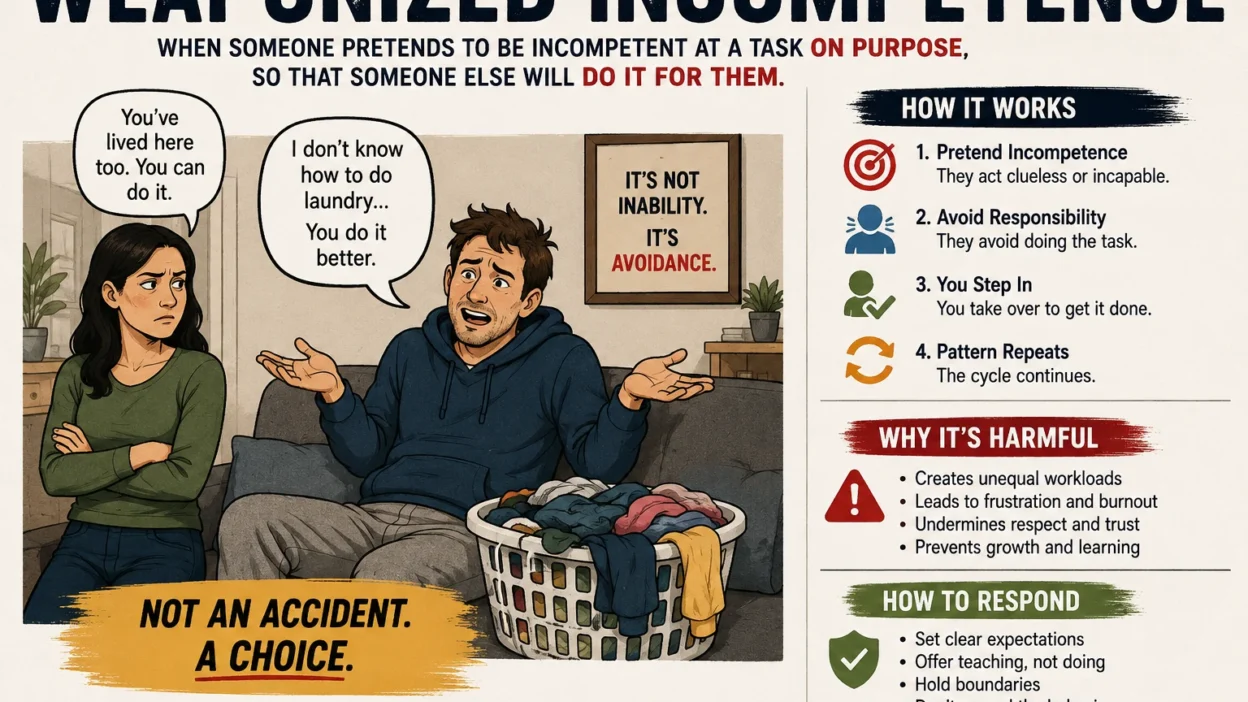
Weaponized incompetence describes a pattern in which someone repeatedly acts as though they are incapable of completing.
A task often poorly performing it, avoiding responsibility, or claiming they “don’t know how” so that someone else eventually takes over.
It is less about genuinely lacking a skill and more about using perceived incompetence as a way to avoid responsibility.
Synonyms and Alternative Terms
There is no single perfect synonym for weaponized incompetence, but several expressions capture similar ideas:
1. Strategic incompetence
This is perhaps the closest alternative. It suggests that someone is deliberately presenting themselves as incapable to avoid doing something.
2. Deliberate incompetence
This emphasizes that the poor performance is intentional rather than accidental.
3. Feigned incompetence
“Feigned” means pretended. This term works when someone is acting as though they cannot do something despite being capable of learning or doing it.
4. Strategic helplessness
This describes deliberately behaving as though one is helpless so another person will step in and handle the responsibility.
5. Learned helplessness
This term is sometimes used similarly, but it is not an exact synonym. In psychology, learned helplessness has a specific meaning and does not necessarily involve intentional manipulation.
6. Responsibility avoidance
A broader, more neutral phrase for repeatedly avoiding tasks, obligations, or accountability.
7. Accountability avoidance
Useful in professional settings when someone consistently finds ways to escape responsibility for outcomes.
8. Playing helpless
A more informal expression for behaving as though one cannot handle a task in the hope that someone else will do it.
9. Passing the buck
This means shifting responsibility or blame to someone else. It overlaps with weaponized incompetence but does not necessarily involve pretending to be incapable.
10. Strategic helplessness
This phrase is particularly useful when the person’s behavior appears designed to make someone else feel responsible for stepping in.
Examples of Weaponized Incompetence
Weaponized incompetence can appear in many situations.
At home, one partner might repeatedly say, “I don’t know how to use the washing machine,” despite having been shown several times. Eventually, the other partner handles all the laundry.
At work, an employee might consistently submit incomplete work and say, “I’m just not good at this,” causing a colleague to fix the work every time.
In a team project, someone might avoid learning how to perform a basic task by repeatedly asking others to do it for them.
The important distinction is the pattern. Everyone struggles with unfamiliar tasks sometimes. Genuine lack of knowledge is not weaponized incompetence.
The concern arises when someone repeatedly avoids learning, improving, or taking responsibility despite having reasonable opportunities to do so.
Why It Can Be Frustrating
The person who continually steps in to compensate may gradually become responsible for far more than their share of the work.
Over time, this can create:
- Resentment
- Burnout
- Unequal workloads
- Frustration
- Loss of trust
- Relationship conflict
- Workplace tension
The problem is therefore not simply that someone “isn’t good at something.” It is that their behavior can shift the burden of responsibility onto another person.
How to Address It
A useful response is to focus on the responsibility rather than the label.
Instead of saying, “You’re using weaponized incompetence,” you might say:
“I’ve noticed that when this task comes up, you often ask me to take over instead of learning how to do it. I need you to take responsibility for your part.”
In a workplace, a more professional approach might be:
“I’m happy to help you learn the process, but I can’t continue completing the task on your behalf.”
Clear expectations, documentation, training, and boundaries can help prevent responsibility from continually being transferred to someone else.
Final Thought
Weaponized incompetence is a useful phrase for describing a specific pattern of behavior, but the best synonym depends on what you are trying to emphasize.
If you want a professional alternative, use strategic incompetence, responsibility avoidance, or accountability avoidance.
If you want a psychological or descriptive alternative, feigned incompetence or strategic helplessness may be more appropriate.
If you want a simple, everyday phrase, you can say someone is playing helpless, avoiding responsibility, or passing the buck.
Ultimately, the issue is not if someone struggles with a task. It is whether they consistently use that struggle as a reason for someone else to carry their responsibility.