
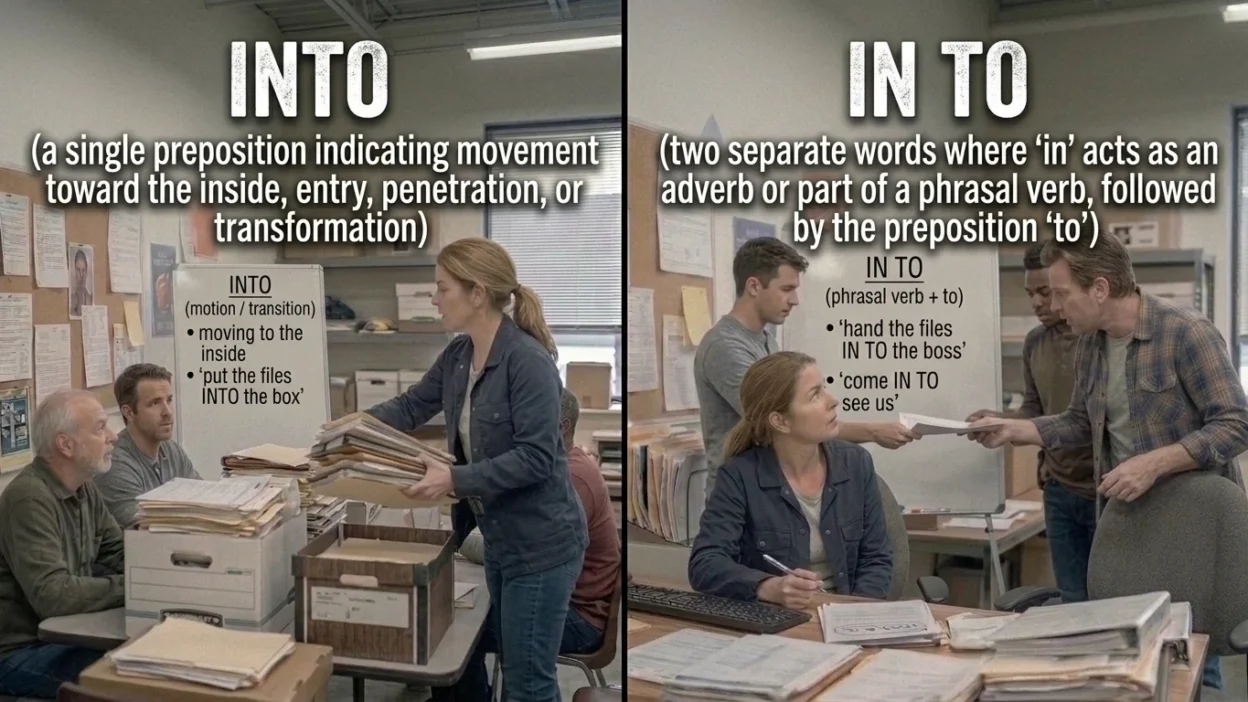
The words into and in to look almost identical, but they are used differently in English.
Knowing when to write them as one word or two can help you avoid common grammar and spelling mistakes.
The main difference is that into is a preposition that often shows movement toward the inside of something, while in to consists of two separate words that belong to different parts of a sentence.
For example, in “She walked into the room,” into shows movement from outside to inside.
However, in “She logged in to check her email,” in belongs to the phrasal verb log in, while to introduces the purpose of the action.
The correct choice depends on the meaning and grammatical structure of your sentence, not simply on how the words sound.
In this guide, you will learn the definitions of into and in to, discover when to use each form, explore practical examples, and find easy ways to remember the difference.
Quick Answer: Into vs. In To
Into is one word that commonly describes movement toward the inside of something, a change, or involvement. In to is two words that appear next to each other when in belongs to one part of the sentence and to belongs to another. For example, “Go into the house” but “Log in to your account.”
Why Do People Confuse Into and In To?
People confuse into and in to because the two forms sound the same in ordinary speech. The difference becomes clear when you examine how each word functions in a sentence.
The confusion often occurs with phrasal verbs, which are verbs combined with short words such as in, on, up, or out. Some phrasal verbs include log in, hand in, turn in, and give in. When another word beginning with to follows one of these expressions, the result may be in to rather than into.
Compare these sentences:
- She went into the office. The word into shows movement toward the inside.
- She turned her assignment in to the teacher. The word in belongs to turn in, and to introduces the recipient.
The best way to choose the correct form is to understand the sentence’s meaning and grammatical structure.
1. Into: Meaning, Definition, and Examples
Into is a preposition. It commonly expresses movement from outside to inside, but it can also describe transformation, involvement, direction, or a change in condition.
When Should You Use Into?
Use into in these common situations.
1. To show movement from outside to inside
This is the most familiar use of into.
Examples:
- The cat jumped into the box.
- She walked into the kitchen.
- He poured the water into the glass.
2. To describe a change or transformation
Into can show that something becomes something else.
Examples:
- The caterpillar turned into a butterfly.
- The writer transformed the story into a movie.
- The ice melted into water.
3. To describe interest or involvement
Into can express a strong interest in something or involvement in an activity.
Examples:
- My brother is into photography.
- She got into trouble at school.
- He went into business with his friend.
4. To describe division or separation
Examples:
- Divide the cake into eight pieces.
- The class was split into four groups.
- The company divided the project into smaller tasks.
5. To describe contact or collision
Examples:
- The car crashed into a fence.
- He accidentally walked into a glass door.
- The ball rolled into the wall.
More Examples of Into in Sentences
- Please put your shoes into the cupboard.
- The children ran into the garden.
- She translated the document into Spanish.
- The small stream flows into the river.
- The investigation developed into a complicated case.
- He looked into the problem carefully.
- The conversation turned into an argument.
- They moved into a new apartment last week.
Remember that into does not always describe literal physical movement. It can also express a figurative change, interest, or involvement.
2. In To: Meaning, Definition, and Examples
In to is not a single preposition. It is a combination of two separate words: in and to. Each word has its own grammatical role in the sentence.
The word in may be part of a phrasal verb, while to may introduce an infinitive verb, identify a recipient, or serve another grammatical purpose.
When Should You Use In To?
Use in to when the sentence requires in and to separately.
1. When to belongs to an infinitive verb
An infinitive commonly uses to followed by a verb in its base form.
Examples:
- She logged in to check her messages.
- He came in to speak with the manager.
- I went in to ask a question.
In these examples, in belongs to the action of logging in, coming in, or going in. The word to introduces the purpose of that action.
2. When in belongs to a phrasal verb and to identifies a recipient
Examples:
- She turned her homework in to the teacher.
- He handed the documents in to the office.
- The employee turned the completed form in to her supervisor.
Here, turn in and hand in mean to submit or deliver something. The following to introduces the person or place receiving it.
3. When the words belong to separate grammatical structures
Examples:
- The visitor came in to see the exhibition.
- He signed in to register for the event.
- The students went in to meet their new teacher.
The exact interpretation depends on the sentence. In each example, the two words perform separate grammatical functions.
More Examples of In To in Sentences
- I logged in to download the report.
- She came in to talk about the schedule.
- He turned the application in to the admissions office.
- The assistant went in to help the customer.
- Please sign in to access the online course.
- The student handed the assignment in to the instructor.
- They checked in to receive their room keys.
- The manager called in to discuss the new plan.
Some sentences can be rewritten to make their meaning clearer. For example, “She turned her homework in to the teacher” can also be written as “She turned in her homework to the teacher.”
Into vs. In To: Comparison Table
| Feature | Into | In To |
|---|---|---|
| Form | One word | Two separate words |
| Grammar | Preposition | Two words with separate grammatical roles |
| Common meaning | Movement inside, transformation, involvement | Depends on the role of in and to |
| Typical example | Walk into the room | Log in to check your email |
| Shows physical movement inside | Often | Not as a single preposition |
| Can introduce a purpose | No, not by itself in this construction | Yes, when to introduces an infinitive |
| Common context | Directions, changes, interests | Phrasal verbs, purposes, recipients |
| Example sentence | She poured milk into the cup. | She came in to help us. |
When Should You Use Into or In To?
The correct form depends on what you want the sentence to say.
Use Into When You Mean Movement or Change
Choose into when it connects an action to a destination, transformation, or state.
Examples:
- The dog ran into the house.
- The artist turned the photograph into a painting.
- She divided the group into two teams.
- He is really into science.
A useful test is to ask whether into means “to the inside of,” “becoming,” or “involved in.” If one of these meanings fits, into may be the right choice.
Use In To When the Words Have Separate Jobs
Choose in to when in belongs to a verb or phrase and to serves a different purpose.
Examples:
- I signed in to check the attendance list.
- She came in to speak with us.
- He turned the report in to his manager.
Try identifying the verb phrase first. If the sentence contains log in, sign in, come in, or turn in, check whether the following to belongs to another part of the sentence.
A Simple Test for Choosing the Correct Form
Consider this sentence:
“She went ___ the room.”
The natural choice is into because the sentence describes movement to the inside of the room.
Now consider:
“She logged ___ check her messages.”
The correct choice is in to: “She logged in to check her messages.” The word in belongs to logged in, while to check expresses the purpose.
Into vs. In To: 12 Examples With Explanations
Here are practical examples to help you recognize the difference.
- Into: The boy jumped into the swimming pool.
Why: The word shows movement from outside to inside. - In to: She logged in to check her account.
Why: In belongs to logged in, and to check expresses purpose. - Into: Pour the juice into the bottle.
Why: The juice moves inside the bottle. - In to: He came in to ask for directions.
Why: In describes entering, and to ask explains why he came in. - Into: The caterpillar developed into a butterfly.
Why: The word expresses transformation. - In to: She turned the assignment in to the teacher.
Why: Turn in means submit, and to the teacher identifies the recipient. - Into: They moved into their new home.
Why: The sentence describes entering and beginning to occupy a place. - In to: I signed in to register for the workshop.
Why: In belongs to signed in, while to register gives the purpose. - Into: The road leads into the village.
Why: The word indicates direction toward or inside a place. - In to: The manager came in to discuss the budget.
Why: The words have separate grammatical functions. - Into: The class was divided into three groups.
Why: The word introduces the resulting groups. - In to: He handed the completed form in to the receptionist.
Why: Hand in means submit, and to the receptionist names the recipient.
Common Mistakes With Into and In To
Mistake 1: Writing Into Before an Infinitive When In To Is Needed
Incorrect: She logged into check her email.
Correct: She logged in to check her email.
Why? Logged in is the completed action, and to check explains its purpose.
Mistake 2: Separating Into When It Shows Movement Inside
Incorrect: The child ran in to the classroom.
Correct: The child ran into the classroom.
Why? The sentence describes the child moving from outside to inside the classroom.
Mistake 3: Assuming Every Sentence About Entering Uses Into
Sometimes, in to is correct even when a person physically enters a place.
Example: “She came in to speak with the director.”
Here, in describes entering, while to speak gives the purpose. The sentence does not need the preposition into.
Mistake 4: Confusing Phrasal Verbs With Prepositions
Incorrect: He turned the form into his supervisor.
Correct: He turned the form in to his supervisor.
Why? If he submitted the form, the phrasal verb is turn in. The word to identifies the recipient. Writing into could suggest movement or transformation instead.
Mistake 5: Choosing by Sound Alone
Both forms are often pronounced alike. Listening to the sentence may not help you decide which spelling is correct.
Instead, identify the grammatical roles of the words and consider the intended meaning.
Memory Trick: How to Remember Into vs. In To
Use these simple reminders:
- Into = one direction or change.
- In to = two words doing separate jobs.
Think of a person walking into a room. The word describes movement toward the inside.
Now think of someone logging in to read a message. The word in belongs to log in, and to introduces the action of reading.
You can also use the replacement test:
- If you can replace into with “to the inside of,” the one-word form may be correct.
- If to introduces a verb such as check, ask, help, or read, examine whether in belongs to the preceding verb phrase.
This trick is helpful, but always consider the full sentence because into also has figurative meanings.
American vs. British English: Is There a Difference?
There is no significant spelling or meaning difference between American and British English for into and in to. Both varieties use into as a preposition and in to when the words have separate grammatical roles.
Examples in American English:
- She walked into the store.
- He signed in to check his account.
Examples in British English:
- She walked into the shop.
- He signed in to check his account.
The nouns store and shop may differ by regional preference, but the distinction between into and in to remains the same. In both varieties, the correct choice depends on grammar and meaning.
Similar Words and Expressions
Several related words and expressions can help you understand how into and in to work.
| Word or phrase | Meaning | Example |
|---|---|---|
| In | Inside or within a place or state | The keys are in the drawer. |
| Into | Toward the inside; becoming | She walked into the room. |
| In to | Two separate words with different roles | He came in to help. |
| Onto | To a position on a surface | The cat jumped onto the table. |
| Within | Inside a boundary or limit | Finish the task within an hour. |
| Inside | In the inner part of something | The package is inside the box. |
| Log in | Access an account or system | Please log in first. |
| Turn in | Submit something or go to bed, depending on context | Turn in your homework today. |
| Sign in | Record your arrival or access a system | Sign in at reception. |
Into vs. In: What Is the Difference?
In often describes a location or state, while into commonly emphasizes movement toward the inside or a change.
- In: The child is in the room.
- Into: The child walked into the room.
The first sentence describes where the child is. The second describes movement.
Into vs. Onto: What Is the Difference?
Into generally describes movement toward the inside of something, while onto describes movement to a position on a surface.
- She jumped into the pool.
- She jumped onto the platform.
The destination determines which preposition is appropriate.
Final Verdict: Into or In To?
The difference between into and in to comes down to meaning and grammar.
- Use into as one word when describing movement toward the inside, transformation, division, or involvement.
- Use in to as two words when in belongs to a verb or phrase and to has a separate grammatical role.
For example, write “He walked into the office” because he moved inside. Write “He logged in to read the report” because in belongs to logged in and to read explains the purpose.
When you are unsure, do not rely on pronunciation. Look at the verb, identify what to connects to, and check whether the sentence describes movement or uses two separate grammatical elements.
Frequently Asked Questions
1. Is into one word or two words?
Into is one word when used as a preposition. It commonly describes movement toward the inside of something, as in “She walked into the room.” The two-word form in to is used when in and to serve separate grammatical functions.
2. Is it log into or log in to?
Both forms can be correct, depending on the sentence.
- “Log into your account” is a common construction in which into connects the action with the account.
- “Log in to check your account” uses in as part of log in and to check to express purpose.
Choose the form that matches the sentence structure and intended meaning.
3. Should I write sign into or sign in to?
Use sign in to when to introduces an action, as in “Sign in to view your results.” Use sign into when the sentence treats the account or system as the destination of the action, as in “Sign into your account.” The surrounding words help determine the best construction.
4. Is it into the room or in to the room?
Usually, into the room is correct when describing movement from outside to inside. For example, “She walked into the room.” However, “She came in to speak with us” is also correct because in describes entering and to speak explains the purpose.
5. Why is it turned in to the teacher instead of turned into the teacher?
When someone submits work, the phrasal verb is turn in, and to the teacher identifies the recipient. Therefore, “She turned the assignment in to the teacher” is correct. Turned into generally suggests transformation or movement toward the inside, depending on context.
6. Can into and in to ever mean the same thing?
They may appear in sentences with similar overall meanings, but they are grammatically different. For example, “She went into the office to ask a question” and “She went in to ask a question” can both describe entering for a purpose. The correct form depends on how the sentence is constructed.
7. Is in to grammatically incorrect?
No. In to is grammatically correct when the two words serve separate functions. For example, “He handed the application in to the office” uses in in the phrasal verb hand in and to to identify the recipient.
8. What is the easiest way to remember into vs. in to?
Remember that into is one word for movement, transformation, or involvement. In to contains two words with separate roles, as in “log in to check.” If you identify the verb phrase and the purpose or recipient that follows, the correct choice becomes easier.
Remember This
- Into is one word and commonly shows movement inside or a change.
- In to is two words that perform separate grammatical functions.
- “Walk into the house” describes movement inside.
- “Log in to check your email” describes logging in for a purpose.
- “Turn the assignment in to the teacher” describes submitting work to someone.
- Both forms are used in American and British English.
The most reliable rule is to check the meaning and structure of the whole sentence.
Conclusion
Into and in to sound alike, but they are not interchangeable in every sentence. The one-word form is a preposition that commonly expresses movement toward the inside, transformation, division, or involvement. The two-word form appears when in and to belong to different parts of the sentence, often with phrasal verbs and infinitives.
To make the right choice, identify what the sentence means before deciding how to spell the words. If you mean movement into a place or a change into something, into is often correct. If in belongs to a verb phrase and to introduces a purpose or recipient, use in to. Practicing these patterns will help you write more clearly and confident