
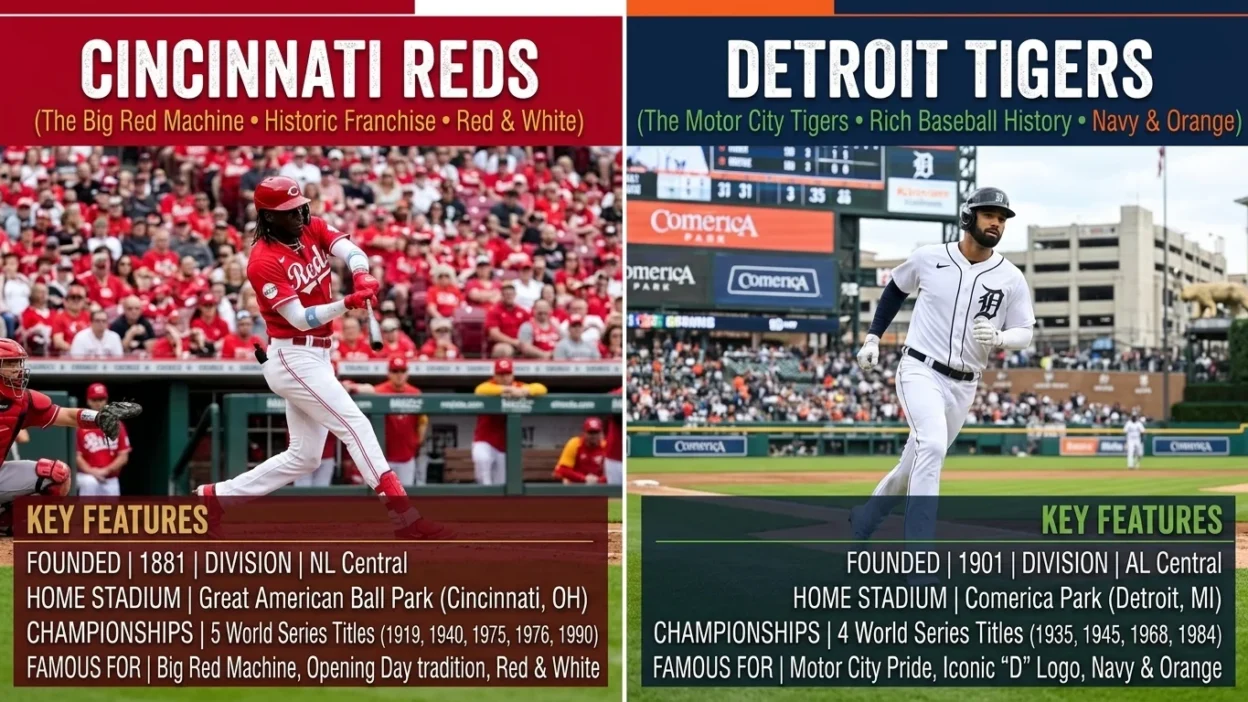
The Cincinnati Reds vs Detroit Tigers match player stats help baseball fans understand how individual players performed, which team controlled the game, and what made the final result possible.
Batting numbers, home runs, runs batted in, pitching performance, and team totals all provide useful details about a Major League Baseball (MLB) matchup.
In their April 26, 2026, meeting at Great American Ball Park in Cincinnati, the Detroit Tigers defeated the Cincinnati Reds by a score of 8–3. Detroit collected 12 hits, while Cincinnati finished with seven.
Gleyber Torres, Spencer Torkelson, and Kerry Carpenter were among Detroit’s key offensive contributors.
Nathaniel Lowe and JJ Bleday hit home runs for Cincinnati, but the Reds could not produce enough runs to overcome Detroit’s late scoring surge.
This article breaks down the game’s player statistics, explains the most important baseball terms, and highlights the performances that shaped the result.
Quick Answer
The Detroit Tigers beat the Cincinnati Reds 8–3 on April 26, 2026. Detroit recorded 12 hits and eight runs, compared with Cincinnati’s seven hits and three runs. Gleyber Torres went 3-for-5 with a home run, three runs scored, and two RBIs, while Spencer Torkelson added three hits and a home run.
Cincinnati Reds vs Detroit Tigers: Match Overview
The April 26 game featured a strong Detroit offense and a difficult late stretch for Cincinnati. The Tigers scored four runs in the seventh inning and added two more in the eighth, turning a close contest into a comfortable victory.
| Match statistic | Detroit Tigers | Cincinnati Reds |
|---|---|---|
| Final score | 8 | 3 |
| Total hits | 12 | 7 |
| Runs batted in (RBI) | 8 | 3 |
| Home runs | 3 | 2 |
| Errors | 1 | 1 |
Source: CBS Sports box score.
Detroit Tigers Player Stats
Detroit’s hitters produced timely hits and converted scoring opportunities into runs. Gleyber Torres delivered one of the game’s strongest performances, while Spencer Torkelson and Kerry Carpenter helped drive the offense.
| Player | At-bats | Hits | Runs | RBIs | Home runs |
|---|---|---|---|---|---|
| Gleyber Torres | 5 | 3 | 3 | 2 | 1 |
| Spencer Torkelson | 4 | 3 | 1 | 1 | 1 |
| Kerry Carpenter | 5 | 2 | 1 | 2 | 0 |
| Hao-Yu Lee | 2 | 1 | 1 | 2 | 1 |
| Kevin McGonigle | 4 | 1 | 1 | 0 | 0 |
| Riley Greene | 5 | 1 | 1 | 0 | 0 |
| Dillon Dingler’s replacement, Jake Rogers | 4 | 1 | 0 | 0 | 0 |
Detroit finished with three home runs. Torres and Torkelson supplied two of them, and Lee added another as a pinch hitter.
Gleyber Torres’ standout performance
Torres went 3-for-5, hit a home run, scored three runs, and recorded two RBIs. His contribution helped Detroit build and extend its lead.
Spencer Torkelson’s offensive impact
Torkelson recorded three hits in four at-bats, including a home run. He also scored once and drove in one run, making him another important part of Detroit’s attack.
Kerry Carpenter’s contribution
Carpenter collected two hits and two RBIs. His production helped Detroit capitalize on opportunities with runners in scoring position.
Cincinnati Reds Player Stats
Cincinnati recorded seven hits and scored three runs. Nathaniel Lowe and JJ Bleday both hit home runs, but Detroit’s pitching and late offensive production kept the Reds from mounting a comeback.
| Player | At-bats | Hits | Runs | RBIs | Home runs |
|---|---|---|---|---|---|
| Nathaniel Lowe | 4 | 1 | 1 | 1 | 1 |
| JJ Bleday | 1 | 1 | 1 | 1 | 1 |
| Matt McLain | 3 | 1 | 0 | 1 | 0 |
| Elly De La Cruz | 4 | 1 | 0 | 0 | 0 |
| TJ Friedl | 4 | 1 | 0 | 0 | 0 |
| Dane Myers | 2 | 1 | 0 | 0 | 0 |
| Ke’Bryan Hayes | 4 | 1 | 1 | 0 | 0 |
Note: The player totals above follow the April 26, 2026, box score. Pinch hitters and substitutions are included where relevant.
Nathaniel Lowe’s home run
Lowe went 1-for-4, scored once, and recorded one RBI with a home run. His long ball gave Cincinnati an important scoring contribution, but the Reds could not sustain their offense.
JJ Bleday’s contribution
Bleday hit a home run and scored a run in his only at-bat. His production was valuable, although Cincinnati needed more hits and scoring opportunities to challenge Detroit.
Pitching Performance: Tigers vs Reds
Pitching statistics explain how teams limit scoring, manage innings, and record outs. A box score includes innings pitched, hits allowed, earned runs, walks, and strikeouts.
Detroit’s pitching staff limited Cincinnati to seven hits and three runs. Cincinnati’s pitchers, by contrast, allowed 12 hits and eight runs.
| Pitching measure | Detroit Tigers | Cincinnati Reds |
|---|---|---|
| Runs allowed | 3 | 8 |
| Hits allowed | 7 | 12 |
| Winning/losing pitcher | Team win | Team loss |
The hitting totals above are the opposing team’s totals allowed. For the full individual pitching lines, including innings pitched and strikeouts, consult the complete CBS Sports box score.
What Decided the Game?
The biggest difference was Detroit’s ability to score several runs in a short period. The Reds kept the game competitive early, but Detroit scored four times in the seventh inning and twice in the eighth.
Three factors explain the outcome:
- More hits: Detroit recorded 12 hits, five more than Cincinnati.
- Power hitting: The Tigers hit three home runs and received production from multiple players.
- Late scoring: Detroit’s seventh-inning rally created separation that Cincinnati could not close.
The result shows why total hits alone do not tell the entire story. Teams must also turn baserunners into runs and prevent opponents from building big innings.
Important Baseball Stats Explained
Understanding a few common terms makes it easier to read the Cincinnati Reds vs Detroit Tigers box score.
- AB (At-bats): The number of official batting opportunities counted as at-bats.
- H (Hits): The number of successful hits a batter records.
- R (Runs): The number of times a player crosses home plate.
- RBI (Runs batted in): Runs credited to a batter because of their plate appearance, with certain exceptions.
- HR (Home runs): Hits that allow the batter to circle the bases and score, usually in one play.
- IP (Innings pitched): The number of innings, or portions of innings, a pitcher completes.
- SO or K (Strikeouts): The number of batters a pitcher retires by strikeout.
- ERA (Earned run average): A pitching statistic estimating earned runs allowed per nine innings.
For example, a player who goes 3-for-5 records three hits in five at-bats. That is a .600 batting average for that individual game, although a single-game figure should not be confused with a player’s season batting average.
Common Mistakes When Reading Match Player Stats
Confusing runs with hits: A team can record more hits without scoring more runs. Hits are opportunities; runs are the points that decide the game.
Treating RBIs as runs scored by the batter: An RBI credits the hitter for driving in a run, which may be scored by a teammate.
Judging a pitcher only by strikeouts: Strikeouts matter, but walks, hits, earned runs, and innings pitched also help explain a pitcher’s performance.
Mixing game stats with season stats: A player’s season batting average is different from the results of one game.
Using outdated box scores: Always check the game date. Player lineups and statistics change throughout the MLB season.
Frequently Asked Questions
1. Who won the Cincinnati Reds vs Detroit Tigers game on April 26, 2026?
The Detroit Tigers won 8–3 against the Cincinnati Reds at Great American Ball Park in Cincinnati.
2. Who had the most hits in the game?
Gleyber Torres and Spencer Torkelson each recorded three hits for Detroit, tying for the most hits by an individual player in the game.
3. How many home runs did the Tigers hit?
Detroit hit three home runs. Gleyber Torres, Spencer Torkelson, and pinch hitter Hao-Yu Lee each hit one.
4. Which Reds players hit home runs?
Nathaniel Lowe and JJ Bleday hit home runs for Cincinnati.
5. How many hits did the Reds record?
The Cincinnati Reds finished with seven hits, compared with Detroit’s 12.
6. What does RBI mean in baseball player stats?
RBI stands for runs batted in. It credits a batter for driving in runs through qualifying offensive plays.
7. Where can I find the complete Reds vs Tigers box score?
You can view the CBS Sports box score for individual batting statistics, game totals, and additional match details.
Remember This
The Detroit Tigers defeated the Cincinnati Reds 8–3 on April 26, 2026. Detroit’s 12 hits, three home runs, and strong seventh inning were central to the victory. Gleyber Torres and Spencer Torkelson led the Tigers’ offense, while Nathaniel Lowe and JJ Bleday supplied Cincinnati’s home runs.
Conclusion
The Cincinnati Reds vs Detroit Tigers match player stats reveal how Detroit earned its 8–3 victory. The Tigers combined consistent hitting, home-run power, and a decisive late rally to pull away from Cincinnati. Torres, Torkelson, and Carpenter were key contributors to the winning effort.
For fans analyzing baseball games, the most useful approach is to consider individual player statistics alongside team totals and the game’s progression. Hits, runs, RBIs, home runs, and pitching numbers each tell part of the story. Always check the date and official box score when looking for the latest Reds vs Tigers player stats, since a new matchup can produce a very different result.