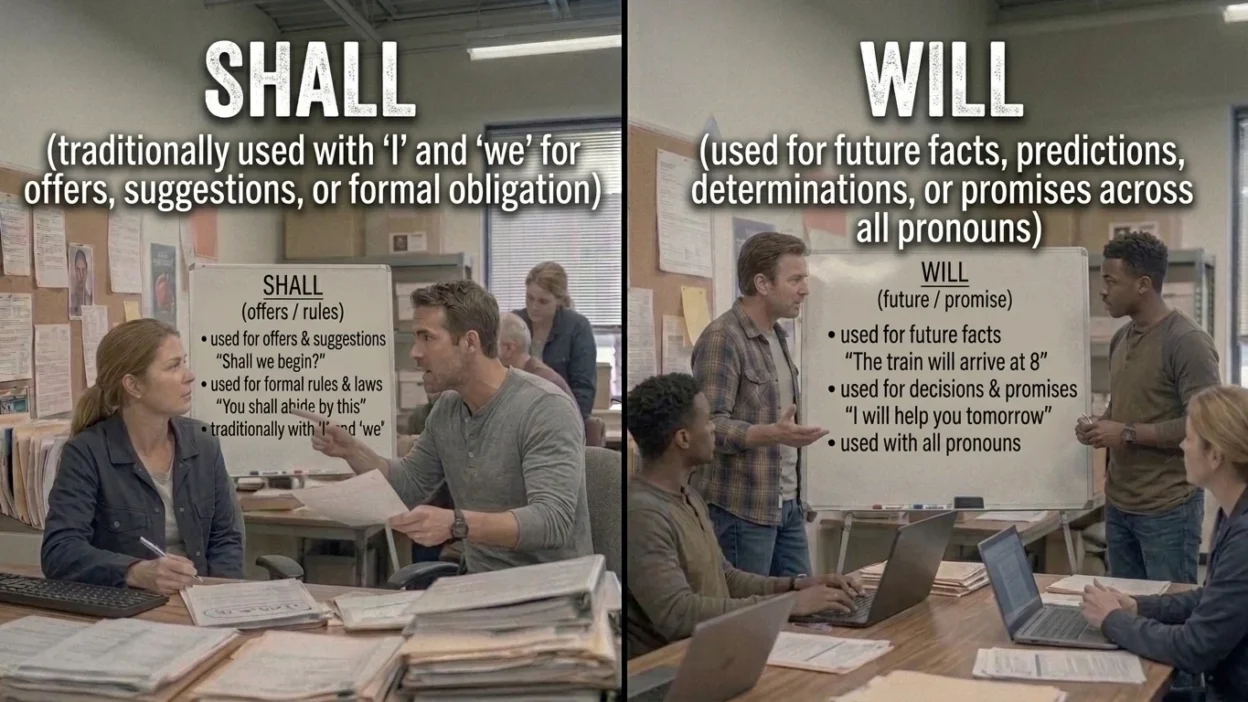
The words shall and will are modal verbs used to talk about the future, make offers, express intentions, and discuss obligations.
Although they sometimes have similar meanings, they are not always interchangeable.
Understanding the difference between shall and will can help you speak and write more naturally,
If you are learning English for school, work, exams, or everyday conversations.
In modern English, will is the most common choice for talking about the future.
For example, “I will call you tomorrow” expresses a future action or intention.
Shall is less common in everyday American English, but it remains useful in formal writing, legal documents, and questions offering suggestions or asking for decisions.
For example, “Shall we begin?” is a natural way to suggest starting an activity.
The right word depends on the sentence, the speaker’s intention, and the level of formality.
This guide explains the meanings, grammar rules, differences, and practical uses of shall and will, with examples to help you choose correctly.
Quick Answer: Shall vs. Will
Will is the usual modal verb for expressing future actions, predictions, promises, and decisions. Shall can also refer to the future, but it is especially common in suggestions such as “Shall we go?” and in formal or legal language expressing requirements. In everyday English, will is generally the more versatile choice.
Why Do People Confuse Shall and Will?
People confuse shall and will because both can refer to future events. In many everyday sentences, they communicate nearly the same basic idea.
For example:
- I will help you tomorrow.
- I shall help you tomorrow.
Both sentences can express a future intention, although the second sounds more formal or old-fashioned to many modern speakers, especially in American English.
Traditional grammar rules sometimes teach that shall should be used with I and we, while will should be used with you, he, she, it, and they to express simple futurity. Under that traditional system, the choices could reverse when expressing determination or insistence.
However, modern everyday English does not generally follow this distinction. Will is widely used with all grammatical subjects to talk about the future.
The main difference today is usually related to context, tone, and purpose rather than subject alone.
1. Shall: Meaning, Definition, and Examples
Shall is a modal auxiliary verb. It can express a future action, make a suggestion, offer help, ask for a decision, or indicate an obligation in formal or legal contexts.
It is less common than will for ordinary future statements, but it remains useful in particular situations.
When Should You Use Shall?
Use shall in the following contexts.
1. To Make Suggestions or Ask What to Do
Questions with shall often invite another person to make a decision or agree to a suggestion.
Examples:
- Shall we start the meeting?
- Shall I open the window?
- Shall we go for a walk?
- Shall I bring you some water?
- Shall we order dinner now?
These questions are especially natural when the speaker is offering an idea or asking for instructions.
2. To Offer Help or Assistance
Shall I…? is a common way to offer to do something for someone.
Examples:
- Shall I carry your bag?
- Shall I call a taxi for you?
- Shall I explain the instructions again?
- Shall I help you with your homework?
The speaker is asking whether the proposed action would be useful or welcome.
3. To Express the Future in Formal or Traditional English
Although will is more common in ordinary future statements, shall can express future actions, especially with I and we in formal or traditional styles.
Examples:
- We shall meet again.
- I shall return before sunset.
- We shall discuss this matter tomorrow.
These sentences are grammatically correct, but depending on the situation, they may sound formal, literary, or old-fashioned.
4. To Express Requirements in Legal or Formal Documents
In some legal and contractual documents, shall is used to express a duty or requirement.
Examples:
- The tenant shall pay the rent by the first day of each month.
- The employee shall maintain the confidentiality of the information.
- The parties shall comply with the terms of this agreement.
In these contexts, shall is intended to establish an obligation. However, legal drafting practices vary, and some modern style guides recommend more precise wording, such as must, to avoid ambiguity.
More Examples of Shall in Sentences
- Shall we begin the lesson?
- Shall I make some tea?
- We shall overcome these difficulties.
- Shall we invite our neighbors?
- Shall I send you the details?
- The parties shall follow the agreed procedure.
- Shall we meet at the library?
- I shall remember your kindness.
2. Will: Meaning, Definition, and Examples
Will is a modal auxiliary verb used to express future actions, predictions, promises, willingness, and decisions. It is one of the most common ways to talk about the future in modern English.
Unlike shall, will works naturally with all subjects in ordinary future statements.
When Should You Use Will?
Use will in the following situations.
1. To Talk About Future Actions
Use will to say that something is expected to happen or that someone plans to do something.
Examples:
- I will call you tonight.
- She will arrive tomorrow.
- They will visit us next week.
- We will finish the project soon.
2. To Make Predictions
Use will when predicting a future event or outcome.
Examples:
- It will rain this evening.
- The team will probably win the match.
- Prices will rise next year.
- You will enjoy this book.
A prediction is not a guarantee. The speaker is expressing what they think is likely to happen.
3. To Make Promises
Use will when promising to do something.
Examples:
- I will always support you.
- I will help you with the assignment.
- We will keep your information private.
- She will return the money tomorrow.
4. To Express Willingness or Make Decisions
Will can express a person’s willingness to do something or a decision made at the time of speaking.
Examples:
- I will help you with those bags.
- Don’t worry; I will handle the problem.
- I’ll answer the phone.
- We will take the next available train.
More Examples of Will in Sentences
- I will finish my homework tonight.
- She will be here in ten minutes.
- They will travel to London next summer.
- We will discuss the plan tomorrow.
- He will help you with your presentation.
- The weather will become colder next week.
- I will never forget this experience.
- You will receive an email confirmation.
Shall vs. Will: Comparison Table
| Feature | Shall | Will |
|---|---|---|
| Main use | Suggestions, offers, formal obligations, and some future statements | Future actions, predictions, promises, and decisions |
| Everyday frequency | Less common for general future statements | Very common |
| Common question | Shall we start? | Will you come tomorrow? |
| Offering help | Shall I carry that? | I’ll carry that for you. |
| Future statement | We shall return. | We will return. |
| Formal or legal language | Sometimes used to state obligations | Also used, depending on the document and intended meaning |
| Common subjects | Often I and we in traditional or formal uses | All subjects |
| American English | Less common in ordinary future statements | Standard and widely used |
| British English | Common in suggestions and certain formal contexts | Standard and widely used |
When Should You Use Shall or Will?
Choosing between shall and will becomes easier when you identify what you want to communicate.
Use Shall for Suggestions and Offers
Choose shall when asking someone to decide what action should happen or when offering to do something.
Examples:
- Shall we start the presentation?
- Shall I close the door?
- Shall we take a break?
These are natural questions because they invite a response or decision.
Use Will for Ordinary Future Statements
Choose will when discussing future actions, plans expressed as intentions, predictions, or promises.
Examples:
- I will call you tomorrow.
- She will finish the report.
- They will arrive after lunch.
For most everyday future statements, will is the safest and most natural choice.
Use Shall Carefully in Formal Documents
In legal or contractual writing, shall may express an obligation. However, the intended meaning should be clear, especially when the wording creates a duty.
For example:
- The supplier shall deliver the goods by Friday.
If the goal is to state a direct requirement in plain English, must may be clearer:
- The supplier must deliver the goods by Friday.
Can Shall and Will Be Used Interchangeably?
Sometimes, yes. Both can express future meaning in certain contexts.
For example:
- We will meet again.
- We shall meet again.
Both refer to a future meeting, but the second may sound more formal or traditional. In other situations, such as “Shall we leave?” and “Will we leave?”, the meanings differ: the first suggests or proposes leaving, while the second asks whether leaving will happen.
Shall vs. Will: 12 Examples With Explanations
- Shall: Shall we go to the park?
Meaning: The speaker is suggesting an activity. - Will: We will go to the park tomorrow.
Meaning: The speaker is stating a future action. - Shall: Shall I help you with your bags?
Meaning: The speaker is offering assistance. - Will: I will help you with your bags.
Meaning: The speaker is promising or deciding to help. - Shall: Shall we start the meeting now?
Meaning: The speaker is asking for agreement about when to begin. - Will: The meeting will start at ten o’clock.
Meaning: The speaker is giving information about a future event. - Shall: The contractor shall comply with the agreement.
Meaning: In this contractual context, the sentence states an obligation. - Will: The contractor will complete the work next week.
Meaning: The sentence describes an expected future action. - Shall: Shall I open the window?
Meaning: The speaker is asking whether opening the window would be welcome. - Will: I will open the window.
Meaning: The speaker is stating a decision or intention. - Shall: We shall remember this day.
Meaning: The sentence expresses a future statement in a formal or literary style. - Will: We will remember this day.
Meaning: The sentence expresses a future expectation or intention in more ordinary modern English.
Common Mistakes With Shall and Will
Mistake 1: Thinking Shall Must Always Be Used With I and We
Traditional grammar often teaches that shall goes with I and we, while will goes with other subjects.
However, modern English commonly uses will with every subject.
- I will call you.
- We will leave soon.
- She will help us.
- They will arrive tomorrow.
You do not need to use shall simply because the subject is I or we.
Mistake 2: Using Will Instead of Shall in Every Suggestion
Both forms can appear in questions, but they do not always communicate the same intention.
Compare:
- Shall we go now? — A suggestion or invitation to agree.
- Will we go now? — A question about whether going now will happen.
If you want to suggest an activity, shall we is usually more natural.
Mistake 3: Assuming Shall Is Always More Polite
Shall can sound polite in offers and suggestions, but politeness depends on the situation and tone.
For example, “Shall I help you?” is a natural offer. “I shall require your immediate response” may sound formal or demanding.
Choose wording that fits the relationship and context.
Mistake 4: Using Shall for Every Future Sentence in British English
Although shall has a stronger traditional role in British English, modern British speakers also commonly use will for future statements.
Examples:
- I will see you tomorrow.
- We will finish the work soon.
Both are natural in British English.
Mistake 5: Assuming Shall Always Means a Legal Obligation
In contracts, shall is often used to express a duty, but its meaning depends on the wording and context. It does not automatically create a clear or enforceable obligation in every sentence.
For plain-language requirements, must is often more direct.
Memory Trick: How to Remember Shall vs. Will
Use this simple memory trick:
- Shall = suggestion or offer.
- Will = future action or promise.
Think of these examples:
- Shall we go out for dinner? — Suggestion.
- I will book a table. — Decision or intention.
You can also remember the questions:
- Shall I…? often offers help.
- Shall we…? often suggests an activity.
- Will you…? often asks about willingness or a future action.
- Will it…? often asks for a prediction or expectation.
These are useful patterns, not absolute rules. Context always matters.
American vs. British English: Is There a Difference?
Both American and British English use shall and will, but their everyday patterns differ slightly.
American English
In American English, will is the usual choice for future statements.
Examples:
- I will call you later.
- We will finish the project tomorrow.
- Shall we get started?
Shall is still used in suggestions, offers, formal language, and some fixed expressions, but it is less common for ordinary future statements.
British English
British English also uses will widely for future actions and predictions. Shall remains familiar in questions such as “Shall we go?” and “Shall I open the window?”
Examples:
- I will see you tomorrow.
- Shall we have a cup of tea?
- Shall I help you with that?
The traditional distinction between shall and will is often taught in British grammar, but it does not describe all modern usage. In both varieties, will is generally the standard choice for everyday future statements.
Similar Words: Shall, Will, Should, and Would
Understanding related modal verbs can help you choose the right expression.
| Word | Main use | Example |
|---|---|---|
| Shall | Suggestions, offers, formal obligations | Shall we begin? |
| Will | Future actions, promises, predictions | I will call you. |
| Should | Advice, expectation, or obligation | You should rest. |
| Would | Hypothetical situations, polite requests, past habits | Would you help me? |
| Must | Strong obligation or necessity | You must wear a seat belt. |
| May | Permission or possibility | May I come in? |
| Might | Possibility | It might rain later. |
| Can | Ability or informal permission | Can you help me? |
Shall vs. Should
Shall often expresses a suggestion or offer, while should commonly expresses advice or what is expected.
- Shall we take a break? — Suggestion.
- You should take a break. — Advice.
Shall vs. Would
Shall is commonly used to make suggestions or offers. Would is often used for polite requests or hypothetical situations.
- Shall I open the window? — Offer.
- Would you open the window? — Polite request.
Will vs. Would
Will commonly expresses future actions, while would often expresses hypothetical actions, polite requests, or future actions viewed from a past point of view.
- I will help you tomorrow.
- I would help you if I had more time.
Final Verdict: Shall or Will?
The difference between shall and will depends on the meaning and context of the sentence.
- Use will for most everyday future statements, predictions, promises, and decisions.
- Use shall to make suggestions or offers, especially in questions such as “Shall we begin?” and “Shall I help?”
- Recognize that shall can also express obligations in certain formal or legal documents.
- Remember that both American and British English use will widely for the future.
If you are unsure, use will for a normal future statement. Choose shall when you are making a suggestion, offering assistance, or following a formal style that calls for it.
Frequently Asked Questions
1. What is the main difference between shall and will?
Will is the most common modal verb for everyday future statements, predictions, promises, and decisions. Shall is especially useful for suggestions and offers, such as “Shall we begin?” It can also express obligations in some formal or legal documents.
2. Should I use shall or will with I and we?
In modern English, you can generally use will with both I and we. For example, “I will call you” and “We will leave soon” are natural sentences. Shall is also possible, particularly in formal or traditional language and in suggestions such as “Shall we go?”
3. Is shall more formal than will?
Often, yes. Shall can sound more formal, traditional, or literary when used in future statements. However, it is also natural in everyday questions such as “Shall I help?” and “Shall we start?” The level of formality depends on the context.
4. Is shall still used in modern English?
Yes. Shall is still used in modern English, particularly for suggestions, offers, and some formal or legal expressions. However, will is much more common for ordinary statements about the future.
5. Is shall we or will we correct?
Both are grammatically correct, but they often mean different things. “Shall we leave?” usually suggests leaving and invites agreement. “Will we leave?” asks whether leaving will happen.
6. Is shall stronger than will?
Not always. In traditional grammar, shall and will were sometimes distinguished by their roles in expressing futurity and determination. In modern English, the strength of either word depends on context. In a legal document, shall may express an obligation, while in everyday conversation, will can express a firm promise.
7. Do Americans and British speakers use shall differently?
There is a difference in frequency rather than a completely different grammar rule. American speakers generally prefer will for future statements, while shall remains common in suggestions such as “Shall we begin?” in both varieties. British speakers also commonly use will for future actions.
8. Can shall and will be used in the same sentence?
Yes, when each word has its own grammatical role. For example, “Shall I tell you what will happen next?” uses shall to make an offer or ask permission and will to refer to a future event.
Remember This
- Will is the usual choice for everyday future statements.
- Shall I…? often makes an offer.
- Shall we…? often makes a suggestion.
- Will can express promises, decisions, and predictions.
- Shall can express obligations in some formal and legal contexts.
- Both words are used in American and British English.
The easiest rule is to use will for most future statements and shall for suggestions or offers when it sounds natural.
Conclusion
Shall and will are both modal verbs that can refer to the future, but they are not always used in the same way. Will is the more common choice for future actions, predictions, promises, and decisions. Shall remains useful for offers, suggestions, and certain formal or legal expressions.
To choose the right word, consider what you want to communicate. Use will for a straightforward statement about the future, and consider shall when asking “Shall I?” or “Shall we?” to offer help or suggest an action. With practice, these patterns will become easier to recognize and use naturally.