When you want to explain the main points of a book, article, meeting, speech, or event in fewer words, a summary is often the right word. But using “summary” again and again can make your writing sound repetitive.
Learning useful summary synonyms helps you choose words that match your exact meaning, tone, and situation.
Different synonyms for “summary” are not always perfect replacements. For example, an abstract is common in academic writing, while a recap sounds more natural when talking about events or conversations.
An overview gives a broad picture, whereas an outline usually focuses on structure and key points.
This guide explains 30 summary synonyms in simple English.
It is designed for students, ESL learners, writers, bloggers, and content creators who want to build vocabulary and understand the small differences between similar words.
What Does “Summary” Mean?
Simple meaning of summary
A summary is a short version of a longer piece of information. It includes the most important ideas while leaving out unnecessary details.
Example:
“Please write a summary of the article in 100 words.”
Here, the person wants the main ideas from the article without all the original details.
Tone and usage of “summary”
“Summary” is a neutral and widely useful word. You can use it in academic, professional, casual, and everyday situations.
For example:
- Academic: “The student wrote a summary of the research paper.”
- Professional: “Here is a summary of today’s meeting.”
- Everyday: “Can you give me a quick summary of the movie?”
Because it works in many situations, “summary” is an excellent general-purpose word. However, choosing a more specific synonym can make your writing clearer and more natural.
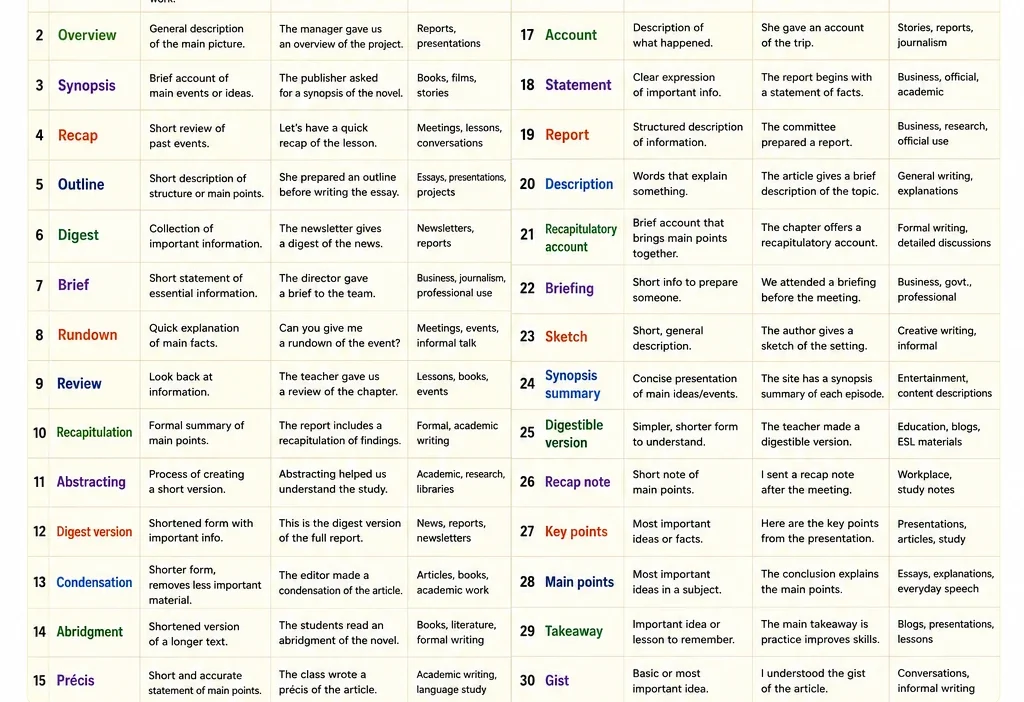
30 Summary Synonyms
1. Abstract
Meaning: A short description of the main ideas of a longer academic or professional work.
Example sentence:
“The researcher included an abstract at the beginning of the paper.”
Best usage context: Academic papers, research, dissertations, and technical writing.
2. Overview
Meaning: A general description that gives you the main picture of something.
Example sentence:
“The manager gave us an overview of the new project.”
Best usage context: Introductions, reports, presentations, and general explanations.
3. Synopsis
Meaning: A brief account of the main events or ideas in a work.
Example sentence:
“The publisher asked the author for a synopsis of the novel.”
Best usage context: Books, films, stories, plays, and creative writing.
4. Recap
Meaning: A short review of events or information that has already happened.
Example sentence:
“Let’s have a quick recap of yesterday’s lesson.”
Best usage context: Meetings, lessons, sports, TV shows, conversations, and informal writing.
5. Outline
Meaning: A short description of the main points or structure of something.
Example sentence:
“She prepared an outline of her presentation before writing the slides.”
Best usage context: Essays, presentations, speeches, projects, and plans.
6. Digest
Meaning: A collection or shortened version of important information.
Example sentence:
“The weekly newsletter provides a digest of the most important news.”
Best usage context: News, newsletters, reports, and collections of information.
7. Brief
Meaning: A short statement containing the most important information.
Example sentence:
“The director gave the team a brief about the upcoming campaign.”
Best usage context: Business, journalism, marketing, military contexts, and professional communication.
8. Rundown
Meaning: A quick explanation or list of the main facts or events.
Example sentence:
“Can you give me a rundown of what happened at the meeting?”
Best usage context: Informal conversations, meetings, events, and workplace communication.
9. Review
Meaning: A look back at information, events, or ideas, often with some evaluation.
Example sentence:
“The teacher gave us a review of the topics covered in class.”
Best usage context: Lessons, books, products, events, and previous information.
10. Recapitulation
Meaning: A formal repetition or summary of the main points.
Example sentence:
“The final section provides a recapitulation of the study’s main findings.”
Best usage context: Formal and academic writing.
11. Abstracting
Meaning: The process of creating a shortened version that presents the essential information.
Example sentence:
“Abstracting the research helped the students understand its central argument.”
Best usage context: Academic, research, library, and information-management contexts.
12. Digest version
Meaning: A shortened form containing the most useful or important information.
Example sentence:
“This article is the digest version of the company’s 50-page report.”
Best usage context: News, reports, newsletters, and simplified content.
13. Condensation
Meaning: A shorter form of something that removes less important material.
Example sentence:
“The editor created a condensation of the original 20-page article.”
Best usage context: Books, articles, academic work, and formal writing.
14. Abridgment
Meaning: A shortened version of a longer text that keeps its essential content.
Example sentence:
“The students read an abridgment of the classic novel.”
Best usage context: Books, literature, historical texts, and formal writing.
15. Précis
Meaning: A short and accurate statement of the main points of a longer text.
Example sentence:
“The professor asked the class to write a précis of the article.”
Best usage context: Academic writing, language study, and formal contexts.
16. Recital
Meaning: An account or description of events, facts, or details.
Example sentence:
“His recital of the events helped everyone understand what had happened.”
Best usage context: Formal descriptions, legal writing, history, and storytelling.
17. Account
Meaning: A description of what happened or an explanation of events.
Example sentence:
“She gave an account of the events that took place during the trip.”
Best usage context: Stories, reports, journalism, history, and personal experiences.
18. Statement
Meaning: A clear expression of important information, facts, or ideas.
Example sentence:
“The report begins with a statement of its main findings.”
Best usage context: Business, official communication, academic writing, and formal documents.
19. Report
Meaning: A structured description of information, events, findings, or results.
Example sentence:
“The committee prepared a report on the results of the investigation.”
Best usage context: Business, research, journalism, education, and official communication.
20. Description
Meaning: Words that explain what something is like or what happened.
Example sentence:
“The article provides a brief description of the main argument.”
Best usage context: General writing when you want to explain characteristics or events.
21. Recapitulatory account
Meaning: A brief account that brings together the important points or events.
Example sentence:
“The final chapter offers a recapitulatory account of the story.”
Best usage context: Formal writing and detailed discussions.
22. Briefing
Meaning: Information given in a short and focused form, especially to prepare someone for something.
Example sentence:
“The team attended a briefing before the conference.”
Best usage context: Business, government, journalism, professional settings, and instructions.
23. Sketch
Meaning: A short and general description without many details.
Example sentence:
“The author gives a quick sketch of the character’s background.”
Best usage context: Creative writing, general descriptions, ideas, and informal explanations.
24. Synopsis summary
Meaning: A concise presentation of the main events or ideas.
Example sentence:
“The website includes a synopsis summary of each episode.”
Best usage context: Entertainment and content descriptions; however, “synopsis” alone is usually more natural.
25. Digestible version
Meaning: A simpler and shorter form that makes information easier to understand.
Example sentence:
“The teacher created a digestible version of the complex chapter.”
Best usage context: Educational content, blogs, guides, and ESL materials.
26. Recap note
Meaning: A short note that records the main points or events.
Example sentence:
“I sent everyone a recap note after the meeting.”
Best usage context: Workplace communication, study notes, and informal writing.
27. Key points
Meaning: The most important ideas or facts from a larger subject.
Example sentence:
“Here are the key points from the presentation.”
Best usage context: Presentations, study materials, articles, meetings, and online content.
28. Main points
Meaning: The most important ideas in a text, discussion, or subject.
Example sentence:
“The final paragraph explains the main points of the argument.”
Best usage context: Academic writing, essays, explanations, and everyday speech.
29. Takeaway
Meaning: An important idea or lesson that someone should remember after reading, watching, or experiencing something.
Example sentence:
“The main takeaway from the lecture is that regular practice improves writing.”
Best usage context: Blogs, presentations, business discussions, lessons, and informal writing.
30. Gist
Meaning: The basic or most important idea of something.
Example sentence:
“I did not understand every word, but I understood the gist of the article.”
Best usage context: Everyday English, ESL learning, conversations, and informal writing.
Summary Synonyms: Quick Comparison Guide
Not every synonym for “summary” means exactly the same thing. The best choice depends on what you are summarizing and how formal you want to sound.
| Synonym | Main idea | Common context | Tone |
|---|---|---|---|
| Summary | Short version of important information | General use | Neutral |
| Abstract | Short academic description | Research papers | Formal |
| Overview | General picture | Reports and introductions | Neutral |
| Synopsis | Main events or ideas | Books and films | Neutral/Formal |
| Recap | Review of what happened | Meetings and events | Informal |
| Outline | Main points or structure | Essays and presentations | Neutral |
| Digest | Selected important information | News and newsletters | Neutral |
| Brief | Focused essential information | Business and professional use | Formal |
| Rundown | Quick account of events | Conversations and meetings | Informal |
| Précis | Accurate short version | Academic writing | Formal |
| Abridgment | Shortened version of a text | Literature | Formal |
| Gist | Basic idea | Everyday English | Informal |
| Takeaway | Main lesson or idea | Presentations and blogs | Informal/Neutral |
| Review | Look back at information | Classes, books, products | Neutral |
| Briefing | Focused information for preparation | Professional settings | Formal |
How to Choose the Right Synonym
For academic writing
Choose words such as abstract, précis, synopsis, outline, or recapitulation when writing for an academic audience.
Example:
“The abstract summarizes the purpose, method, and findings of the research.”
Use these terms when precision and formality matter.
For business and professional writing
Words such as brief, briefing, overview, report, and recap work well in professional settings.
Example:
“Here is a brief overview of the project.”
For workplace communication, “overview” is often a safe alternative to “summary.”
For books, movies, and stories
Use synopsis, outline, account, or abridgment depending on your meaning.
Example:
“The film synopsis reveals the basic storyline without explaining every detail.”
If you are describing a shortened literary work, abridgment is more precise.
For casual conversations
Use recap, rundown, gist, or takeaway.
Example:
“Give me the quick rundown.”
These words sound natural in everyday English and are usually less formal than “summary.”
For simple explanations
Use overview, main points, key points, gist, or digestible version.
Example:
“Can you give me an overview of the chapter?”
These choices are especially useful when writing for beginners or ESL learners.
Summary vs. Synopsis vs. Overview
Summary
A summary is a general shortened version of something. It can be used almost anywhere.
Example:
“Write a summary of the article.”
Synopsis
A synopsis usually presents the main events or ideas of a specific work, especially a book, movie, play, or story.
Example:
“Read the synopsis before deciding whether to watch the film.”
Overview
An overview gives a broad picture rather than necessarily retelling all the main points.
Example:
“The first chapter provides an overview of the subject.”
A simple way to remember the difference is:
Summary = shortened version
Synopsis = main story or content
Overview = general picture
Summary vs. Recap vs. Review
Summary
A summary simply presents the important information in a shorter form.
Recap
A recap usually looks back at something that happened earlier.
Example:
“Here is a quick recap of the previous episode.”
Review
A review can mean looking back at information, but it can also include an opinion or evaluation.
Example:
“The teacher reviewed the material before the exam.”
This means “review” is not always a direct replacement for “summary.”
Summary vs. Gist
Summary
A summary normally gives several important points in a structured way.
Gist
The gist is simply the basic idea.
For example, if you read a long article and understand only its central message, you understand the gist. If you write down the major arguments and supporting points, you are creating a summary.
Why Use Summary Synonyms?
Avoid repetition
Repeating the same word too often can make writing feel mechanical. Appropriate synonyms can add variety.
Improve precision
Different words can tell readers exactly what kind of shortened information they are receiving.
Match the tone
“Gist” sounds casual, while “précis” sounds formal. Choosing the right word helps your writing fit its audience.
Build vocabulary
Learning related words helps ESL learners recognize more expressions when reading and listening.
Write more naturally
Native-like writing is not only about knowing difficult words. It is also about knowing which word sounds natural in a particular situation.
Common Mistakes When Using Summary Synonyms
Using “abstract” for every summary
An abstract is strongly associated with academic and research writing. It is not always the best word for a casual summary.
Using “synopsis” for a meeting
A meeting usually has a summary, recap, overview, or rundown, rather than a synopsis.
Using “gist” for a detailed summary
“Gist” means the basic idea. It does not normally suggest a complete list of important details.
Using “review” when you only mean a short version
A review can involve judgment or evaluation. If you simply want the main information, “summary” may be clearer.
Choosing difficult words unnecessarily
A sophisticated synonym is not automatically better. In most situations, the clearest word is the best word.
How to Use Summary Synonyms in SEO Content
Use synonyms naturally
When writing online content, related terms can help make your language more varied and useful. However, you should never force synonyms into sentences simply to repeat keywords.
For example, a useful article might naturally use:
- summary
- overview
- key points
- recap
- main ideas
- gist
- takeaway
Each phrase can serve a slightly different purpose.
Focus on search intent
If someone searches for “how to summarize an article,” they probably need practical instructions. If they search for “summary synonyms,” they may want vocabulary, definitions, examples, and differences between related words.
Good SEO writing answers the reader’s actual question rather than simply repeating a target keyword.
Frequently Asked Questions About Summary Synonyms
What is the best synonym for summary?
Overview is one of the most useful alternatives because it works in many general and professional contexts. However, the best choice depends on the situation.
What is a formal synonym for summary?
Abstract, précis, recapitulation, abridgment, and brief can sound formal, although each has a different use.
What is an informal synonym for summary?
Recap, rundown, gist, and takeaway are common informal or conversational choices.
What is the synonym for summary in academic writing?
Abstract is especially common for research papers. Précis and recapitulation can also work in appropriate formal contexts.
What is the difference between a summary and an overview?
A summary usually presents the main points of something in a shorter form. An overview gives a broad picture of a subject and may be less detailed.
What is the difference between a summary and a synopsis?
A summary can describe almost any type of information. A synopsis is often used for the main content or storyline of a book, film, play, or other work.
What is the easiest synonym for summary?
Overview and gist are easy alternatives, but they are not identical. “Overview” gives a general picture, while “gist” means the basic idea.
Final Takeaways
Learning summary synonyms is useful because no single word fits every situation. Summary remains the safest general choice, but words such as overview, abstract, synopsis, recap, outline, digest, brief, gist, and takeaway can make your communication more precise.
The key is to consider both meaning and context. Use “abstract” for research, “synopsis” for stories, “recap” for past events, “overview” for a broad picture, “gist” for the basic idea, and “brief” for focused professional information.
For students and ESL learners, learning these distinctions can make reading easier and writing more natural. For writers and content creators, they provide more flexibility and help avoid unnecessary repetition. The best synonym is not the most complicated word—it is the word that communicates your intended meaning clearly.