Have you ever confused personal vs personnel while writing an email, completing a job application, or reading a workplace document?
These two words look and sound similar, but they have very different meanings.
Using the wrong one can change the meaning of your sentence, especially when discussing employees, private matters, or professional responsibilities.
Fortunately, learning the difference is easier than you might think.
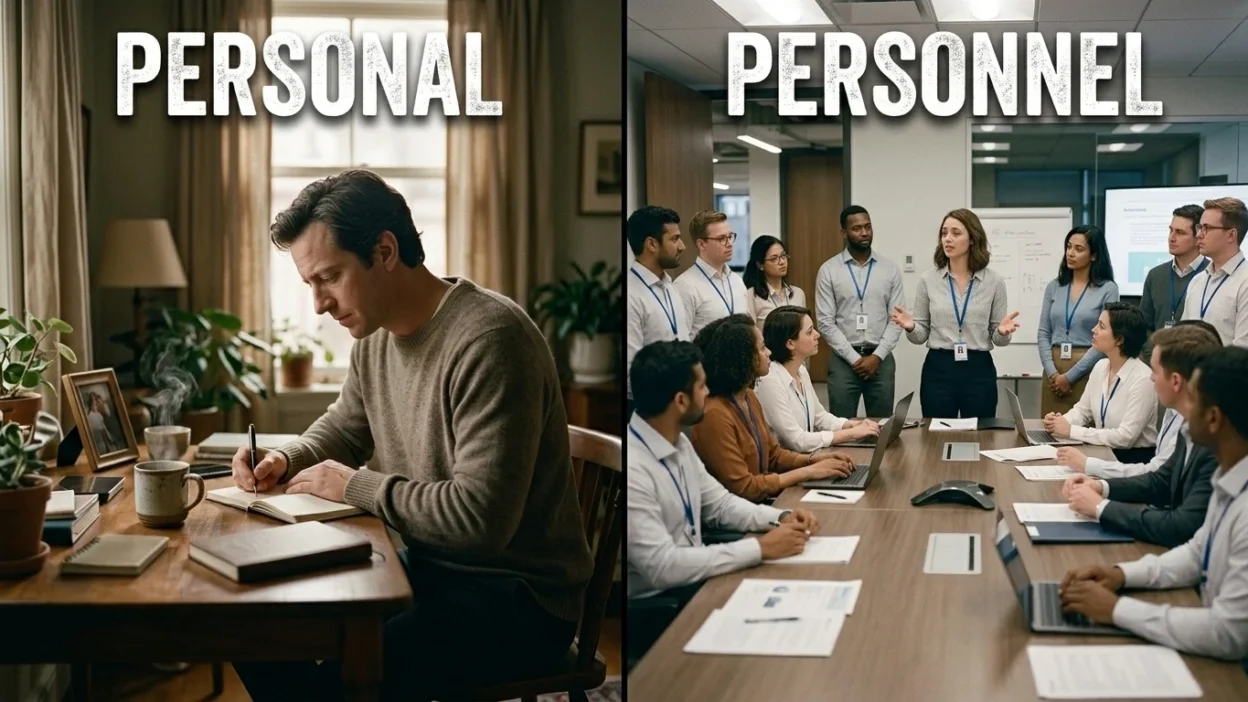
Personal refers to something related to an individual, such as personal opinions, personal belongings, or personal information.
Personnel refers to the people who work for an organization, company, school, or military unit.
For example, a personal email is a private or individual email, while personnel records contain information about employees.
Once you understand what each word describes, you can choose the correct term confidently in everyday conversations, academic writing, and professional communication.
Quick Answer: Personal vs Personnel
Personal means relating to a particular person, their private life, or individual preferences. Personnel means the employees or staff members of an organization. Use personal when describing something belonging or relating to an individual, and use personnel when talking about a workforce. For example, personal information is private information, while personnel management concerns employees.
Why Do People Confuse Personal and Personnel?
People often confuse personal and personnel because their spelling and pronunciation are similar. Both words relate to people, but they describe different things.
The main difference is their meaning and grammatical use:
- Personal is an adjective that describes something related to an individual.
- Personnel is usually a noun that refers to the employees or staff of an organization.
Consider these examples:
- “This is my personal opinion.” The opinion belongs to or comes from an individual.
- “The company needs additional personnel.” The company needs more employees.
The confusion becomes especially common in workplace communication because both words appear in professional settings. However, a personal matter concerns an individual, whereas personnel matters concern an organization’s workforce.
What Does Personal Mean?
Personal is an adjective that describes something connected with a particular person, their private life, feelings, choices, or individual interests.
It can refer to something privately owned, personally experienced, or specific to an individual rather than a group.
Common expressions include:
- Personal information
- Personal belongings
- Personal opinion
- Personal experience
- Personal goals
- Personal responsibility
- Personal email
- Personal preferences
Examples of Personal in Sentences
- Please keep your personal information secure.
- Everyone has a personal opinion about the issue.
- She uses her personal laptop for studying.
- I prefer to keep my personal life separate from my professional life.
- He shared a personal experience during the discussion.
- Your personal goals may change over time.
- This decision is a personal choice.
- Please do not take my comments personally.
In each sentence, personal describes something related to an individual.
What Is the Meaning of Personal in the Workplace?
In professional settings, personal often refers to an employee’s private matters, individual preferences, or belongings.
For example:
- “Please use your personal email for non-work messages.”
- “The manager respected her personal boundaries.”
- “Employees should protect their personal information.”
Notice that personal does not mean employees as a group. It describes something connected to an individual.
What Does Personnel Mean?
Personnel is a noun that refers to the people employed by or working for an organization. Depending on the context, it can mean employees, staff members, workers, or members of a particular service.
The word is common in business, government, education, healthcare, and military settings.
Common expressions include:
- Personnel department
- Personnel records
- Military personnel
- Medical personnel
- Personnel management
- Personnel policy
- Personnel training
- Personnel requirements
Examples of Personnel in Sentences
- The hospital needs additional medical personnel.
- All personnel must attend the safety training session.
- The company hired new personnel to support its growing operations.
- Military personnel received instructions before the mission.
- The personnel department handles employee-related records.
- Emergency personnel arrived at the scene quickly.
- The manager is responsible for coordinating project personnel.
- Only authorized personnel may enter this restricted area.
In these examples, personnel refers to workers, employees, or other members of a professional group.
What Does Personnel Mean in Business?
In business, personnel generally refers to the employees or workforce of an organization.
For example, a company might need more personnel to manage customer requests during a busy season. A personnel department may also handle employee records, recruitment, and workplace policies, although many organizations now use the term human resources (HR) for this function.
Personnel can refer to a group of workers collectively rather than to one individual.
Personal vs Personnel: Comparison Table
| Feature | Personal | Personnel |
|---|---|---|
| Meaning | Related to an individual or private life | Employees or staff members |
| Part of speech | Adjective | Noun |
| Refers to | Individual matters, belongings, opinions, or experiences | A workforce or group of workers |
| Common contexts | Everyday life, education, privacy, and work | Business, government, healthcare, and military |
| Example phrase | Personal information | Personnel records |
| Example sentence | This is my personal decision. | The organization needs more personnel. |
| Similar words | Private, individual, private-use | Staff, employees, workforce |
The easiest way to remember the difference is that personal describes something about a person, while personnel identifies a group of people working in an organization.
When Should You Use Personal or Personnel?
Choosing the correct word becomes simple when you identify what you are describing.
When to Use Personal
Use personal when referring to an individual’s private life, belongings, opinions, experiences, or choices.
Examples:
- Personal information: information about an individual.
- Personal belongings: items owned or used by an individual.
- Personal opinion: an individual’s viewpoint.
- Personal responsibility: a responsibility assigned to or accepted by an individual.
- Personal account: an account used by an individual rather than for organizational purposes.
Example: “I use my personal phone outside working hours.”
The word personal describes the phone’s individual or private use.
When to Use Personnel
Use personnel when referring to employees, staff members, or workers within an organization or service.
Examples:
- Hospital personnel: people working at a hospital.
- Military personnel: members of the armed forces.
- Office personnel: people working in an office.
- Personnel training: training for employees or members of a workforce.
- Personnel records: records relating to employees.
Example: “All personnel must follow the company’s safety procedures.”
Here, personnel refers to the employees or relevant members of the organization.
12 Examples of Personal vs Personnel in Everyday English
The following examples show how these words work in different situations.
| Personal | Personnel |
|---|---|
| She shared her personal opinion. | The company recruited new personnel. |
| Keep your personal documents safe. | Authorized personnel can access the files. |
| This is my personal computer. | The IT personnel repaired the network. |
| He discussed a personal problem. | Hospital personnel assisted the patients. |
| I have a personal appointment. | Emergency personnel responded immediately. |
| She values her personal privacy. | The organization needs experienced personnel. |
Here are six more examples in complete sentences:
- Personal: I prefer not to discuss personal matters at work.
- Personnel: The manager informed all personnel about the new policy.
- Personal: Please enter your personal email address in this field.
- Personnel: The personnel responsible for the event arrived early.
- Personal: He set a personal goal to improve his writing.
- Personnel: Additional personnel were assigned to the project.
These examples demonstrate that the two words are not interchangeable, even though both relate to people.
Common Mistakes When Using Personal and Personnel
Understanding the definitions is useful, but recognizing common errors will help you apply them correctly.
Mistake 1: Writing “Personnel Information” When You Mean Private Information
Incorrect for the intended meaning: “Please protect your personnel information.”
Correct: “Please protect your personal information.”
Personal information refers to details about an individual, such as their contact information or identification details.
Personnel information can be used in a specialized workplace context to refer to employee-related information, but personal information is the usual choice when discussing an individual’s privacy.
Mistake 2: Writing “Personal Needed” Instead of “Personnel Needed”
Incorrect: “The hospital needs more personal.”
Correct: “The hospital needs more personnel.”
If you mean that an organization requires additional workers, personnel is the appropriate word.
You could also say, “The hospital needs more staff members.”
Mistake 3: Confusing Personal and Personnel Departments
A department responsible for employee administration has traditionally been called a personnel department.
For example:
Correct: “Contact the personnel department about your employment records.”
A personal department would not normally express this meaning.
Today, many organizations use human resources department or HR department instead.
Mistake 4: Assuming Personnel Refers to One Person
Personnel generally refers to employees or members of a workforce collectively, rather than one individual.
Instead of writing, “One personnel attended the meeting,” write:
- One employee attended the meeting.
- One staff member attended the meeting.
- A member of the personnel team attended the meeting.
The correct choice depends on the situation.
Mistake 5: Mispronouncing the Words
The words sound similar, which contributes to spelling mistakes. In common English pronunciation, personal is often pronounced approximately PUR-suh-nuhl, while personnel is pronounced pur-suh-NEL, with the stress on the final syllable.
Practicing the pronunciation can help you distinguish them when speaking and writing.
Memory Trick: How to Remember Personal vs Personnel
Use this simple trick to remember the difference.
Personal = Person
The word personal contains the idea of a person. Think about individual belongings, private information, personal opinions, or private experiences.
Example: “My personal notes are in my bag.”
Personnel = People at work
Think of personnel as the employees or staff who make up an organization.
Example: “The company hired more personnel.”
Another helpful approach is to replace the word with a synonym:
- If private or individual makes sense, personal is probably correct.
- If staff, employees, or workforce makes sense, personnel is probably correct.
For example, “The company needs more employees” can become “The company needs more personnel.” This replacement works because both words refer to the workforce.
Personal vs Personnel in American and British English
There is no significant difference between American and British English in the meanings or spellings of personal and personnel. Both varieties use the words in the same basic way.
However, workplace terminology may vary between organizations and regions.
- American English: Personnel is used for employees or staff, although human resources is common when referring to the department responsible for employment matters.
- British English: Personnel is also used, but staff, employees, and human resources are common alternatives.
- International English: Personal information and personnel records are widely understood expressions.
For example, an American company might refer to its human resources department, while another organization may still use personnel department. Neither usage changes the distinction between personal and personnel.
Similar Words You Should Know
Several related words can help you communicate more accurately.
Personal vs Private
Personal describes something connected with an individual. Private emphasizes restricted access or something not intended for public knowledge.
Example: “She shared a personal experience but kept some details private.”
Personnel vs Staff
Both personnel and staff can refer to people working for an organization. Staff is often more conversational, while personnel can sound more formal or administrative.
Example: “The hotel staff were helpful” and “All hotel personnel must follow safety rules.”
Personnel vs Employee
An employee is usually one person who works for an employer. Personnel commonly refers to a group of employees or workers collectively.
Example: “The employee submitted a request” versus “The company hired additional personnel.”
Personal vs Personalized
Personal means related to an individual. Personalized means adapted or customized for a particular person.
Example: “This is my personal notebook” versus “The company sent me a personalized message.”
Knowing these distinctions will help you choose words that communicate your meaning precisely.
Frequently Asked Questions
1. What is the main difference between personal and personnel?
Personal describes something related to an individual or their private life. Personnel refers to employees, staff members, or workers in an organization.
2. Is personnel singular or plural?
Personnel is generally a collective noun referring to a group of people. It usually takes a plural verb in American English when the individual members are emphasized, while British English may also use singular agreement when the group is treated as a unit. In either variety, avoid using a personnel to mean one employee.
3. Is it personal information or personnel information?
Personal information is the normal expression for information about an individual. Personnel information may be used in an employment context to refer to information about employees.
4. What does personnel mean in a job description?
In a job description, personnel usually refers to employees or workers. For example, a supervisor may be responsible for managing personnel, coordinating staff, or training employees.
5. What is the difference between a personal department and a personnel department?
Personnel department is the traditional term for a department handling employee-related matters. Personal department is not the standard expression for this function. Many organizations now use human resources department instead.
6. Can personal and personnel be used interchangeably?
No. Personal describes something related to an individual, while personnel refers to a workforce. Substituting one for the other can change the meaning of a sentence.
7. How do you pronounce personal and personnel?
Personal is commonly pronounced PUR-suh-nuhl, with stress on the first syllable. Personnel is commonly pronounced pur-suh-NEL, with stress on the final syllable.
8. What is another word for personnel?
Depending on the context, alternatives include staff, employees, workforce, workers, and team members. In formal organizational writing, personnel is often appropriate; in everyday conversation, staff may sound more natural.
Remember This: Personal vs Personnel
Keep these two simple rules in mind:
- Personal = individual or private. Example: personal belongings, personal opinions, personal information.
- Personnel = employees or workforce. Example: hospital personnel, military personnel, personnel records.
When you are unsure, ask yourself whether you are describing something connected with an individual or referring to a group of workers. That quick question will help you select the correct word in most situations.
Conclusion
The difference between personal and personnel is straightforward once you focus on their meanings. Personal is an adjective used to describe an individual’s private life, belongings, experiences, preferences, or responsibilities. Personnel is a noun that refers to employees or members of an organization or service. Although the words look and sound similar, they serve different grammatical purposes and cannot normally replace each other. Understanding this distinction will help you write more clearly in academic assignments, workplace emails, job applications, and everyday conversations.
The best way to remember the difference is to connect personal with an individual person and personnel with a group of workers. Use personal information when talking about someone’s private details, and use personnel records when discussing employee documentation. With regular practice and attention to context, choosing the right word will become natural. When in doubt, try replacing personal with private or individual, or replacing personnel with staff or employees, to check whether your sentence makes sense.

Liam Henry is a content author at Synonymed, specializing in vocabulary enrichment and synonym guides. He creates clear, engaging resources that help learners improve English word knowledge and language fluency.