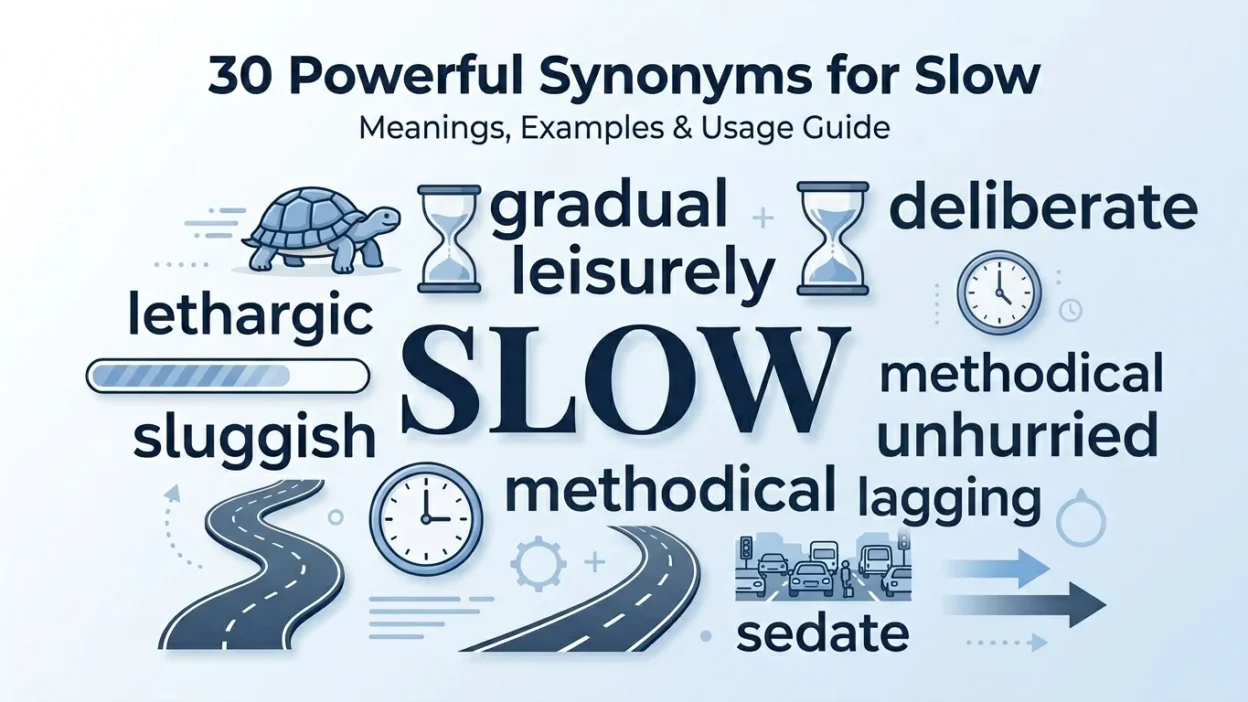
The word “slow” is commonly used in English to describe something that moves, happens, or works at a low speed.
If you’re talking about a person walking slowly, a computer taking too long to load, or progress happening gradually, this simple word appears in everyday conversations and writing.
However, using the same word repeatedly can make your writing feel repetitive. Learning different synonyms for slow helps students,
ESL learners, writers, and content creators communicate more clearly and choose words that fit specific situations.
In this guide, you’ll discover the meaning of slow, explore 30 useful synonyms,
learn their simple definitions, see example sentences, and understand when each word is most appropriate to use.
Meaning of “Slow”
The word slow means moving, happening, or functioning at a low speed. It can also describe a person who takes a long time to understand something or progress that happens gradually.
Simple Definition:
Not fast; taking more time than expected.
Example Sentence:
The train was slow because of the bad weather.
Common Usage Contexts:
- Movement (slow walking, slow driving)
- Technology (slow internet, slow computer)
- Learning (slow learner)
- Business (slow growth, slow sales)
- Progress (slow improvement)
30 Synonyms for Slow
1. Gradual
Meaning: Happening little by little over time.
Example Sentence:
The company experienced gradual growth.
Best Usage Context: Changes and progress.
2. Unhurried
Meaning: Done without rushing.
Example Sentence:
They enjoyed an unhurried walk through the park.
Best Usage Context: Relaxed activities.
3. Leisurely
Meaning: Moving at a relaxed pace.
Example Sentence:
We took a leisurely stroll along the beach.
Best Usage Context: Pleasant, calm situations.
4. Sluggish
Meaning: Moving or working slowly due to lack of energy.
Example Sentence:
The computer became sluggish after the update.
Best Usage Context: Technology, performance, energy.
5. Deliberate
Meaning: Slow because of careful thought.
Example Sentence:
She made a deliberate decision after reviewing the facts.
Best Usage Context: Careful actions and decisions.
6. Lazy
Meaning: Unwilling to work or move quickly.
Example Sentence:
He felt lazy on Sunday afternoon.
Best Usage Context: Informal descriptions.
7. Lagging
Meaning: Falling behind in speed or progress.
Example Sentence:
Sales are lagging behind expectations.
Best Usage Context: Business and performance.
8. Crawling
Meaning: Moving extremely slowly.
Example Sentence:
Traffic was crawling during rush hour.
Best Usage Context: Traffic and movement.
9. Plodding
Meaning: Moving steadily but slowly.
Example Sentence:
The hikers were plodding up the mountain.
Best Usage Context: Long, tiring activities.
10. Tardy
Meaning: Late or delayed.
Example Sentence:
The student received a warning for being tardy.
Best Usage Context: School and formal settings.
11. Behindhand
Meaning: Late or behind schedule.
Example Sentence:
The project is behindhand due to supply issues.
Best Usage Context: Formal writing.
12. Lingering
Meaning: Taking longer than expected.
Example Sentence:
The lingering smell remained for hours.
Best Usage Context: Effects, feelings, or situations.
13. Measured
Meaning: Controlled and not rushed.
Example Sentence:
He spoke in a measured tone.
Best Usage Context: Speech and behavior.
14. Easygoing
Meaning: Relaxed and not hurried.
Example Sentence:
She has an easygoing approach to life.
Best Usage Context: Personality descriptions.
15. Relaxed
Meaning: Calm and not rushed.
Example Sentence:
The meeting had a relaxed atmosphere.
Best Usage Context: Social situations.
16. Dull
Meaning: Slow and lacking excitement.
Example Sentence:
The movie felt dull and slow.
Best Usage Context: Entertainment reviews.
17. Inactive
Meaning: Not moving or progressing much.
Example Sentence:
The account remained inactive for months.
Best Usage Context: Business and technology.
18. Idle
Meaning: Not active or working.
Example Sentence:
The machines stood idle overnight.
Best Usage Context: Equipment and work.
19. Static
Meaning: Showing little or no movement.
Example Sentence:
The economy remained static this quarter.
Best Usage Context: Business and economics.
20. Lethargic
Meaning: Feeling tired and moving slowly.
Example Sentence:
The hot weather made everyone lethargic.
Best Usage Context: Health and energy levels.
21. Torpid
Meaning: Physically or mentally inactive.
Example Sentence:
The animal appeared torpid during winter.
Best Usage Context: Formal and scientific writing.
22. Sedate
Meaning: Calm, steady, and slow.
Example Sentence:
The couple enjoyed a sedate evening.
Best Usage Context: Formal descriptions.
23. Slack
Meaning: Slow or lacking activity.
Example Sentence:
Business was slack during the holiday season.
Best Usage Context: Work and business.
24. Slow-Moving
Meaning: Progressing at a low speed.
Example Sentence:
The slow-moving storm lasted several days.
Best Usage Context: Weather and events.
25. Delayed
Meaning: Occurring later than expected.
Example Sentence:
The flight was delayed by two hours.
Best Usage Context: Scheduling and transportation.
26. Dawdling
Meaning: Wasting time by moving slowly.
Example Sentence:
Stop dawdling and finish your homework.
Best Usage Context: Informal conversations.
27. Dragging
Meaning: Moving or progressing too slowly.
Example Sentence:
The presentation seemed to be dragging.
Best Usage Context: Events and activities.
28. Heavy
Meaning: Slow because of weight or difficulty.
Example Sentence:
The truck moved at a heavy pace uphill.
Best Usage Context: Physical movement.
29. Methodical
Meaning: Slow because of careful organization.
Example Sentence:
She took a methodical approach to solving the problem.
Best Usage Context: Professional and academic work.
30. Patient
Meaning: Willing to move slowly when necessary.
Example Sentence:
The teacher was patient with new learners.
Best Usage Context: Personal behavior and learning.
Comparison Guide: When to Use Different Synonyms
| Synonym | Best For | Tone |
|---|---|---|
| Gradual | Progress and change | Neutral |
| Leisurely | Relaxed movement | Positive |
| Sluggish | Low energy or performance | Negative |
| Deliberate | Careful actions | Positive |
| Crawling | Extremely slow movement | Informal |
| Tardy | Being late | Formal |
| Lethargic | Lack of energy | Negative |
| Methodical | Careful work | Professional |
| Delayed | Scheduling issues | Neutral |
| Dawdling | Wasting time | Informal |
How to Choose the Right Synonym
For Slow Movement
Use:
- Crawling
- Plodding
- Leisurely
- Unhurried
- Slow-Moving
These words describe physical movement.
For Slow Progress
Use:
- Gradual
- Lagging
- Static
- Delayed
These work well when discussing growth, projects, or development.
For Careful Actions
Use:
- Deliberate
- Methodical
- Measured
These suggest thoughtful and careful behavior rather than laziness.
For Low Energy
Use:
- Sluggish
- Lethargic
- Torpid
These describe tiredness or poor performance.
For Informal Conversation
Use:
- Lazy
- Dawdling
- Dragging
- Leisurely
These sound natural in everyday speech.
For Formal Writing
Use:
- Tardy
- Methodical
- Sedate
- Deliberate
- Torpid
These fit academic, professional, and business content.
Common Mistakes When Using Synonyms for Slow
Confusing Slow with Lazy
A person can be slow without being lazy. Slow often refers to speed, while lazy refers to effort.
Using Negative Synonyms Incorrectly
Words like sluggish and lethargic usually have negative meanings and may not fit positive situations.
Ignoring Context
A deliberate action is intentionally slow and careful, while a delayed action happens later than planned.
Why Learning Synonyms for Slow Matters
Expanding your vocabulary helps you:
- Avoid repeating the same words
- Improve essays and assignments
- Create more engaging content
- Speak English more naturally
- Understand subtle differences in meaning
- Communicate ideas more precisely
A strong vocabulary allows you to choose words that accurately match the tone and purpose of your message.
Conclusion
Learning useful synonyms for slow can make your writing more interesting, precise, and professional.
While slow is a common and useful word, alternatives such as gradual, leisurely, deliberate, sluggish, and methodical offer more specific meanings for different situations.
The best synonym depends on the context, tone, and message you want to communicate.
By understanding these subtle differences, students, ESL learners, writers, and content creators can express themselves more effectively and confidently.