Many English learners wonder whether to use “a” or “an” before words starting with U. The answer is simple: choose based on the sound of the word, not just the letter U.
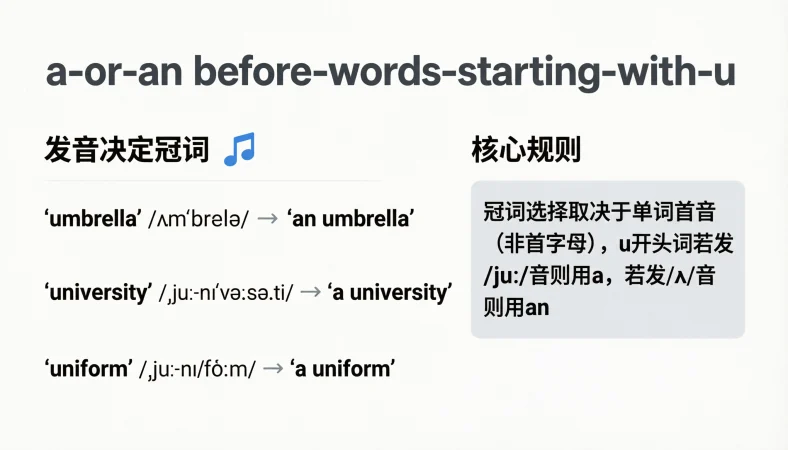
Use “a” when U begins with a consonant sound, such as the /y/ sound in university or user. Use “an” when U begins with a vowel sound, as in umbrella, uncle, or unusual.
This rule can feel confusing because the letter U can represent different sounds in English. For example, we say “a university” but “an umbrella.” Understanding the pronunciation makes the choice much easier.
In this guide, you will learn the rule, see practical examples, compare common words, and learn a quick memory trick to help you choose correctly every time.
Quick Answer
Use “a” before U-words that begin with a consonant sound, such as a university, a user, and a unique idea. Use “an” before U-words that begin with a vowel sound, such as an umbrella, an uncle, and an unusual event. The sound matters, not the spelling.
Why Do People Confuse It?
People often think the rule is simply:
“Use an before every word beginning with a vowel letter.”
That rule is incomplete.
English articles a and an depend on the sound that comes immediately after the article.
The letter U is especially confusing because it can have different sounds. In words such as university, user, and unique, U often begins with a /y/ sound, similar to the beginning of you. This is a consonant sound, so we use a.
In words such as umbrella, uncle, and unusual, U begins with a vowel sound. Therefore, we use an.
First Word: “A” Before U
Use “a” when a U-word begins with a consonant sound, especially the /j/ or “y” sound.
Examples:
- a university
- a user
- a uniform
- a unique idea
- a useful tool
- a usual problem
- a unit
- a union
- a unicorn
- a USB drive
Notice that these words begin with sounds like “you”:
- university → “you-niversity”
- user → “you-zer”
- uniform → “you-ni-form”
- unique → “you-neek”
Because the first sound is consonant-like, a is correct.
Why “a university” Is Correct
We say:
She studies at a university.
Not:
She studies at an university.
The word university starts with the /juː/ sound, not a pure vowel sound. The beginning sounds like “you.”
Second Word: “An” Before U
Use “an” when a U-word begins with a vowel sound.
Examples include:
- an umbrella
- an uncle
- an unusual story
- an urgent message
- an ugly picture
- an unlikely result
- an upcoming event
- an unexpected problem
- an understanding
- an ultimate goal
For example:
I bought an umbrella.
The first sound in umbrella is a vowel sound, so an is correct.
Similarly:
It was an unusual experience.
The word unusual begins with a vowel sound, so we use an.
A vs. An Before U: Comparison Table
| Word | Correct Article | Example | Reason |
|---|---|---|---|
| university | a | a university | Starts with /y/ sound |
| user | a | a user | Starts with /y/ sound |
| uniform | a | a uniform | Starts with /y/ sound |
| unique | a | a unique idea | Starts with /y/ sound |
| useful | a | a useful book | Starts with /y/ sound |
| umbrella | an | an umbrella | Starts with a vowel sound |
| uncle | an | an uncle | Starts with a vowel sound |
| unusual | an | an unusual event | Starts with a vowel sound |
| urgent | an | an urgent request | Starts with a vowel sound |
| ugly | an | an ugly building | Starts with a vowel sound |
When Should You Use “A” or “An” Before U?
The easiest method is to say the word aloud and listen to its first sound.
Use a when the word sounds as if it starts with “you.”
Examples:
- a university
- a user
- a uniform
- a useful idea
- a unique opportunity
Use an when the word starts directly with a vowel sound.
Examples:
- an umbrella
- an uncle
- an unusual situation
- an urgent request
- an unexpected answer
A Simple Test
Ask yourself:
Does the word begin with a “yoo” sound?
If yes, use a.
a university
a user
a uniform
If not, listen for a vowel sound.
an umbrella
an uncle
an unusual event
10+ Examples of “A” Before U
Here are common examples where a is correct:
- a university
She attends a university in London. - a user
Each user needs an account. - a uniform
The students wear a uniform. - a unique opportunity
This is a unique opportunity to learn. - a useful website
This is a useful website for students. - a useful lesson
We had a useful lesson today. - a unit
We completed a unit of the course. - a union
He joined a union. - a unicorn
The child drew a unicorn. - a USB drive
I saved the document on a USB drive. - a usual problem
It was a usual problem with the old system. - a universal rule
The teacher explained a universal rule.
10+ Examples of “An” Before U
Here are common examples where an is correct:
- an umbrella
She carried an umbrella. - an uncle
I visited an uncle last weekend. - an unusual idea
He suggested an unusual idea. - an urgent message
I received an urgent message. - an ugly building
They demolished an ugly building. - an unexpected result
The test produced an unexpected result. - an unlikely outcome
That is an unlikely outcome. - an upcoming event
We are preparing for an upcoming event. - an ultimate goal
Her ultimate goal is to become a doctor. - an understanding
The agreement created an understanding between the two groups. - an unpleasant experience
It was an unpleasant experience. - an unknown person
An unknown person called the office.
Common Mistakes
Mistake 1: Using “an” Before Every U-Word
Incorrect:
an university
Correct:
a university
The first sound in university is /j/, like the beginning of you.
Mistake 2: Using “a” Before Every U-Word
Incorrect:
a umbrella
Correct:
an umbrella
Umbrella begins with a vowel sound, so an is required.
Mistake 3: Looking Only at the Spelling
The first letter can be misleading.
For example:
a unique idea
The word begins with U, but its sound begins like “you.”
Compare:
an unusual idea
Although both words begin with U, unusual starts with a vowel sound.
Mistake 4: Forgetting Abbreviations
Abbreviations are also determined by pronunciation.
For example:
a USB drive
The letter U in “USB” is pronounced “you,” so a is correct.
But:
an MRI scan
“M” is pronounced “em,” which begins with a vowel sound.
The same sound-based rule applies.
Memory Trick
Remember this simple sentence:
A = “you” sound. An = vowel sound.
If a U-word starts like “you”, use a:
- a university
- a user
- a uniform
- a unique idea
If it starts with a vowel sound, use an:
- an umbrella
- an uncle
- an unusual event
- an urgent message
Think about sound first, spelling second.
American vs. British English
The basic a/an rule is the same in American and British English: the choice depends on pronunciation.
For common U-words such as university, user, umbrella, and uncle, both varieties normally use the same article:
- a university
- a user
- an umbrella
- an uncle
Pronunciation can sometimes vary between speakers or regions, so an article may occasionally change when the pronunciation changes. The safest approach is to listen to the actual sound at the beginning of the word.
Similar Words
The same sound-based rule applies beyond words beginning with U.
“A” Before a Consonant Sound
- a university
- a European country
- a one-time event
- a useful tool
- a hotel
“An” Before a Vowel Sound
- an umbrella
- an hour
- an honest person
- an unusual idea
- an MBA
Notice something important: the first written letter is not always the deciding factor.
For example:
a European country
European begins with a /j/ sound, similar to “you.”
But:
an hour
The H is silent, so hour begins with a vowel sound.
Final Verdict
The correct choice between “a” and “an” before a word starting with U depends on pronunciation, not spelling.
Use a before U-words that begin with a consonant sound:
a university, a user, a uniform, a unique idea
Use an before U-words that begin with a vowel sound:
an umbrella, an uncle, an unusual event, an urgent message
When you are unsure, say the word aloud. If it starts with a sound like “you,” choose a. If it starts with a vowel sound, choose an.
FAQs
Is it “a university” or “an university”?
The correct phrase is “a university.” University begins with the /juː/ sound, similar to “you,” so it starts with a consonant sound.
Is it “a umbrella” or “an umbrella”?
The correct phrase is “an umbrella.” Umbrella begins with a vowel sound, so an is used.
Is it “a unique” or “an unique”?
The correct phrase is “a unique.” For example: a unique opportunity. Unique begins with a /juː/ sound.
Is it “a user” or “an user”?
The correct phrase is “a user.” The beginning of user sounds like “you,” so a is used.
Why do we say “a university” but “an umbrella”?
Although both words start with U, their initial sounds are different. University begins with a consonant /j/ sound, while umbrella begins with a vowel sound.
Is “an unusual” correct?
Yes. “An unusual” is correct because unusual begins with a vowel sound.
For example:
It was an unusual experience.
Do American and British English use different rules for a and an?
No. Both varieties generally use the same sound-based rule. The article depends on the pronunciation of the following word.
Should I choose a or an based on the first letter?
No. Choose based on the first sound, not simply the first letter. This is why we say a university but an umbrella.
Remember This
A before a consonant sound. An before a vowel sound.
For U-words:
- a university
- a user
- a uniform
- a unique idea
- an umbrella
- an uncle
- an unusual event
- an urgent message
Listen to the sound, not just the letter U.
Conclusion
Choosing between “a” and “an” before words beginning with U becomes easy once you focus on pronunciation.
Words such as university, user, uniform, and unique begin with a “you” sound, so they take a.
Words such as umbrella, uncle, unusual, and urgent begin with vowel sounds, so they take an.
The most useful rule to remember is simple: articles follow sounds rather than letters.