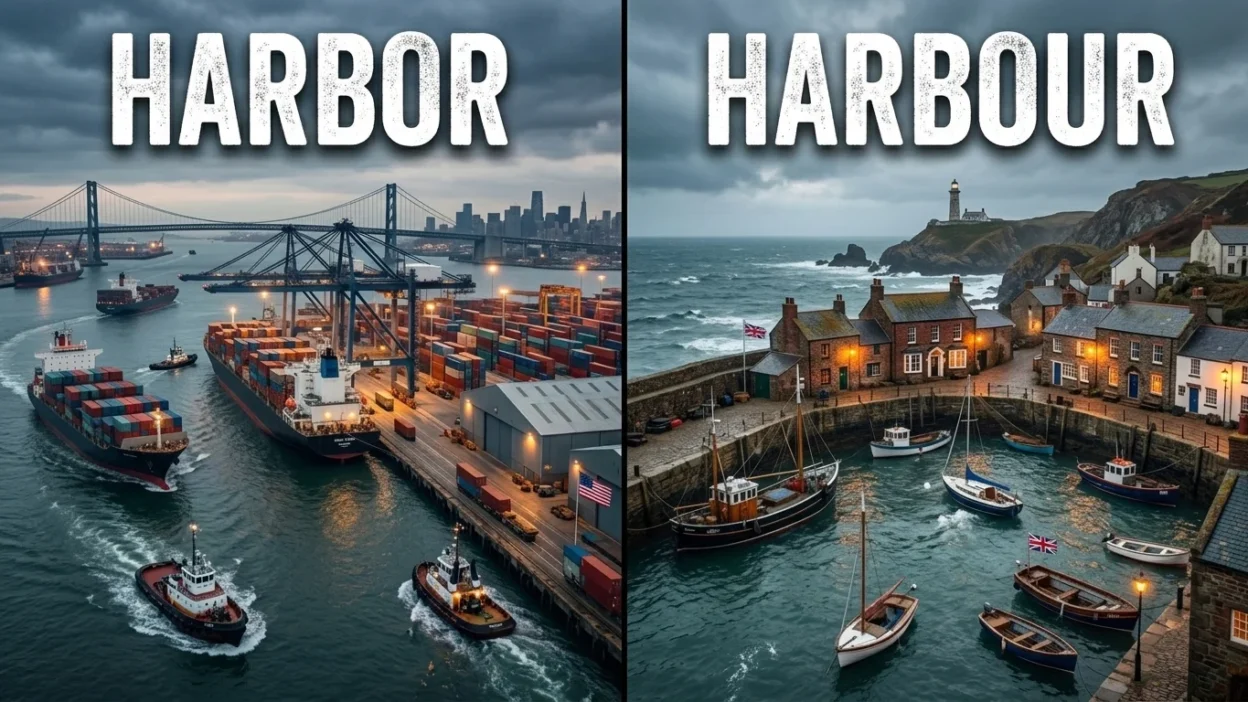
Have you ever wondered whether to write “harbor” or “harbour”?
Both spellings are correct, and both refer to a sheltered place where ships and boats can anchor safely.
The difference is not in their meaning but in the variety of English being used.
Choosing the right spelling depends mainly on whether you are writing in American English, British English, or another English variety.
Understanding the difference between harbor and harbour can help you write more accurately in school assignments, travel articles, business documents, and everyday communication.
Although the two words look different, they share the same pronunciation, meaning, and grammatical uses.
In this guide, you will learn what each spelling means, when to use it, how American and British English differ, and how to avoid common spelling mistakes.
You will also find practical examples, related words, and simple memory tricks to help you remember the correct spelling.
Quick Answer: Harbor or Harbour?
Harbor is the standard American English spelling, while harbour is the standard British English spelling. Both words mean a sheltered area of water where ships and boats can anchor or find protection. They can also refer to providing shelter or keeping a thought or feeling. The meaning and pronunciation remain the same.
Why Do People Confuse Harbor and Harbour?
People confuse harbor and harbour because they have the same meaning and pronunciation, with only one spelling difference: the letter u.
This difference is part of a broader pattern in American and British English. American English often uses shorter spellings, while British English retains the letter u in several words derived from French.
For example:
- Harbor: American English
- Harbour: British English
- Color / Colour: American and British English
- Neighbor / Neighbour: American and British English
- Labor / Labour: American and British English
Neither harbor nor harbour is inherently more correct than the other. The appropriate spelling depends on your intended audience and the English variety you are following.
What Does Harbor Mean?
Harbor is the American English spelling of a noun meaning a sheltered place along a coast, river, or lake where ships and boats can stay safely.
A harbor provides protection from strong winds, waves, and rough water. Many harbors also contain facilities for loading cargo, transporting passengers, fishing, and maintaining vessels.
The word can also be used as a verb. To harbor something may mean to provide shelter or to hold a thought, feeling, suspicion, or belief.
Examples of Harbor in Sentences
Here are some examples of the American spelling:
- The fishing boats returned to the harbor before sunset.
- The city built a new harbor to support international trade.
- We watched the ships enter the busy harbor.
- The storm forced several boats to seek shelter in the harbor.
- The coastal town is famous for its beautiful harbor.
- The small harbor protects boats from strong waves.
- The organization provides a harbor for vessels in need of temporary shelter.
- He continued to harbor doubts about the proposed agreement.
In the first seven examples, harbor refers to a sheltered place or safe refuge. In the last example, it is a verb meaning to continue holding a feeling or thought.
What Does Harbor Mean as a Verb?
As a verb, harbor can mean to shelter, accommodate, or continue to hold something internally.
Examples include:
- The building was suspected of harboring criminals.
- She did not harbor any resentment toward her colleague.
- The investigators believed that the location might harbor important evidence.
The precise meaning depends on the context. Harboring a person can mean giving them shelter, while harboring a feeling means continuing to experience or hold that feeling.
What Does Harbour Mean?
Harbour is the British English spelling of the same word. It has the same meaning, pronunciation, and grammatical uses as harbor.
A harbour is a sheltered area of water that offers protection to ships and boats. It may serve as a fishing location, a commercial port, a marina, or a place where vessels can anchor safely.
The British spelling is commonly used in the United Kingdom and in other English-speaking places that follow British spelling conventions, including Australia and New Zealand.
Examples of Harbour in Sentences
- The fishing boats returned to the harbour before sunset.
- The coastal village has a small natural harbour.
- Tourists enjoyed walking around the historic harbour.
- The captain guided the ship safely into the harbour.
- The harbour was crowded with fishing vessels.
- The new harbour facilities support local businesses.
- The storm made it necessary for the boats to remain in the harbour.
- He refused to harbour any resentment toward his former friend.
These sentences have the same meanings as their American English equivalents. Only the spelling changes.
What Does Harbour Mean as a Verb?
Harbour can also be a verb in British English. It means to provide shelter or to continue holding a thought, suspicion, or feeling.
Examples:
- The suspect was accused of harbouring a fugitive.
- She did not harbour any ill feelings toward her neighbor.
- The abandoned building was believed to harbour dangerous animals.
The verb follows the same spelling convention as the noun. If you are writing in British English, use harbour and harbouring.
Harbor vs Harbour: Comparison Table
| Feature | Harbor | Harbour |
|---|---|---|
| English variety | American English | British English |
| Meaning | A sheltered place for boats or ships | A sheltered place for boats or ships |
| Pronunciation | HAR-ber | HAR-ber |
| Part of speech | Noun and verb | Noun and verb |
| Example as a noun | The ship entered the harbor. | The ship entered the harbour. |
| Example as a verb | He did not harbor resentment. | He did not harbour resentment. |
| Common related spelling | Harboring | Harbouring |
| Correctness | Correct in American English | Correct in British English |
The key difference is spelling, not meaning. Both forms are standard English words.
When Should You Use Harbor or Harbour?
Choosing between the two spellings is easy when you know your audience.
When to Use Harbor
Use harbor when writing in American English.
It is the preferred spelling for:
- American school assignments
- US business documents
- American news articles
- Websites aimed at US readers
- Writing that follows American spelling conventions
Examples:
- The ship arrived at the harbor early in the morning.
- The city plans to improve its harbor facilities.
- They watched the sunset over the harbor.
When to Use Harbour
Use harbour when writing in British English or following a spelling style that retains the u.
It is appropriate for:
- British school assignments
- UK business documents
- Publications using British English
- Australian and New Zealand English
- Writing that follows British spelling conventions
Examples:
- The ship arrived at the harbour early in the morning.
- The city plans to improve its harbour facilities.
- They watched the sunset over the harbour.
What If You Are Writing for an International Audience?
Both spellings are widely understood. However, you should choose one spelling system and use it consistently throughout your document.
If your article targets American readers, use harbor. If it targets British, Australian, or New Zealand readers, harbour is generally the safer choice.
12 Examples of Harbor and Harbour in Everyday English
The following examples show how the spelling changes while the meaning remains the same.
| American English | British English |
|---|---|
| The harbor was full of boats. | The harbour was full of boats. |
| We visited the local harbor. | We visited the local harbour. |
| The ship entered the harbor safely. | The ship entered the harbour safely. |
| The harbor provides shelter during storms. | The harbour provides shelter during storms. |
| The town developed around its harbor. | The town developed around its harbour. |
| The fishing harbor opens early. | The fishing harbour opens early. |
Here are six additional examples showing the word’s different uses:
- American: The captain guided the vessel into the harbor.
British: The captain guided the vessel into the harbour. - American: The harbor is an important center for fishing.
British: The harbour is an important center for fishing. - American: The boat remained in the harbor overnight.
British: The boat remained in the harbour overnight. - American: He did not harbor any doubts about her honesty.
British: He did not harbour any doubts about her honesty. - American: The abandoned structure might harbor bats.
British: The abandoned structure might harbour bats. - American: The organization was accused of harboring a fugitive.
British: The organization was accused of harbouring a fugitive.
These examples demonstrate that the spelling convention applies to both the noun and the verb.
Common Mistakes When Using Harbor and Harbour
Although the difference is straightforward, writers sometimes make avoidable mistakes.
Mistake 1: Thinking One Spelling Is Wrong
Incorrect assumption: Harbour is always misspelled.
Correct understanding: Harbour is standard British English, while harbor is standard American English.
Choose the spelling that matches your writing style.
Mistake 2: Mixing American and British Spellings
Using harbor in one paragraph and harbour in another can make a document look inconsistent if both refer to the same word.
Better approach: Follow one spelling convention throughout your article, essay, or report.
Mistake 3: Confusing a Harbor With a Port
A harbor is primarily a sheltered area of water where vessels can find protection. A port is a place where ships load or unload passengers and cargo and may include terminals and other transport facilities.
A harbor can contain a port, but the words are not always interchangeable.
Mistake 4: Forgetting the Verb Form
When harbor or harbour is used as a verb, its spelling should follow the same regional convention.
- American English: harboring
- British English: harbouring
For example, “He was accused of harboring a fugitive” follows American spelling, while “He was accused of harbouring a fugitive” follows British spelling.
Mistake 5: Assuming the Word Always Refers to Ships
Harbor and harbour can also be verbs that describe providing shelter or holding feelings and thoughts.
For example, “She continued to harbor resentment” uses the word figuratively rather than referring to a place for boats.
Memory Trick: How to Remember Harbor vs Harbour
Here is an easy way to remember which spelling to use.
Harbor = American English
Think of the shorter spelling as the American version. It does not contain the extra u.
Harbour = British English
Remember that British spelling retains the u, just as it does in colour, favour, and neighbour.
You can also use this simple pattern:
- US: harbor, color, favor, neighbor
- UK: harbour, colour, favour, neighbour
If you remember the difference between color and colour, you can apply the same spelling pattern to harbor and harbour.
Harbor vs Harbour in American and British English
The spelling difference reflects a wider distinction between American and British English.
American English generally uses harbor, while British English uses harbour. The same distinction is commonly followed in Australian and New Zealand English, although individual style guides may have their own preferences.
The difference also appears in related forms:
| American English | British English |
|---|---|
| Harbor | Harbour |
| Harboring | Harbouring |
| Harbored | Harboured |
| Color | Colour |
| Favor | Favour |
| Neighbor | Neighbour |
For formal writing, follow the style guide required by your school, employer, publication, or client. Consistency is more important than treating one regional spelling as universally correct.
Similar Words You Should Know
Understanding related words can help you describe coastal locations more accurately.
Harbor vs Port
A harbor is a sheltered area of water for vessels. A port is a place equipped for ships to load and unload cargo or passengers.
Example: “The fishing boats took shelter in the harbor, while cargo ships unloaded at the port.”
Harbor vs Marina
A marina is a facility designed mainly for recreational boats and yachts, often providing docking spaces and services.
Example: “We left our sailboat at the marina overnight.”
Harbor vs Bay
A bay is a body of water partly enclosed by land. Some bays provide natural harbors, but not every bay functions as a harbor.
Example: “The wide bay offered sheltered water for smaller vessels.”
Harbor vs Haven
A haven is a safe or protected place. It can refer to a physical refuge or a figurative source of safety.
Example: “The island became a haven for sailors during the storm.”
A harbor can be a haven for boats, but haven has a broader meaning.
Final Verdict: Harbor or Harbour?
Both harbor and harbour are correct spellings of the same English word. The only difference is regional spelling convention: harbor is standard in American English, while harbour is standard in British English. Both can function as nouns referring to sheltered water for vessels and as verbs meaning to provide shelter or continue holding a thought or feeling.
Frequently Asked Questions
1. Is harbor or harbour correct?
Both are correct. Harbor is the standard American spelling, while harbour is the standard British spelling.
2. Do harbor and harbour mean the same thing?
Yes. Both refer to a sheltered place where ships and boats can anchor. They can also be used as verbs meaning to shelter or hold a thought or feeling.
3. Is harbour British or American English?
Harbour is the standard British English spelling. It is also commonly used in Australian and New Zealand English.
4. How do you spell harbor in the United States?
In the United States, the standard spelling is harbor, without the letter u.
5. How do you spell harbour in the UK?
In the United Kingdom, the standard spelling is harbour, with the letter u.
6. Is harboring or harbouring correct?
Both are correct. Harboring is the American spelling, while harbouring is the British spelling.
7. Is there a pronunciation difference between harbor and harbour?
No significant pronunciation difference exists in standard usage. Both are commonly pronounced HAR-ber.
8. What is the difference between a harbor and a port?
A harbor is a sheltered area of water where vessels can find protection. A port is a place where ships load or unload passengers and cargo. A harbor may contain a port, but the terms have different meanings.
Remember This
- Harbor: American English spelling.
- Harbour: British English spelling.
- Meaning: The same in both varieties.
- Pronunciation: Generally the same.
- Best practice: Match your spelling to your audience and remain consistent.
Conclusion
The choice between harbor and harbour depends on the type of English you are writing. American English uses harbor, while British English uses harbour. Both spellings refer to a sheltered area where boats and ships can stay safely, and both can describe the act of providing shelter or holding a thought or feeling. Neither spelling is universally better; each is correct within its respective spelling convention.
To avoid mistakes, identify your audience before you begin writing. Use harbor for American readers and harbour for British readers, as well as readers in other regions that follow British spelling conventions. Apply the same rule to related forms such as harboring and harbouring. Once you remember the pattern used in words such as color and colour, choosing the correct spelling becomes simple.