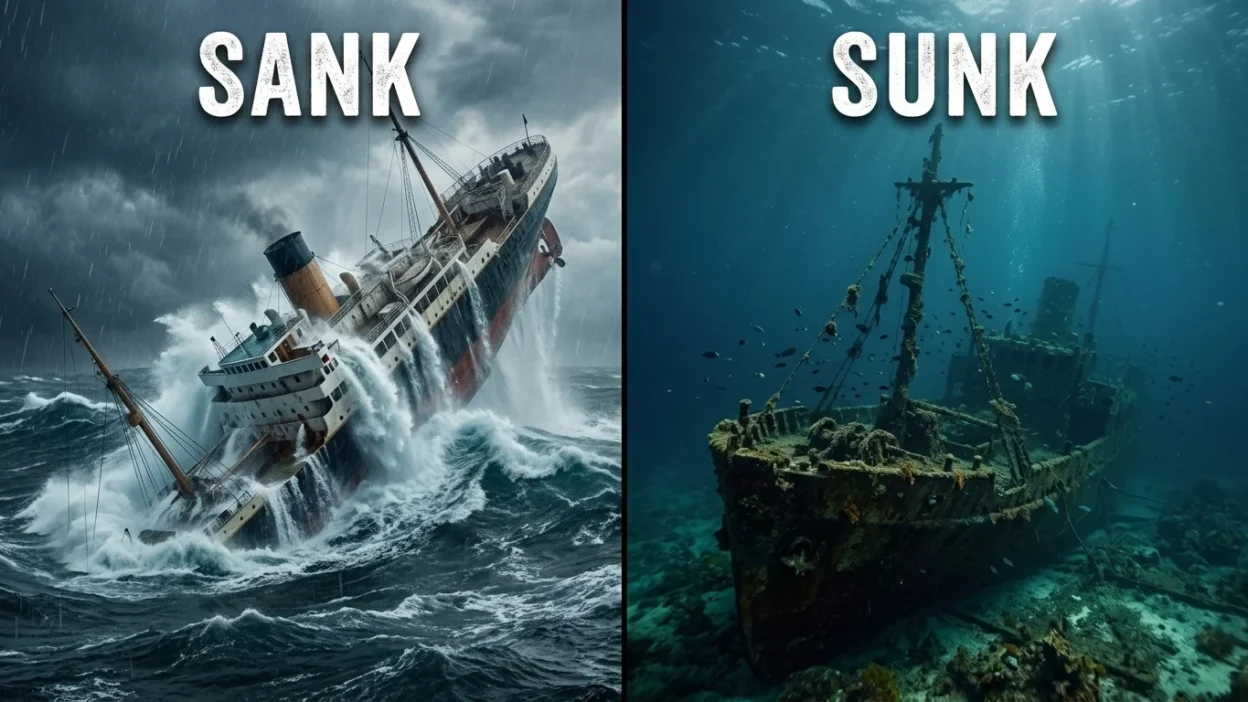
Are you unsure whether to write “sank” or “sunk”?
Both words are correct forms of the verb sink, but they are used differently depending on the tense and grammatical structure of a sentence.
This common English grammar question can confuse students, ESL learners, and even fluent speakers, especially when describing a boat going underwater, an object dropping into water, or a situation that has deteriorated.
The good news is that the difference between sank and sunk is easy to understand once you learn the basic verb forms.
Sank is the simple past tense of sink, while sunk is its past participle.
For example, you would say, “The boat sank yesterday,” but “The boat has sunk.” In this guide, you will learn the meanings, grammar rules, sentence patterns, common mistakes, and practical examples that will help you choose the correct word confidently in everyday conversations and formal writing.
Quick Answer: Sank or Sunk?
Sank is the simple past tense of sink, while sunk is the past participle. Use sank for a completed action in the past: “The ship sank last night.” Use sunk with helping verbs such as has, have, or had: “The ship has sunk.” Both words describe the past, but their grammatical roles differ.
Why Do People Confuse Sank and Sunk?
People often confuse sank and sunk because both words describe an action that has already happened. They are also irregular verb forms, meaning they do not follow the usual pattern of adding -ed to form the past tense.
For regular verbs, the pattern is simple:
- Walk → walked → walked
- Jump → jumped → jumped
- Finish → finished → finished
However, the verb sink changes its form:
- Sink → sank → sunk
The difference becomes clearer when you look at how each form appears in a sentence.
- Sank: The stone sank to the bottom.
- Sunk: The stone has sunk to the bottom.
Both sentences describe a completed action, but the second uses the present perfect tense, which requires the past participle sunk.
What Does Sank Mean?
Sank is the simple past tense of sink. It describes an action that happened in the past, such as an object moving below the surface of water or a level decreasing.
The word can also be used figuratively to describe a person’s mood, a falling value, or a situation becoming worse.
Examples of Sank in Sentences
- The boat sank during the storm.
- The stone sank to the bottom of the lake.
- The sun sank below the horizon.
- The temperature sank overnight.
- His heart sank when he heard the bad news.
- The company’s profits sank last year.
- The swimmer sank beneath the surface before returning to the top.
- The audience sank into silence after the announcement.
In each example, sank describes something that happened in the past.
When Should You Use Sank?
Use sank when describing a past event without a helping verb such as has, have, or had.
For example:
- The ship sank in 1912.
- The water level sank after several dry weeks.
- Her confidence sank after the disappointing result.
The simple past form is particularly useful when you mention a specific past time, such as yesterday, last week, or several years ago.
What Does Sunk Mean?
Sunk is the past participle of sink. It is generally used with a helping verb, such as has, have, or had, to form perfect tenses. It can also appear in passive constructions and certain adjective-like expressions.
For example:
“The ship has sunk.”
Here, has is the helping verb, and sunk is the past participle.
Examples of Sunk in Sentences
- The boat has sunk near the coast.
- The stone has sunk into the mud.
- The sun had sunk below the horizon before we arrived.
- The temperature has sunk to freezing levels.
- Their hopes had sunk after the final defeat.
- The damaged vessel was sunk deliberately.
- The treasure was sunk with the ship.
- The costs have sunk below the original estimate.
These examples demonstrate how sunk works with helping verbs and in passive constructions.
When Should You Use Sunk?
Use sunk when the sentence requires a past participle.
Common patterns include:
- Has sunk: The ship has sunk.
- Have sunk: Several boats have sunk.
- Had sunk: The vessel had sunk before help arrived.
- Was sunk: The ship was sunk during the battle.
- Been sunk: The damaged boat has been sunk intentionally.
The helping verb and sentence structure determine whether sunk is the appropriate form.
Sank vs Sunk: Comparison Table
| Feature | Sank | Sunk |
|---|---|---|
| Base verb | Sink | Sink |
| Verb form | Simple past tense | Past participle |
| Typical use | A completed past action | Perfect tenses and passive constructions |
| Helping verb required? | Usually no | Usually yes, in perfect tenses |
| Example | The ship sank yesterday. | The ship has sunk. |
| Another example | The stone sank quickly. | The stone had sunk already. |
| Common mistake | The ship has sank. | The ship has sunk. |
The most important rule is simple: use sank for the simple past and sunk for the past participle.
When Should You Use Sank or Sunk?
Choosing between these forms depends on the structure of your sentence.
Use Sank for a Simple Past Event
Use sank when describing an action that happened at a definite or understood time in the past.
Examples:
- The boat sank last night.
- The sun sank behind the mountains.
- His spirits sank after the interview.
You do not need a helping verb before sank in these examples.
Use Sunk With Has, Have, or Had
Use sunk when forming the present perfect or past perfect tense.
Examples:
- The boat has sunk.
- Several ships have sunk in this area.
- The vessel had sunk before rescuers arrived.
These sentences describe past actions connected to another time or situation.
Use Sunk in Passive Sentences
Sunk is also used in passive constructions.
Examples:
- The ship was sunk during the conflict.
- The damaged vessel had been sunk deliberately.
- Several old boats were sunk to create an artificial reef.
In these sentences, the focus is on the ship or boat receiving the action rather than performing it.
12 Examples of Sank and Sunk in Everyday English
The following examples show how to use both forms correctly.
| Sank | Sunk |
|---|---|
| The ship sank yesterday. | The ship has sunk. |
| The rock sank quickly. | The rock had sunk into the sand. |
| The sun sank below the horizon. | The sun had sunk by the time we arrived. |
| His heart sank after the news. | His heart has sunk with disappointment. |
| The temperature sank overnight. | The temperature has sunk below zero. |
| The boat sank during the storm. | The boat has been sunk. |
Here are six more examples:
- Sank: The fisherman watched as the damaged boat sank.
- Sunk: The damaged boat had sunk before the rescue team arrived.
- Sank: Her confidence sank after the difficult examination.
- Sunk: His confidence has sunk since the disappointing interview.
- Sank: The water level sank during the dry season.
- Sunk: The water level has sunk considerably over the past month.
Remember that sunk is not automatically correct just because a sentence refers to the past. It must fit the tense and grammatical structure.
Common Mistakes When Using Sank and Sunk
Mistake 1: Saying “Has Sank”
Incorrect: The boat has sank.
Correct: The boat has sunk.
The present perfect tense uses has or have followed by the past participle. Since sunk is the past participle of sink, it is the correct choice.
Mistake 2: Saying “Had Sank”
Incorrect: The ship had sank before sunrise.
Correct: The ship had sunk before sunrise.
Had requires the past participle, so sunk is correct.
Mistake 3: Using “Sunk” for Every Past Event
Incorrect in standard past-tense usage: The boat sunk yesterday.
Correct: The boat sank yesterday.
When describing a simple past action, use sank. Although sunk may appear as a simple past form in some nonstandard or dialectal usage, sank is the standard choice in formal English.
Mistake 4: Confusing Active and Passive Voice
Compare these sentences:
- Active: The storm sank the boat.
- Passive: The boat was sunk by the storm.
In the active sentence, sank is the simple past tense. In the passive sentence, sunk is the past participle following was.
Mistake 5: Forgetting Other Forms of Sink
The complete basic verb pattern is:
- Present: sink
- Simple past: sank
- Past participle: sunk
- Present participle: sinking
Examples:
- I sink the basket into the water.
- I sank the basket yesterday.
- I have sunk the basket before.
- I am sinking the basket now.
Knowing all four forms helps you avoid tense errors.
Memory Trick: How to Remember Sank vs Sunk
Use this simple memory trick:
Sank = happened in the past.
Example: “The ship sank yesterday.”
Sunk = has, have, had, or a passive construction.
Example: “The ship has sunk.”
You can also remember the pattern by saying it aloud:
Sink → Sank → Sunk
Think of sank as the form that stands on its own for a simple past action, while sunk often works with a helping verb.
When checking your sentence, ask yourself:
- Am I describing a simple past event? Use sank.
- Am I using has, have, or had? Use sunk.
- Is the sentence passive, as in “was ___”? Use sunk.
This quick check will help you make the correct choice in most situations.
Sank vs Sunk in American and British English
There is no significant difference between American and British English in the standard use of sank and sunk. Both varieties use the same verb forms.
| Tense or structure | American English | British English |
|---|---|---|
| Simple past | The ship sank. | The ship sank. |
| Present perfect | The ship has sunk. | The ship has sunk. |
| Past perfect | The ship had sunk. | The ship had sunk. |
| Passive voice | The ship was sunk. | The ship was sunk. |
Although regional or informal speech may vary, sank is the standard simple past form and sunk is the standard past participle in both varieties.
Similar Words You Should Know
Understanding other irregular verbs can help you learn the same grammatical pattern.
Drink: Drank vs Drunk
- Simple past: She drank a glass of water.
- Past participle: She has drunk a glass of water.
Begin: Began vs Begun
- Simple past: The meeting began at nine.
- Past participle: The meeting has begun.
Swim: Swam vs Swum
- Simple past: He swam across the pool.
- Past participle: He has swum across the pool.
Ring: Rang vs Rung
- Simple past: The telephone rang.
- Past participle: The telephone has rung several times.
These verbs follow a similar pattern: the middle form is the simple past, while the final form is the past participle.
Final Verdict: Sank or Sunk?
Sank and sunk are both correct, but they are not interchangeable in standard English. Sank is the simple past tense of sink, while sunk is the past participle. Use sank when describing a completed action in the past, as in “The boat sank yesterday.” Use sunk with has, have, or had, as in “The boat has sunk.” Sunk is also used in passive constructions, such as “The boat was sunk deliberately.”
Frequently Asked Questions
1. Is it sank or sunk?
Both words are correct forms of sink. Sank is the simple past tense, while sunk is the past participle.
2. Is “the ship has sank” grammatically correct?
No. In standard English, the correct sentence is “The ship has sunk.” The helping verb has must be followed by the past participle.
3. Should I say “the boat sank” or “the boat sunk”?
Use “the boat sank” for standard simple past tense. For example, “The boat sank yesterday.”
4. Is it “had sank” or “had sunk”?
The correct form is “had sunk.” Had is followed by the past participle, as in “The ship had sunk before help arrived.”
5. What is the past participle of sink?
The past participle of sink is sunk. It appears in perfect tenses and passive constructions, such as “has sunk” and “was sunk.”
6. Is sunk ever used as a simple past tense?
Sunk appears as a simple past form in some informal or dialectal speech, but sank is the standard form recommended for formal writing.
7. Is sank or sunk different in American and British English?
No. Both American and British English use sank as the standard simple past tense and sunk as the standard past participle.
8. What are the three forms of sink?
The three principal forms are sink, sank, sunk. Sink is the base form, sank is the simple past tense, and sunk is the past participle.
Remember This
- Sink: Present or base form.
- Sank: Simple past tense.
- Sunk: Past participle.
- Correct: The ship sank yesterday.
- Correct: The ship has sunk.
- Correct: The ship was sunk during the battle.
If you remember only one rule, remember this: use sank for a simple past event and sunk after has, have, or had.
Conclusion
The difference between sank and sunk becomes easy to understand when you focus on verb tense. Sank describes an action that happened in the past, while sunk is the past participle used in perfect tenses and passive constructions. For example, “The boat sank during the storm” is correct, and so is “The boat has sunk.” However, “The boat has sank” is incorrect in standard English. Learning these patterns will help you write accurate sentences and communicate more confidently.
To avoid mistakes, memorize the three forms of the verb: sink, sank, sunk. Pay attention to helping verbs such as has, have, and had, because they usually signal that you need the past participle. The same principle applies to many other irregular verbs, including drink, begin, and swim. With a little practice, you will be able to choose the right form naturally in schoolwork, professional writing, and everyday conversations.