Have you ever wondered whether to write once or ones?
These two words look and sound similar, but they have completely different meanings.
Using the wrong word can change the meaning of your sentence or make your writing confusing.
Fortunately, understanding the difference is simple once you know how each word works.
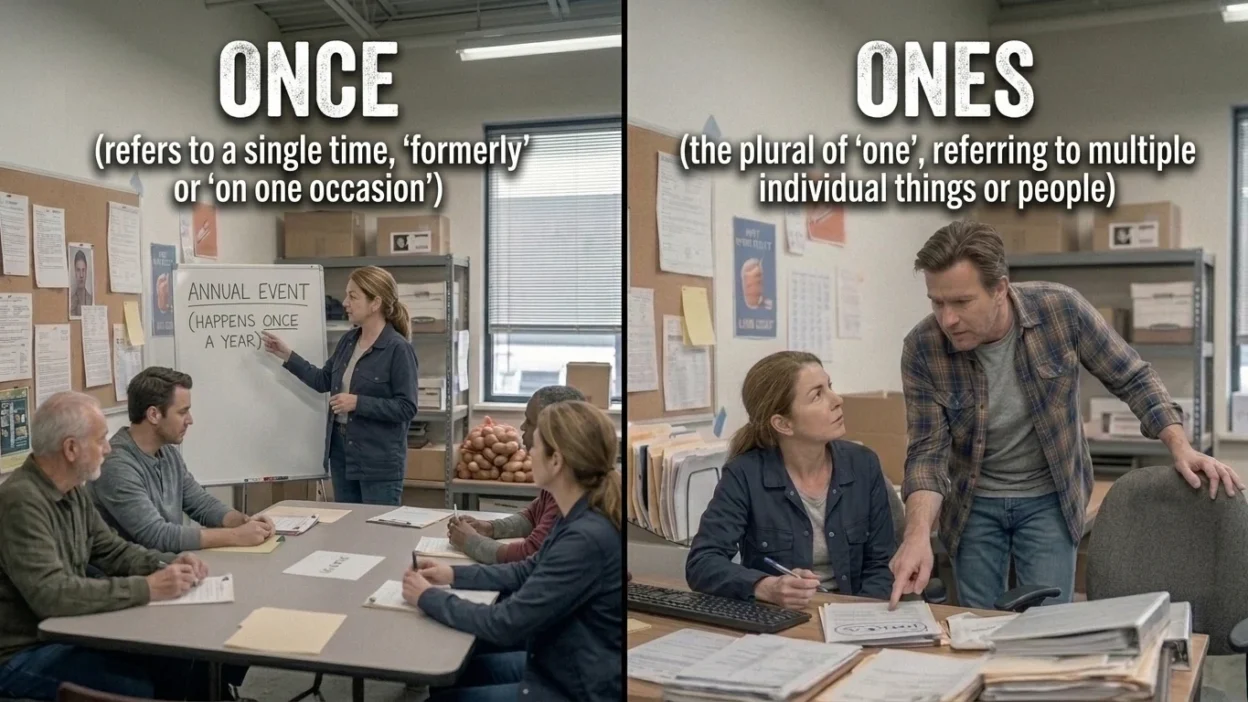
Once usually means “one time” or refers to something that happened in the past. For example, “I visited London once.”
Ones is the plural form of one when it replaces a plural noun that has already been mentioned or is understood from the context.
For example, “I prefer the red ones.”
The correct choice depends on what you want to say. In this guide, you will learn the meanings of once and ones, discover their grammatical differences, explore common mistakes, and practice with clear examples that will help you use both words correctly.
Quick Answer: Once vs. Ones
Once means one time, formerly, or as soon as a particular condition is met. Ones is the plural form of one, used to refer to people or things without repeating their names.
- Once: I have visited that restaurant once.
- Ones: I like the blue shoes, not the black ones.
Remember: Use once when talking about time or a condition. Use ones when referring to more than one person or thing.
Why Do People Confuse Once and Ones?
People often confuse once and ones because they differ by only one letter. Both contain the letters o, n, and e, and their pronunciation can sound similar to some learners.
However, they serve different purposes in a sentence. Once is commonly an adverb or conjunction, while ones is a plural pronoun-like form used to replace a plural noun.
For example:
- Incorrect: I have been there ones.
- Correct: I have been there once.
- Correct: I prefer the larger ones.
The easiest way to choose the right word is to check whether your sentence refers to time or to people and things.
What Does Once Mean?
Once commonly means “one time.” It can also mean “formerly” or introduce a condition meaning “as soon as” or “when.”
It is frequently used in conversations about experiences, frequency, past situations, and future conditions.
Examples of Once
- I called him once yesterday.
- She has visited Paris once.
- Once, I lived in a small village.
- He was once a professional athlete.
- Once you finish your homework, you can watch television.
How to Use Once in a Sentence
Use once in several common ways.
1. To mean one time
- I have read this book once.
- We met once at a conference.
2. To describe the past
- This building was once a school.
- She was once my closest friend.
3. To introduce a condition
- Once you understand the rules, the game becomes easier.
- Once the rain stops, we will go outside.
4. In the expression “once in a while”
- I eat fast food once in a while.
- We visit our grandparents once in a while.
Remember that once does not always mean a single occasion. Its meaning depends on the sentence.
What Does Ones Mean?
Ones is the plural form of one. It is used to refer to people or things that have already been mentioned or can be understood from the context. It helps you avoid repeating the same noun.
Examples of Ones
- I like the red apples, but not the green ones.
- These shoes are more comfortable than those ones.
- The small boxes are cheaper than the large ones.
- Which cookies do you want: the chocolate ones or the vanilla ones?
- My old phones were heavier than the new ones.
How to Use Ones in a Sentence
Use ones when you are referring to more than one person or thing without repeating the noun.
1. To avoid repeating a plural noun
- I bought some pens, but the blue ones do not work.
- These chairs are better than the old ones.
2. When comparing different items
- The expensive bags look nicer than the cheaper ones.
- I prefer fresh strawberries to frozen ones.
3. When choosing between options
- Which shirts should I wear, the white ones or the black ones?
- I want the ripe bananas, not the green ones.
4. After descriptive words
- The injured ones were taken to the hospital.
- The lucky ones received prizes.
The noun being replaced should be clear from the surrounding sentence or conversation.
Once vs. Ones: Comparison Table
| Feature | Once | Ones |
|---|---|---|
| Main meaning | One time; formerly; when a condition is met | More than one person or thing |
| Grammatical role | Commonly an adverb or conjunction | Plural form of one |
| Refers to time? | Yes, in common uses | No |
| Replaces a noun? | No | Yes, often replaces a plural noun |
| Example | I visited once. | I prefer the red ones. |
The main difference is that once often relates to time, while ones refers to people or things.
When to Use Once
Use once when you want to talk about how often something happens, something that happened in the past, or a condition that must be met.
1. When Talking About One Occasion
- I tried sushi once.
- She called me once last night.
2. When Describing the Past
- He was once a famous singer.
- This house was once a hospital.
3. When Explaining What Happens After a Condition
- Once you arrive, call me.
- Once the meeting ends, we can leave.
4. When Talking About Infrequent Events
- We go hiking once a month.
- I visit the dentist once every six months, unless I need an extra appointment.
5. In Common Expressions
- Once in a while, I enjoy a quiet evening at home.
- Once upon a time, there lived a kind king.
Quick test: If you can replace once with “one time,” “formerly,” or “when/as soon as,” it may be the correct word.
When to Use Ones
Use ones when you want to refer to multiple people or things without repeating the noun.
1. When Comparing Objects
- These shoes are more comfortable than the old ones.
- The red flowers are prettier than the yellow ones.
2. When Choosing Between Items
- I want the large cookies, not the small ones.
- Which bags are yours: these ones or those ones?
3. When Avoiding Repetition
- The new computers are faster than the old ones.
- I lost my keys, but I found the spare ones.
4. When Describing People
- The brave ones continued helping.
- The youngest ones went home first.
5. When Talking About Different Types
- I prefer natural products to artificial ones.
- Some books are easier to understand than other ones.
Quick test: If ones can replace a plural noun, such as shoes, books, or bags, it is probably the correct choice.
Once vs. Ones: 15 Example Sentences
Here are 15 examples to help you understand how to use both words.
- Once: I visited my hometown once last year.
- Ones: I prefer the black shoes to the brown ones.
- Once: She has watched that movie once.
- Ones: These apples are sweeter than those ones.
- Once: He was once a schoolteacher.
- Ones: The new phones are lighter than the old ones.
- Once: Once you finish eating, wash your plate.
- Ones: I want the ripe mangoes, not the green ones.
- Once: We meet once a week to discuss our plans.
- Ones: Which cookies do you prefer, the chocolate ones or the vanilla ones?
- Once: Once the sun sets, the temperature may drop.
- Ones: The larger boxes are heavier than the smaller ones.
- Once: I heard that song once on the radio.
- Ones: The blue pens work better than the red ones.
- Once: Once you learn the basics, you can improve with practice.
Notice that once relates to time or a condition, while ones replaces a plural noun.
Common Mistakes With Once and Ones
Mistake 1: Using Ones to Mean One Time
Incorrect: I have visited that place ones.
Correct: I have visited that place once.
Why? The sentence describes the number of times you visited, so once is needed.
Mistake 2: Using Once to Replace a Plural Noun
Incorrect: I prefer the red shoes to the blue once.
Correct: I prefer the red shoes to the blue ones.
Why? The sentence refers to multiple shoes, so use ones.
Mistake 3: Confusing Once With One’s
Incorrect: Every person should respect ones privacy.
Correct: Every person should respect one’s privacy.
Also correct: Everyone should respect their privacy.
Why? One’s is the possessive form of the pronoun one. It is different from both once and ones.
Mistake 4: Using Ones When You Mean Once in a While
Incorrect: I eat pizza ones in a while.
Correct: I eat pizza once in a while.
Why? The expression once in a while means occasionally.
Mistake 5: Using Ones Without a Clear Reference
Unclear: I bought some books and put the ones on the table.
Clearer: I bought some books and put the new ones on the table.
Why? Readers should be able to understand which items ones refers to. Add a description when necessary.
Easy Memory Trick: Once vs. Ones
Here is a simple trick to remember the difference:
- Once = Time: I visited once.
- Ones = Things: I chose the red ones.
Think of the final letter:
- Once ends in -ce, and it can refer to an occasion.
- Ones ends in -es, and it refers to multiple people or things.
You can also remember these two questions:
- How many times? Once.
- Which things? Ones.
For example:
“How many times did you call?” — “Once.”
“Which shoes do you want?” — “The black ones.”
Once vs. Ones in American and British English
The meanings and spellings of once and ones are the same in American and British English. Both varieties use once to refer to an occasion, the past, or a condition, and ones to refer to multiple people or things.
Examples used in both varieties include:
- I have been there once.
- The red ones are cheaper.
- Once you finish your work, you can leave.
In some contexts, speakers may differ in how naturally they use expressions such as “those ones.” However, this does not change the basic distinction between once and ones.
Similar Words: Once, One, Ones, and One’s
These words look similar, but each has a different meaning or grammatical function.
| Word | Meaning | Example |
|---|---|---|
| Once | One time, formerly, or when a condition is met | I visited once. |
| One | The number 1 or a singular substitute for a noun | I want one. |
| Ones | Plural substitute for a noun | I prefer the red ones. |
| One’s | Possessive form of the pronoun one | One should protect one’s health. |
Once vs. One
Use once to refer to one occasion. Use one for the number or a single item.
- I called once.
- I bought one apple.
Ones vs. One’s
Use ones to refer to multiple people or things. Use one’s to show possession in formal or general statements.
- The new ones are better.
- One should consider one’s options.
Once vs. One’s
Once relates to time or a condition, while one’s indicates possession.
- Once you arrive, let me know.
- One should respect one’s family.
Frequently Asked Questions
1. What is the main difference between once and ones?
Once usually means one time, formerly, or when a condition is met. Ones is the plural form of one, used to refer to people or things without repeating their names.
2. Is it “I met him once” or “I met him ones”?
The correct sentence is “I met him once.” You are describing one occasion, so once is the correct word.
3. Is “the red ones” correct?
Yes. “The red ones” is correct when referring to multiple red items whose names are already understood. For example, “I like the red shirts, but the blue ones are cheaper.”
4. What is the difference between ones and one’s?
Ones is a plural form used to refer to people or things. One’s is possessive and means belonging to one. For example, “I prefer the new ones” and “One should protect one’s health.”
5. Can once mean formerly?
Yes. Once can mean that something was true in the past but may not be true now. For example, “She was once a professional dancer.”
6. Can once mean as soon as?
Yes. Once can introduce a condition that must be met before something else happens. For example, “Once you finish the assignment, you can go home.”
7. Can I use ones for people?
Yes, in suitable contexts. For example, “The brave ones stayed behind to help.” However, make sure the people being referred to are clear from the context.
8. How can I remember once and ones?
Remember once = time and ones = things or people. If you are talking about how many times something happened, use once. If you are replacing a plural noun, use ones.
Remember This
- Once usually refers to one occasion, the past, or a condition.
- Ones refers to multiple people or things.
- Say “I visited once,” not “I visited ones.”
- Say “I prefer the blue ones,” not “I prefer the blue once.”
- One’s is a separate word that shows possession.
Conclusion
The difference between once and ones is easy to understand when you focus on meaning. Once usually relates to time, something that happened in the past, or a condition that must be met. Ones refers to multiple people or things and helps you avoid repeating a noun. Although the two words look similar, they are used in different ways.
When choosing between them, ask yourself what your sentence means. If you are describing how many times something happened, use once. If you are referring to several items or people, use ones. With regular practice and attention to context, you can use both words correctly in everyday conversations, messages, and formal writing.